

Contents 26
The Algarve covers the whole south of mainland Portugal, from the Spanish border to Cape St. Vincent. Its central coast is a line of ochre sandstone cliffs, coves and sea caves, including the Algar de Benagil; to the west lie Lagos and Ponta da Piedade; to the east, the Ria Formosa lagoon around Faro and Tavira. Inland are Silves and the Serra de Monchique, whose summit, Fóia, rises to 902 m.
This guide gathers 12 must-sees, from boat trips to historic towns, followed by the practical information: arriving via Faro airport, getting around, when to go, where to stay, entry rules and safety.
Overview
Mainland Portugal's southernmost region: cliffs and sea caves in the centre, the Ria Formosa lagoon in the east, Lagos and Cape St. Vincent in the west.
The Algarve is the southernmost region of mainland Portugal. Its coast alternates ochre sandstone cliffs, coves and sea caves in the centre and west with long sandy beaches on the islands of the Ria Formosa lagoon in the east. The climate is Mediterranean: hot, dry summers and mild winters.
Beyond the beaches, the region has whitewashed towns, fishing ports, the Moorish castle of Silves and seafood cooking (grilled sardines, cataplana). The highlights run from Benagil cave and Ponta da Piedade in Lagos to Cape St. Vincent, the south-western tip of mainland Europe, by way of Faro, the regional capital.
13 places to take with you
In the guide's order, ready for Google Maps or your GPS.
Book the activities from this guide
Our picks for Algarve, well rated and free to cancel.
-
Book this activity
Speedboat to the Benagil caves from Portimão
€25 per person (GetYourGuide price 2026)
-
Book this activity
Kayaking in the Ponta da Piedade caves from Lagos
€40 per person (GetYourGuide price 2026)
-
Book this activity
Dolphin watching with a marine biologist in Lagos
€40 per person (GetYourGuide price 2026)
Affiliate links: Travel Advice earns a commission if you book, at no extra cost to you. Learn more

Sea caves and the Algar de Benagil
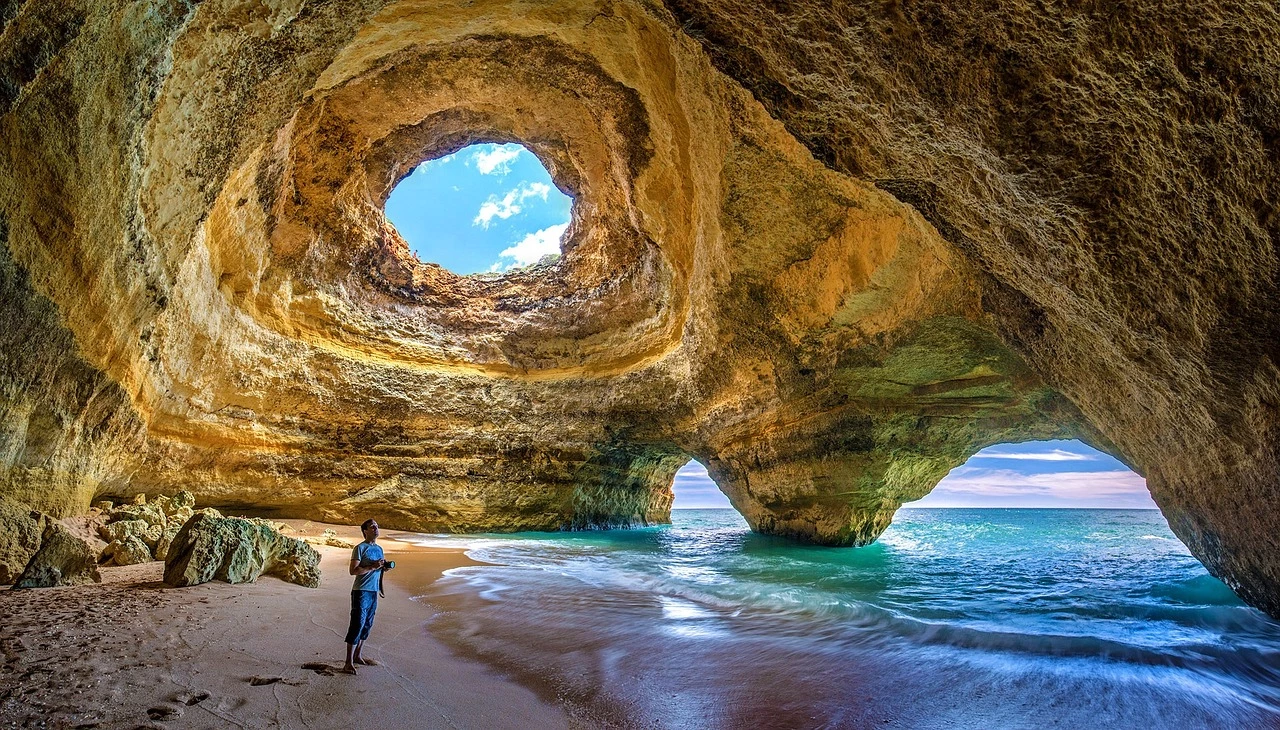
Between Portimão and Albufeira, the sea has carved dozens of caves and arches into the sandstone. The best known, the Algar de Benagil, is a vast cavern whose roof is pierced by a round opening that lets light fall onto a small inner beach. Further west, Ponta da Piedade in Lagos is a line of arches and rock stacks; at Carvoeiro, the Algar Seco forms pools and passages at the foot of the cliff.
The caves are seen from the sea, by boat, kayak or paddleboard, from Portimão, Benagil, Carvoeiro, Armação de Pêra or Lagos. On land, the Seven Hanging Valleys trail follows the clifftop above Benagil and lets you look down through the opening in the roof.

Algarve beaches
The coast changes from west to east. In the centre, between Lagoa and Albufeira, the coves are framed by cliffs: Marinha beach, with its arches and rocks, Benagil beach, where the boats to the cave leave from, and further on Falésia beach, several kilometres long at the foot of red and white cliffs between Olhos de Água and Vilamoura.
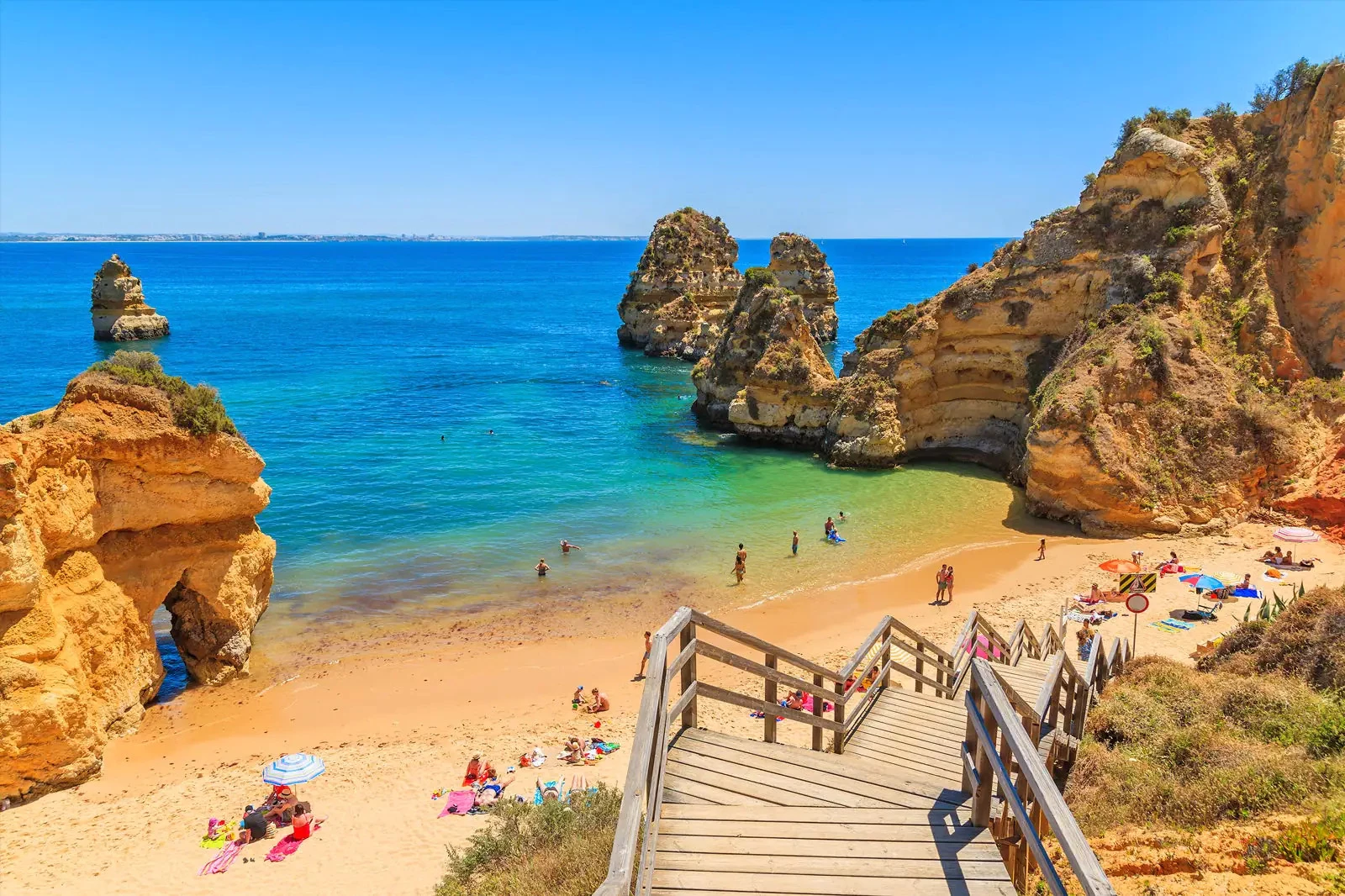
Near Lagos, Dona Ana and Camilo beaches, the latter reached by a long wooden staircase, are small and sheltered. In Portimão, Rocha beach is wide and lined with a promenade. In the east, the fine-sand beaches lie on the barrier islands of the Ria Formosa (Faro, Culatra, Tavira), reached by bridge for Faro island and by boat for the others.

Lagos
In the west of the Algarve, Lagos keeps an old town ringed by walls, with cobbled lanes, the church of Santo António and the Ponta da Bandeira fort, which guarded the harbour entrance. The Mercado de Escravos, on the main square, is a small museum about the Atlantic slave trade, in which Lagos was one of the first ports in the 15th century.
South of town, Ponta da Piedade raises its sandstone arches and stacks above the water; a staircase leads down to sea level, and kayaks and boats leave from the marina to pass beneath the arches. Dona Ana and Camilo beaches can be reached on foot from the centre.

Faro
The regional capital and gateway through its airport, Faro has kept its Cidade Velha, the old town, enclosed within its walls. You enter through the Arco da Vila to reach the cathedral (Sé), whose bell tower overlooks the lagoon. In the lower town, the Carmo church houses a Chapel of Bones lined with skulls and bones.
Faro sits on the Ria Formosa, a lagoon sheltered by a chain of barrier islands. From the marina quay, boats run to Deserta (Barreta) island and Farol island; Faro island is linked to the mainland by a bridge.

Albufeira
Once a fishing port and now the Algarve's largest resort, Albufeira has kept an old town of white houses above Pescadores beach, which you reach from the centre by steps and a lift. To the east, Falésia and Olhos de Água beaches stretch below red cliffs.
Nightlife is concentrated on Avenida Sá Carneiro, nicknamed "The Strip", away from the old town. The marina, to the west, is the departure point for boat trips to the caves along the coast.

Cape St Vincent and Sagres fortress
At the far south-western tip of mainland Portugal, Cape St Vincent (Cabo de São Vicente) looks over the Atlantic from its cliffs, topped by a lighthouse. A few kilometres away, Sagres fortress stands on a headland linked to Henry the Navigator and the beginnings of the Age of Discovery.
People come for the wind, the end-of-the-world feel and above all the sunset over the ocean, one of the most spectacular in the Algarve.

Portimão
One of the Algarve's main towns, Portimão spreads along the bank of the Arade estuary. The Portimão Museum occupies a former fish cannery by the river and tells the story of the fishing and canning industries the town lived on.
To the south, the Praia da Rocha district runs along a wide sandy beach below the cliffs, with the Santa Catarina fort at the harbour mouth. Many boat trips to Benagil leave from the centre and the marina.

Tavira
East of Faro, Tavira climbs both banks of the Gilão, linked by a stone bridge known as the "Roman bridge", rebuilt in the 17th century. The remains of the castle look out over the rooftops and the town's many bell towers, next to the church of Santa Maria do Castelo.
The town sits on the Ria Formosa: from the Quatro Águas jetty, a boat crosses the lagoon to Tavira island and its long sandy beach. Less built-up than the central coast, Tavira suits a slow-paced stay.

Vilamoura
A resort built from the 1960s around one of Portugal's largest marinas, Vilamoura combines hotels, harbourside restaurants and golf courses. Falésia beach begins west of the marina.
At the entrance to the resort, the Roman site of Cerro da Vila preserves the remains of a villa and baths, with a small museum. Boat trips, including dolphin watching, leave from the marina.

Silves
Inland, on the Arade river, Silves was the capital of the Algarve in Moorish times. Its red sandstone castle, with crenellated walls, dominates the town and the surrounding citrus orchards.
Below stands the Gothic cathedral, built after the Christian reconquest in the 13th century, and the municipal archaeology museum, which displays remains of the Islamic town.

Hiking in the Serra de Monchique and to Fóia
North of Portimão, the Serra de Monchique is covered in cork oaks, eucalyptus and strawberry trees. Its summit, Fóia, rises to 902 m, the highest point in the Algarve: on a clear day the view reaches the coast and the ocean. The town of Monchique and the spa village of Caldas de Monchique are the starting points.
The Via Algarviana, a waymarked long-distance trail that crosses the hinterland from east to west to Cape St. Vincent, runs through the range. On the coast, the Seven Hanging Valleys trail links Marinha beach to Vale Centeanes along the clifftops.

Water parks and theme parks
The Algarve has several large leisure parks, open mainly in the warm season. Zoomarine, at Guia near Albufeira, combines marine animal shows and pools; Aqualand, at Alcantarilha, and Slide & Splash, at Estômbar (Lagoa), are water parks with slides; Aquashow, at Quarteira, adds rides to its pools.
Krazy World, at Algoz, is an animal park with pools and mini-golf, quieter for young children.
Algarve festivals
Loulé carnival, in February, is one of the best known in the country, with its parades of floats. Also in Loulé, Festival MED usually brings world music to the lanes of the old town in late June.
Summer is the season of food festivals: the Olhão seafood festival and the Portimão sardine festival are usually held in August. Dates change every year: check the Visit Algarve events calendar before you go.
Speedboat to the Benagil caves from Portimão
An hour and a half by speedboat along the cliffs between Portimão and Benagil, with a safety briefing and life jacket, passing coves that can only be reached by sea. The highlight: pulling up in front of the Algar de Benagil and its pierced roof, from the boat.
Allow €25 per person on GetYourGuide, with free cancellation; the meeting point is near the ruins of the São Francisco convent in Portimão. You stay on board: landing on the cave's beach is banned.
- 1.5 hrs
- €25 per person (GetYourGuide price 2026)
Kayaking in the Ponta da Piedade caves from Lagos
You leave Lagos marina by catamaran for Ponta da Piedade, then spend about 1 hour 15 kayaking with a guide through narrow passages, caves and small beaches at the foot of the cliffs. The highlight: gliding beneath the sandstone arches at water level.
Allow €40 per person on GetYourGuide, with free cancellation, guided in English or Portuguese. There is time for a swim from the boat after the kayaking: wear your swimsuit.
- 2 hrs
- €40 per person (GetYourGuide price 2026)
Dolphin watching with a marine biologist in Lagos
An hour and a half by speedboat off Lagos, looking for the Atlantic's wild dolphin pods, with marine biologists on board who explain their behaviour and collect data for their monitoring. The highlight: a pod swimming alongside the boat, watched from a respectful distance.
Allow €40 per person on GetYourGuide, with free cancellation, departing from Lagos marina. The sea can be choppy offshore: bring a windbreaker and, if needed, a seasickness remedy.
- 1.5 hrs
- €40 per person (GetYourGuide price 2026)
Ria Formosa islands by boat from Faro
Four hours in a small group (11 passengers at most) through the channels of the Ria Formosa, with a local guide, and two stops: Farol island and its lighthouse, then Deserta island and its dunes. The highlight: free time on Deserta's almost empty beach.
Allow €42 per person on GetYourGuide, with free cancellation; departure from Faro marina. Swimming is possible in spring and summer: bring a swimsuit, water and sun protection.
- 4 hrs
- €42 per person (GetYourGuide price 2026)
Getting there
Through Faro airport (FAO), or by train and bus from Lisbon, about 3 hours away.
The main gateway is Faro airport (FAO), connected to many European cities. From the airport, you reach the resorts by hire car, pre-booked transfer, taxi, or by bus and train to Albufeira, Lagos, Portimão and Tavira.
Trains (Comboios de Portugal) and long-distance buses also link the Algarve with Lisbon, about 3 hours away. To explore the region freely, a car remains the most practical option.
Getting around
Preferably by hire car; coastal train Lagos-Vila Real de Santo António and buses between towns.
A hire car is the most practical option: many beaches, viewpoints and inland villages, such as Monchique, are poorly served by public transport.
The regional railway runs along the coast from Lagos to Vila Real de Santo António, and buses link the main towns, with limited frequency. Taxis and ride-hailing operate in the towns. Boat trips (caves, dolphins) leave from the marinas of Lagos, Portimão, Albufeira, Vilamoura and Faro.
What to do
Boat or kayak to Benagil, kayaking at Ponta da Piedade, dolphins from Lagos, the Ria Formosa islands, then Faro, Silves, Tavira and Fóia.
On the central coast, the boat or kayak trip to Benagil cave and the Marinha coves is the headline activity; in Lagos, you kayak beneath the arches of Ponta da Piedade and head out to watch dolphins with marine biologists. In the east, boats from Faro and Tavira cross the Ria Formosa to Deserta, Farol and Tavira islands.
On land, Faro old town, Silves castle, Tavira and the climb to Fóia in the Serra de Monchique round off a beach holiday. The water parks (Zoomarine, Aqualand, Slide & Splash, Aquashow) fill family days.
Climate & seasons
When to go to Portugal?
Monthly averages over the past 5 years (Open-Meteo).
Best months
- April
- May
- June
- July
- August
- September
- November
| Jan | Feb | Mar | Apr | May | Jun | Jul | Aug | Sep | Oct | Nov | Dec | |
|---|---|---|---|---|---|---|---|---|---|---|---|---|
| Our take | ||||||||||||
| Weather | ||||||||||||
| High | 17° | 18° | 19° | 22° | 25° | 28° | 32° | 32° | 27° | 25° | 20° | 17° |
| Rain (mm) | 76 | 67 | 102 | 43 | 17 | 13 | 0 | 1 | 26 | 90 | 61 | 87 |
| Beach | Beach May | Beach June | Beach July | Beach August | Beach September | Beach October |
What to do by season (autumn)
-
Beach
Warm air and water, little rain.
When to go
May-June and September for warmth without crowds; July-August for peak beach season; spring and autumn for hiking.
The best times are May-June and September: warm weather, swimmable sea and far fewer people than in high season. July and August are the hottest, busiest and most expensive months.
Spring and autumn suit hiking (Serra de Monchique, Seven Hanging Valleys trail) and exploring the towns. Winter stays mild and quiet, but the sea is cool.
Where to stay
Lagos for the west, Albufeira or Carvoeiro for Benagil, Faro or Tavira for the Ria Formosa.
Your choice of base depends on what you want to see: the coast runs from Sagres to the Spanish border.
- Lagos: old town, Ponta da Piedade and the western beaches, towards Sagres and Cape St. Vincent.
- Albufeira or Carvoeiro: in the centre, near Benagil, Marinha beach and Falésia beach.
- Vilamoura: marina, golf and family hotels.
- Faro: handy on arrival by air and for the Ria Formosa.
- Tavira: a quieter feel in the east, near Tavira island.
In July and August, book several months ahead: prices rise sharply.
Safety
A safe region: follow beach flags, keep away from cliffs, beware of summer wildfires; emergencies on 112.
The Algarve is a safe region; precautions are mainly about the sea and the sun. Follow the flags on lifeguarded beaches (red: no swimming), keep away from the foot of the cliffs, which are prone to rockfalls, and do not go near the edge at the top.
In summer, the wildfire risk is high inland: follow local instructions and skip hikes during alerts. The emergency number in Portugal is 112.
Formalities
ID card or passport for EU citizens, no visa; ETIAS not yet in service; euro.
Portugal is part of the European Union and the Schengen area. Citizens of the EU, the EEA and Switzerland need no visa: a valid ID card or passport is enough.
Visa-exempt non-EU travellers go through the EU Entry/Exit System (EES), fully operational since 10 April 2026. The ETIAS authorisation is not yet in service and no launch date has been set (September 2026); it will not apply to EU citizens. The currency is the euro and the language Portuguese (English is widely spoken in tourist areas). No vaccinations are required.
FAQ
Season, access to Benagil cave, car or public transport, entry rules: the practical answers for planning a stay in the Algarve.
When is the best time to visit the Algarve?
May-June and September: warm weather, swimmable sea and fewer crowds than in July-August. Winter is mild and quiet but the sea is cool.
How do I get from Faro airport to the resorts?
Hire car, pre-booked transfer, taxi, or bus and train to Albufeira, Lagos, Portimão and Tavira.
How do you get into Benagil cave?
From the sea, on a trip run by an authorised operator by boat, kayak or paddleboard. Landing on the inner beach is no longer allowed, and since August 2024 the number of boats inside at once has been limited (about 2 minutes per boat). To see it from above, follow the Seven Hanging Valleys trail to the clifftop.
Do you need a car in the Algarve?
It is the most practical option. Trains and buses link the main towns but serve the beaches, viewpoints and the interior, such as Monchique, poorly.
Is the Algarve good for families?
Yes: sheltered beaches, water parks (Zoomarine, Aqualand, Slide & Splash, Aquashow), boat trips on the Ria Formosa and resorts such as Albufeira and Vilamoura.
Which beaches should I choose?
Marinha beach and the Benagil area, Falésia beach between Olhos de Água and Vilamoura, Dona Ana and Camilo beaches near Lagos, and the Ria Formosa islands near Faro and Tavira.
Do I need a visa or ETIAS for the Algarve?
Not as an EU citizen: a valid ID card or passport is enough. The ETIAS authorisation is not yet in service and no launch date has been set (September 2026); it will not apply to EU citizens. The currency is the euro.
How many days should I plan?
5 to 7 days let you combine beaches, a boat trip (Benagil or Ponta da Piedade), a historic town (Lagos, Tavira or Silves) and a day in Monchique. A long weekend covers the essentials of the centre.
Sources
The figures in this guide come from the sources below, checked on the publication date.
Leave a comment
Share your thoughts or travel experience. Your email will not be published.