

Contents 29
Salzburg packs into a few streets a UNESCO-listed baroque old town, Hohensalzburg Fortress and Mozart's birthplace, with the Alps and the Salzkammergut lakes less than an hour away. This guide gathers its 15 highlights, from the cathedral to Hellbrunn Palace, then the practical information: getting there, getting around, budget and the best season.
Overview
Salzburg, Austria's fourth-largest city, is Mozart's birthplace; its baroque historic centre, overlooked by Hohensalzburg Fortress, has been a UNESCO World Heritage Site since 1996.
Salzburg spreads across both banks of the Salzach, at the foot of the Alps, on the Bavarian border. The old town, on the left bank, is the stage of the prince-archbishops who ruled the city until the early 19th century and rebuilt it in baroque style: cathedral, Residenz, squares and fountains, beneath Hohensalzburg Fortress.
Two names draw visitors: Mozart, born at 9 Getreidegasse in 1756, and « The Sound of Music », filmed in the city and its surroundings. The Salzburg Festival every summer and the Christmas markets set the rhythm of the year. The city is also the gateway to the Salzkammergut: see our Hallstatt guide and our guide to Vienna, 2 hrs 25 by train.
15 places to take with you
In the guide's order, ready for Google Maps or your GPS.
Book the activities from this guide
Our picks for Salzburg, well rated and free to cancel.
-
Book this activity
The original « Sound of Music » tour
€75 per person (GetYourGuide price 2026)
-
Book this activity
Mozart concert in the Marble Hall of Mirabell Palace
from €39 per person (GetYourGuide price 2026)
-
Book this activity
Eagle's Nest and Berchtesgaden from Salzburg
€105 per person (GetYourGuide price 2026)
Affiliate links: Travel Advice earns a commission if you book, at no extra cost to you. Learn more

The Old Town (Altstadt)
On the left bank of the Salzach, at the foot of the Mönchsberg, Salzburg's old town has been a UNESCO World Heritage Site since 1996. Its baroque squares, Residenzplatz, Domplatz and Kapitelplatz, follow one another between the cathedral and the Residenz, the palaces of the prince-archbishops who ruled the city.
Getreidegasse, a narrow shopping street with wrought-iron shop signs, leads to Mozart's birthplace. Everything is on foot, with Hohensalzburg Fortress towering above.

Hohensalzburg Fortress
Founded in the 11th century by the prince-archbishops and enlarged until the 17th century, Hohensalzburg Fortress sits on the Festungsberg above the old town. It is one of the largest surviving medieval castles in Europe.
The visit takes in the princely apartments, the fortress museums and the ramparts, with views over the old town rooftops, the Salzach and the Alps. You go up by the FestungsBahn funicular or on foot from Kapitelplatz.

Mozart's Birthplace
Wolfgang Amadeus Mozart was born on 27 January 1756 on the third floor of 9 Getreidegasse, where his family lived until 1773. The house is now a museum run by the Mozarteum Foundation.
It displays the family apartment, portraits, letters and instruments that belonged to the composer, including his childhood violin. The visit combines with Mozart's Residence (Mozart-Wohnhaus) on Makartplatz, across the Salzach.

Salzburg Cathedral (Dom zu Salzburg)
Consecrated on 24 September 1628 after fourteen years of work led by the architect Santino Solari, Salzburg Cathedral is dedicated to Saints Rupert and Virgil. Its pale marble façade and twin towers close off Domplatz.
The bright, stuccoed baroque interior holds the font where Mozart was baptised. The cathedral museum and galleries are part of the DomQuartier circuit, which links the cathedral to the Residenz.

Mirabell Palace and Gardens
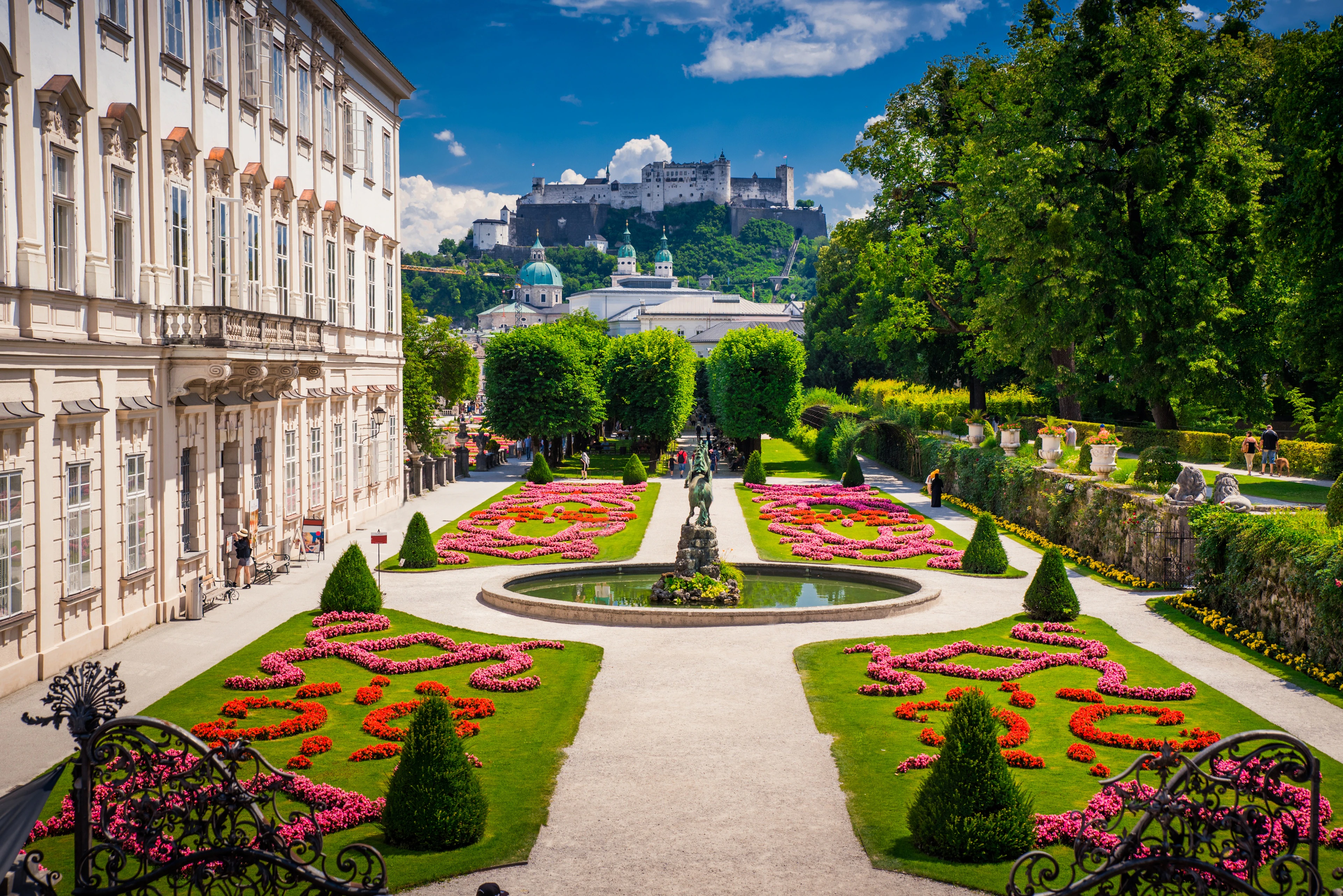
On the right bank of the Salzach, Mirabell Palace was built in 1606 by Prince-Archbishop Wolf Dietrich and remodelled in the 18th century. Its Marble Hall, a former banqueting hall where Mozart and his sister performed, now hosts chamber music concerts.
The baroque gardens, with their flowerbeds, statues and fountains, frame the fortress in the distance. Several scenes of « The Sound of Music » were filmed here, around the Pegasus Fountain and the steps.

Great Festival Hall (Grosses Festspielhaus)
Set against the Mönchsberg on Hofstallgasse, the Grosses Festspielhaus was designed by Clemens Holzmeister and opened in 1960. With 2,179 seats, it is the largest hall in the festival district, next to the House for Mozart and the Felsenreitschule, the former riding school carved into the cliff.
Every summer, from late July to late August, the Salzburg Festival stages opera, concerts and theatre here. The rest of the year, the halls can be seen on a guided tour.

Mönchsberg Hill
The Mönchsberg forms a wooded cliff on the left bank, right behind the old town. A lift cut into the rock rises from Gstättengasse to the Museum der Moderne, whose terrace has one of the best views over the rooftops, domes and fortress.
At the top, forest paths link the museum to Hohensalzburg Fortress along the old ramparts: a quiet walk a few minutes from the crowds of Getreidegasse.

Salzburg Residenz
On Residenzplatz, the Residenz was for centuries the palace of Salzburg's prince-archbishops. Its baroque state rooms, with painted ceilings, saw the young Mozart play before the court.
It is part of the DomQuartier, a circuit linking the state rooms, the Residenz picture gallery, the cathedral galleries and the St Peter's museum. Opposite, the Residenz Fountain is one of the largest baroque fountains north of the Alps.

Hellbrunn Palace and Trick Fountains
5 km south of the centre, Hellbrunn Palace was built in the early 17th century by Prince-Archbishop Markus Sittikus as a summer residence. Its gardens hide the trick fountains (Wasserspiele): grottoes, automata and jets that soak visitors by surprise.
The free park also holds the glass pavilion from « The Sound of Music ». Allow half a day with the palace visit.

House of Nature (Haus der Natur)
On Museumsplatz, at the foot of the Mönchsberg, the Haus der Natur is Salzburg's natural history and science museum. It brings together an aquarium, a reptile zoo, galleries on dinosaurs, space and the human body, and a hands-on Science Center.
It is the safest bet on a rainy day, especially with children.

Hallein Salt Mine (Salzwelten Salzburg)
About twenty kilometres south of Salzburg, on the Dürrnberg above Hallein, salt has been mined since Celtic times: it made the prince-archbishops rich and gave the city its name.
The guided tour is in miners' overalls, with the mine train, the wooden slides and a crossing of an underground lake. Above ground, a reconstructed Celtic village rounds off the outing.

Salzburg's traditional cafés
Salzburg has kept its old-style cafés, with banquettes, newspapers and pastry counters. Café Tomaselli, on Alter Markt, is one of the oldest in Austria; Café Bazar, on the right bank, looks out over the Salzach and the fortress.
The Fürst confectionery, founded by Paul Fürst, who invented the Mozartkugel in 1890, still sells its balls of pistachio, marzipan and nougat coated in chocolate, wrapped by hand.

Salzburg Christmas Market (Christkindlmarkt)
During Advent, the Christkindlmarkt sets up on Domplatz and Residenzplatz, between the cathedral and the Residenz. Its stalls sell wooden decorations, candles, Lebkuchen and mulled wine beneath the illuminated fortress.
Choirs and brass bands play regularly on the squares, and other markets open around the city, including in the fortress courtyard and at Hellbrunn.

Lake Wolfgangsee
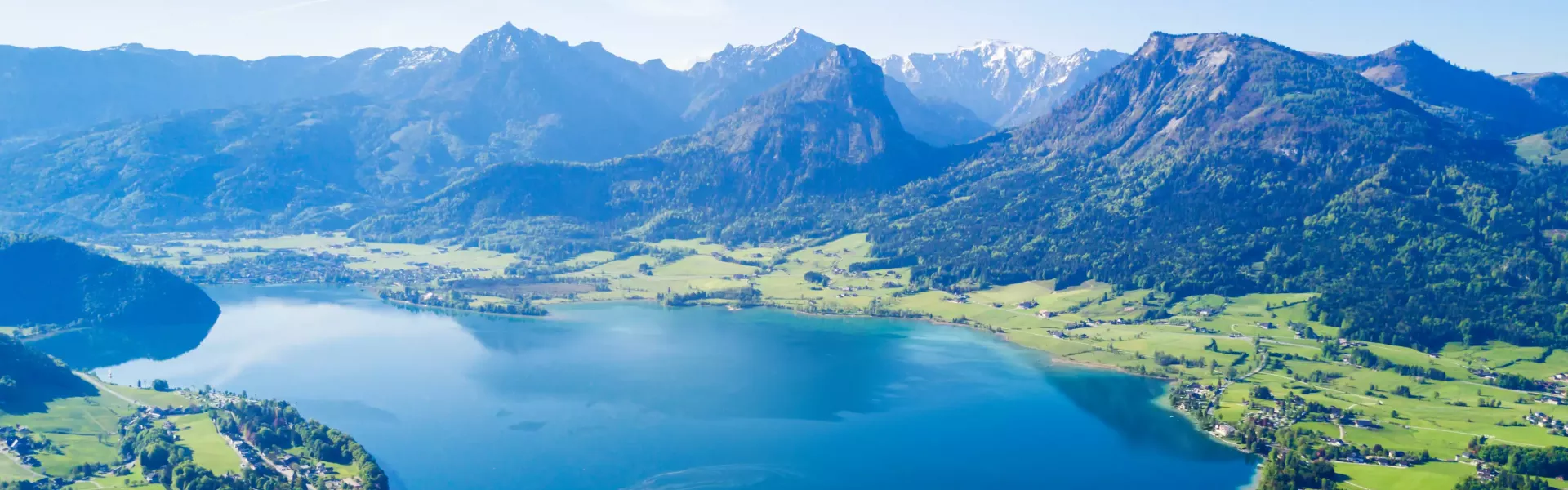
About thirty kilometres east of Salzburg, the Wolfgangsee is lined by three villages: St. Gilgen, birthplace of Mozart's mother, St. Wolfgang, with its pilgrimage church and Michael Pacher altarpiece, and Strobl.
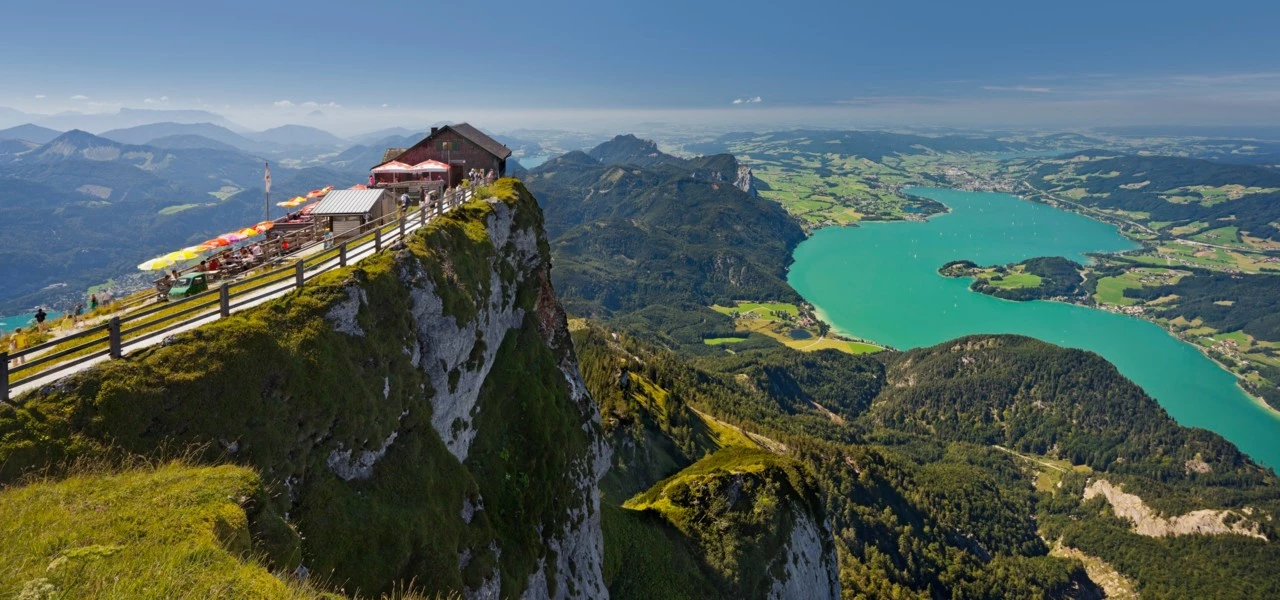
Boats link the villages in season, and the Schafberg cog railway leaves St. Wolfgang for a summit overlooking a string of Salzkammergut lakes.

The Salzkammergut and Hallstatt
East of Salzburg lies the Salzkammergut, a region of lakes and mountains whose core, Hallstatt and the Dachstein, is a UNESCO World Heritage Site. Hallstatt, a village clinging between its lake and the salt mountain, is reached by bus via Bad Ischl or on an organised trip.
Above Obertraun, the Krippenstein cable car leads to the Dachstein ice caves and the 5fingers platform. Allow a full day, ideally with a night on site.
The original « Sound of Music » tour
A half-day coach tour with a guide to the film's locations, in town and in the lake district: Leopoldskron Palace, whose lakeside terrace served as the set for the von Trapp villa, Nonnberg Abbey, Lake Fuschl, then the church in Mondsee where the wedding scene was shot, with the soundtrack playing along the way. The highlight: the Salzkammergut lakes road.
Allow €75 per person on GetYourGuide, with free cancellation, for about 4 hours; commentary in English, departure from Hubert-Sattler-Gasse, near Mirabell.
- 4 hrs
- €75 per person (GetYourGuide price 2026)
Mozart concert in the Marble Hall of Mirabell Palace
A 90-minute chamber music concert in the Marble Hall of Mirabell Palace, the former banqueting hall of the prince-archbishops, where Leopold Mozart and his children Wolfgang and Nannerl performed. Soloists and ensembles change from night to night. The highlight: Mozart's music played in a room he knew.
From €39 per person on GetYourGuide, with free cancellation; a voucher is exchanged for the ticket on site, and the concert is not open to children under 6.
- 1.5 hrs
- from €39 per person (GetYourGuide price 2026)
Eagle's Nest and Berchtesgaden from Salzburg
A half day on the Bavarian side: the coach follows the Berchtesgaden valley up to Obersalzberg, then a special bus and the lift climb to the Kehlsteinhaus, the « Eagle's Nest » given to Hitler for his 50th birthday, with a guide's commentary on the Second World War. The highlight: the view of the Hoher Göll and the Bavarian Alps.
Allow €105 per person on GetYourGuide, with free cancellation, entry and lift included; commentary in English and German. Bring an ID: you cross into Germany. Only possible from about mid-May to late October, when the Kehlstein road is open.
- 4.5 hrs
- €105 per person (GetYourGuide price 2026)
Half-day trip to Hallstatt
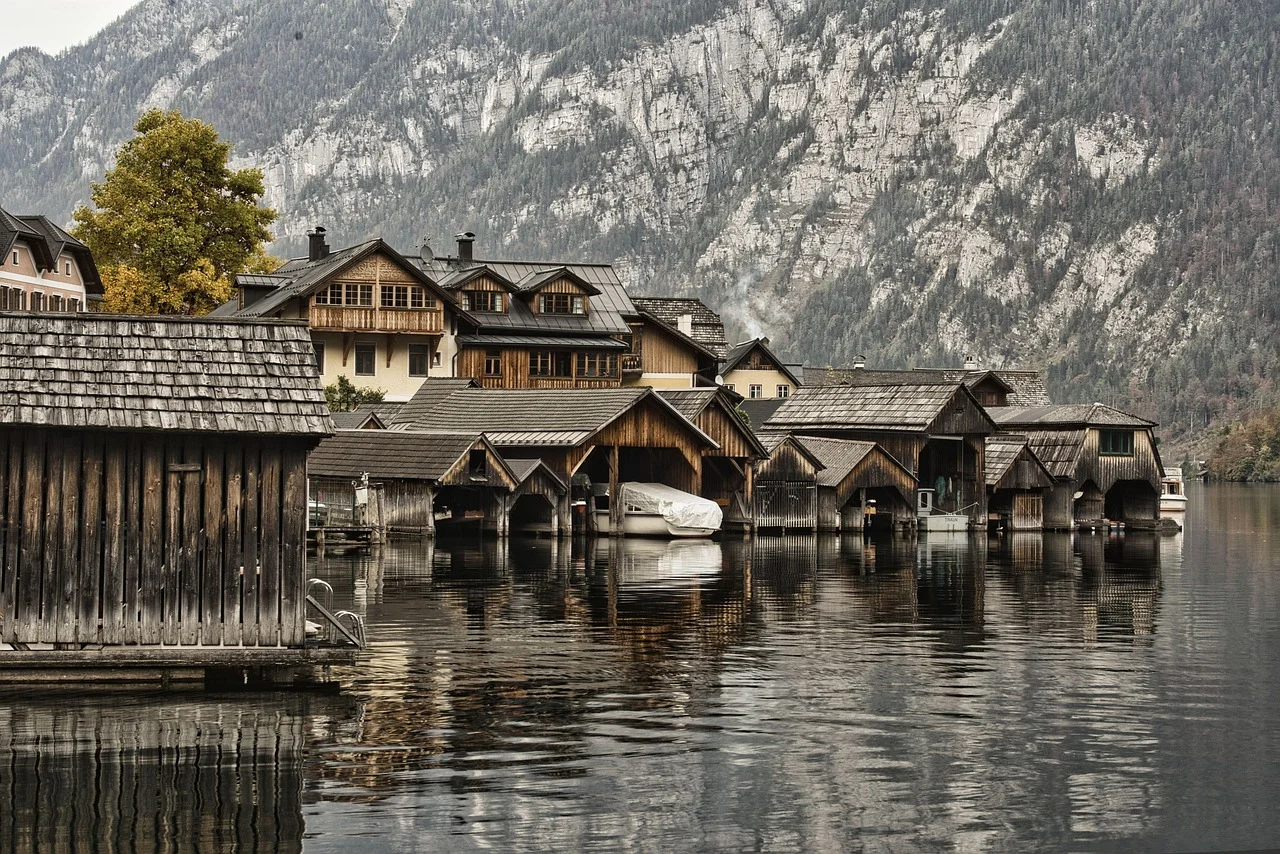
A coach crosses the Salzkammergut and its lakes with a guide's commentary, then leaves 2.5 hours of free time in Hallstatt, with an introduction to the village, the ossuary and the Mühlbach waterfall. The highlight: the walk along the lake, facing the houses clinging to the slope.
Allow €85 per person on GetYourGuide, with free cancellation, for about 5.5 hours. The time on site does not allow for the salt mine tour.
- 5.5 hrs
- €85 per person (GetYourGuide price 2026)
Getting there
Salzburg has an international airport (SZG) and rail links to Vienna (~2h25) and Munich (~1h28).
By air: W. A. Mozart Airport (code SZG), west of the city, handles European flights. There is no direct rail link from the airport: take bus no. 2 or a taxi to the main station (Salzburg Hauptbahnhof) in about 15 minutes.
By train: ÖBB connects Salzburg to Vienna in ~2h25 (Railjet, up to 2/hour) and to Munich in ~1h28. The main station is a 15-20 min walk from the old town.
By car: Salzburg sits on the A1 (Vienna-Linz) and A8/A10; an Austrian motorway vignette is required. The historic centre is largely pedestrian, so use the peripheral car parks.
Getting around
The old town is explored on foot; trolleybuses and city buses serve the station, Hellbrunn (line 25) and the districts, and the FestungsBahn funicular climbs to the fortress.
The Altstadt and the right bank (Mirabell, Linzer Gasse) are walkable, crossing the Salzach on the Makartsteg footbridge or the Staatsbrücke. The FestungsBahn funicular climbs to the fortress from Festungsgasse, and the Mönchsberg lift leaves from Gstättengasse.
For the station, the airport (bus 2) and Hellbrunn (bus 25, 25 to 30 minutes), the trolleybus and city bus network is enough; a 24-hour ticket covers the core zone. For the lakes, regional buses leave from the station (line 150 to the Wolfgangsee and Bad Ischl). Avoid driving in town: the centre is largely pedestrian.
What to do
Hohensalzburg Fortress, the cathedral and DomQuartier, Mozart's birthplace, the Mirabell Gardens, a Mozart concert, the Hellbrunn trick fountains, then a day trip to the Wolfgangsee, Hallstatt or the Eagle's Nest.
One day is enough for the Altstadt: the fortress in the morning, the cathedral and DomQuartier, Getreidegasse and Mozart's birthplace, then the Mirabell Gardens on the right bank. In the evening, a Mozart concert in the Marble Hall of Mirabell Palace or at the fortress.
On day two, Hellbrunn and its trick fountains in the morning, the Mönchsberg at the end of the day. Beyond that, one trip a day: the « Sound of Music » tour, the Wolfgangsee, Hallstatt, the Hallein salt mine or the Eagle's Nest at Berchtesgaden, on the Bavarian side. The activities below detail the bookable options.
Climate & seasons
When to go to Austria?
Monthly averages over the past 5 years (Open-Meteo).
| Jan | Feb | Mar | Apr | May | Jun | Jul | Aug | Sep | Oct | Nov | Dec | |
|---|---|---|---|---|---|---|---|---|---|---|---|---|
| Our take | ||||||||||||
| Weather | ||||||||||||
| High | 6° | 9° | 12° | 14° | 18° | 25° | 25° | 24° | 21° | 17° | 10° | 6° |
| Rain (mm) | 95 | 82 | 83 | 98 | 165 | 104 | 166 | 171 | 146 | 89 | 113 | 100 |
| Hiking & nature | Hiking & nature March | Hiking & nature April | Hiking & nature June | Hiking & nature October | ||||||||
| City sightseeing | City sightseeing March | City sightseeing April | City sightseeing June | City sightseeing September | City sightseeing October |
What to do by season (autumn)
-
Hiking & nature
Mild temperatures, stable conditions.
-
City sightseeing
Pedestrian-friendly most of the year.
When to go
May-June and September-October for mild weather and moderate crowds; July-August for the Salzburg Festival, at the cost of crowds; Advent for the Christmas markets.
Spring and early autumn: the best seasons for walking the Altstadt and heading out to the lakes. The Hellbrunn trick fountains run from 28 March to 1 November 2026.
July-August: the Salzburg Festival fills the city from late July to late August; hotels are expensive and full, so book early. Summer showers are frequent: keep a museum plan (Haus der Natur, DomQuartier).
Winter: from late November to late December, the Christmas markets set up on Domplatz and Residenzplatz. The Salzburg Card is cheaper from November to March (€35 for 24 hours against €38 in high season).
Budget
The Salzburg Card costs €38 for 24 hours, €45 for 48 hours and €49 for 72 hours in the 2026 high season; allow €16.50 for Hellbrunn, €35 for the Hallein salt mine and from €39 for a Mozart concert.
Salzburg Card (one free entry to the city's attractions): €38 for 24 hours, €45 for 48 hours, €49 for 72 hours from April to October 2026; €35, €41 and €44 from November to March. Half price for ages 6-15.
Entry fees and outings: Hellbrunn palace and trick fountains €16.50, Hallein salt mine €35, Mozart concert at Mirabell Palace from €39, « Sound of Music » tour about €75 (2026 adult prices).
Accommodation: prices rise sharply during the Festival and Advent; the right bank and the station area remain the most affordable.
Where to stay
The old town to do everything on foot, the right bank around Mirabell and Linzer Gasse for better value, the station area for day trips by train and bus.
Altstadt (left bank): at the foot of the fortress and steps from Getreidegasse, the most convenient and most expensive, with hotels in old townhouses.
Right bank (Mirabell, Linzer Gasse, Steingasse): five to ten minutes' walk from the old town across the bridges, more hotels and guesthouses, often cheaper.
Main station: less charm, but ideal for day trips to the Wolfgangsee, Hallstatt or Hallein, and 15-20 minutes' walk from the Altstadt. During the Festival (July-August) and Advent, book several months ahead.
Safety
Salzburg is a safe city; watch your belongings in the crowds of Getreidegasse and the Christmas markets. Emergencies: 112, police 133, ambulance 144, fire 122, mountain rescue 140.
The city poses no particular risk; pickpocketing can happen in crowds, on Getreidegasse, at the Christmas markets and on packed buses. France Diplomatie advises French citizens abroad to be extra vigilant: check its Austria page before leaving.
On mountain outings (Untersberg, Schafberg, Dachstein), the weather changes fast: warm clothes and a checked forecast. Emergency numbers: 112 (European), police 133, ambulance 144, fire 122, mountain rescue 140.
Formalities
Austria is in the Schengen Area and uses the euro; no visa is needed for short tourist stays by EU citizens.
Austria is part of the Schengen Area and the European Union; the currency is the euro (EUR). EU, EEA and Swiss citizens travel with a national ID card or passport, no visa required.
Visa-exempt travellers from other countries (UK, Canada, USA, etc.) may stay up to 90 days within any 180-day period in the Schengen Area. ETIAS (electronic travel authorisation, about 20 EUR) will become mandatory for these nationals, but it is not yet in service and no launch date has been set (September 2026); check the official EU website before you go.
No specific vaccination is required. The European Health Insurance Card (EHIC) covers care for EU residents.
FAQ
Quick answers on visas, currency, the Salzburg Card, the best season and day trips from Salzburg.
Do I need a visa to visit Salzburg?
No for nationals of the European Union, the European Economic Area and Switzerland, who travel on a simple ID card or passport, without a visa. Austria is part of the Schengen Area and the European Union, and the currency is the euro. Travellers from other visa-exempt countries, notably the United Kingdom, Canada and the United States, may stay 90 days within any 180 in the Schengen Area. ETIAS, an electronic authorisation costing around €20, will become mandatory for them; it is not yet in service and no launch date has been set (September 2026).
What currency is used in Salzburg?
The euro, as Austria belongs to both the eurozone and the European Union: no currency exchange is needed from another eurozone country. Cards are accepted almost everywhere, in shops, restaurants and on public transport.
Is the Salzburg Card worth it?
Yes, as soon as you string several sights together. It includes free entry to all the attractions, among them Hohensalzburg Fortress, Mozart's birthplace and the DomQuartier, plus the city's public transport. Peak-season 2026 prices run at about €38 for 24 hours, €45 for 48 hours and €49 for 72 hours, with the longer versions quickly working out better value. For a single day in the Altstadt, where everything is walkable, the maths depends on how many paid entries you plan.
When is the best time to visit?
Spring and autumn for mild weather and thinner crowds: the most comfortable seasons for walking the Altstadt. Summer, July and August, coincides with the Salzburg Festival, the city's cultural highlight but also its busiest stretch: book accommodation early. Advent offers another reason to come, with Christmas markets set up on Domplatz and Residenzplatz. Day trips to Wolfgangsee or the Salzkammergut work best from late spring through autumn.
Can you see Salzburg in one day?
Yes for the core of the Altstadt: Hohensalzburg Fortress, the cathedral, Mozart's birthplace and the Mirabell gardens are all walkable, and the main station is only a 15 to 20 minute walk from the old town. Allow 2 to 3 days to add a day trip: Lake Wolfgangsee at 45 minutes to an hour, the Hallein salt mines at about half an hour, or the Salzkammergut region with Hallstatt and the Schafberg, which needs a full day.
What day trips can I take from Salzburg?
Three classic trips radiate out from Salzburg. Lake Wolfgangsee, 45 minutes to an hour away, for a half day by the water. The Hallein salt mines, only about half an hour out, which explain the origin of the city's name and its historic wealth. The Salzkammergut region, with Hallstatt and the Schafberg, needs a full day. Salzburg is well connected by rail, 2h25 from Vienna and 1h28 from Munich, which also makes it an easy stop on a wider itinerary.
For the Hallstatt day trip, see the essential things to do in the village and, above all, what time to go to avoid the crowds.
Sources
The figures in this guide come from the sources below, checked on the publication date.
Leave a comment
Share your thoughts or travel experience. Your email will not be published.