

Contents 20
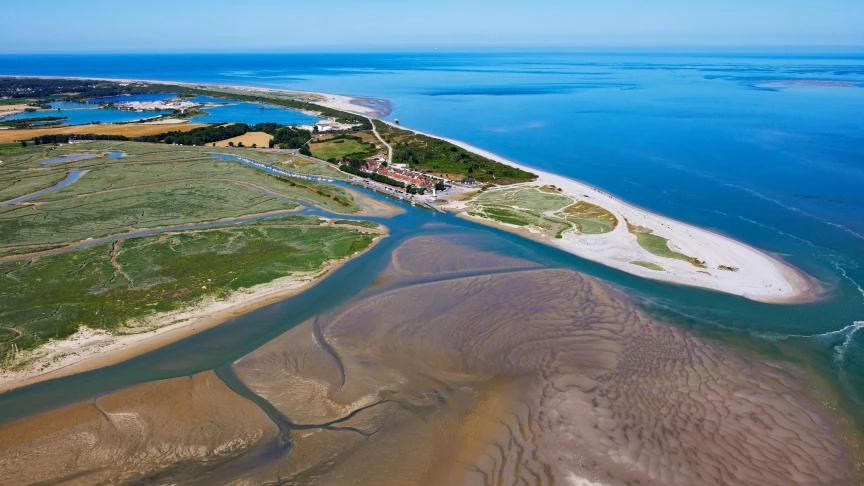
The Baie de Somme is northern France's largest estuary, on the Picardy coast, at the heart of a Grand Site de France of 20,000 ha across 31 communes and 70 km of coastline. People come for France's largest harbour-seal colony, the birds of the Parc du Marquenterre, tides that uncover miles of sand, and the small towns around the estuary: Saint-Valery-sur-Somme, Le Crotoy and Cayeux-sur-Mer.
Everything runs on the tides: seals, walks across the bay and the light change by the hour, and most outings are timed to low water.
Overview
The largest estuary in northern France (~70 km²), the Baie de Somme is a labelled Grand Site de France and a member of the World’s Most Beautiful Bays club, famous for its birdlife and seal colony.
The Baie de Somme is northern France’s largest estuary (about 70 km²), at the heart of a Grand Site de France of 20,000 ha across 31 communes and 70 km of coastline (Somme, Hauts-de-France).
Listed among the World’s Most Beautiful Bays, it is known for its salt meadows, dunes and shingle, its birdlife (over 300 species at the Marquenterre park) and the largest harbour-seal colony in France, at the Pointe du Hourdel.
8 places to take with you
In the guide's order, ready for Google Maps or your GPS.
Book the activities from this guide
Our picks for Baie de Somme, well rated and free to cancel.
-
Book this activity
Guided walk to see the seals
€23 per person (GetYourGuide price 2026)
-
Book this activity
Walking across the bay from Le Crotoy to Saint-Valery
€23 per person (GetYourGuide price 2026)
Affiliate links: Travel Advice earns a commission if you book, at no extra cost to you. Learn more

Marquenterre Park
At the heart of the Baie de Somme Nature Reserve, the Parc du Marquenterre covers more than 200 hectares of dunes, marshes and pine woods on the bird migration route between northern Europe and Africa. More than 300 species have been recorded here, including the spoonbill, the avocet and the white stork.
A main trail of about 6 km, with two shortcuts, links 13 hides tucked into the vegetation; naturalist guides answer questions in the hides. Spring brings nesting; late summer and autumn bring the great migration stopovers.

Pointe du Hourdel
At the southern tip of the bay, in the commune of Cayeux-sur-Mer, the Pointe du Hourdel is a spit of shingle and sandbanks that the tides reshape every day. The pebbles, eroded from the chalk cliffs, pile up here in long ridges.
It is the best seal-watching spot in the bay: harbour and grey seals rest on the sandbanks at low tide, visible from the sea wall, the blockhouse or the Route Blanche. The small harbour still lives off brown-shrimp fishing, and the Hourdel lighthouse, rebuilt after the Second World War, marks the point.

Saint-Valery-sur-Somme
On the southern shore of the estuary, Saint-Valery-sur-Somme is listed among 'Les Plus Beaux Détours de France'. Its upper town keeps its ramparts, the Porte de Nevers and the Guillaume towers, as well as the church of Saint-Martin, built in a chequerboard of flint and limestone, and the remains of the abbey founded in the 7th century by Saint Valery.
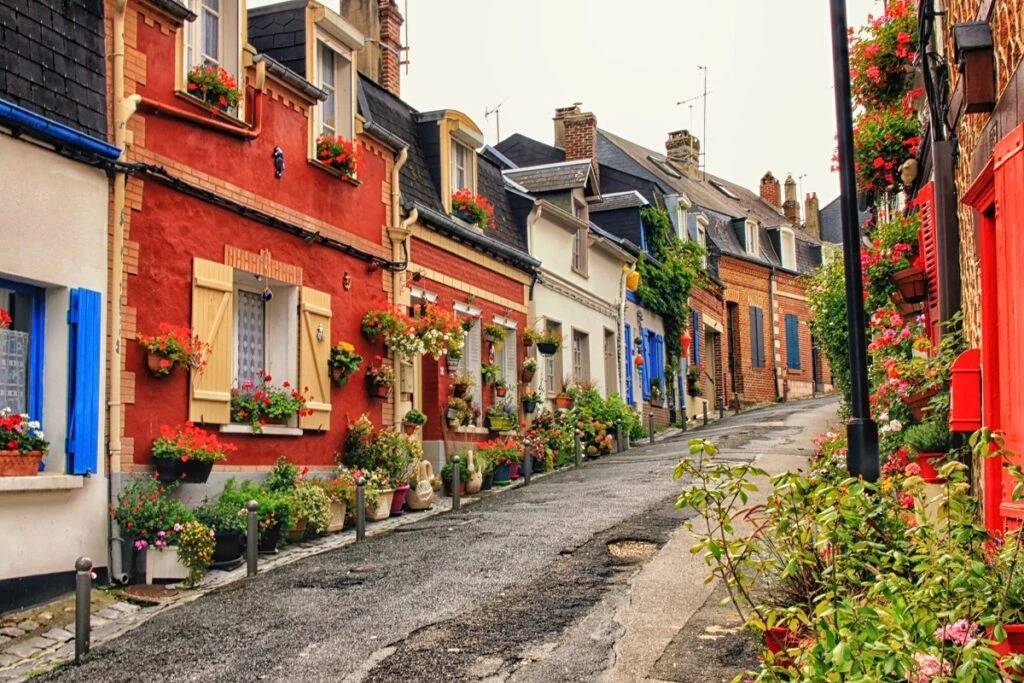
Below lies the Courtgain, the old fishermen's quarter of small colourful houses, running down to the marina and the quays. On the heights of Cap Hornu, the sailors' chapel watches over the bay; the town is also a steam-railway station and the finish of guided crossings from Le Crotoy.

Le Crotoy
On the northern shore of the estuary, Le Crotoy faces Saint-Valery across the bay. Jules Verne moved here in 1865 and lived here until 1871: it was here, during his outings at sea on his boat, the Saint-Michel, that he wrote part of Twenty Thousand Leagues Under the Seas.
Le Crotoy is also a terminus of the Baie de Somme steam railway and a starting point for guided walks across the bay at low tide to Saint-Valery. At the harbour, mussels, brown shrimps and local fish are served on terraces facing the estuary.

Cayeux-sur-Mer
Cayeux-sur-Mer turns its back on the bay to face the Channel: a shingle beach, with sand uncovered at low tide, lined by a boardwalk of about 2.6 km and nearly 500 colourful beach huts.
The resort is the closest to the Pointe du Hourdel and its seals to the north, and to the Hâble d'Ault to the south. It is also a terminus of the Baie de Somme steam railway, linked to Saint-Valery.

Cliffs of Ault
South of the bay, Ault marks the start of the living chalk cliffs of Picardy, which extend the Alabaster Coast: from here northwards, the coast drops to shingle ridges all the way to the estuary. At Ault, the cliffs reach 38 m.
The cliff is retreating: about 30 cm a year on average, and 70 m lost in the 20th century alone. The seafront promenade at Ault-Onival shows the contrast between the white chalk above the shingle beach and the nearby Hâble d'Ault.

Hâble d’Ault
Between Cayeux-sur-Mer and Ault, the Hâble d'Ault is a freshwater and brackish lagoon sheltered behind the shingle ridge. A former harbour open to the sea in the Middle Ages, it was closed off in the 18th century by a shingle dike to gain farmland; today it is a Natura 2000 site of wet meadows, ponds and reed beds.
Some 270 bird species have been recorded here over two centuries. In spring and autumn, during the migrations, greylag geese, ducks, avocets and plovers can be watched from the dike path and the hides.

Mers-les-Bains
At the southern edge of the Picardy coast, where the chalk cliffs extend the Alabaster Coast, Mers-les-Bains forms a trio of towns on the Bresle with Le Tréport and Eu. Its shingle beach, which gives way to sand at low tide, is lined with beach huts and white cliffs.
Mers is best known for its Belle Époque seaside district: hundreds of villas with bow windows and colourful façades, lined up between the beach and the cliff. Across the Bresle, the Le Tréport funicular climbs to the top of the cliffs for the view over the Channel.
Guided walk to see the seals
A two-hour walk with a naturalist guide to approach, at a safe distance, the bay's harbour and grey seals, France's largest harbour-seal colony. The outing is timed to low tide, when the seals rest on the sandbanks; the highlight is watching them raise their heads as a flock of birds passes, in the silence of the bay.
An easy walk suitable for everyone, families included, for €23 per person on GetYourGuide, with free cancellation. Bring binoculars and shoes that can get wet: you sometimes cross damp ground.
- 2 hrs
- €23 per person (GetYourGuide price 2026)
Walking across the bay from Le Crotoy to Saint-Valery
You set off from the locks at Le Crotoy for two and a half to three hours of walking across the bay to Saint-Valery-sur-Somme: sandbanks, streams to wade, mudflats and salt meadows where sheep graze. Depending on the season, the guide lets you taste samphire and sea aster; you walk through the middle of the uncovered estuary, with a town on either side.
Expect €23 per person on GetYourGuide, with free cancellation; the time changes every day with the tide. Never try the crossing alone: the sea rises fast in the channels. You can return to Le Crotoy by steam train.
- 2.5-3 hrs
- €23 per person (GetYourGuide price 2026)
Steam train ride on the Baie de Somme railway
The Baie de Somme railway runs round the estuary at 25 km/h, between Le Crotoy, Noyelles, Saint-Valery and Cayeux. Three routes in 2026: Le Crotoy – Saint-Valery (about 2 hours return, 4 April to 1 November), Saint-Valery – Cayeux (about 1 hr 10) and the long Le Crotoy – Cayeux route (about 3 hrs 30, April to mid-September). The finest stretch runs along the salt meadows, window open, with the bay stretching away.
Tickets from €12.30 on the railway's website, which also lists the days with steam haulage. Combine a guided walk one way with the train back.
- 1 hr 10 to 3 hrs 30 return depending on the route
- from €12.30 (2026 fares, chemindefer-baiedesomme.fr)
Getting there
From Paris-Nord, allow ~1h50-2h by TER to Noyelles-sur-Mer, where the Baie de Somme heritage steam train serves Le Crotoy, Saint-Valery and Cayeux. By car, take the A16.
By train: from Paris-Gare du Nord, a Hauts-de-France TER reaches Noyelles-sur-Mer in about 1h50-2h (connections via Amiens or Abbeville).
From Noyelles, the Baie de Somme heritage railway (a line opened in 1887, run as a heritage steam train since 1971) links Le Crotoy, Saint-Valery-sur-Somme and Cayeux-sur-Mer — a scenic ride in itself.
By car: via the A16 motorway (Paris/Beauvais – Amiens – Abbeville), then local roads to Le Crotoy or Saint-Valery. The 'Pack TER Chemin de fer de la Baie de Somme' bundles a TER ticket with the tourist train.
Getting around
By car, and on the Baie de Somme railway between Le Crotoy, Noyelles, Saint-Valery and Cayeux.
The Baie de Somme railway links the estuary towns at 25 km/h, by steam or diesel depending on the service. In 2026 there are three routes: Le Crotoy – Noyelles – Saint-Valery (about 2 hours return, 4 April to 1 November 2026, €18.40 adult return), Saint-Valery – Cayeux (about 1 hr 10 return, April to mid-September) and the long Le Crotoy – Cayeux route (about 3 hrs 30 return, April to mid-September). Fares from €12.30; timetable and tickets on chemindefer-baiedesomme.fr.
Otherwise the car is simplest, as the sites are spread around the estuary; seafront car parks fill up quickly in summer. On foot, never cross the bay alone: the tide comes in fast and the channels are dangerous.
What to do
Watch the seals at low tide, cross the bay on foot with a guide, see the Marquenterre birds and ride the steam railway.
- Seals: harbour and grey seals resting on the sandbanks at low tide, at the Pointe du Hourdel or on a guided outing.
- Walking across the bay: between Le Crotoy and Saint-Valery, always with an approved guide and timed to the tides.
- Birds: the Parc du Marquenterre and the Hâble d'Ault during the migrations.
- Steam railway: the Baie de Somme railway links Le Crotoy, Noyelles, Saint-Valery and Cayeux.
- The coast: the beach huts of Cayeux, the cliffs of Ault and the Belle Époque district of Mers-les-Bains.
Climate & seasons
When to go to France?
Monthly averages over the past 5 years (Open-Meteo).
Best months
- April
- June
- August
| Jan | Feb | Mar | Apr | May | Jun | Jul | Aug | Sep | Oct | Nov | Dec | |
|---|---|---|---|---|---|---|---|---|---|---|---|---|
| Our take | ||||||||||||
| Weather | ||||||||||||
| High | 8° | 10° | 12° | 14° | 17° | 20° | 21° | 22° | 21° | 17° | 12° | 9° |
| Rain (mm) | 123 | 66 | 63 | 59 | 69 | 77 | 82 | 61 | 85 | 100 | 127 | 96 |
When to go
Spring (March-May) and autumn (August-October) are best for migrating birds; harbour seals are seen April to September (pups in June-July). Summer suits the beach and bay crossings.
The bay is worth visiting year-round, but each season has its highlights:
- Spring (Mar-May) and autumn (Aug-Oct): migration peaks, the best times for birdwatching at Marquenterre and the Hâble d’Ault.
- April to September: harbour seal watching, with pups born in June-July (the most popular time).
- November to March: more grey seals; quieter atmosphere and low, golden light.
- Summer: beach, sand yachting and bay crossings (temperate oceanic climate, often windy).
Where to stay
Saint-Valery or Le Crotoy to be on the estuary and the steam railway; Cayeux or Ault for quiet by the sea; Rue or Quend for the Marquenterre.
- Saint-Valery-sur-Somme: the most central base, between the medieval upper town and the harbour, with a steam-railway station.
- Le Crotoy: facing the bay, the starting point of guided crossings and a terminus of the steam railway.
- Cayeux-sur-Mer and Ault: on the Channel side, quieter, close to the Pointe du Hourdel, the Hâble d'Ault and the cliffs.
- Rue and Quend: inland, closest to the Parc du Marquenterre.
In July-August and on spring weekends, book early: accommodation is mostly small hotels, B&Bs and self-catering cottages. The full list is on the Baie de Somme tourist office website.
Formalities
No special formalities for EU visitors; in the nature reserve, stay on the paths and 300 m from the seals.
The Baie de Somme is in France: an ID card is enough for EU citizens, and other visitors follow the Schengen rules. On site, the rules come from the nature reserve: stay on marked paths, keep 300 m from the seals and never get between them and the water, and never go out into the bay without a guide.
Tips
Never cross the bay without a licensed guide: fast tides, mud (slikke) and shifting channels are dangerous. For seals, watch from 300 m at low tide and never get between them and the water.
The bay crossing (e.g. Le Crotoy – Saint-Valery, ~7 km) must be done with a licensed guide: the tide rushes back through the channels, the mud (slikke) traps, and the safe routes shift between seasons. Never go alone.
Watching seals: head to the Pointe du Hourdel 1-2 hours before low tide, keep 300 m away, never get between the animals and the water, and prefer a guided outing (Picardie Nature). Binoculars or a scope are essential.
Bring windproof layers and suitable footwear (shingle at Cayeux), and check the tide times before every outing.
FAQ
Getting there from Paris, watching the seals, crossing the bay, the best season, Marquenterre prices: the essentials before your Baie de Somme trip.
How do I get to the Baie de Somme from Paris?
By TER from Paris-Gare du Nord to Noyelles-sur-Mer (~1h50-2h), with connections via Amiens or Abbeville. From Noyelles, the Baie de Somme heritage steam train serves Le Crotoy, Saint-Valery and Cayeux. By car, take the A16.
Where and when can I see the seals?
At the Pointe du Hourdel, home to France’s largest harbour-seal colony. Watch at low tide (or 1-2 hours before) from 300 m away, never getting between the seals and the water. Harbour seals are mainly seen April to September (pups in June-July).
Can I cross the bay on foot alone?
No. The bay crossing must always be done with a licensed guide: tides rush in fast, the mud (slikke) can trap you and the channels shift. Going alone is dangerous. Departures follow the tide times.
What is the best season for birdwatching?
Spring (March-May) and autumn (August-October), during the migration peaks. The Marquenterre park (over 300 species recorded) and the Hâble d’Ault reserve are at their best then.
How much is entry to the Marquenterre park?
About €12 for an adult, €8.60 for a child aged 6-17, free under 6, with a family rate. Allow 3-4 hours for the 6 km circuit; the ticket office closes 2 hours before the park.
Is Mers-les-Bains in Normandy?
No: Mers-les-Bains is in the Somme department (Hauts-de-France), facing Le Tréport (Seine-Maritime) across the Bresle estuary. Its chalk cliffs continue the Côte d’Albâtre, and its Belle Époque seaside quarter is a listed heritage site.
Sources
The figures in this guide come from the sources below, checked on the publication date.
- www.ecologie.gouv.fr
- www.baiedesomme.org
- www.somme-tourisme.com
- www.parcdumarquenterre.fr
- fr.wikipedia.org
- www.cayeux-sur-mer.fr
- www.merslesbains.fr
- fr.wikipedia.org
- www.chemindefer-baiedesomme.fr
- www.ter.sncf.com
- www.somme-tourisme.com
- chemindefer-baiedesomme.fr
- fr.wikipedia.org
- france3-regions.franceinfo.fr
- www.cayeux-sur-mer.fr
- www.tourisme-baiedesomme.fr
- commons.wikimedia.org
- chemindefer-baiedesomme.fr
Leave a comment
Share your thoughts or travel experience. Your email will not be published.