

Contents 27
Ibiza (Eivissa in Catalan) is the third-largest of the Balearic Islands, off Spain's eastern coast. It is known for its clubs, but the island has other sides: Dalt Vila, the fortified old town inscribed on the UNESCO World Heritage List in 1999, dozens of coves in the west and north, the salt pans and flamingos of the south, and a pine-covered interior topped by Sa Talaiassa (475 m).
This guide brings together 14 places and experiences, from beaches to hippy markets, the Es Vedrà islet and a day on Formentera, with seasons, transport and entry rules to plan your stay.
Overview
Ibiza, in Spain's Balearic Islands, combines turquoise beaches and coves, world-famous nightlife and a UNESCO-listed old town.
Ibiza (Eivissa in Catalan) is one of the Balearic Islands, in the Mediterranean off Spain's eastern coast. It is best known for two complementary faces: dozens of clear-water beaches and coves, and a party scene famous worldwide, with clubs such as Pacha, Amnesia, Ushuaïa and Hï Ibiza.
But the island is far more than nightlife. Its capital, Eivissa, is home to Dalt Vila, a fortified old town inscribed on the UNESCO World Heritage List since 1999 ("Ibiza, Biodiversity and Culture"), with its Renaissance walls and Gothic cathedral. Inland there are pine forests, hippy markets dating from the 1960s and 1970s, and the summit of Sa Talaiassa (475 m). To the south, the Ses Salines Natural Park protects historic salt flats and birdlife.
From beaches to hiking, Mediterranean food to day trips to neighbouring Formentera, Ibiza suits very different kinds of stay depending on the season you choose.
14 places to take with you
In the guide's order, ready for Google Maps or your GPS.
Book the activities from this guide
Our picks for Ibiza, well rated and free to cancel.
-
Book this activity
Boat day to Formentera, Espalmador and Ses Illetes
€110 per person (GetYourGuide price 2026)
-
Book this activity
Cruise to Es Vedrà from Sant Antoni
€25 per person (GetYourGuide price 2026)
-
Book this activity
Kayak and snorkelling in the north-east marine reserve
€50 per person (GetYourGuide price 2026)
Affiliate links: Travel Advice earns a commission if you book, at no extra cost to you. Learn more

Dalt Vila (Ibiza Old Town)
Dalt Vila, Ibiza's upper town, sits on the hill above the harbour. Its 16th-century Renaissance walls enclose a maze of cobbled lanes and whitewashed houses; the whole area has been on the UNESCO World Heritage List since 1999, as part of "Ibiza, Biodiversity and Culture".
You enter through the Portal de ses Taules, the main gate, then climb to Santa Maria d'Eivissa Cathedral, a Catalan Gothic building remodelled in the Baroque period. The walkway along the bastions looks over the harbour, the lower town and, on clear days, Formentera. Below the walls, Plaça del Parc and the Marina district are full of cafés and restaurants.

Es Vedrà
Es Vedrà is a 413-metre limestone islet about 2.5 km off Ibiza's south-west coast, facing Cala d'Hort beach. Uninhabited, it belongs to the Cala d'Hort nature reserve and is the subject of many local legends.
You don't land on the rock: you admire it from the coast, at the Cala d'Hort viewpoint or near the Torre des Savinar, above all at sunset. Boat trips from Sant Antoni let you see it from the sea.

Cala Comte
On the west coast, in the municipality of Sant Josep, Cala Comte (or Cala Conta) is a string of small sandy beaches separated by rocky points. The water is shallow and very clear, with the islets of sa Conillera and s'Espartar offshore.
It is one of the busiest sunset spots on the island: people settle on the rocks or at one of the bars above the sea. Bring a mask and snorkel for the rocks.

Playa d'en Bossa
South of Ibiza Town, Playa d'en Bossa is a long strip of golden sand shelving gently into the sea, facing Formentera. It is the island's liveliest beach area: beach bars, hotels in every category and two of the big clubs, Ushuaïa and Hï Ibiza, set back from the seafront.
By day, people come for easy swimming, water sports and sunloungers. At night the mood changes, especially during the club season, from late April to mid-October. For a quiet beach, head to the western coves instead.

Ses Salines Natural Park
Declared a natural park in 2001, ses Salines protects the south of Ibiza, the north of Formentera and the strait between them, es Freus: about 15,400 hectares, mostly marine. On land, the old salt pans form a landscape of pink and white mirrors, edged by dunes and pine woods.
Flamingos live here all year round, along with many waterbirds, and the site is a Ramsar wetland. Underwater, the Posidonia seagrass meadows are part of the UNESCO property "Ibiza, Biodiversity and Culture". Ses Salines beach, at the end of the road, lies inside the park.

Formentera
The smallest inhabited island of the Pityuses is reached by boat from Ibiza harbour: ferries arrive at La Savina, the main port. Formentera is flat and easy to explore by bike, scooter or hire car.
Its white-sand beaches are the reason to go: Ses Illetes and Llevant in the north, inside the Ses Salines Natural Park, and the longer, quieter Migjorn in the south. To the east, the La Mola plateau and its lighthouse overlook the sea; Sant Francesc, the little capital, has a few shops and terraces. One day is enough for the northern beaches; stay overnight to go further.

Pacha and Ibiza's clubs
Facing the harbour in Ibiza Town, Pacha, recognisable by its twin cherries, is one of the landmark clubs of the electronic scene that made Ibiza famous. The other big names are Amnesia in Sant Rafel, Hï Ibiza and Ushuaïa in Playa d'en Bossa, and DC10 near the airport, home of the Circoloco parties.
The club season runs from late April to mid-October, marked by opening and closing parties. Ushuaïa hosts open-air parties that start in the afternoon; the others open late and close at dawn. Out of season, most of the big clubs are shut.

Cala Saladeta
North of Sant Antoni, Cala Saladeta is a small white-sand cove tucked between rocks and pines, next to Cala Salada. There is no road down to the sand and no bar: you reach it on foot along a coastal path, which keeps it wild.
The turquoise water and the rocks are good for snorkelling. The cove is tiny and fills up fast in summer; out of season it is one of the quietest swimming spots on the west coast.

Las Dalias and Punta Arabí hippy markets
A legacy of the hippy wave that reached Ibiza in the 1960s and 1970s, the craft markets are still an island ritual. The best known, Las Dalias, is held on Saturdays near Sant Carles de Peralta, in the north-east: jewellery, clothes, crafts and live music in a garden setting.
The Punta Arabí market, at Es Canar near Santa Eulària, takes place on Wednesdays. Bigger and more touristy, it lines up hundreds of stalls under the pines. Both pair well with a swim on the east coast.

Sant Antoni de Portmany
The island's second town, Sant Antoni de Portmany lies at the head of a wide bay on the west coast. Its seafront, the "Sunset Strip", is famous for bars facing the sunset, including Café del Mar and Café Mambo, and the town revolves around nightlife in summer.
It is also a handy harbour: boats to nearby coves (Cala Bassa, Cala Comte), trips out to Es Vedrà and connections to Formentera. To the north, Cala Salada and Cala Gració offer quieter swimming.

Cala Jondal
On the south coast, between Sant Josep and the airport, Cala Jondal is a pebble bay framed by low cliffs and pine trees. It is best known for its upmarket beach clubs and restaurants, including Blue Marlin Ibiza, and for the yachts anchored offshore in summer.
The water is clear and swimming is pleasant, but this is not a sandy beach: people come as much for a long lunch by the water as for a swim.

Hiking in Sa Talaiassa
Sa Talaiassa is Ibiza's highest point, at 475 metres, in the municipality of Sant Josep de sa Talaia. The climb usually starts from the village of Sant Josep, on paths through pine woods and scrub; some are direct and steep, others longer and gentler, with uneven waymarking.
Allow 2 to 4 hours there and back depending on the route. From the top, the view takes in the west of the island, Es Vedrà and, on clear days, Formentera. Walking shoes, water and a hat are essential; in summer, set off early in the morning.

Cala Tarida
On the west coast, south of Cala Comte, Cala Tarida is a white-sand bay split into several small beaches by rocky outcrops. It is lined with hotels and apartments, with restaurants and sunlounger hire, which makes it a practical base for families.
The water stays shallow near the shore and the rocks at either end are good for snorkelling. Like the rest of the west coast, the bay faces the sunset.

Can Marçà Cave
Above the bay of Port de Sant Miquel, on the north coast, the Cova de Can Marçà is Ibiza's show cave. The guided tour follows walkways between stalactites, stalagmites and old frozen waterfalls, with a sound and light show.
Its entrance opens in the cliff above the sea. It makes a good outing on a grey day or in the heat of the afternoon, combined with a swim at Port de Sant Miquel or nearby Cala Benirràs.
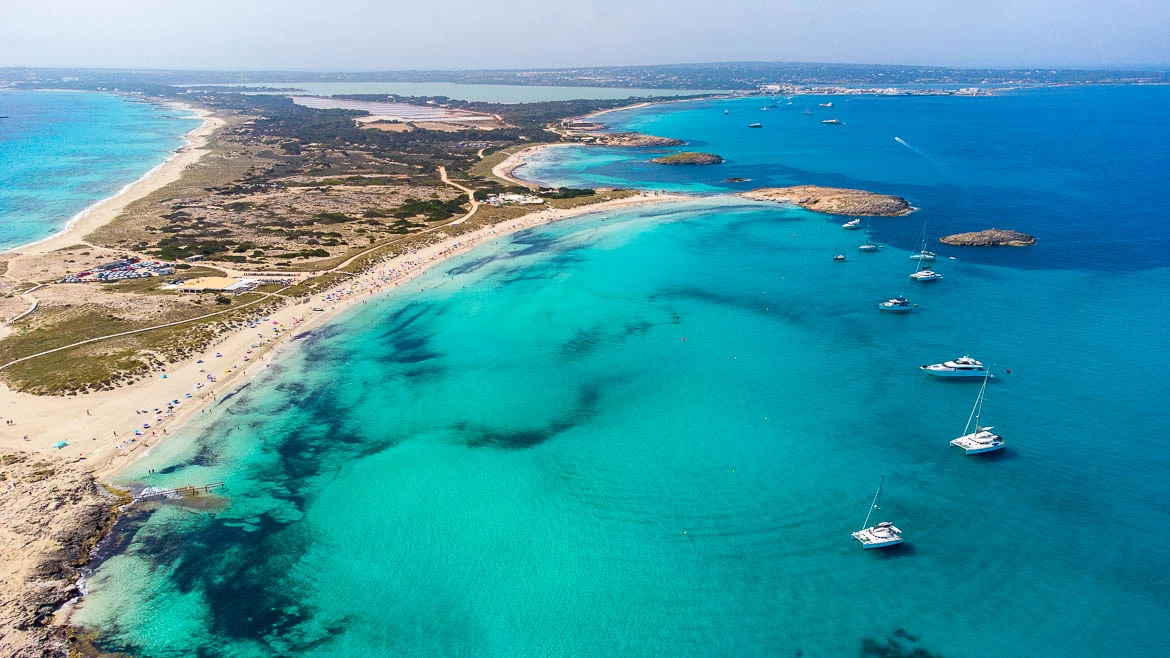
Boat day to Formentera, Espalmador and Ses Illetes
A boat leaves Playa d'en Bossa heading south: a swim off the islet of Espalmador, then two hours at anchor at Ses Illetes, with paddleboards, snorkelling and lunch cooked on board. In the afternoon the boat drops you on Formentera for about six hours of free time before the return at around 6 pm. The highlight: the turquoise water of Ses Illetes seen from the deck.
Allow €110 per person on GetYourGuide, drinks included and free cancellation up to 24 hours before. A good option if you want to see Formentera without arranging a ferry and rentals yourself.
- 10 hrs
- €110 per person (GetYourGuide price 2026)
Cruise to Es Vedrà from Sant Antoni
Three hours by boat from Sant Antoni, along the cliffs of the south-west coast to Es Vedrà, the 413-metre islet usually seen only from the shore. A stop off the rock for photos, then a swim in a cove near Cala d'Hort. The highlight: sailing along the face of Es Vedrà from the sea.
Allow €25 per person on GetYourGuide, two drinks and snacks included, with free cancellation up to 24 hours before. The boat has a shaded area and toilets; suitable for families.
- 3 hrs
- €25 per person (GetYourGuide price 2026)
Kayak and snorkelling in the north-east marine reserve
From Es Figueral beach on the north-east coast, three hours of guided kayaking in the marine reserve: past the Ses Mayoles sea cave, a stop at the little beach on the islet of s'Or, reachable only by sea, then snorkelling at Punta des Llaut. The highlight: paddling between the islets over very clear water.
Allow €50 per person on GetYourGuide, with a snack and dry bag provided and free cancellation up to 24 hours before. Suitable for beginners; the guide may speak only English or Spanish.
- 3 hrs
- €50 per person (GetYourGuide price 2026)
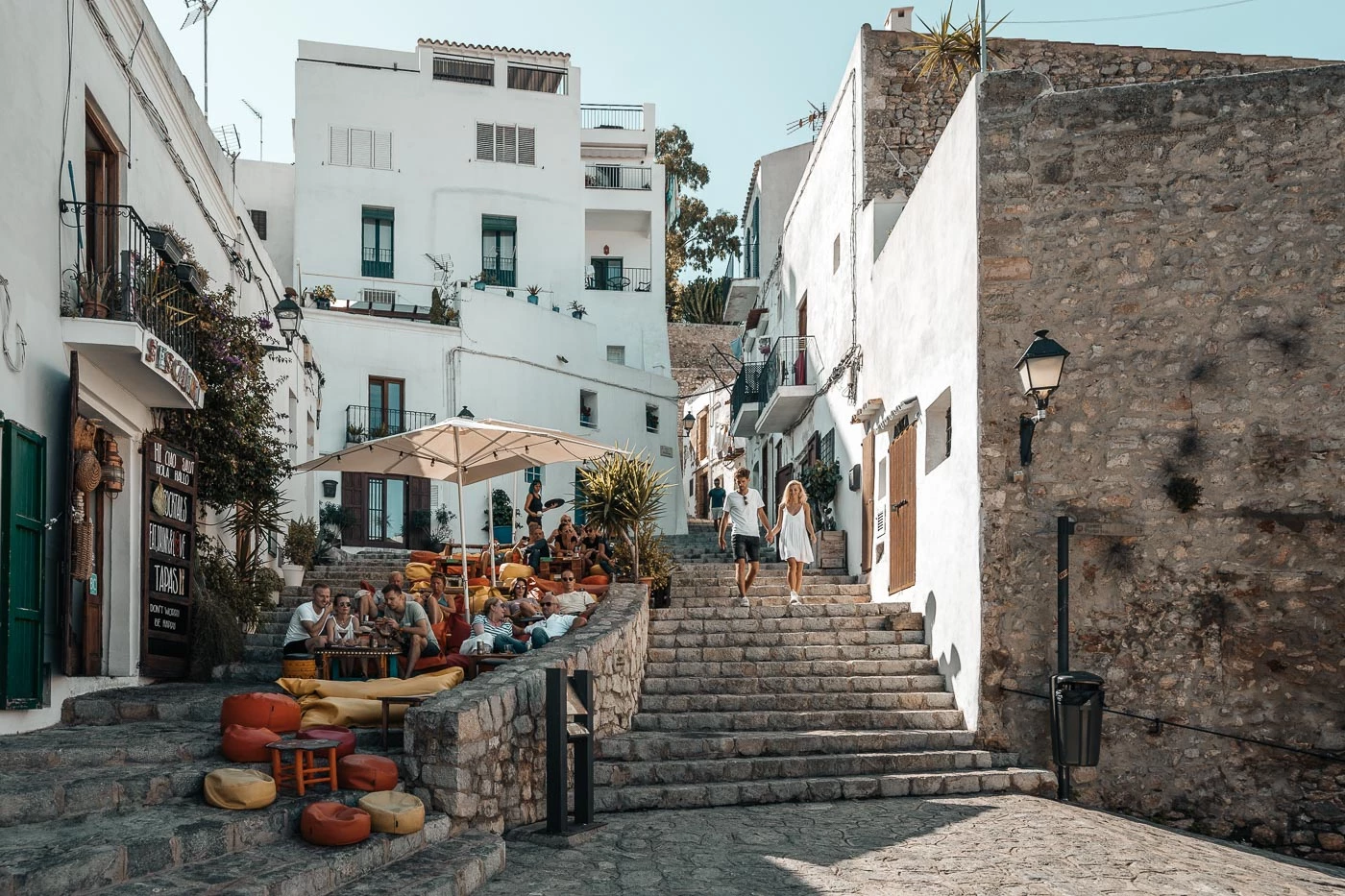
Walking the walls of Dalt Vila
A loop on foot through the upper town: in through the Portal de ses Taules, up the lanes to Santa Maria d'Eivissa Cathedral, then back along the walkway of the Renaissance bastions, UNESCO-listed with the rest of Dalt Vila. The highlight: the view over the harbour and Formentera from the bastions at the end of the day.
The walk is free; only museums and some monuments charge admission. Wear good shoes, as the slopes are steep and cobbled, and avoid midday in summer.
- 2 hrs
- Free (self-guided)
Getting there
By air via Ibiza Airport (IBZ), about 7 km southwest of Eivissa, or by ferry from Dénia (~2h15), Valencia or Barcelona.
By air: Ibiza Airport (IATA code IBZ, operated by Aena) is about 7 km southwest of Ibiza Town. It is very well connected in season from many European cities.
By ferry: from the mainland, the shortest crossings leave from Dénia (about 2h15, year-round). The island is also reachable from Valencia (~5-7 hrs) and Barcelona (~8-9 hrs), with operators such as Baleària and Trasmed. Handy if you want to bring your car.
Getting around: a bus network links the main towns and beaches in summer; renting a car or scooter remains the most flexible way to reach the remote coves.
Getting around
A hire car or scooter reaches every cove; buses link the towns and main beaches, and boats serve the coast and Formentera.
Car or scooter: the most flexible way to reach the coves of the west and north, which public transport serves poorly. Agencies at the airport and in the towns; book early for July-August and avoid parking along beach access roads, where it is often banned.
Bus: a network of lines links Ibiza Town, the airport, Sant Antoni, Santa Eulària and the main beaches, with more frequent services in summer. Cheap, but not convenient for small coves.
Boat: from Ibiza harbour, Sant Antoni or Santa Eulària, water taxis serve nearby beaches, and ferries run to Formentera (La Savina port).
Taxi: available at town ranks and the airport, but scarce in high season when the clubs close; plan your ride home.
What to do
Explore Dalt Vila, swim in the western coves, watch the sunset facing Es Vedrà, spend a day on Formentera and, in season, go out to the big clubs.
Spend a first day in Dalt Vila, the UNESCO-listed fortified old town, then in the Marina district. The following days split between the western coves (Cala Comte, Cala Tarida, Cala Saladeta) and those of the north, with a sunset facing Es Vedrà or on the Sant Antoni seafront.
By boat, you can reach Formentera for the day or kayak around the sea caves of the north-east marine reserve. On Wednesdays and Saturdays, the Punta Arabí and Las Dalias hippy markets liven up the east coast. From late April to mid-October, the clubs (Pacha, Amnesia, Hï Ibiza, Ushuaïa) host the big nights.
Climate & seasons
When to go to Spain?
Monthly averages over the past 5 years (Open-Meteo).
Best months
- January
- February
- April
- May
- June
- July
- August
- October
- November
- December
| Jan | Feb | Mar | Apr | May | Jun | Jul | Aug | Sep | Oct | Nov | Dec | |
|---|---|---|---|---|---|---|---|---|---|---|---|---|
| Our take | ||||||||||||
| Weather | ||||||||||||
| High | 15° | 16° | 17° | 19° | 23° | 28° | 30° | 31° | 27° | 24° | 19° | 17° |
| Rain (mm) | 26 | 23 | 65 | 44 | 40 | 11 | 10 | 19 | 105 | 48 | 53 | 36 |
| Beach | Beach June | Beach July | Beach August | Beach October |
What to do by season (autumn)
-
Beach
Warm air and water, little rain.
When to go
High season is July-August (hot, lively, pricey); May-June and September-early October offer the best balance of weather, price and crowds.
Ibiza has a Mediterranean climate with hot, dry summers and mild winters.
July-August: peak season. Heat (around 30°C), sea at 25-26°C, nightlife at its height — but also big crowds and high prices.
May-June and September-early October: the best window for most travellers. Pleasant weather, sea still swimmable (22-26°C June to September), and more reasonable crowds and prices.
November-March: low season, quieter and cheaper, ideal for the old town and hiking, but not for swimming, and some venues close. For winter swimming without leaving Spain, head to the Canaries: see Tenerife's highlights.
The club season opens in late April and ends in mid-October, around the opening and closing parties.
Where to stay
Ibiza Town and Dalt Vila for culture, Sant Antoni and Playa d'en Bossa for nightlife, Santa Eulària and the north for quiet, family stays.
Ibiza Town (Eivissa): in the heart of the action, near Dalt Vila and the restaurants; from boutique hotels to budget options.
Sant Antoni de Portmany: famous for its sunsets and nightlife, ideal for party-goers.
Playa d'en Bossa: beach and clubs (Ushuaïa, Hï Ibiza) in one spot, for all budgets.
Santa Eulària des Riu: a calmer, family-friendly feel with a pretty marina, on the east coast.
The north (Portinatx, Sant Joan): quiet coves, agrotourism and countryside, for a peaceful retreat.
Safety
Ibiza is a safe destination; the usual risks are pickpocketing in busy areas, theft from cars parked near beaches and excess on nights out.
Ibiza poses no particular risk. The precautions are those of any tourist destination: watch bags and phones in busy areas and at night, leave nothing visible in a car parked near a beach, and keep an eye on your drink in clubs.
In summer, protect yourself from the sun and heat, and follow the swimming flags on lifeguarded beaches.
Useful numbers in Spain: 112 (emergencies, all languages), 061 (medical emergencies), 091 (Policía Nacional), 062 (Guardia Civil).
Formalities
Spain is in the Schengen Area: an ID card for EU/EEA/Swiss nationals; 90 days per 180 for visa-exempt non-EU travellers. Currency: the euro.
Ibiza is part of Spain, a member of the European Union and the Schengen Area.
EU / EEA / Swiss nationals: free movement. A valid national ID card or passport is enough, with no limit on length of stay.
Visa-exempt non-EU travellers (e.g. UK, Canada): tourist stays are limited to 90 days within any 180-day period, with a valid passport.
EES: since 10 April 2026, the EU Entry/Exit System registers non-EU short-stay travellers at the border (passport, photo, fingerprints); no advance step is needed.
ETIAS: the travel authorisation is not yet in service; no launch date has been set (September 2026): check the official EU website before you travel. EU citizens are affected by neither EES nor ETIAS.
Currency: the euro (EUR). Cards are widely accepted, and ATMs are plentiful in tourist areas.
FAQ
Answers to the most common questions about a trip to Ibiza: season, formalities, transfers and day trips.
When is the best time to visit Ibiza?
May-June and September-early October offer the best balance: warm weather, swimmable sea and reasonable crowds. July-August is peak season (the liveliest and most expensive).
Do I need a visa for Ibiza?
Spain is in the Schengen Area. EU/EEA/Swiss nationals travel with an ID card. Visa-exempt non-EU travellers can stay 90 days per 180 with a valid passport. Since 10 April 2026 they are registered at the border by the EES; ETIAS is not yet in service and no launch date has been set (September 2026).
How do I get to Ibiza?
By air via Ibiza Airport (IBZ), about 7 km from Eivissa, or by ferry from Dénia (~2h15), Valencia or Barcelona.
How do I get around the island?
Renting a car or scooter is the most convenient way to reach the remote coves; a bus network links towns and beaches in summer, and taxis are available in tourist areas.
Can I take a day trip to Formentera?
Yes: by fast ferry from Ibiza Town harbour to La Savina, allow about 25 to 35 minutes. Ideal for a day on the Ses Illetes and Migjorn beaches.
What currency is used in Ibiza?
The euro (EUR). Cards are widely accepted and ATMs are plentiful.
Sources
The figures in this guide come from the sources below, checked on the publication date.
Leave a comment
Share your thoughts or travel experience. Your email will not be published.