

Contents 25
Majorca, also known as Mallorca in Spanish and Catalan, is the largest of the Balearic Islands, a Spanish archipelago in the Mediterranean Sea. Renowned for its beaches, scenic landscapes and heritage, its capital is Palma, a vibrant city crowned by the Gothic cathedral of La Seu.
With its Mediterranean climate, Majorca has something for every traveller, from beach relaxation to mountain hiking, culture and food. Here are the island's highlights, from the southern beaches to the villages of the Serra de Tramuntana.
Overview
Majorca (Mallorca) is the largest of the Balearic Islands in the Spanish Mediterranean, known for its beaches, its capital Palma and the UNESCO-listed Serra de Tramuntana.
Majorca, or Mallorca in Spanish and Catalan, is the largest of the Balearic Islands, a Spanish archipelago in the Mediterranean Sea. Its capital, Palma, concentrates most of the island's urban life around the Gothic cathedral of La Seu, which overlooks the bay.
The island blends very different worlds: turquoise coves and long sandy beaches to the south and east, stone villages and terraced olive groves in the Serra de Tramuntana to the north-west, and spectacular caves on the east coast. Its Mediterranean climate keeps most of the year pleasant, from a flower-filled spring to hot summers buzzing with nightlife.
11 places to take with you
In the guide's order, ready for Google Maps or your GPS.
Book the activities from this guide
Our picks for Mallorca, well rated and free to cancel.
-
Book this activity
Palma Cathedral (La Seu) with skip-the-line ticket
€11 per person (GetYourGuide price 2026)
-
Book this activity
Drach Caves from Palma, concert and boat ride
€54 per person, transport from Palma and entry included (GetYourGuide price 2026)
-
Book this activity
Island tour: Lluc, Sa Calobra by boat and the Sóller train
€99 per person (GetYourGuide price 2026)
Affiliate links: Travel Advice earns a commission if you book, at no extra cost to you. Learn more

Palma de Mallorca
The island's capital, Palma spreads around a wide bay on the south-west coast. The Gothic cathedral of La Seu towers over the seafront; next to it, the Almudaina royal palace recalls the city's past, and the old town mixes lanes, patios and busy squares.
Spend at least a day here: La Seu and its Gaudí additions, the Lonja district for tapas bars, the Olivar market for island produce, and the harbour promenade. The beaches of the bay are a few minutes away by bus.

Serra de Tramuntana
The Serra de Tramuntana runs along the whole north-west coast of Majorca, from the tip of Andratx to Cap de Formentor. The range has been on the UNESCO World Heritage List since 2011 as a cultural landscape: dry-stone terraces, irrigation networks, mills and stone villages bear witness to centuries of mountain farming.
You can explore it on foot, from an easy path between two villages to multi-day routes, or along the spectacular road linking Andratx, Valldemossa, Deià, Sóller and Pollença. In summer, walk early in the morning, carry plenty of water and download your routes: some areas are remote.

Drach Caves
Near Porto Cristo on the east coast, the Coves del Drac (Caves of the Dragon) lead underground on a route of about an hour, between stalactites, stalagmites and lit chambers. The visit ends on the shore of Lake Martel, a vast underground lake.
Every visit includes a live classical music concert on Lake Martel, then the crossing by boat or on foot. Tours leave at set times, roughly every hour in season.

Cap de Formentor
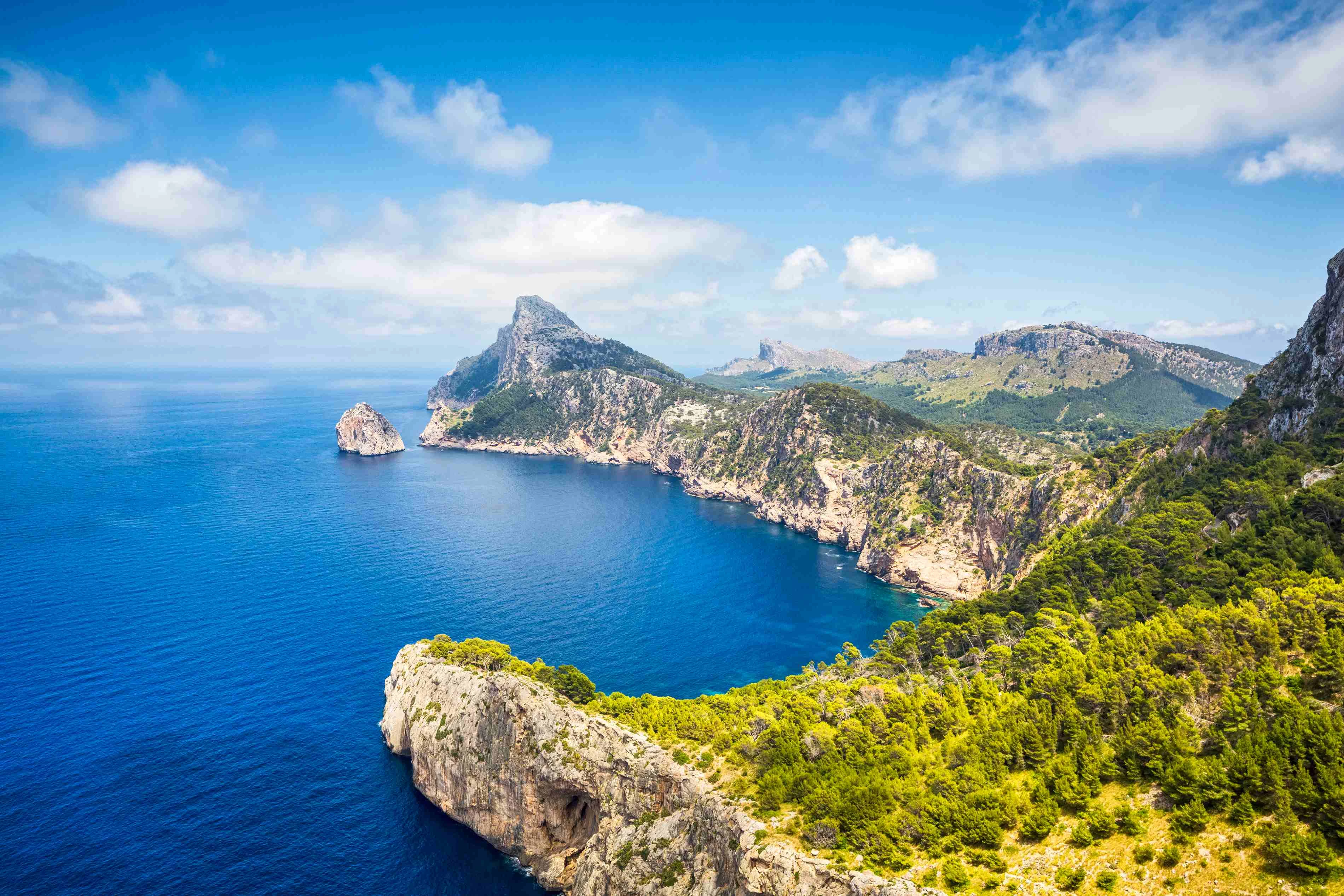
At the island's northern tip, the Formentor peninsula juts about twenty kilometres into the sea, all cliffs and pine woods. The Ma-2210 road leaves Port de Pollença, passes the Es Colomer viewpoint and Formentor beach, then winds out to the lighthouse at the end of the cape.
The views over the cliffs and islets are the finest on the north coast, and pine-fringed Formentor beach has very clear water. Cyclists are numerous on the narrow, winding road.

Valldemossa
A honey-coloured stone village in the Serra de Tramuntana, about twenty minutes from Palma, Valldemossa is built around the Royal Charterhouse (Real Cartuja). Frédéric Chopin and George Sand spent the winter of 1838-1839 here; the cells they stayed in now house a museum devoted to the composer.
Around it, flower-filled lanes lead to the birthplace of Saint Catalina Thomàs, the island's saint, and to viewpoints over the olive terraces. Try coca de patata, the local potato bun, in the town-centre bakeries.

Sóller
At the bottom of a valley of orange and lemon groves, ringed by the Tramuntana peaks, Sóller is a small town of modernista façades and a large shady square. It is linked to Palma by a wooden train inaugurated in 1912, which crosses the mountains through a string of tunnels.
From the square, a historic tram runs down to Port de Sóller, an almost enclosed bay with a beach and fish restaurants. The valley is also the starting point for walks to Fornalutx and Biniaraix.

Es Trenc Beach
On the south coast, between Colònia de Sant Jordi and Sa Ràpita, Es Trenc is a beach of about 2 km of white sand, with no buildings, backed by dunes. It belongs to the protected Es Trenc–Salobrar de Campos natural area, which also includes salt pans popular with birds.
The shallow turquoise water suits children. There is little shade and few facilities: bring a parasol, water and a picnic. In July and August the beach is very busy at weekends.

Deià
Clinging to the mountainside above the sea, between Valldemossa and Sóller, Deià is a village of stone houses and terraced gardens. The British poet Robert Graves settled here and is buried here; his house can be visited, and the village has drawn artists and musicians ever since.
A path leads down to Cala Deià, a small pebble cove with a few fish restaurants. The village is also a stop on the Tramuntana hiking trail to Sóller.

Cala d'Or
On the south-east coast, in the municipality of Santanyí, Cala d'Or is a resort built around several small sandy coves, including Cala Gran, Cala Esmeralda and Cala Ferrera. Its low white houses and marina give it a calmer feel than the big resorts on the Bay of Palma.
The sheltered, shallow coves suit family swimming and snorkelling. It is a practical base for exploring the south-east coves, such as Caló des Moro and Mondragó Natural Park.

Cala Millor
On the east coast, Cala Millor is a family resort built along a sandy beach of about 2 km, shared by the municipalities of Sant Llorenç des Cardassar and Son Servera. The beach has facilities and lifeguards, and a promenade links it to S'Illot.
Hotels, restaurants and water sports line the seafront. The Drach Caves in Porto Cristo are about twenty minutes away by car.

Playa de Palma
East of the city, between Can Pastilla and S'Arenal, Playa de Palma is the big sandy beach of the bay, lined by a continuous promenade with numbered "balnearios" (beach stations with bars). It is a few minutes from the airport and from central Palma.
By day people come for swimming and water sports; the S'Arenal end is known for its very lively nightlife. For a calmer feel, choose the Can Pastilla end.
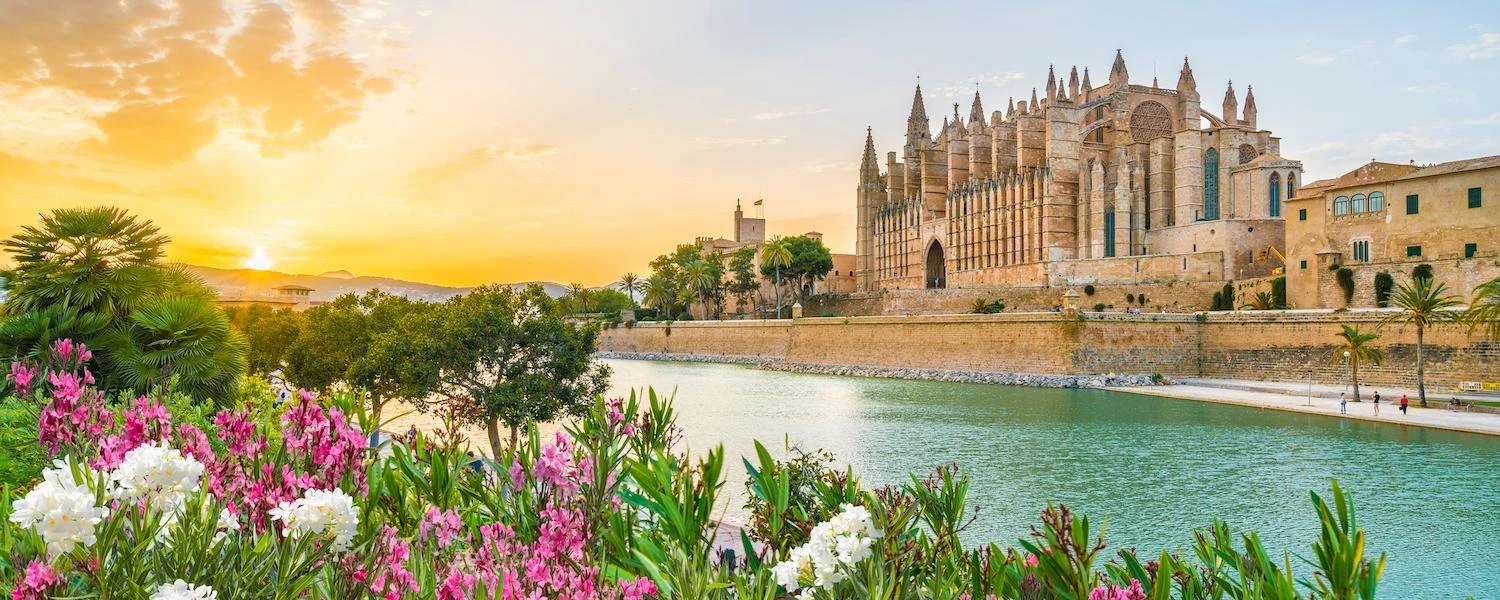
Palma Cathedral (La Seu) with skip-the-line ticket
A self-guided visit of La Seu, the Gothic cathedral overlooking the Bay of Palma: three naves, one of the largest rose windows in the world, Antoni Gaudí's canopy and early-20th-century alterations, then the chapel of the Blessed Sacrament covered in ceramics by Miquel Barceló. The highlight: stained-glass light across the nave in the late morning.
Allow from €11 per person on GetYourGuide, skip-the-line ticket with free cancellation. A paid option adds access to the terraces and rooftops.
- 1.5 hrs
- €11 per person (GetYourGuide price 2026)
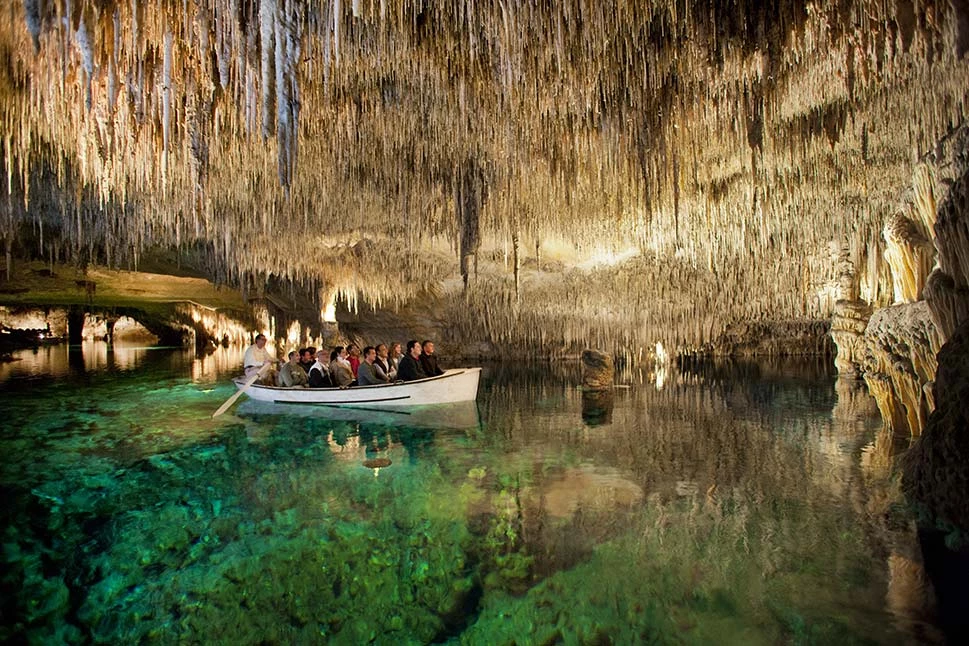
Drach Caves from Palma, concert and boat ride
A half-day from Palma by air-conditioned coach, with a guide, to the Drach Caves in Porto Cristo. Skip-the-line ticket, then over two hours on site: the route between stalactites and stalagmites, a classical music concert on Lake Martel and a short boat crossing. The highlight: the live concert in the silence of the cave.
Allow €54 per person on GetYourGuide, with free cancellation. The best-rated offer for the caves (4.4/5, over 1,400 reviews). If you have a car, entry alone costs €18.50 online.
- 5 hrs
- €54 per person, transport from Palma and entry included (GetYourGuide price 2026)
Island tour: Lluc, Sa Calobra by boat and the Sóller train
A day by coach from Palma through the Serra de Tramuntana: a stop at Lluc monastery, the hairpin road down to Sa Calobra and free time at the mouth of the Torrent de Pareis, then 40 minutes by boat along the coast to Port de Sóller. Back on the historic tram and the 1912 wooden train to Palma. The highlight: the Tramuntana coast seen from the sea.
Allow €99 per person on GetYourGuide, pickup included, with free cancellation. Free time in Sóller is short, set by the train timetable; on your own, the Palma-Sóller train costs €23 one way.
- 8 hrs
- €99 per person (GetYourGuide price 2026)
Boat from Port de Pollença to Formentor beach
A crossing of about 30 minutes by catamaran across Pollença Bay to pine-fringed Formentor beach, with views of the cape's cliffs. On arrival, free time to swim and snorkel; you pick your return boat from several departures during the day. The highlight: reaching the beach by sea, with no parking to hunt for.
Allow €19 per person on GetYourGuide, with free cancellation. In summer it is the alternative to the road, restricted from 10am to 10pm between 15 May and 18 October (cars by authorisation only). Bring your own mask and snorkel.
- Full day (choose your return)
- €19 per person, return (GetYourGuide price 2026)
Getting there
By air via Palma airport (PMI), with many direct European flights, or by ferry from Barcelona, València and Dénia.
By air. Majorca is served by Palma de Mallorca Airport (IATA code PMI, also called Son Sant Joan), one of Spain's busiest airports, with direct flights from many European cities. About 8 km east of Palma, it is linked to the city centre by the A1 bus line and by taxi.
By ferry. Car and passenger ferries connect mainland Spain to the port of Palma from Barcelona, València and Dénia, operated notably by Baleària and Trasmediterránea. The crossing takes about 3.5 to 8 hours depending on the route and vessel (fast or conventional ferry).
Getting around
A rental car gives the most freedom; the TIB bus network covers most of the island cheaply, and cycling and the Sóller train round out the options.
Several options combine depending on your itinerary:
- Rental car — the most flexible way to reach coves and mountain villages; agencies at Palma airport and in the main towns.
- TIB bus (Transports de les Illes Balears) — a solid network linking most towns to Palma, cheap but less handy for remote spots.
- Bicycle — the island is a cycling paradise, with many marked routes and rental shops everywhere.
- Sóller train — the historic wooden line (1912) links Palma to Sóller in about an hour through the Tramuntana.
- Taxi and tours — convenient for short trips or major sites (Drach Caves, Valldemossa, Cap de Formentor).
What to do
Explore Palma and its cathedral, travel the Serra de Tramuntana between Valldemossa, Deià and Sóller, go down into the Drach Caves, drive out to Cap de Formentor and swim at Es Trenc or in the south-east coves.
Start with Palma: La Seu cathedral, the Almudaina and the old town fit into one day. To the north-west, the Serra de Tramuntana can be explored by road or on foot, from Valldemossa to Deià and Sóller, which you reach from Palma on the 1912 wooden train.
On the east coast, the Drach Caves and their concert on Lake Martel pair well with a swim at Porto Cristo or Cala Millor. In the north, Cap de Formentor is best visited early in the morning or by shuttle in summer; in the south, Es Trenc beach and the coves around Cala d'Or are the best for swimming.
Climate & seasons
When to go to Spain?
Monthly averages over the past 5 years (Open-Meteo).
Best months
- January
- February
- March
- April
- May
- June
- August
- October
- November
- December
| Jan | Feb | Mar | Apr | May | Jun | Jul | Aug | Sep | Oct | Nov | Dec | |
|---|---|---|---|---|---|---|---|---|---|---|---|---|
| Our take | ||||||||||||
| Weather | ||||||||||||
| High | 15° | 17° | 18° | 20° | 24° | 31° | 33° | 33° | 28° | 25° | 19° | 17° |
| Rain (mm) | 32 | 49 | 55 | 38 | 51 | 16 | 11 | 32 | 72 | 40 | 73 | 37 |
| Beach | Beach May | Beach June | Beach July | Beach August | Beach September | Beach October |
What to do by season (autumn)
-
Beach
Warm air and water, little rain.
When to go
Spring (April-June) and early autumn (September-October) bring 20 to 25°C and fewer crowds; July-August is hot (often above 30°C) and very busy.
Majorca's Mediterranean climate gives four distinct seasons:
- Spring (April to June): 20 to 25°C by day, green, flowering landscapes; the best time for hiking, cycling and the villages.
- Summer (July-August): heat often above 30°C, crowded beaches and resorts; peak season, ideal for swimming.
- Autumn (September to November): sea still warm in September, 20 to 25°C early in the season, fewer people and falling prices.
- Winter (December to March): mild by European standards (10 to 15°C by day) and quiet; a season for walking and cultural visits.
In January, the Sant Antoni festivities (16-17 January) bring bonfires and "dimonis" to Sa Pobla, Manacor and Artà, and Palma celebrates Sant Sebastià around 20 January. For a swim in midwinter, look further south, to the Canary Islands.
Where to stay
Palma for the city and culture, Alcúdia and Pollença for the northern beaches, Cala d'Or for the eastern coves, Sóller and Valldemossa for the mountains, or a finca inland.
Your choice depends on the atmosphere you want:
- Palma de Mallorca — lively capital, from hostels to grand hotels, ideal for culture and dining.
- Sóller and Valldemossa — picturesque mountain villages, boutique hotels in historic buildings.
- Alcúdia and Port de Pollença — in the north, fine beaches, a medieval old town and water sports.
- Cala d'Or — on the east coast, crystal-clear coves and a laid-back vibe.
- Magaluf and Palma Nova — livelier, popular with families and younger travellers.
- Country finca — traditional farmhouses for a quiet stay amid rural landscapes.
Safety
Majorca is a safe destination; the usual risks are pickpocketing in Palma and the resorts, theft from cars near beaches, and heat on hikes.
Majorca poses no particular risk. Watch bags and phones in Palma's old town, the markets and the busy resorts, and leave nothing visible in a car parked near a beach or at a trailhead.
When hiking in the Tramuntana, summer is heatstroke season: set off early, carry water and tell someone your route. On the narrow mountain roads, watch out for cyclists on the bends.
Useful numbers in Spain: 112 (emergencies, all languages), 061 (medical emergencies), 091 (Policía Nacional), 062 (Guardia Civil).
Formalities
Spain is in the EU and the Schengen Area: French and EU travellers enter without a visa using a valid ID card or passport. Remember the European Health Insurance Card (EHIC).
Spain is a member of the European Union and the Schengen Area. French and EU nationals enter freely, without a visa, with a valid passport or national ID card. ID cards issued to adults between 2004 and 2013 remain valid for 5 years beyond the date on the back, but it is better to travel with an unexpired document.
No travel authorisation is required for EU citizens. Non-EU short-stay travellers have been registered at the border by the EU Entry/Exit System (EES) since 10 April 2026; the ETIAS authorisation is not yet in service and no launch date has been set (September 2026). Neither applies to EU citizens.
For health cover, order your European Health Insurance Card (EHIC) free from your insurer, ideally at least 15 days before departure: it covers necessary medical care on site. It does not cover repatriation, so a complementary travel insurance is recommended.
Tips
Rent a car for the remote coves, book the Drach Caves and the Sóller train ahead, and head to protected beaches like Es Trenc in the morning.
- Book the Drach Caves (timed slots) and the Sóller train online in high season.
- For Cap de Formentor, the Ma-2210 is restricted from 15 May to 18 October 2026, 10am to 10pm (TIB 334 shuttle, taxis, bikes; cars for the beach with a DGT authorisation): arrive before 10am or take the shuttle.
- Arrive early at protected beaches (Es Trenc): paid car parks fill quickly.
- Try the local specialities: sobrassada (sausage) and ensaïmada (spiral pastry).
- Off-season, check TIB bus times — less frequent to remote villages.
FAQ
Quick answers on the best season, formalities, getting around and the must-sees of Majorca.
When is the best time to visit Majorca?
Spring (April-June) and autumn (September-October) offer pleasant temperatures and fewer crowds. Summer is hot and lively, winter mild and quiet.
Do I need a visa for Majorca?
Not for EU nationals: Spain is in the Schengen Area, so a valid ID card or passport is enough. Non-EU travellers follow the 90-days-in-180 rule and have been registered at the border by the EES since 10 April 2026.
How do I get around without a car?
The TIB bus network serves most towns from Palma, and the historic train links Palma to Sóller. For remote coves, however, a car remains more practical.
How much does it cost to visit the Drach Caves?
Adult admission is €18.50 online (€19.50 at the desk) and €11.50 for children; the live classical concert on Lake Martel is included.
Can you drive to Cap de Formentor?
From 15 May to 18 October 2026, 10am to 10pm, the Ma-2210 is restricted from the edge of Port de Pollença. The lighthouse can only be reached by TIB 334 shuttle, bike, taxi or coach; Formentor beach accepts cars with a DGT authorisation requested 3 working days ahead, subject to parking space. Otherwise, arrive before 10am or park at Port de Pollença and take the shuttle.
Sources
The figures in this guide come from the sources below, checked on the publication date.
Leave a comment
Share your thoughts or travel experience. Your email will not be published.