

For a first two- to three-week trip to Southeast Asia, Vietnam is currently the simpler choice for many European travellers: 45 days visa-free for French, German, Italian, Spanish, British and Nordic passports until March 2028, daily costs roughly a third below Thailand's, and scenery that runs from the rice terraces of the north to the Mekong Delta. Thailand keeps two clear advantages: better and more accessible beaches, and the most polished tourist infrastructure in Asia. But it has just shortened its visa exemption to 30 days for around 60 countries, effective 15 September 2026.
This comparison rests on data checked on 9 September 2026: French Foreign Ministry travel advice, official Vietnamese regulations, European Central Bank exchange rates and official arrival statistics as reported by the press in both countries. Every figure links to its source. The verdict shifts with your departure month, your budget and what you want from the trip, and that is what the sections below work through.
Book the activities from this article
Our picks for Thailand and Vietnam, well rated and free to cancel.
-
Book this activity
Ayutthaya temples day trip from Bangkok
from €29 per person (GetYourGuide rate, 2026)
-
Book this activity
Phi Phi, Maya Bay and Bamboo Island by speedboat from Phuket
from €50 per person (GetYourGuide rate, 2026)
-
Book this activity
Two-day cruise in Lan Ha Bay
from €122 per person (GetYourGuide rate, 2026)
Affiliate links: Travel Advice earns a commission if you book, at no extra cost to you. Learn more
Visas: Vietnam took the lead in September 2026
A French passport holder enters Vietnam visa-free for 45 days, and Thailand for only 30 days from 15 September 2026. That is the most concrete change of the year for this comparison. Thailand had granted 60 days since July 2024; according to the French Foreign Ministry, the exemption drops to 30 days for ordinary passports, for tourism only. The immigration law firm Fragomen notes that the measure covers 60 countries, including France, Belgium, Switzerland and Luxembourg, and that travellers who entered before 15 September keep their 60 days. Overstaying means a fine or deportation. Visa-free entries by land are also capped at two per calendar year.
You also need to complete the Thailand Digital Arrival Card, compulsory since 1 May 2025 for every foreign visitor, whatever the mode of arrival. It is free and is filled in online within 72 hours before arrival, on the Thai immigration website (tdac.immigration.go.th). Beware of paid websites that imitate the official form.
On the Vietnamese side, Resolution 44/NQ-CP exempts citizens of twelve countries from visas for 45 days, whatever the purpose of the stay, from 15 March 2025 to 14 March 2028: France, Germany, Italy, Spain, the United Kingdom, Russia, Japan, South Korea, Denmark, Sweden, Norway and Finland. Belgium, the United States, Canada and Australia are not on the list: their citizens apply for the official e-visa (evisa.gov.vn), valid for up to 90 days. Switzerland falls under a separate scheme, a 45-day exemption tied to an organised tour, announced in 2025 for a limited period: check its validity on the official portal before booking. Since 1 April 2026, Circular 28/2026/TT-BTC sets its fee at 25 US dollars for single entry and 50 dollars for multiple entries. A new formality applies to arrivals in Ho Chi Minh City: online registration within 72 hours before landing at Tan Son Nhat, in force since 15 April 2026 according to the French Foreign Ministry, which also reports tougher penalties for overstaying.
In practice: for a three-week trip, both countries remain open without a paid procedure for the twelve exempt nationalities. Beyond a month, or for an itinerary with several entries, Vietnam is far more flexible.
When to go: two almost opposite calendars
From December to February, Thailand is dry almost everywhere while northern Vietnam shivers under drizzle. From May to August the picture reverses for central Vietnam, which enjoys its best months while Thailand sits under the monsoon. This asymmetry is the most useful decision tool in this article.
In Thailand, according to the climate normals compiled by Climates to Travel, Bangkok's dry season runs from December to February, with temperatures between 23 and 34 °C (73 to 93 °F) depending on the season and rainfall concentrated in May, September and October. The Andaman coast (Phuket, Krabi, Koh Lanta) is dry from December to March. The Gulf of Thailand (Koh Samui, Koh Tao) works on a shifted schedule: dry from mid-January to April, with peak rainfall in October and November. The trap in the north is different: the agricultural burning season, from January to April, badly degrades the air around Chiang Mai. On 4 March 2026 the city ranked third among the world's most polluted cities according to IQAir, with an air quality index above 150.
Vietnam stretches 1,700 km (about 1,060 miles) from north to south, and its three regions do not share the same weather. Hanoi and Ha Long Bay are dry from November to April, but winter, from December to February, hovers between 14 and 16 °C (57 to 61 °F) on average under a frequently grey sky. The centre (Hue, Da Nang, Hoi An) gets its heaviest rain from September to December, peaking in October and November, with 2,795 mm (110 inches) of annual rainfall in Hue, one of the highest totals in Southeast Asia. Its dry season runs from May to August. The south (Ho Chi Minh City, the Mekong Delta, Phu Quoc) is dry from November to April, at around 27 °C (81 °F) in December and January. These figures come from the same site's Vietnam page.
For Christmas and February, Thailand offers the better sky, unless you are heading for southern Vietnam, which is also dry then. For July and August, central Vietnam is the only stretch of coast in either country where you can count on fine weather. In October and November, avoid Hoi An and Koh Samui; aim for Bangkok, the Andaman coast late in the period, or southern Vietnam.
Budget: Vietnam costs about a third less
Like for like, daily life costs 32 to 36 percent less in Vietnam than in Thailand. That is the gap Numbeo measures between Bangkok and Hanoi (35.5 percent excluding rent) and between Bangkok and Ho Chi Minh City (32.1 percent). The data is crowd-sourced and describes local life rather than tourism, but the same order of magnitude shows up in the items that matter to a traveller: an inexpensive meal costs 100 baht in Bangkok against the equivalent of 66 baht in Hanoi, a half-litre of draught beer 90 baht against 38, a public transport ticket 36 baht against 13. In restaurants, Ho Chi Minh City comes out 38.9 percent cheaper than the Thai capital.
To convert: the ECB reference rate stood at 38.3 baht to the euro on 9 September 2026, and the market rate at about 30,100 dong to the euro the same day. A 100-baht street meal is therefore €2.60, and a Hanoi to Saigon sleeper berth at 1,758,000 dong about €58 (around 70 US dollars).
Two tax details favour Vietnam in 2026. Its VAT stays cut to 8 percent instead of 10 until 31 December 2026, hotels, restaurants and transport included, according to the law firm DFDL. Thailand, for its part, applies dual pricing in its national parks: a foreign adult pays 100 to 500 baht per entry depending on the park (500 in the Similan Islands, 300 at Ao Phang Nga, 200 at Khao Sok), five to ten times the rate charged to Thai nationals. Over two weeks of islands and parks, those fees add up quickly. The 300-baht entry tax that has been discussed for years is still not being collected: in March 2026 The Nation still described it as a proposal with no collection date.
Where the gap narrows: boutique hotels and beach resorts, where Thailand has more supply and therefore more competition, and organised excursions, priced in dollars in both countries. Our tips for travelling on a budget apply to both destinations.
« A 100-baht street meal costs €2.60 in Bangkok. In Hanoi, the same meal comes to the equivalent of 66 baht. The difference looks small on a plate; over three weeks it pays for the domestic flights. »
Flights from Europe: Bangkok is better served
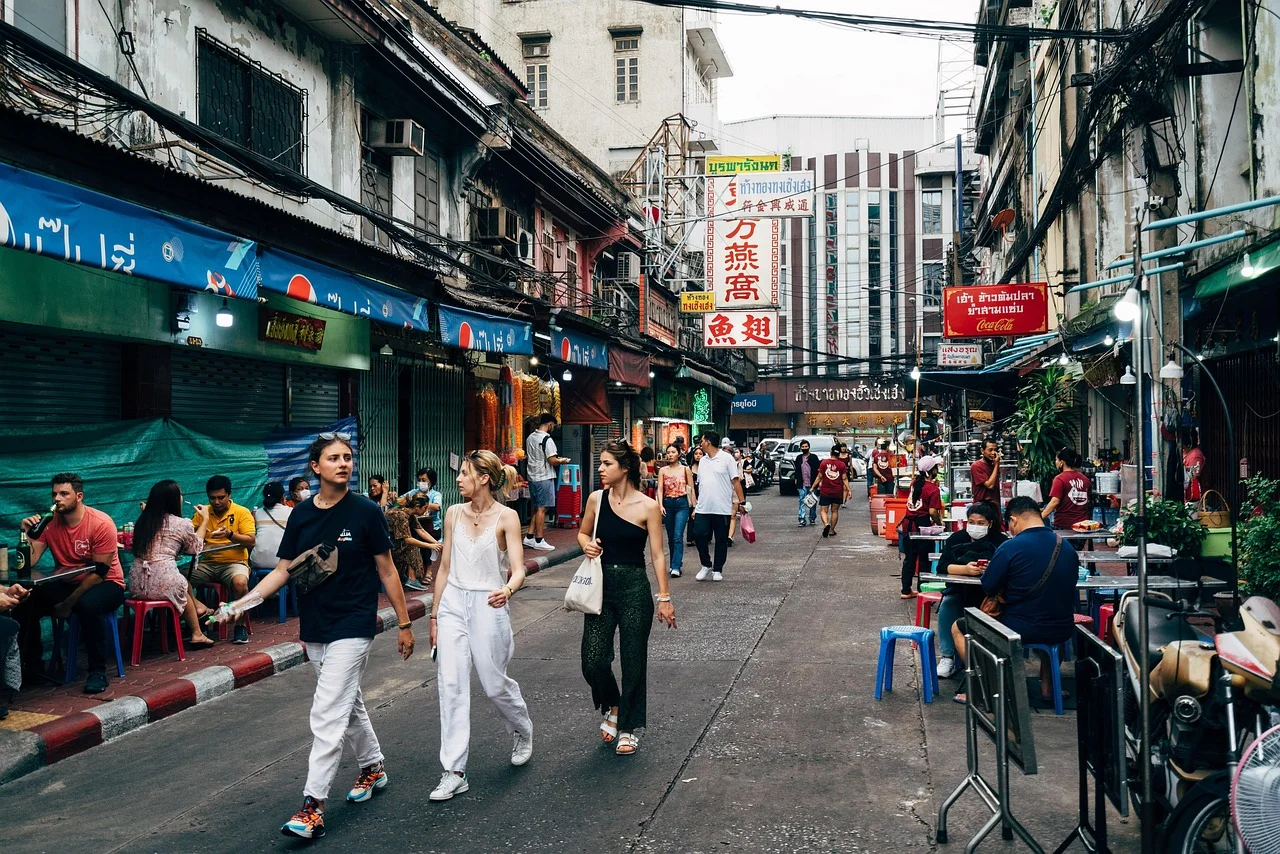
Paris to Bangkok has twice as many nonstop flights as Paris to Ho Chi Minh City, and Hanoi is linked nonstop only by Vietnam Airlines. According to the schedules compiled by FlightConnections for September 2026, Air France and Thai Airways operate 14 weekly nonstop flights between Paris Charles de Gaulle and Bangkok, for about 11 h 20 in the air. To Ho Chi Minh City, Air France and Vietnam Airlines offer seven flights a week on the Airbus A350, for about 12 h 40. To Hanoi, only Vietnam Airlines flies nonstop, one daily departure of about 11 h 40. The pattern is similar from London, Frankfurt and other European hubs: Bangkok has more direct options than any Vietnamese city, and travellers from North America or Australia usually reach both via a Gulf or East Asian connection.
On fares, the only reliable public figure comes from Vietnam Airlines, which in early September 2026 advertised economy return fares from Paris starting at €880 to Ho Chi Minh City, €945 to Hanoi and €1,033 to Da Nang. These prices move every week; they give a floor, not a promise. For Bangkok, competition from Gulf carriers with a stopover often pushes prices below nonstop fares, particularly outside school holidays.
One practical detail for Vietnam: flying into Hanoi and out of Ho Chi Minh City (or the reverse) saves you retracing 1,700 km. Vietnam Airlines sells this kind of open-jaw ticket on its own flights.
Scenery and culture: more contrast in Vietnam, more ease in Thailand
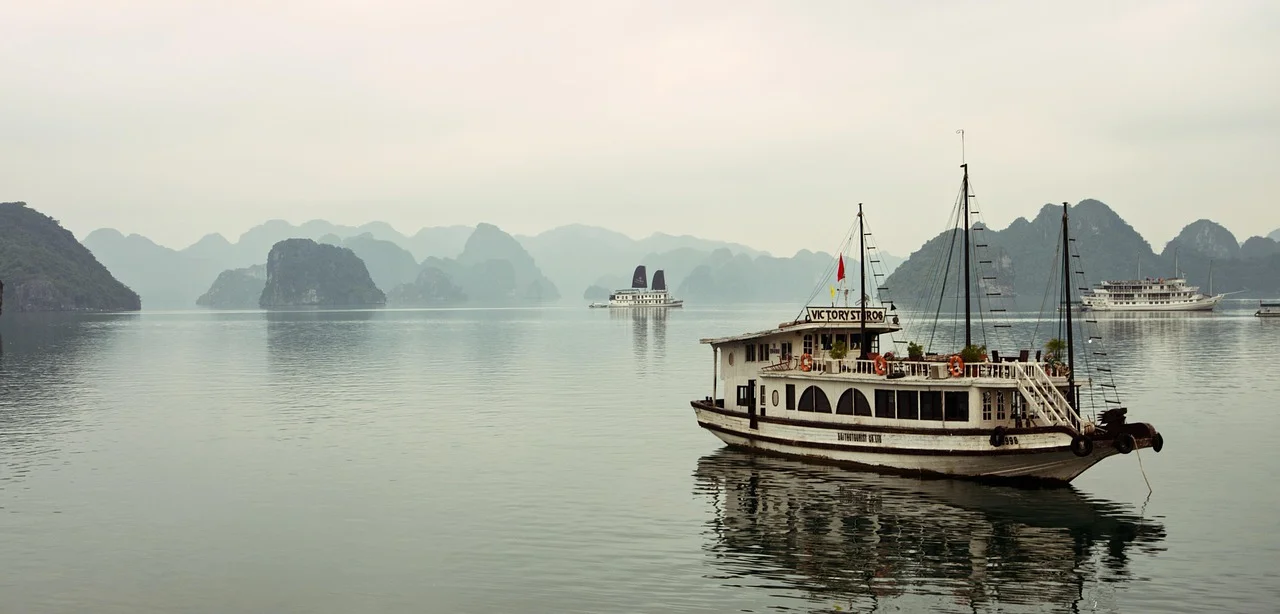
Each country has nine UNESCO World Heritage sites, but Vietnam's are concentrated on natural landscapes while Thailand's are mostly ancient cities. The Vietnamese list includes Ha Long Bay, extended in 2023 to the Cat Ba archipelago, the old town of Hoi An, Phong Nha-Ke Bang national park with its giant caves, which became a cross-border site with Laos in 2025, and the Trang An complex near Ninh Binh, often described as Ha Long Bay on land. Add the rice terraces of Sapa and the Ha Giang motorbike loop in the far north.
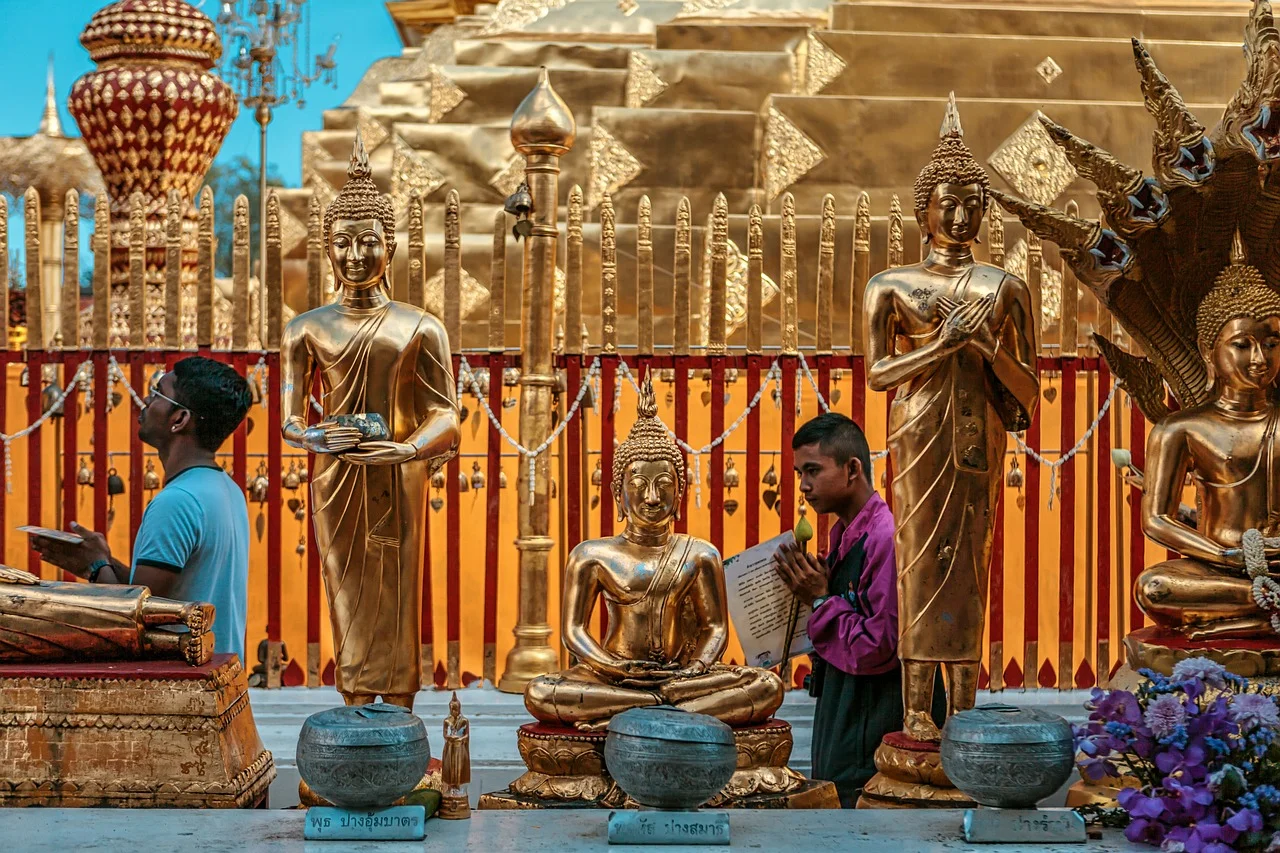
The Thai list counts the former capitals of Ayutthaya and Sukhothai, the ancient town of Si Thep, inscribed in 2023, and the Phu Phrabat historical park, inscribed in 2024. The great temples of Bangkok and Chiang Mai, though unlisted, remain the most memorable visits on a first trip. Our guide to the 15 things to see in Bangkok sets out the priorities.
The difference lies in the pace. Thailand is effortless to travel: English is widely spoken, bus-and-boat connections are sold as a single ticket, and accommodation is everywhere. Vietnam asks for a little more planning and a higher tolerance for noise and traffic, but it changes character every 300 km, from the karst of the north to the canals of the Mekong Delta. For a traveller who wants "easy" Asia, Thailand. For one who accepts some friction in exchange for more variety, Vietnam.
Getting around: night trains in both countries
Both countries can be crossed by night train for under €60, but Vietnamese distances are far longer. The Reunification Express links Hanoi and Saigon over 1,726 km (1,072 miles); according to Seat 61, train SE1 leaves Hanoi at 20:50 and arrives two mornings later at 05:45, about 33 hours, with a soft-sleeper berth in a four-bed compartment around 1,758,000 dong (€58, roughly 70 US dollars). Nobody does it in one go: the trip is split into Hanoi to Hue (13 to 16 hours overnight depending on the train), Hue to Da Nang (2 h 30 to 3 h 30, the most scenic stretch, worth doing by day) and Da Nang to Saigon (about 17 hours). Sleeper buses and domestic flights with Vietnam Airlines and Vietjet fill in the rest of the network.
In Thailand, the same source describes night trains 9 and 10 between Bangkok and Chiang Mai, in recent sleeper cars, taking 14 to 15 hours at 938 to 1,038 baht for a second-class berth (about €25). Trains now depart from Krung Thep Aphiwat station, north of the city centre. Southbound, Bangkok to Surat Thani (the connection for Koh Samui and Koh Tao) takes 10 to 12 hours overnight. An international night train also links Bangkok with Vientiane in Laos in 10 to 11 hours, an argument if you are considering an extension. Online booking opens six months ahead in Thailand, but only 60 to 90 days before departure in Vietnam.
Food: Thailand has the stars, Vietnam has the street
If you travel to eat, the two countries are level at street level and Thailand dominates fine dining. The Michelin Guide Thailand 2026, unveiled in November 2025, lists 43 starred restaurants, including two three-star addresses in Bangkok, Sorn and Sühring, among 468 selected restaurants. The Michelin Guide Vietnam 2026, unveiled in June 2026, has only existed since 2023: it selects 193 addresses, 11 one-star restaurants and 72 Bib Gourmands, across Hanoi, Ho Chi Minh City and Da Nang.
On the everyday plate, the two cuisines differ more than people expect. Thai cooking relies on chilli, coconut milk, sugar and lemongrass, with signature dishes such as pad thai, green curry, som tam and khao soi in the north. Vietnamese cooking is more herbal and lighter: pho, bun cha, banh mi, cao lau in Hoi An, plus a coffee culture of its own, from Hanoi's egg coffee to Saigon's iced ca phe sua da. For a palate sensitive to chilli, Vietnam is more comfortable; for depth of flavour, Thailand.
Beaches and islands: Thailand's advantage
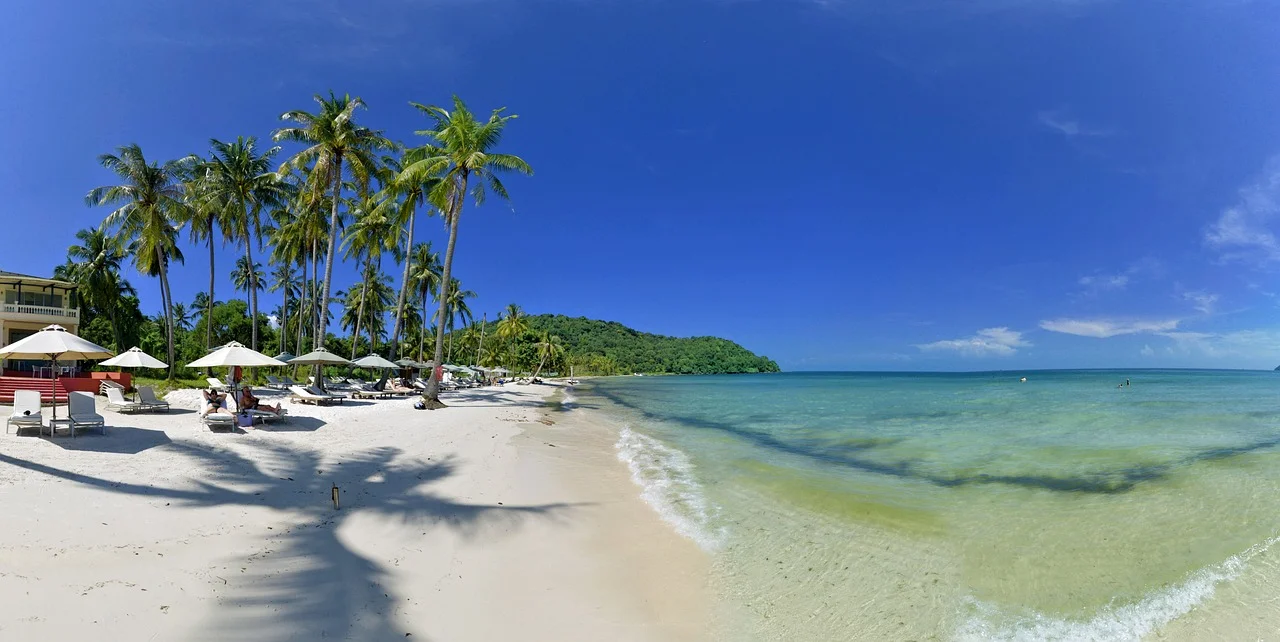
For a trip built around the beach, Thailand wins outright. Its two coastlines offer islands for every budget, from the cliffs of Railay to the waters of Koh Lipe, and above all two offset seasons that let you find fine weather almost all year round. The downside is the crowds: the best-known sites are now regulated. Maya Bay, on Koh Phi Phi Leh, closes every year from 1 August to 30 September to let the coral recover, and marine parks charge foreigners for entry, as noted above. Our Phuket guide covers the Andaman coast in detail.
Vietnam has some very fine beaches, but fewer and more scattered: Phu Quoc in the Gulf of Thailand, dry from November to April; An Bang near Hoi An and My Khe in Da Nang, at their best from May to August; the coves of Con Dao. You go there to end a tour with a few days of rest, rarely for a wholly beach-based holiday. Ha Long Bay is a UNESCO-listed marine karst landscape, but it is not a swimming destination.
Safety and health: two safe countries, one caveat for Thailand
No part of Vietnam is advised against by the French Foreign Ministry, whereas Thailand has two areas it formally advises against. The Thailand advice page, updated on 4 September 2026, excludes the provinces of Narathiwat, Pattani, Yala and Songkhla in the far south, as well as a 50 km strip along the Cambodian border, because of the 2025 clashes and unexploded ordnance. That second zone covers the classic overland route to Siem Reap via Poipet: if your plan combines Thailand with the temples of Angkor, fly. None of Thailand's major tourist sites is affected.
The Vietnam advice page, updated on 26 August 2026, flags no area to avoid. It warns about the typhoon season, from August to November, with a heightened risk from September to November on the northern and central coasts. In both countries the main risk remains road traffic, and in particular scooters rented without a suitable licence or insurance.
On health, the recommendations of the Institut Pasteur are identical for both destinations: routine vaccinations up to date and hepatitis A for everyone; Japanese encephalitis, hepatitis B, rabies and typhoid depending on the length and type of stay. Malaria is absent from cities and coasts in both countries, and confined to forested border areas in Thailand and the central and southern highlands in Vietnam. Dengue is the real issue of 2026: southern Vietnam recorded more than 56,000 cases in the first seven months of the year, up 34 percent, and Thailand's Department of Disease Control issued an alert for the rainy season. Repellent and long sleeves at dusk, in both cases.
So, Thailand or Vietnam?
Vietnam for budget, variety and any stay longer than 30 days; Thailand for beaches, simplicity and a winter departure. Traveller numbers tell the same story: Vietnam welcomed 15.9 million visitors from January to August 2026, up 14.4 percent, including 2.7 million Europeans (up 53 percent), after a record 21.2 million in 2025. Thailand remains far ahead in volume, with 33 million arrivals in 2025, but it slipped 3.2 percent over the first seven months of 2026.
Thailand or Vietnam for a first trip to Asia?
Thailand if you want a trip without friction, Vietnam if you would rather discover several countries in one. Thailand is the gentlest place in Southeast Asia to learn the ropes. Vietnam takes a little more energy but rewards curiosity more.
Thailand or Vietnam on a tight budget?
Vietnam, by about a third. Meals, beer, urban transport and trains cost noticeably less, and the 8 percent VAT runs until the end of 2026. Thailand becomes competitive mainly on beach hotels, where supply is wider.
Thailand or Vietnam in December and January?
Thailand, or southern Vietnam. Bangkok, northern Thailand and the Andaman coast are dry then, as are Saigon and the Mekong Delta. Hanoi and Ha Long Bay are cool and often overcast, and Hoi An is only just ending its rainy season.
Thailand or Vietnam in July and August?
Central Vietnam. Hue, Da Nang and Hoi An are in their dry season while the rest of both countries sits under the monsoon. In Thailand, only the Gulf (Koh Samui, Koh Tao) remains reliably pleasant.
Can you stay more than a month without a visa?
In Vietnam yes, up to 45 days for the twelve exempt nationalities, until March 2028. In Thailand no: the exemption drops to 30 days on 15 September 2026. Travellers from Belgium, the United States, Canada or Australia get 30 days in Thailand and need a 25-dollar e-visa for Vietnam; Swiss travellers should check the status of their conditional exemption before leaving.
Do you have to choose? Can you combine the two?
Yes, provided you have at least three weeks and accept one intra-Asian flight. Bangkok to Hanoi or Bangkok to Saigon takes under two hours. The most coherent combination: Thailand first for the beaches, then northern Vietnam to finish on scenery, or the reverse depending on the season.
If Vietnam wins you over, the natural next read is our Vietnam travel guide from north to south: a detailed route from Hanoi to the Mekong Delta, entry formalities, regional seasons and a realistic budget.
Activities to book
Four excursions we picked and checked on GetYourGuide, two per country, to places this comparison mentions (partner links, free cancellation). Our Bangkok, Phuket and Vietnam guides cover the rest of the route.
Ayutthaya temples day trip from Bangkok
A guided day in Siam's old capital, by air-conditioned van or minibus from Bangkok, or joining the group at the first stop: Wat Lokayasutha and its huge reclining Buddha, Wat Phra Sri Sanphet inside the former royal palace grounds, Wat Mahathat and its Buddha head wrapped in tree roots, a buffet lunch at a local restaurant, then Wat Chaiwattanaram by the river.
From €29 per person. Entry fees and lunch are included, except with the English-only tour option; hotel pickup depends on the option, and the return drop-off is at Chong Nonsi BTS station, not your hotel. Shoulders and knees must be covered in the temples; guides speak English, German or Thai.
- 7 to 7.5 hours
- from €29 per person (GetYourGuide rate, 2026)
Phi Phi, Maya Bay and Bamboo Island by speedboat from Phuket
A day on a speedboat from Phuket: Loh Sama Bay, Maya Bay where The Beach was filmed, Pileh Lagoon, Viking Cave, Monkey Beach seen from the boat, a buffet lunch on Phi Phi Don, a swim at Nui Bay, then an hour and a half of free time on Bamboo Island. Snorkel gear, water, juice and fruit are provided.
From €50 per person. Hotel pickup in Phuket province and the national park fee are only included if you pick the matching option. While Maya Bay is closed, from 1 August to 30 September, the operator limits that stop to exploring the bay, and the rest of the day stays the same. The operator does not accept pregnant women or travellers over 60.
- 8 hours
- from €50 per person (GetYourGuide rate, 2026)
Two-day cruise in Lan Ha Bay
One night on board in a private air-conditioned cabin with its own bathroom, leaving from Ben Beo harbour on Cat Ba island. On day one you sail between the karst peaks, kayak and swim at Ba Trai Dao beach, then watch a cooking demonstration and go squid fishing in the evening; the next morning you cycle to Viet Hai village in Cat Ba National Park, then have brunch and disembark around 11:50 am.
From €122 per person, with meals on board and entry fees included; drinks and tips are extra, and solo travellers pay a USD 50 supplement. The bus transfer from Hanoi depends on the option you book. English-speaking guide, 15 people at most. Lan Ha Bay lies along the Cat Ba archipelago, which was added to the Ha Long Bay UNESCO site in 2023.
- 2 days
- from €122 per person (GetYourGuide rate, 2026)
Ninh Binh from Hanoi: Hoa Lu, Trang An and Mua Cave
A day from Hanoi by limousine bus or shuttle: the old capital of Hoa Lu, a sampan ride at Trang An, a Vietnamese lunch at a local restaurant, a short bike ride through the countryside, then the climb at Mua Cave for the panoramic view.
From €50 per person, with entry fees and the boat included. Pickup between 7 and 7:45 am in Hanoi's Old Quarter, back around 7 pm; drinks and tips for the rowers are extra. English-speaking guide. It is an easy way to see Trang An, often called Ha Long Bay on land, without staying the night.
- 1 day
- from €50 per person (GetYourGuide rate, 2026)
Sources
The figures in this guide come from the sources below, checked on the publication date.
- www.diplomatie.gouv.fr
- www.fragomen.com
- en.wikipedia.org
- vietnam.travel
- english.luatvietnam.vn
- www.diplomatie.gouv.fr
- www.climatestotravel.com
- www.climatestotravel.com
- www.iqair.com
- www.flightconnections.com
- www.flightconnections.com
- www.flightconnections.com
- www.vietnamairlines.com
- www.ecb.europa.eu
- www.xe.com
- www.numbeo.com
- www.numbeo.com
- www.nationthailand.com
- www.nationthailand.com
- www.dfdl.com
- www.nationthailand.com
- www.nationthailand.com
- e.vnexpress.net
- vietnamnews.vn
- www.seat61.com
- www.seat61.com
- en.wikipedia.org
- en.wikipedia.org
- www.nationthailand.com
- www.timeout.com
- english.vov.vn
- www.pasteur.fr
- www.pasteur.fr
- vietnamnews.vn
- www.nationthailand.com
Leave a comment
Share your thoughts or travel experience. Your email will not be published.