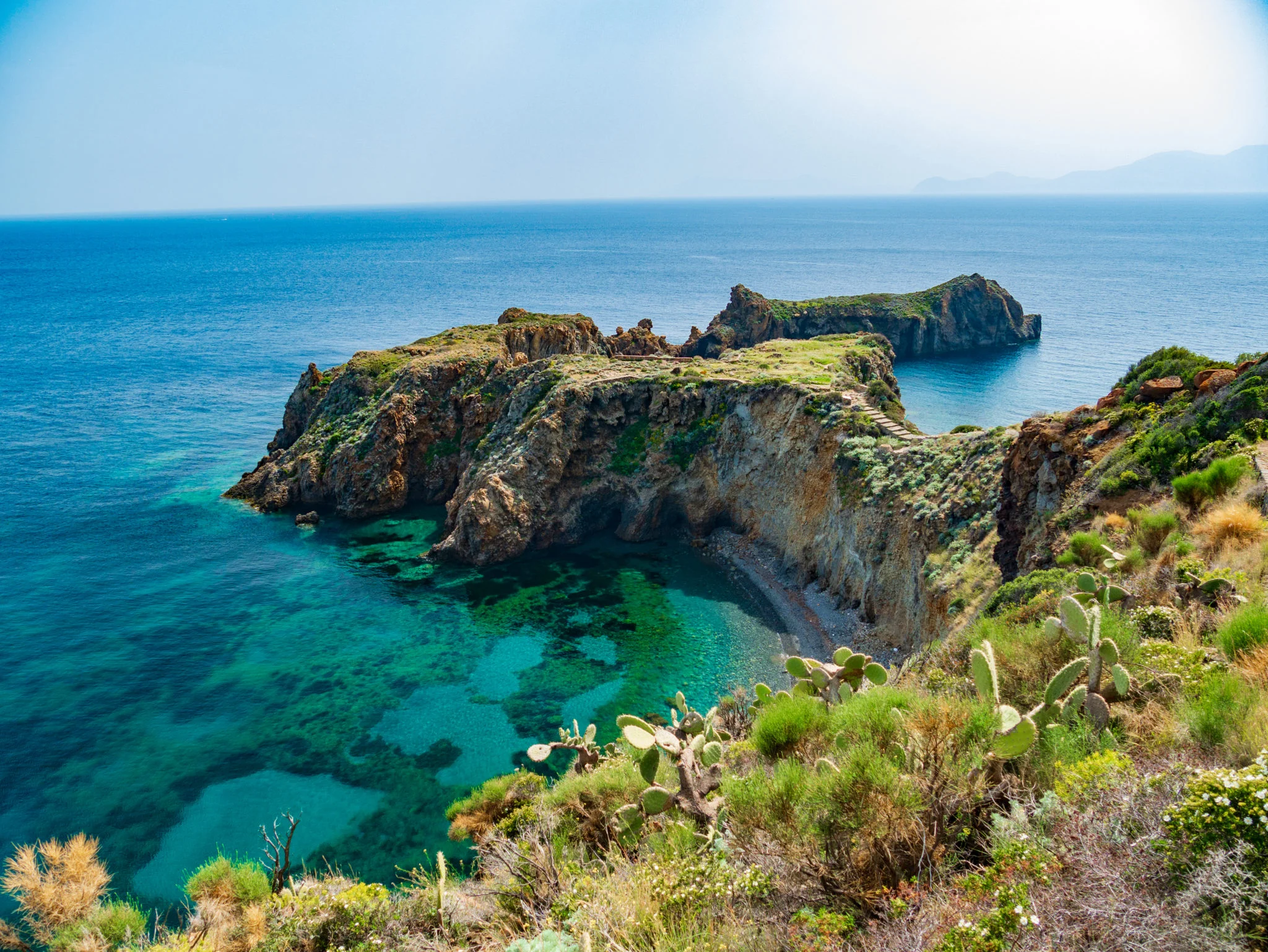


Contents 25
Overview
From the Saint-Tropez peninsula to Menton, the Riviera alternates long sandy beaches (Pampelonne, Cannes, Juan-les-Pins), pebbles (Nice, Menton) and rocky coves (Esterel, the Antibes and Ferrat capes).
Between the Saint-Tropez peninsula, in the Var, and Menton, on the Italian border, the Riviera lines up three kinds of beach: the fine sand of Pampelonne, Cannes or Juan-les-Pins, the pebbles of Nice and Menton, and the rocky coves of the capes and the Esterel.
Most of the coast is public and free; private concessions rent sunbeds and parasols in season. This guide picks 13 beaches for their setting and access, often possible by regional train.
13 places to take with you
In the guide's order, ready for Google Maps or your GPS.
Book the activities from this guide
Our picks for Côte d'Azur, well rated and free to cancel.
-
Book this activity
RIB from Nice to the Mala caves and Villefranche
€75 per person (GetYourGuide price 2026)
-
Book this activity
Ferry from Cannes to Île Sainte-Marguerite
€21 return (GetYourGuide price 2026)
-
Book this activity
Boat along the red Esterel calanques
€75 per person (GetYourGuide price 2026)
Affiliate links: Travel Advice earns a commission if you book, at no extra cost to you. Learn more

Pampelonne Beach, Ramatuelle (near Saint-Tropez)
Almost five kilometres of fine sand facing the Gulf of Saint-Tropez: Pampelonne actually lies in the commune of Ramatuelle, a few minutes from the village of Saint-Tropez. Classified as a protected natural area, the beach lines up about twenty sectors alternating beach clubs and wide stretches of public sand.
This is the heart of the peninsula's beach-club scene: Club 55, Tahiti Plage and L'Épi Plage are the best-known names. In between, the public sections remain free, with water that deepens gently.
Car parks, paid in season, are spread along route de l'Épi and the access lanes; Ramatuelle has no train station, so you come by car or by bus from Saint-Raphaël.

Garoupe Beach, Cap d'Antibes
Contrary to popular belief, la Garoupe is a fine-sand beach — one of the few on Cap d'Antibes, where rocky coves dominate. Sheltered from the waves at the back of its bay, it slopes very gently, which makes it a good pick with children.
Two historic concessions, Plage Keller and Plage Joseph, take up most of the beach: the free public stretch is only about forty metres long. Arrive early, or book a lounger.
It is also the starting point of the Tirepoil footpath, a loop of about 5 km (two hours on foot) around the cape, whose finest stretch runs from La Garoupe to Villa Eilenroc.

Mala Beach, Cap-d'Ail
La Mala has to be earned: this cove tucked beneath the cliffs of Cap-d'Ail can only be reached on foot, down a long staircase from avenue Raymond-Gramaglia, or along the coastal path from Marquet beach. The lack of nearby parking naturally keeps the crowds down.
The setting rewards the effort: clear turquoise water, ideal for snorkelling, enclosed by rock walls covered in vegetation. The seabed mixes sand and pebbles — bring water shoes for the public gravel section beyond the clubs.
Two private establishments share the loungers, Eden Plage Mala and La Réserve de la Mala; the rest of the cove is free but has no services, so pack water and a picnic.

Paloma Beach, Saint-Jean-Cap-Ferrat
On the south-east side of the Saint-Jean-Cap-Ferrat peninsula, Paloma beach (anse de la Scaletta) stretches about 150 metres of pebbles and gravel facing Beaulieu-sur-Mer and the Èze cliffs — bring water shoes, fine sand was never part of the deal here.
A page has recently turned: the private Paloma Beach club, founded in 1948, bearing Paloma Picasso's first name, and run for over 70 years by the Vannini family, was taken down after the 2024 season; cliff-reinforcement works at the Scaletta prevented it from reopening in 2025, and its permanent closure was announced on 4 March 2026. Public access to the beach remains open.
It remains one of the finest swims on the peninsula, along the Saint-Hospice walk: the water is calm, clear and east-facing — perfect in the morning.

Salis Beach, Antibes
Between Antibes' old town and Cap d'Antibes, la Salis is the city's main free public beach: sand, shallow water the tourist office describes as perfect for young children, and a view running to the ramparts on one side and the cape on the other.
It is one of the best-equipped beaches on the coast: seasonal lifeguard post, showers, toilets, a sailing school and a large car park nearby. It holds the Tourisme & Handicap and Handiplage labels, with step-free access to the water.
Very busy in summer — the price of free sand — it is best enjoyed early in the morning, when the light picks out the Alps in the background.

Croisette Beach, Cannes
The fine sand of the Croisette owes much to recent works: in 2018-2019, Cannes carried out a major sand replenishment that clearly widened the shore. The result lines the city's most famous boulevard, facing the bay and the Lérins Islands.
The city counts 7.6 km of beaches: 18 free public beaches, 33 private concessions and one municipally run beach, Zamenhof, at the end of the Croisette — picnics allowed, free showers and toilets, lifeguards from mid-June to mid-September and disabled access.
True to its Festival reputation, the palace-hotel private beaches line up loungers and waterfront restaurants; the public sections fill up early in July and August. A free beach library operates opposite Macé beach.

Marinières Beach, Villefranche-sur-Mer
Villefranche-sur-Mer's largest public beach stretches about 700 metres of coarse sand and fine gravel at the back of the bay, with a view sweeping over the colourful old town and its citadel. An anti-jellyfish net protects the swimming area in summer.
Its quirk: the Marseille–Vintimille railway line runs directly above the beach. An occasional soundtrack, but mostly an asset — Villefranche-sur-Mer station is a few minutes' walk away, making this one of the easiest beaches to reach by train on the whole coast.
If you drive, count on the paid car park of around 400 spaces; it fills up fast in high season.

The Promenade des Anglais beaches, Nice
The Baie des Anges lines up kilometres of grey and white pebbles along the Promenade des Anglais, from the airport to the Quai des États-Unis: some twenty free municipal beaches and around fifteen private establishments, with sunbeds, restaurants and changing cabins.
You swim right in the city, between visits to Old Nice or Castle Hill. The water gets deep quickly: these beaches suit swimmers better than toddlers.

Gravette Beach, Antibes
Tucked between the ramparts of Antibes' old town and Port Vauban, la Gravette is a fine-sand cove protected by breakwaters: the water stays calm even in a swell, which makes it a favourite with families with young children.
Its real luxury is its location: it is a two-minute walk down from the Provençal market and the Picasso Museum quarter. A swim between two strolls through the old lanes, with no car and no planning needed.
Free and public, it inevitably gets busy at the height of summer; its modest size argues for a morning or late-afternoon visit.

Sablettes Beach, Menton
Below Menton's old town, along quai Bonaparte between the Vieux Port and Garavan, les Sablettes lines up about 350 metres of fine gravel facing the colourful facades and, in the distance, the Italian coast. The pedestrian promenade alongside was fully renovated in 2019.
The beach keeps evolving: a €4.1 million project launched in 2026 adds a 57-metre underwater breakwater and a sand recharge to stabilise the shore.
The last major French beach before the border, it pairs naturally with a visit to the Saint-Michel basilica, whose square directly overlooks the shore.

Passable Beach, Saint-Jean-Cap-Ferrat
On the north-west flank of the Saint-Jean-Cap-Ferrat peninsula, Passable faces the sunset: the beach looks straight over the rade de Villefranche, and it is one of the few places on this coast where you swim facing the sinking sun.
The shore is gravel — coarse sand mixed with small pebbles — and the sheltered cove suits families well. The beach is split between a public section and a historic private club, the Plage de Passable restaurant.
It sits below the Villa Ephrussi de Rothschild side of the peninsula: the garden visit followed by a swim makes a fine half-day on the cape.

Buse Beach, Roquebrune-Cap-Martin
Below the hamlet of Cabbé in Roquebrune-Cap-Martin, plage du Buse is a public pebble beach set at the foot of the railway: you walk straight down from the Cabbé station on the coastal line. Next door, the larger Golfe Bleu beach is a good snorkelling spot with clear, shallow water.
The place has a singular history: on the coastal path overlooking the beach — the promenade Le Corbusier — stand Le Corbusier's Cabanon (3.66 m by 3.66 m, 1952), a UNESCO World Heritage site, the Camping Units and Eileen Gray's villa E-1027, grouped within the Cap Moderne site.
Pebbles oblige, water shoes are welcome; in exchange, the crowds stay reasonable even in summer.

Aiguille Beach, Théoule-sur-Mer
At the western tip of the Alpes-Maritimes, plage de l'Aiguille hides inside the 7-hectare Pointe de l'Aiguille departmental park, where the red volcanic rocks of the Esterel — lava flows around 300 million years old, in pink, orange and purplish hues — plunge straight into the sea.
There are in fact four pebble coves with clear, sheltered water, reachable only via the park's marked footpaths (stay on the trails, the cliffs are unstable); a belvedere overlooks the corniche. From mid-June to mid-September, a marked underwater trail lets you snorkel over Posidonia seagrass beds.
Access: TER train to Théoule-sur-Mer station then the promenade Pradeyrol on foot, or via the RD6098 towards Saint-Raphaël (two car parks, 2 km after Théoule).
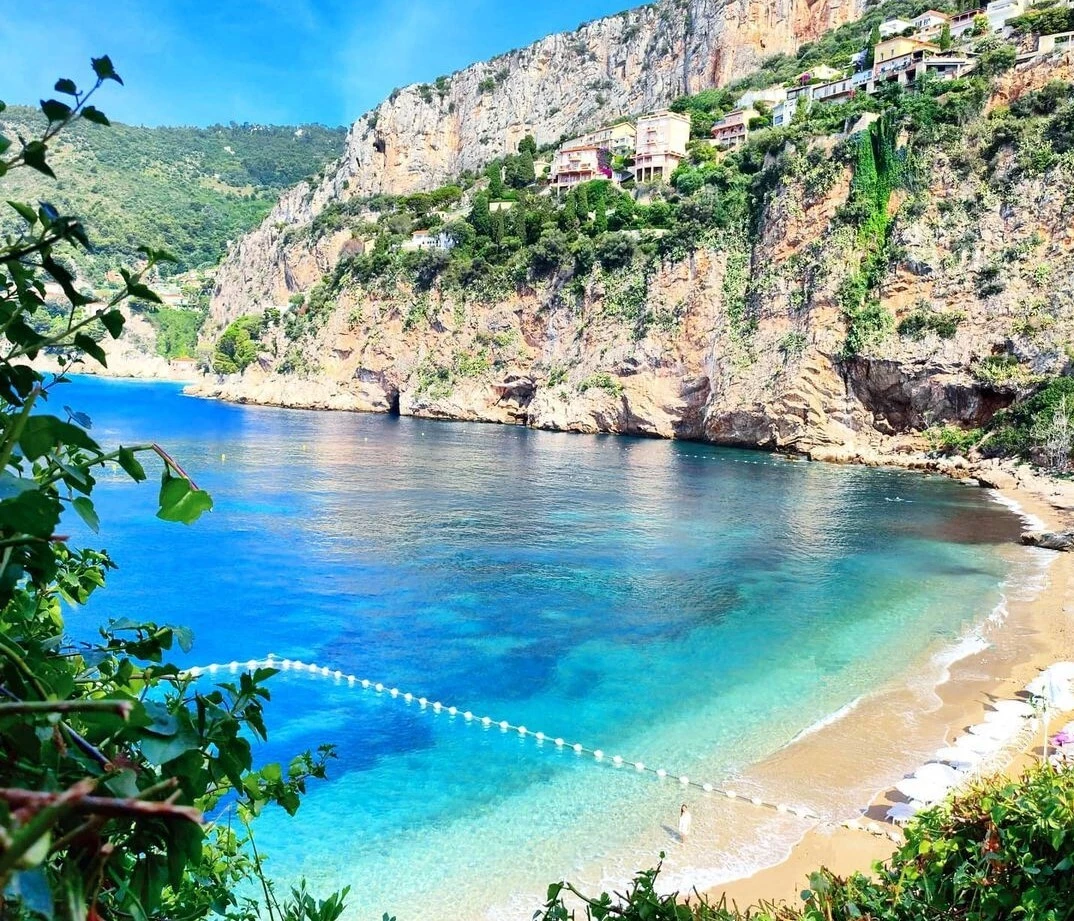
RIB from Nice to the Mala caves and Villefranche
Three hours on a rigid inflatable from Nice harbour: along the coast to the Mala cave, below the cliffs between Èze and Cap-d'Ail, a swim and snorkel stop in clear water, then 45 minutes to wander Villefranche-sur-Mer before heading back. The highlight: entering the Mala cave, where the water turns turquoise.
The easiest way to see coves you cannot reach on foot; allow €75 per person on GetYourGuide, with free cancellation. Bring swimwear and mineral sunscreen.
- 3 hrs
- €75 per person (GetYourGuide price 2026)
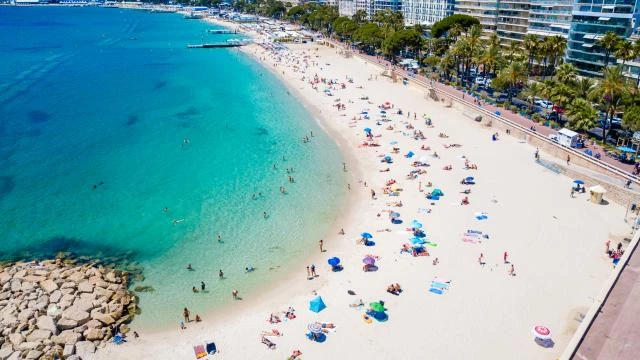
Ferry from Cannes to Île Sainte-Marguerite
A short crossing from Cannes harbour to spend the day on the largest of the Lérins Islands: pine and eucalyptus woods, coves for swimming, the Fort Royal where the Man in the Iron Mask was held, and the underwater eco-museum, whose sculptures you explore with a snorkel. The highlight: a swim facing Cannes, far from the crowded Croisette beaches.
Return ticket €21 on GetYourGuide, with free cancellation; you choose your return time. Bring a picnic and water, as there are few places to buy food on the island.
- 1 day
- €21 return (GetYourGuide price 2026)
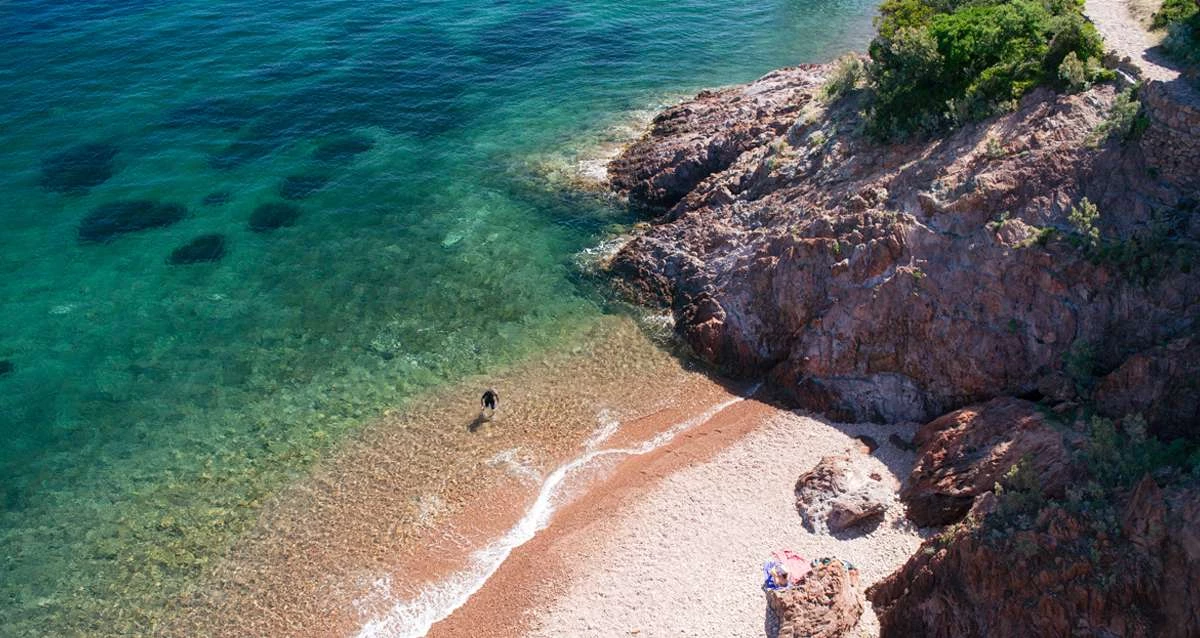
Boat along the red Esterel calanques
Two and a half hours on a rigid inflatable from Cannes heading west: the red volcanic rocks of the Esterel plunging into the sea, the coves of Théoule and Pierre Cardin's Bubble Palace clinging to the cliff, with a local skipper who knows every inlet. The highlight: the red calanques seen from the water, where no road goes.
A small group, ideal with friends or family; allow €75 per person on GetYourGuide, with free cancellation. Book a late-afternoon departure, when the rock takes on its most vivid colour.
- 2.5 hrs
- €75 per person (GetYourGuide price 2026)
Getting there
Nice Côte d'Azur airport (NCE) and the Marseille–Vintimille TER rail line serve most beaches in this guide; only the Saint-Tropez area requires a car or bus.
Nice Côte d'Azur airport (NCE) is the main gateway to the coast; Toulon-Hyères airport can serve the Saint-Tropez side.
By train
The Marseille–Vintimille rail line (TER Sud) hugs the shore and directly serves most beaches in this guide: Théoule-sur-Mer (Aiguille beach), Cannes (Croisette), Antibes (Salis, Gravette, Garoupe), Nice, Villefranche-sur-Mer (Marinières), Beaulieu-sur-Mer, Cap-d'Ail (Mala), Cabbé (Buse beach) and Menton (Sablettes). Allow 25 to 40 minutes between Nice and Cannes.
The Saint-Tropez case
Saint-Tropez and Ramatuelle have no train station: for Pampelonne you need a car or a bus from Saint-Raphaël — and patience on the coastal road in summer.
Getting around
The coastal TER (roughly every 30 minutes between Cannes and Nice) and the regional Zou! bus network are your best allies; driving runs into scarce, expensive parking near the beaches.
The TER remains the most reliable way to move between beaches: roughly one train every 30 minutes between Cannes and Nice, and stations within a few minutes' walk of the beaches at Villefranche, Cap-d'Ail, Cabbé, Menton and Théoule. The regional Zou! bus network covers what the train does not.
Driving: avoid it near the beaches
Parking is the summer pain point: la Mala has almost no parking (stair access only), les Marinières relies on a paid car park of about 400 spaces that fills fast, Pampelonne works with paid lots along route de l'Épi, and the Croisette sends you to paid underground car parks.
Simple rule: for every beach on the rail line, take the train; keep the car for the Saint-Tropez peninsula.
What to do
Snorkelling at Cap d'Antibes or L'Aiguille, coastal paths (Tirepoil, Cap-Martin), boat trips to the Lérins Islands or the Esterel calanques.
Between swims, the coast is best explored on foot along its coastal paths: the Tirepoil around Cap d'Antibes, the Le Corbusier promenade at Cap-Martin, the paths of Cap-Ferrat. A mask and snorkel are enough to explore the sea bed at Pointe de l'Aiguille, where an underwater trail is marked in summer.
By boat, the Lérins Islands are a few minutes from Cannes, and rigid inflatables from Nice or Cannes head for coves no road reaches.
Climate & seasons
When to go to France?
Monthly averages over the past 5 years (Open-Meteo).
Best months
- May
- June
- July
- August
- September
| Jan | Feb | Mar | Apr | May | Jun | Jul | Aug | Sep | Oct | Nov | Dec | |
|---|---|---|---|---|---|---|---|---|---|---|---|---|
| Our take | ||||||||||||
| Weather | ||||||||||||
| High | 13° | 14° | 16° | 18° | 21° | 26° | 29° | 30° | 26° | 22° | 17° | 14° |
| Rain (mm) | 78 | 70 | 90 | 74 | 58 | 40 | 9 | 24 | 60 | 112 | 76 | 74 |
| Beach | Beach June | Beach July | Beach August | Beach September |
What to do by season (autumn)
-
Beach
Warm air and water, little rain.
When to go
The swimming season runs from May to September, with the sea at 18-22°C in May-June and September, and 22-26°C in July-August.
The swimming season on the French Riviera runs from May to September. The sea hovers between 18 and 22°C in May-June and again in September, and climbs to 22-26°C in July-August, peaking around mid-August (up to 26-27°C off Nice).
High season and crowds
July and August concentrate the crowds: public beaches fill by late morning, car parks saturate and private clubs run on reservations. June and September offer the best compromise — water already (or still) pleasant, breathable beaches and establishments open.
About jellyfish
Episodes of mauve stinger jellyfish (Pelagia noctiluca) occur mostly in spring and summer, varying with the currents. Some beaches, such as les Marinières in Villefranche-sur-Mer, deploy a protective net in season.
Beyond the beaches, the region is worth visiting year-round: see the our French Riviera guide.
Where to stay
Nice is the most practical base (trains both ways), Antibes the most family-friendly, Cannes the most upscale with public beaches; Saint-Tropez requires a car.
Your base determines which beaches you can reach without a car:
- Nice: at the centre of the coastal rail line, it lets you fan out by train towards Cannes or Menton — the most versatile base for this guide.
- Antibes / Juan-les-Pins: gently sloping sandy beaches (Salis, Ponteil) with accessibility labels, midway between Nice and Cannes on the TER — the best family choice.
- Cannes: Croisette palaces on one side, 18 free public beaches on the other; an upscale base that stays well connected to the rail line.
- Saint-Tropez / Ramatuelle: the Pampelonne beach-club scene, but no train station — a car is essential, with a budget to match.
If the peninsula tempts you, our 7 must-sees in Saint-Tropez cover what earns the detour beyond the Pampelonne beaches.
Formalities
The Riviera is in France, in the Schengen area: ID card or passport for Europeans, and the euro as currency.
The Riviera is in France, in the Schengen area: EU citizens travel with an ID card or valid passport, other nationalities under Schengen rules. The currency is the euro.
On the beaches, follow local by-laws: dogs are banned from most public beaches in season, swimming zones are marked and lifeguard flags apply.
Tips
Arrive before 10am in summer, favour the train, pack water shoes for the pebble beaches and check water quality on the official ARS website.
- Arrive early: in July-August, public beaches fill by late morning; before 10am you can still choose your spot.
- Favour the train: the stations at Villefranche, Cap-d'Ail, Cabbé, Menton and Théoule open onto the beaches within minutes — faster than hunting for parking.
- Water shoes: essential on the pebble and gravel beaches (Paloma, Passable, Mala, Buse, Aiguille, Sablettes).
- Sun and hydration: sunscreen, a hat and plenty of water, especially on coves without services such as Mala or l'Aiguille.
- Water quality: official ARS test results are published beach by beach on baignades.sante.gouv.fr.
- Respect the sites: take your litter away, stay on marked trails in protected areas (Pointe de l'Aiguille, Pampelonne) and observe the posted municipal bylaws.
FAQ
Most of the coast is public and free; private concessions rent sunbeds and parasols in season. The coastal train, arriving before 10 am and water shoes answer most questions.
Are French Riviera beaches free?
Most of the coastline consists of free public beaches; private concessions occupy only part of the shore and rent loungers and parasols in season. In Cannes, for instance, there are 18 public beaches, one municipal beach and 33 concessions along 7.6 km of coast.
Are dogs allowed on the beaches?
They are generally banned in season on supervised beaches by municipal bylaw; in Nice, Cannes or Antibes they are usually tolerated only in the evening and early morning in summer. Rules vary by commune — check the signs at the beach entrance; from October to May tolerance is much broader.
Are there jellyfish on the French Riviera?
Episodes of Pelagia noctiluca (mauve stinger) occur mostly in spring and summer, depending on currents.
Are topless sunbathing and naturism allowed?
Topless sunbathing is legal unless banned by a posted municipal bylaw. Full naturism is only allowed on officially designated beaches; elsewhere it may fall under Article 222-32 of the French penal code.
Which beaches are best for families?
La Salis and le Ponteil in Antibes (sand, shallow water, lifeguards, Handiplage label), Zamenhof beach in Cannes (municipal, picnics allowed, lifeguards 15 June to 15 September) and la Gravette in Antibes (a cove sheltered by breakwaters).
How do I check bathing water quality?
Official ARS test results are published in real time, beach by beach, on baignades.sante.gouv.fr.
Sources
The figures in this guide come from the sources below, checked on the publication date.
- www.theoule-sur-mer.org
- www.antibesjuanlespins.com
- www.cannes.com
- www.francebleu.fr
- www.menton-riviera-merveilles.co.uk
- nicepresse.com
- www.club55.fr
- www.rivieraedition.com
- fr.wikipedia.org
- provence-alpes-cotedazur.com
- baignades.sante.gouv.fr
- www.ramatuelle.fr
- www.rivieraedition.com
- cap-antibes.com
- nissactu.fr
- commons.wikimedia.org
- commons.wikimedia.org
Leave a comment
Share your thoughts or travel experience. Your email will not be published.