

Contents 26
The historic capital of the Alsace vineyards, Colmar charms visitors with its remarkably preserved medieval centre: colourful half-timbered houses, the canals of Petite Venise, the covered market hall and cobbled lanes. The city is also the birthplace of Bartholdi, sculptor of the Statue of Liberty, born here in 1834.
Compact and entirely pedestrian at its core, Colmar is easily explored on foot over one or two days. Above all it makes the ideal central base for the Alsace Wine Route (170 km from Marlenheim to Thann) and for reaching villages such as Riquewihr, Eguisheim and Kaysersberg. This guide brings together the twelve must-sees of the city and its surroundings, each with verified practical tips.
Overview
Colmar is a medieval town in Alsace, capital of the vineyard, famous for its half-timbered houses and the Petite Venise quarter.
In the Haut-Rhin, at the foot of the Vosges, Colmar (around 70,000 inhabitants) is one of the best-preserved towns in Alsace. Its historic centre lines up half-timbered houses, Renaissance dwellings such as the Maison Pfister (1537) and the Maison des Têtes, and the romantic Petite Venise quarter along the Lauch.
Birthplace of the sculptor Frédéric Auguste Bartholdi (Statue of Liberty), Colmar is also home to the Unterlinden Museum and its Isenheim Altarpiece. Its central location makes it the best starting point for the Alsace Wine Route.
12 places to take with you
In the guide's order, ready for Google Maps or your GPS.
Book the activities from this guide
Our picks for Colmar, well rated and free to cancel.
-
Book this activity
Guided walk through the old town and Alsace wine tasting
€45 per person (GetYourGuide price 2026)
-
Book this activity
A day on the wine route: Eguisheim, Kaysersberg, Ribeauvillé and Riquewihr
€135 per person (GetYourGuide price 2026)
Affiliate links: Travel Advice earns a commission if you book, at no extra cost to you. Learn more

Little Venice
La Petite Venise is Colmar's most photographed quarter: a row of colourful half-timbered houses reflected in the waters of the Lauch, at the southern end of the old town. The nickname recalls the canals of Venice.
Stroll along the Quai de la Poissonnerie and the rue de la Herse, cross the Pont Saint-Pierre for the most famous view, and hop aboard a flat-bottomed boat to discover the quarter from the water. Cafés and winstubs line the cobbled lanes.

The Unterlinden Museum
The Unterlinden Museum, set in a 13th-century former Dominican convent enlarged by a contemporary extension, houses the Isenheim Altarpiece, carved by Niclaus de Haguenau around 1490 and painted by Matthias Grünewald between 1512 and 1516 — one of the great masterpieces of the German Renaissance.
The collections range from the Middle Ages to modern art: Rhenish painting, sculpture, decorative arts and 20th-century works. The convent's Gothic chapel houses the altarpiece.

Explore the Christmas markets
During Advent, Colmar hosts six Christmas markets across the old town, including those on the Place des Dominicains and the Place de l'Ancienne Douane. They offer crafts, decorations and specialities: mulled wine, bredele (Alsatian biscuits) and gingerbread.
The illuminated streets and decorated half-timbered houses make it one of France's most renowned Christmas markets. The 2026 edition runs from 23 November to 29 December.

Riquewihr
Riquewihr, about 13 km north-west of Colmar, is one of France's most beautiful villages and a highlight of the Alsace Wine Route. Its cobbled lanes lined with 15th- and 16th-century half-timbered houses have earned it the nickname "pearl of the vineyard".
It is easily reached by car or bus through the vineyards. Its emblematic landmark is the Dolder, a gate-belfry from 1291 standing about 25 metres tall and built into the village's medieval ramparts. Riquewihr is renowned for its white grands crus, chiefly Riesling and Gewurztraminer: many cellars offer tastings.

The Old Town
The historic heart of Colmar is explored on foot, from the Place de l'Ancienne Douane (the Koïfhus) to the Place de la Cathédrale. Here stand the Maison Pfister (1537) and the Maison des Têtes, a Renaissance dwelling from 1609 bristling with carved heads.
The cobbled lanes are lined with artisan shops, winstubs and terraces. A short walk away are the Unterlinden Museum and the Bartholdi Museum, set in the birthplace of the sculptor of the Statue of Liberty.

The Pfister House
La Maison Pfister, completed in 1537 for the hatter Ludwig Scherer, is the first example of Renaissance architecture in Colmar. Its façade features a two-storey corner oriel, an octagonal turret and painted murals depicting Germanic emperors and biblical scenes.
The house owes its name to the Pfister family, who occupied it from 1841 to 1892. Listed as a Historic Monument since 1927, it has belonged to the Judlin family since 1892. It is a private residence: it cannot be visited and is not a museum — admire it from rue des Marchands.

Kaysersberg
Kaysersberg, about a dozen kilometres from Colmar along the wine route, was voted the French public's favourite village in 2017. The village is overlooked by its castle ruins and crossed by a 16th-century fortified bridge spanning the Weiss.
Visit the Gothic Sainte-Croix church and the birthplace of Albert Schweitzer, the Nobel Peace Prize winner born here in 1875. Cellars and winstubs line the half-timbered lanes.

Walks in the vineyards
Colmar is the ideal starting point for the Alsace Wine Route, which runs 170 km from Marlenheim to Thann. From the town you can reach the wine villages of Eguisheim, Turckheim, Riquewihr and Kaysersberg in minutes.
Many estates offer cellar visits and tastings of Riesling, Gewurztraminer, Pinot Gris and Pinot Noir. Signposted vineyard trails also let you walk among the vines, on foot or by bike.

The Collegiate Church of Saint-Martin
The Saint-Martin collegiate church, Colmar's main church, is a Gothic building in Vosges sandstone constructed between 1234 and 1365. Its south tower, whose spire burned in 1572, was then capped with a distinctive lantern turret.
Inside are stained-glass windows, medieval sculptures and an organ used for concerts. Still a place of worship, the church dominates the Place de la Cathédrale at the centre of the old town.

The Covered Market
Colmar's covered market occupies a brick and cast-iron hall opened in 1865, at 13 rue des Écoles, on the edge of Petite Venise beside the Lauch.
About twenty stallholders sell fresh produce and Alsatian specialities: cheeses, charcuterie, fruit and vegetables, wines. Grab a quick lunch before stepping out onto the waterside terrace.

The Schongauer House
The "Zum Schwan" house, at 2 rue Schongauer, is linked to the great engraver and painter Martin Schongauer, born in Colmar around 1450. He bought this late-15th-century dwelling in 1477 to set up his studio; on his death in 1491 it passed to his brother Ludwig, also an engraver.
A witness to late-medieval Colmar, the house is admired from the street that now bears the artist's name. Schongauer's work is preserved and showcased at the nearby Unterlinden Museum, whose learned society is named the "Société Schongauer".

The Toy Museum
Set at 40 rue Vauban in a former cinema, the Toy Museum spreads its collections over three floors: antique dolls and bears, model trains, cars, games and automata trace the evolution of toys.
Several interactive displays and a large model-train layout make it a favourite family stop, especially on a rainy day.
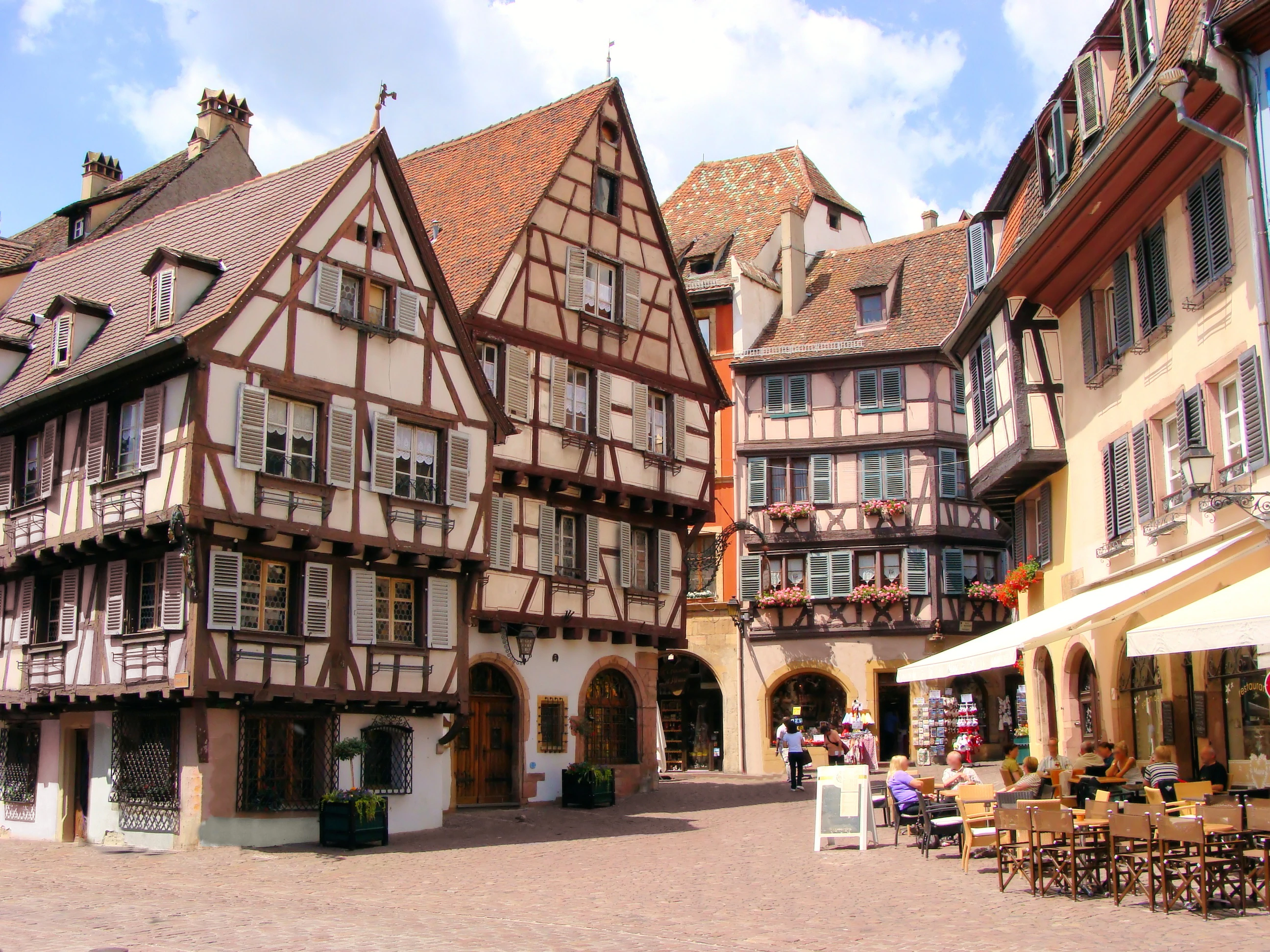
Guided walk through the old town and Alsace wine tasting
Two hours on foot with a local guide through the historic centre: Renaissance mansions, half-timbered houses, the Gothic church and cobbled lanes, with the story of the "capital of Alsace wine". The walk ends at a wine estate for a tasting of whites such as Riesling, Pinot Gris and Gewurztraminer.
Allow €45 per person on GetYourGuide, with free cancellation up to 24 hours before. Groups of 6 at most, in French or English; the meeting point is the Bruat fountain in the Champ de Mars park. The tour runs rain or shine.
- 2 hrs
- €45 per person (GetYourGuide price 2026)
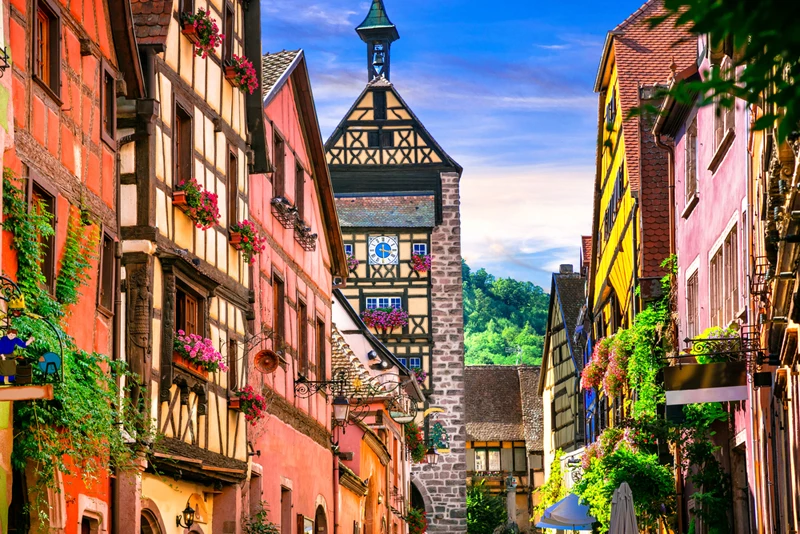
A day on the wine route: Eguisheim, Kaysersberg, Ribeauvillé and Riquewihr
A small-group day from Colmar linking four wine-route villages: Eguisheim and its circular lanes, Kaysersberg and its fortified bridge, Ribeauvillé below its three castles, then Riquewihr and the Dolder. Photo stops in the vineyards break up the drive.
Allow €135 per person on GetYourGuide, with free cancellation up to 24 hours before; 7 participants at most, pick-up included, guide in French or English. The wine tasting offered along the way is not included in the price.
- 8 hrs
- €135 per person (GetYourGuide price 2026)
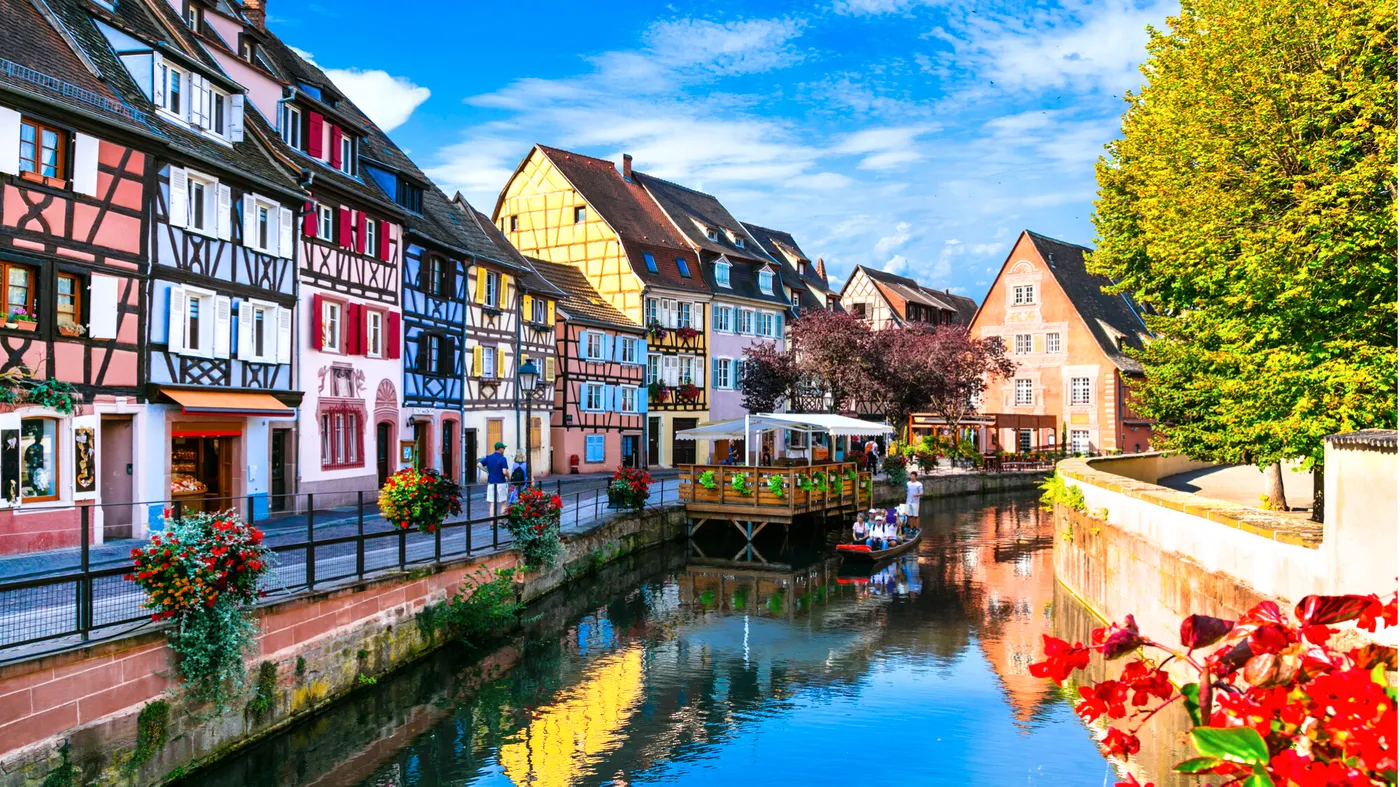
Boat ride on the Lauch through Petite Venise
Flat-bottomed boats glide along the Lauch between the half-timbered houses of Petite Venise and the market gardens of the Krutenau quarter, before heading back towards the covered market. It is the only way to see the façades from the water side, where the quays do not reach.
The landing stages are around the Pont Saint-Pierre and the rue de la Herse; tickets are sold on the spot, with no booking. In summer and December the queue can be long: come at opening time or late in the day.
- Short loop on the Lauch
- Ticket bought at the landing stage
Getting there
Colmar is on the Strasbourg-Mulhouse-Basel TGV/TER line; the nearest airports are EuroAirport Basel-Mulhouse and Strasbourg-Entzheim.
By train: Colmar station is served by direct TGV trains from Paris-Est (under 3 hours) and by regional TER trains on the Strasbourg (30 min) - Mulhouse - Basel axis.
By air: EuroAirport Basel-Mulhouse-Freiburg (about 60 km) and Strasbourg-Entzheim airport are the closest. By car: Colmar is on the A35 motorway; plan to park on the outskirts as the centre is largely pedestrian.
Strasbourg is about thirty minutes away by train, and many travellers pair the two cities on one trip. See the 11 must-do things in Strasbourg.
Getting around
The historic centre is explored on foot; use buses, a bike, a car or an organised tour for the wine-route villages.
Colmar's core is pedestrian and compact: from the Place de l'Ancienne Douane to Petite Venise, everything is a few minutes' walk. Leave the car in a car park on the edge of the centre, where traffic is very restricted.
For the wine route a car is the most flexible option: Eguisheim, Turckheim, Kaysersberg and Riquewihr are about ten kilometres away. Without a car, regional bus lines and, in season, shuttles link Colmar to the villages; cycling works on the vineyard cycle paths, and several day tours leave from the centre.
What to do
Stroll through Petite Venise and the old town, visit the Unterlinden Museum and explore the wine route.
The town essentials: Petite Venise and the old town, the Unterlinden Museum (Isenheim Altarpiece), the Maison Pfister, the Saint-Martin collegiate church and the covered market. For families, the Toy Museum is a safe bet, and the Bartholdi Museum traces the career of the creator of the Statue of Liberty.
Around the town, the Wine Route leads to Riquewihr, Eguisheim and Kaysersberg; tastings and walks among the vineyards round off the stay.
To go further, three ways to discover the town and its vineyards: a guided walk followed by a wine tasting, a day on the wine route to Eguisheim, Kaysersberg, Ribeauvillé and Riquewihr, and a flat-bottomed boat ride on the Lauch through Petite Venise.
Food
Try sauerkraut, flammekueche, baeckeoffe and Alsace white wines (Riesling, Gewurztraminer).
Alsatian cuisine is hearty: choucroute garnie, tarte flambée (flammekueche), baeckeoffe, pretzels and, in winter, mulled wine and gingerbread at the Christmas markets.
For wine, the region produces renowned whites — Riesling, Gewurztraminer, Pinot Gris and Crémant d'Alsace. The covered market is the perfect place to sample local produce and takeaway dishes by the Lauch.
Climate & seasons
When to go to France?
Monthly averages over the past 5 years (Open-Meteo).
| Jan | Feb | Mar | Apr | May | Jun | Jul | Aug | Sep | Oct | Nov | Dec | |
|---|---|---|---|---|---|---|---|---|---|---|---|---|
| Our take | ||||||||||||
| Weather | ||||||||||||
| High | 6° | 9° | 13° | 15° | 19° | 25° | 25° | 25° | 21° | 17° | 10° | 7° |
| Rain (mm) | 103 | 67 | 61 | 72 | 96 | 86 | 91 | 81 | 86 | 79 | 101 | 78 |
| City sightseeing | City sightseeing March | City sightseeing April | City sightseeing May | City sightseeing June | City sightseeing July | City sightseeing August | City sightseeing September | City sightseeing October |
What to do by season (autumn)
-
City sightseeing
Pedestrian-friendly most of the year.
When to go
Spring and autumn offer mild weather and fewer crowds; December is for the Christmas markets (23 November - 29 December 2026).
Spring (March-May) and autumn (September-November) are the ideal seasons: mild temperatures, fewer people and, in autumn, the grape harvest in the vineyards.
Summer is warm and lively but busy. Winter, especially December, transforms the town with its six Christmas markets (2026 edition: 23 November to 29 December). Book accommodation well ahead for this period.
Where to stay
Stay in the old town or Petite Venise to do everything on foot; book early in December.
The historic centre and the Petite Venise quarter place visitors at the heart of the sights, within walking distance of the Unterlinden Museum and the markets. Here you'll find charming hotels, guesthouses and rentals.
Staying near the station makes train day-trips easy, and the surrounding Alsatian countryside offers quieter cottages and farm inns. In December availability is very tight: book several months ahead.
Safety
Colmar is a safe town; watch out for pickpockets in the Christmas-market crowds. Emergencies: 15, 17, 18 or 112.
Colmar poses no particular risk to visitors. The main thing to watch is pickpocketing in the Christmas-market crowds and in the lanes of Petite Venise at weekends: keep bags and phones closed and in front of you.
Emergency numbers in France: 15 (medical emergencies, SAMU), 17 (police), 18 (fire brigade) and 112 (European emergency number, from a mobile); 114 by text for deaf or hard-of-hearing people. On the wine route, do not drive after tastings: appoint a sober driver or spit.
Formalities
Colmar is in France, in the Schengen Area: ID card or passport depending on nationality, euro as currency.
Colmar is in France, a member of the European Union and the Schengen Area. EU/EEA/Swiss nationals travel with a valid ID card or passport.
Non-EU visitors are subject to Schengen rules (90-day short stay within 180 days; visa depending on nationality). The currency is the euro (€) and bank cards are widely accepted. No specific health formalities are required.
Tips
Explore on foot, visit museums early, and book well ahead for the Christmas markets.
As the centre is pedestrian and compact, explore Colmar on foot and leave the car on the outskirts. For the Unterlinden Museum, aim for opening time or the reduced late-day rate.
In December the town is packed at weekends: favour weekday visits and book accommodation several months ahead. For the wine route without a car, seasonal buses and shuttles link Colmar to Riquewihr, Kaysersberg and Eguisheim.
FAQ
Answers to the most common traveller questions about Colmar.
How long do you need to visit Colmar?
One to two days are enough for the historic centre. Add a day to explore the wine route and villages such as Riquewihr or Kaysersberg.
When is the best time to come?
Spring and autumn for mild, quiet conditions; December for the Christmas markets (23 November to 29 December 2026), though the town is very busy then.
Can you visit the Maison Pfister?
No: it is a private residence (Judlin family since 1892). Its 1537 Renaissance façade is admired from the street.
What is there to see at the Unterlinden Museum?
Its masterpiece is the Isenheim Altarpiece (Grünewald, 1512-1516). Open 9am-6pm, closed Tuesday; full price €14.
How do you reach the wine route from Colmar?
By car, by bike, or via seasonal buses and shuttles to Riquewihr, Eguisheim and Kaysersberg, all about ten kilometres away.
Is Colmar Bartholdi's birthplace?
Yes, Frédéric Auguste Bartholdi, sculptor of the Statue of Liberty, was born here in 1834; a museum dedicated to him is at 30 rue des Marchands.
Sources
The figures in this guide come from the sources below, checked on the publication date.
Leave a comment
Share your thoughts or travel experience. Your email will not be published.