

Contents 28
On an island 180 km long, Corsica brings together white-sand beaches, high mountains crossed by the GR20 and Genoese towns such as Bonifacio, Calvi and Corte. This guide gathers its 14 must-sees, from the Scandola reserve to Cap Corse, with the access rules in force in 2026 in the protected areas.
Then comes the practical information: when to go, how to get there and around, where to stay, what to eat, entry requirements and safety, followed by an FAQ.
Overview
A Mediterranean island nicknamed the Island of Beauty, Corsica pairs turquoise beaches with high mountains on a compact territory.
Corsica, nicknamed the Island of Beauty, is a French Mediterranean island where high mountains drop straight into a turquoise sea. Within a few hours' drive you move from the sandy beaches of the south to the peaks and forests of the interior and the hilltop villages of the Balagne and Castagniccia.
The island is compact but the roads are winding: always allow more travel time than the distance suggests.
14 places to take with you
In the guide's order, ready for Google Maps or your GPS.
Book the activities from this guide
Our picks for Corse, well rated and free to cancel.
-
Book this activity
Scandola and Girolata by boat from Calvi
€80 per person (GetYourGuide price 2026)
-
Book this activity
Lavezzi islands and Bonifacio sea caves by boat
€87 per person (GetYourGuide price 2026)
-
Book this activity
Sunset at the Sanguinaires Islands by RIB
€50 per person (GetYourGuide price 2026)
Affiliate links: Travel Advice earns a commission if you book, at no extra cost to you. Learn more

Bonifacio
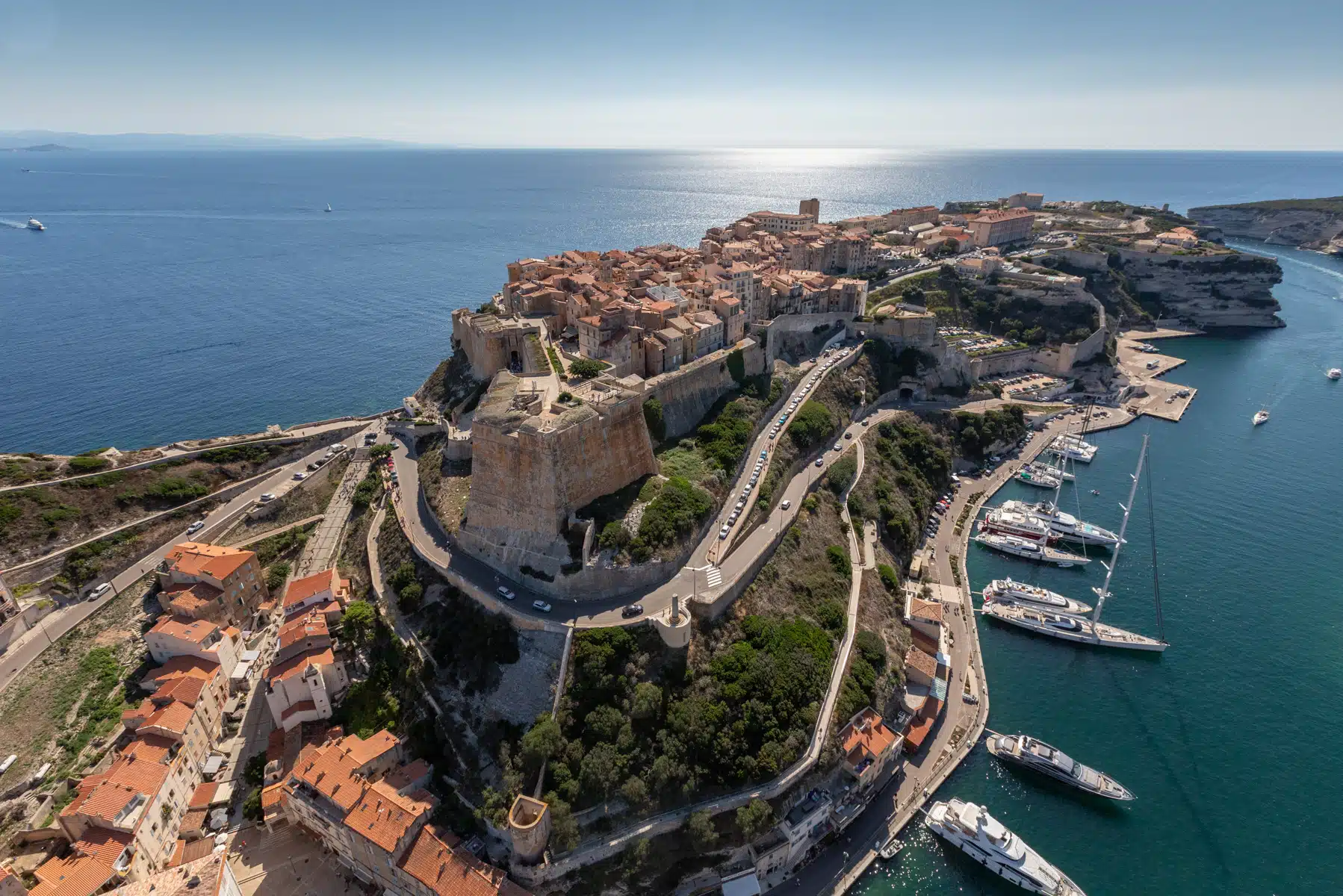
At the island's southern tip, Bonifacio's upper town sits on the edge of high white limestone cliffs above the sea. You enter the citadel on foot through the Genoa Gate to walk its lanes, churches and houses lined up above the drop; the King of Aragon's Stairway, cut into the cliff, runs down to the sea.
The marina, at the end of a narrow inlet, is where boat trips leave for the sea caves and the Lavezzi archipelago, in the Bouches de Bonifacio nature reserve. Sardinia can be seen on a clear day, about twelve kilometres away.

Scandola Nature Reserve
Created in 1975, Scandola Nature Reserve protects a volcanic peninsula of red porphyry between Galéria and Girolata: 919 hectares on land and 604 hectares at sea, 70 of them in a strict reserve. It is part of the property "Gulf of Porto: Calanche of Piana, Gulf of Girolata, Scandola Reserve", inscribed on the UNESCO World Heritage List in 1983. Cliffs, sea caves and rock columns shelter species such as the osprey.
The reserve is seen from the sea, on boat trips from Calvi, Porto or Ajaccio, often with a stop in Girolata. According to the Corsica Regional Nature Park, the following are banned in the reserve: taking plants or animals, hiking and climbing, camping, bivouacs and fires, scuba diving, spearfishing, all recreational fishing, and flying below 1,000 metres. Anchoring is allowed only from sunrise to sunset, and never in the strict reserve (from Gargalu island to Punta Palazzu).

Ajaccio
Ajaccio, on the west coast, is Napoleon Bonaparte's birthplace and the island's main gateway. Maison Bonaparte, where he was born in 1769, is now a national museum; he was baptised in the Cathedral of Our Lady of the Assumption, a few streets away. The Palais Fesch, founded by Cardinal Fesch, the emperor's uncle, holds one of France's main collections of Italian painting.
The central market, the old-town lanes and the Tino Rossi harbour are all walkable. 12 km to the west, the Sanguinaires road follows the coast to the Pointe de la Parata; Capo di Feno beach is about twenty minutes north-west.

The Calanques of Piana
Between Piana and Porto, the D81 road winds for a few kilometres through the Calanques of Piana, spires and jumbles of red granite sculpted by erosion that drop sheer into the Gulf of Porto. The site is part of the property inscribed on the UNESCO World Heritage List in 1983, together with the Gulf of Girolata and the Scandola reserve.
Several trails start from the road, such as the Château Fort path to a headland overlooking the gulf. From the sea, boat trips from Porto run along the foot of the cliffs.

The GR20
The GR20 crosses Corsica from north to south over about 180 kilometres, from Calenzana, in the Balagne, to Conca, north of Porto-Vecchio, in 16 stages. It is known as one of Europe's toughest long-distance trails: rocky sections with fixed chains, exposed ridges and steep climbs, especially in the northern half.
Hikers sleep in mountain huts or in the bivouac areas around them. You can walk just one half: the village of Vizzavona, served by the train, divides the northern GR20 from the easier southern GR20.

The Bavella Needles
Above Zonza, in southern Corsica, the Bavella Needles are reddish granite peaks rising over a forest of Laricio pines. The road crosses the Col de Bavella (1,218 m), where the statue of Our Lady of the Snows stands; the GR20 runs nearby.
From the pass, the trail to the Trou de la Bombe, a natural arch pierced through the rock, is the most popular hike; other routes climb to the ridges. The canyons around, including the Purcaraccia, are descended with an instructor.

Calvi
Capital of the Balagne, on the north-west coast, Calvi is overlooked by a Genoese citadel set on a rocky headland. Inside the ramparts, the Cathedral of Saint John the Baptist and the cobbled lanes look over the bay; below, the marina and the church of Sainte-Marie-Majeure make up the lower town.
Calvi beach stretches for several kilometres, backed by a pine wood. Boat trips to the Scandola reserve and the village of Girolata leave from the harbour, and the Capu di a Veta trail (703 m) gives a view over the whole bay and the mountains.

Corte
In the centre of the island, at about 400 metres above sea level, Corte was the capital of Pasquale Paoli's independent Corsica in the 18th century. Its citadel, built from 1419 on a rocky spur, now houses the Museum of Corsica. The Pasquale Paoli University, founded by Paoli in 1765 and reopened in 1981, keeps the town lively.
Corte is the gateway to the Restonica valley and its high lakes, and a stop on the train line between Ajaccio and Bastia. Since storms Ciaran and Domingos in November 2023, the valley has been reached mainly by a shuttle from the station.

Corsica's beaches
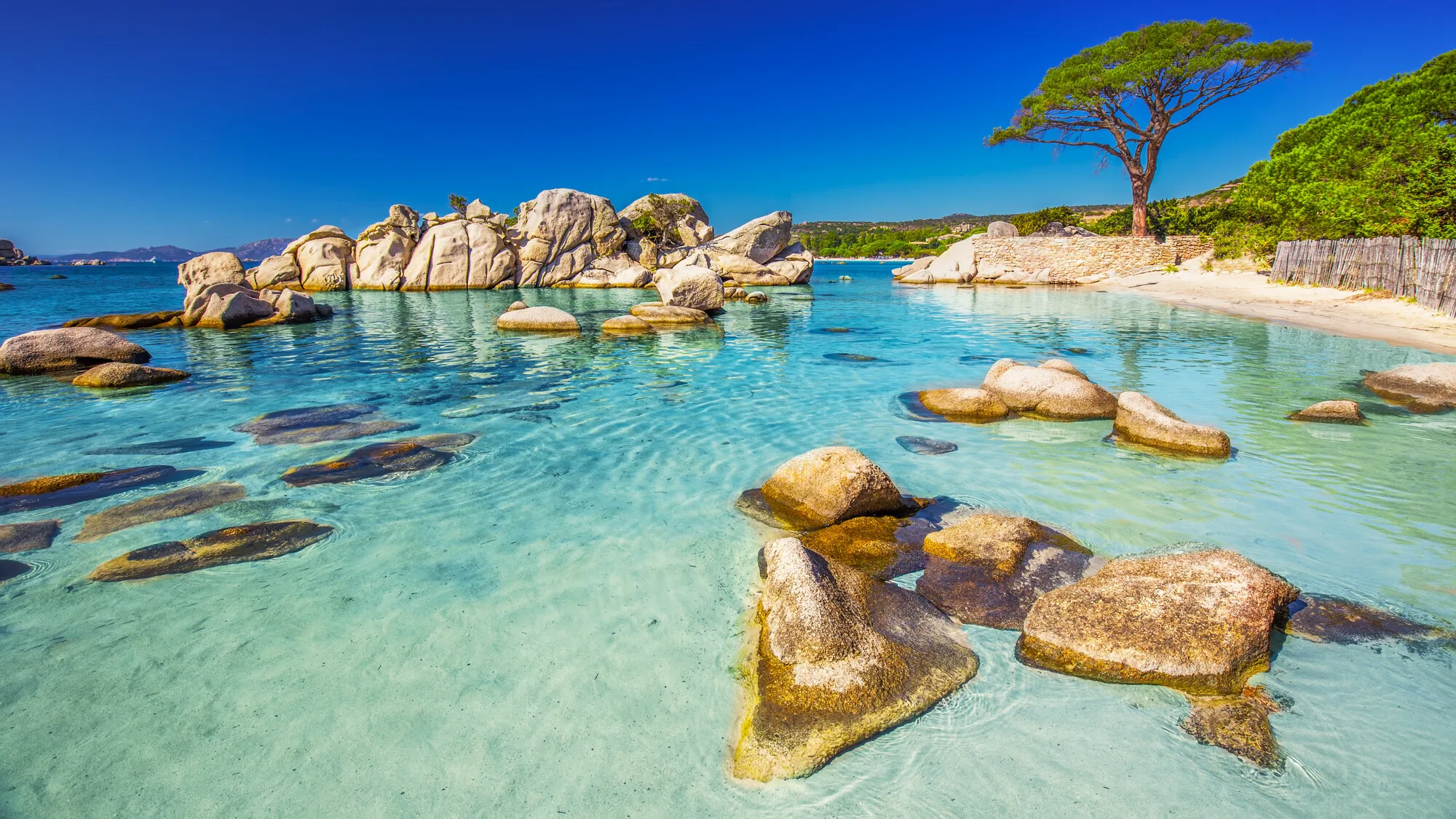
The south has the best-known white-sand beaches: Palombaggia and Santa Giulia near Porto-Vecchio, the shell-shaped Rondinara between Porto-Vecchio and Bonifacio, and Roccapina, overlooked by a lion-shaped rock, on the road to Sartène. In the north, Saleccia and Lotu line the Agriates desert: you get there by boat from Saint-Florent, by a long dirt track or on foot along the coastal path.
Near Ajaccio, Capo di Feno is a windswept sandy beach popular with surfers. On Cap Corse, the dark-pebble beach at Nonza is reached by a stairway from the village.

Cap Corse
The Cap Corse peninsula stretches for about forty kilometres north of Bastia. The D80 road loops around it, past fishing villages, Genoese towers and small harbours. On the east side, Erbalunga and its port; at the tip, Centuri, known for spiny lobster; on the west side, Nonza, perched on a rock above a beach of dark pebbles that come from the spoil of the former Canari asbestos mine.
The customs officers' path links Macinaggio to Centuri along the north coast, and the wine estates produce Muscat du Cap Corse. Seneca's Tower, above Luri, is reached on foot from the Col de Santa Lucia.

The Sanguinaires Islands
At the entrance to the Gulf of Ajaccio, the Sanguinaires archipelago lines up four islets of dark rock that turn red at sunset. The largest, Mezu Mare, has a lighthouse and an old Genoese tower; some boat trips land there.
On the mainland, the Sanguinaires road leads to the Pointe de la Parata, topped by a Genoese tower: a path loops around it and gives the widest view of the archipelago. Boats leave from Ajaccio harbour and Porticcio.

Lakes Melo and Capitello
At the head of the Restonica valley, above Corte, Lake Melo (1,711 m) and Lake Capitello (1,930 m) are the island's most visited mountain lakes. The trail first climbs to Melo over rock slabs, some fitted with chains, then continues to Capitello, framed by sheer walls.
The storms of November 2023 damaged the valley. From 1 May to 30 September 2026, the C13 shuttle links Corte station with the A Frasseta terminus, with several stops in the valley. Further north, Lake Nino, in the Niolu, is reached by other trails.

The inland villages
In the Balagne, Sant'Antonino, listed among the Most Beautiful Villages of France, coils around a hilltop above the plain of L'Île-Rousse. To the west, Piana, also listed, overlooks the calanques; higher up, Evisa sits above the Spelunca gorge, which you walk down towards Ota. Cargèse, on the coast, has two churches facing each other, one Latin, the other of the Greek rite, a legacy of the Greek community that settled in Corsica in the late 17th century.
In the Alta Rocca and Taravo, Zicavo is a starting point for the Coscione plateau. These villages are linked by narrow roads through chestnut woods and maquis.

The Cavu natural pools
In the hills behind Porto-Vecchio, the Cavu river comes down the mountain in a chain of clear pools carved into the granite, between smooth boulders and pines. You swim in water cooler than the sea, and paths follow the stream.
The pools nearest the car parks are the busiest; walking upstream you find quieter ones. The site lies above Sainte-Lucie-de-Porto-Vecchio, on the road towards Zonza.
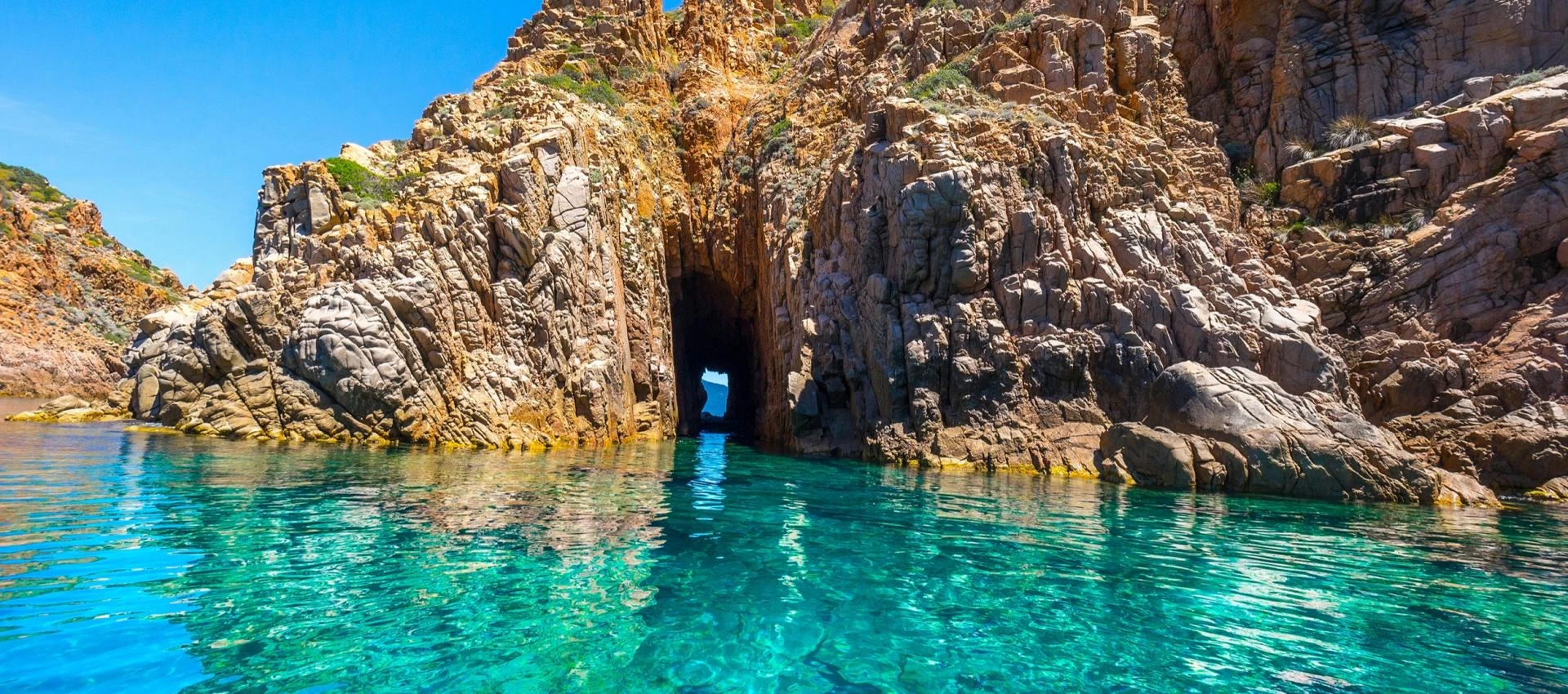
Scandola and Girolata by boat from Calvi
A trip with a local guide aboard a 48-seat boat: about 1 hr 15 at sea to the Scandola reserve, which the boat follows close to the cliffs and caves, then a stop in Girolata, a village reached only by sea or on foot. The highlight: gliding between the reserve's red porphyry rocks.
Two options: the full day (6 hrs, with 1 hr 30 in Girolata for lunch, meal not included) or the afternoon (4.5 hrs, 30-minute stop). Allow €80 per person on GetYourGuide, with free cancellation. There is no swimming stop from the boat, which stays out of the no-anchoring zones.
- 4.5 or 6 hrs
- €80 per person (GetYourGuide price 2026)
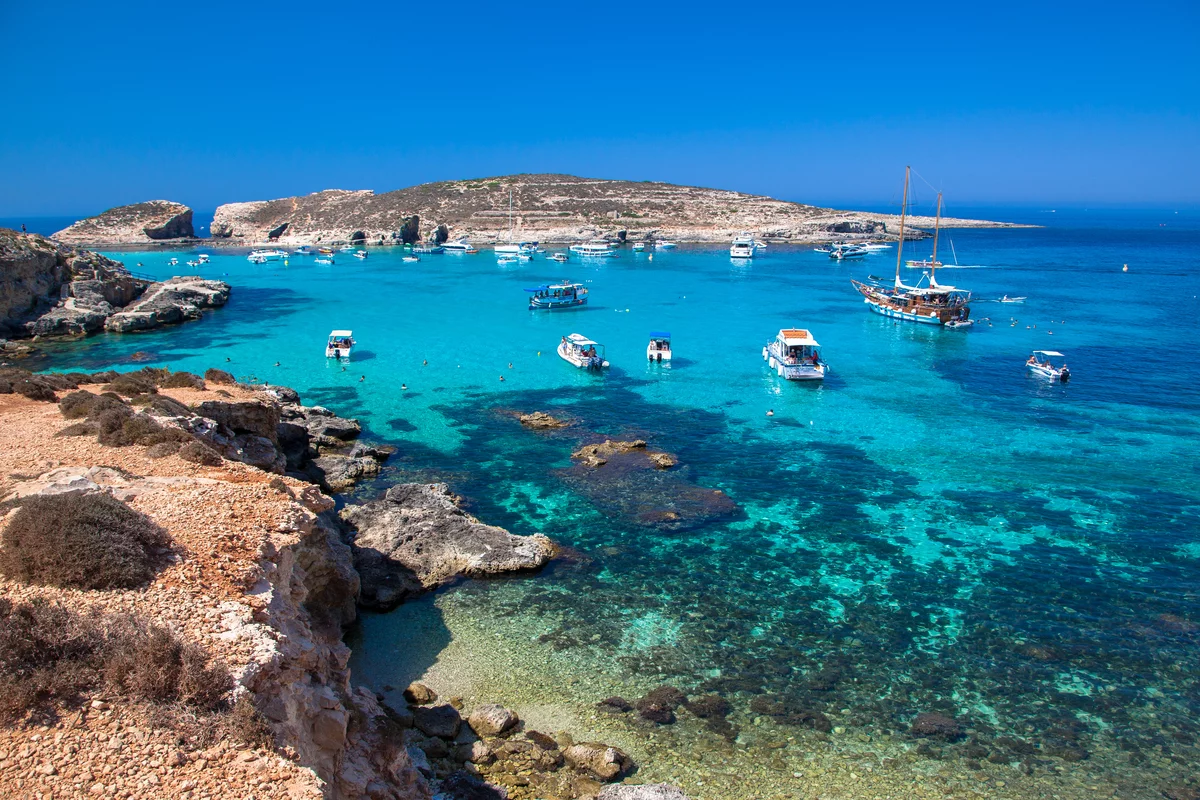
Lavezzi islands and Bonifacio sea caves by boat
A half-day at sea from Bonifacio harbour: the cliffs and old town seen from the water, the Saint-Antoine and Sdragonato caves, the Sperone headland, then the Lavezzi archipelago, with swimming stops in the coves and a snorkelling session, mask and snorkel provided. The highlight: the turquoise water between the Lavezzi granite boulders.
Allow €87 per person on GetYourGuide, with free cancellation, snacks and drinks included. Inside the reserve the crew keeps out of the no-navigation zones; if you go ashore, stay on the marked paths.
- 4 hrs
- €87 per person (GetYourGuide price 2026)
Sunset at the Sanguinaires Islands by RIB
A rigid-inflatable boat trip from Ajaccio or Porticcio to the Sanguinaires archipelago, with a possible stop on Mezu Mare to explore the island, a swim in a cove and a Corsican aperitif at sunset. The highlight: the rock turning red as the sun goes down.
Allow €50 per person on GetYourGuide, with free cancellation. A RIB is bumpier than a large boat: bring a windbreaker for the ride back.
- 2.5 to 3 hrs
- €50 per person (GetYourGuide price 2026)
Cap Corse and the Agriates beaches by boat from Saint-Florent
A small-group day from Saint-Florent: north along Cap Corse to the Pigeons cave and the dark-pebble beach at Nonza, then back towards the Agriates desert, with a swim at Lotu and a long stop on Saleccia beach, lunch included. The highlight: the white sand of Saleccia, with no paved road leading to it.
Paddleboards and snorkelling gear are on board. Allow €110 per person on GetYourGuide, with free cancellation. It is the easiest way to reach Saleccia without tackling the dirt track.
- 6 hrs
- €110 per person (GetYourGuide price 2026)
Getting there
By plane to Ajaccio, Bastia, Calvi or Figari, or by ferry from Marseille, Toulon and Nice.
Plane: four airports — Ajaccio, Bastia, Calvi and Figari — connected to several French and European cities.
Ferry: from Marseille, Toulon and Nice to Ajaccio, Bastia, L'Île-Rousse, Calvi, Propriano or Porto-Vecchio, with Corsica Linea, La Méridionale and Corsica Ferries. Bringing your own car avoids renting on the island; book well ahead in summer.
If you sail from Marseille, the city is worth a night before the crossing: see the 12 must-see attractions in Marseille.
Getting around
A rental car is by far the most practical option: public transport links the main towns but is scarce in rural areas.
In Corsica a car is the most flexible way to reach remote beaches, hilltop villages and mountain sites, on roads that are often narrow and winding (allow generous driving times). Rentals are available at the airports and ports; book early in July-August.
The bus network and the train (Chemins de fer de la Corse, the Ajaccio-Corte-Bastia line and the Calvi-L'Île-Rousse "Balagne Tramway") mainly serve the larger towns and thin out in the interior. Seasonal sea links run along part of the coast. For the interior and the GR20, hiking is the main means of access.
What to do
Bonifacio and the Lavezzi in the south, the Scandola reserve and the Piana calanques in the west, Corte and the Restonica lakes in the centre, Cap Corse and the Agriates in the north.
In the south, Bonifacio is explored on foot and then from the sea, with its sea caves and the Lavezzi archipelago; the beaches of Palombaggia, Santa Giulia and Rondinara are under an hour away, and the Bavella Needles lie inland. In the west, the Scandola reserve and the Piana calanques are seen by boat from Porto or Calvi, and Ajaccio has Maison Bonaparte and the Palais Fesch.
In the centre, Corte is the base for the Restonica valley and its lakes, and for a section of the GR20. In the north, the Cap Corse loop and the Agriates beaches, reached by boat from Saint-Florent, complete the tour of the island. For a one-week stay, pick two bases rather than changing hotels every night.
Food
Charcuterie (lonzu, coppa, figatellu), brocciu, sheep's cheeses, fiadone and AOC wines: Corsican food comes from the maquis and the mountains.
Corsican charcuterie (lonzu, coppa, prisuttu and, in winter, liver figatellu) comes from free-ranging pigs. Brocciu, a fresh whey cheese made from sheep's or goat's milk, fills omelettes, cannelloni and fiadone, a lemon cheesecake. Chestnut flour is used for fritters and pulenda.
On the coast, spiny lobster made Centuri's name. The island produces appellation wines (Patrimonio, Ajaccio, Muscat du Cap Corse) and chestnut beer. In the villages, farm inns often serve a single set menu: book ahead.
Climate & seasons
When to go to France?
Monthly averages over the past 5 years (Open-Meteo).
Best months
- June
- July
- August
- September
Avoid
- January
| Jan | Feb | Mar | Apr | May | Jun | Jul | Aug | Sep | Oct | Nov | Dec | |
|---|---|---|---|---|---|---|---|---|---|---|---|---|
| Our take | ||||||||||||
| Weather | ||||||||||||
| High | 4° | 6° | 7° | 10° | 14° | 21° | 24° | 23° | 18° | 14° | 8° | 6° |
| Rain (mm) | 165 | 94 | 125 | 114 | 117 | 39 | 22 | 40 | 78 | 125 | 180 | 142 |
| Hiking & nature | Hiking & nature May | Hiking & nature June | Hiking & nature July | Hiking & nature August | Hiking & nature September |
What to do by season (autumn)
-
Hiking & nature
Mild temperatures, stable conditions.
When to go
May-June and September offer the best balance: warm sea, walkable trails and fewer crowds than July-August.
Spring (May-June): mild weather, blooming landscapes, ideal for hiking and towns.
Summer (July-August): peak season, lively beaches and warm sea, but crowded and pricey; book early.
Autumn (September-October): still-warm sea, fewer crowds, great for both coast and mountains.
The GR20 and high-altitude lakes run from mid-June to late September.
Where to stay
Ajaccio and Porto-Vecchio for the coast and beaches, Corte for the mountains, Calvi and the Balagne for the northwest.
Ajaccio (west): cultural and seaside base, well connected.
Porto-Vecchio (southeast): close to Palombaggia and Santa Giulia beaches.
Bonifacio (south): dramatic cliffs.
Calvi & L'Île-Rousse (northwest): Balagne, beaches and hilltop villages.
Corte (centre): ideal for hiking and mountain valleys.
Safety
The main risks are natural: summer wildfires, mountain storms and rough seas. Emergencies: 112, ambulance 15, police 17, fire brigade 18, sea rescue 196.
In summer the wildfire risk is high: never light a fire in the maquis, and check access to the massifs, which may be restricted on very windy days. In the mountains, storms often build in the afternoon; on the GR20 and towards the lakes, start early. At sea, the wind picks up quickly in the Strait of Bonifacio.
On the narrow, winding roads, watch out for free-roaming animals (cows, pigs) and for overtaking on bends. Emergency numbers: 112, ambulance 15, police 17, fire brigade 18, sea rescue 196.
Formalities
Corsica is a French region: EU citizens enter with a valid ID card or passport, without a visa.
Corsica is part of France and the Schengen area. European Union citizens travel with a valid ID card or passport, without a visa. Non-EU travellers follow Schengen entry rules: the European Entry/Exit System (EES) records their crossings at external borders, and the ETIAS authorisation is not yet in operation, with no launch date set (September 2026).
The currency is the euro. Mobile coverage is good on the coast, more limited in the mountains and in some valleys, such as the Restonica.
FAQ
Access, the GR20, Scandola and Lavezzi rules, the Restonica shuttle: the practical answers for planning a trip to Corsica.
How do you get to Corsica?
By plane to one of the four airports (Ajaccio, Bastia, Calvi, Figari) or by ferry from Marseille, Toulon and Nice to Ajaccio, Bastia, L'Île-Rousse, Calvi, Propriano or Porto-Vecchio (Corsica Linea, La Méridionale, Corsica Ferries).
How long is the GR20 and how many stages does it have?
About 180 km in 16 stages, between Calenzana in the north and Conca in the south. It is known as one of Europe's toughest long-distance trails, the northern half being the most technical.
When is the best time to hike the GR20?
From mid-June to late September, once the snow has melted at altitude. Outside that window some sections remain snowy or dangerous.
Can you land in the Scandola reserve?
The reserve is visited from the sea. Hiking, climbing, camping, fires, scuba diving and all recreational fishing are banned; anchoring is allowed only in daytime, and never in the strict reserve. Boat trips leave from Porto, Calvi or Ajaccio, often with a stop in the village of Girolata.
What are the rules on the Lavezzi islands?
The archipelago is an enhanced protection zone of the Bouches de Bonifacio nature reserve. On Lavezzu island, stay on the marked paths, do not climb on the rocks (nesting areas) and take your rubbish away; anchoring on Posidonia seagrass is banned. The island has no drinking water, toilets or restaurant.
How do you reach Lakes Melo and Capitello from Corte?
From 1 May to 30 September 2026, the C13 shuttle runs from Corte station to A Frasseta, at the head of the Restonica valley: €4 return, free for under-8s, booking required on the Via Corsica app.
Do you need a car to visit Corsica?
It is strongly recommended. Trains and buses link the main towns (Ajaccio, Bastia, Corte, Calvi) but are scarce in rural areas; a car gives access to remote beaches and mountain villages.
When should you visit Corsica to avoid the crowds?
In May-June and September-October: the sea is already or still warm and the beaches are quieter than in July-August.
Sources
The figures in this guide come from the sources below, checked on the publication date.
Leave a comment
Share your thoughts or travel experience. Your email will not be published.