

For a first two-week trip to the Caucasus, choose Georgia. One reason settles it: you can stay a year without a visa, European travellers can enter on a national ID card, there are direct flights from several European cities, and no major tourist region carries a travel warning. Armenia ticks none of those four boxes as cleanly.
This is not a disguised draw. But Georgia has two real drawbacks that most comparisons pass over in silence, including a mandatory insurance requirement that came into force on 1 January 2026. And Armenia clearly wins for three traveller profiles we set out at the end. All the safety and entry information below was verified on 31 July 2026 against French government advice: it changes fast, so cross-check before booking.
Book the activities from this article
Our picks for Georgia and Armenia, well rated and free to cancel.
-
Book this activity
Kakheti wine day from Tbilisi
from €34 per person (GetYourGuide rate, 2026)
-
Book this activity
Georgian Military Road to Kazbegi
from €46 per person (GetYourGuide rate, 2026)
-
Book this activity
Khor Virap, Areni-1 cave and Noravank from Yerevan
from €31 per person (GetYourGuide rate, 2026)
Affiliate links: Travel Advice earns a commission if you book, at no extra cost to you. Learn more
Which is easier to reach from Europe?
Georgia, and the gap comes down to departure airports. Tbilisi has year-round direct flights from Paris Charles de Gaulle with Georgian Airways, and also from Nice. Transavia adds seasonal routes from Orly and CDG, broadly July to October. Yerevan, by contrast, is served directly only from Paris CDG, by Air France and FlyOne Armenia, on a flight of about 4h40.
If you live in southern France, that detail reshapes the whole trip. A direct flight from Nice saves the train to Paris, a hotel night, or a connection in Istanbul with five hours to kill. For Armenia, a traveller from Marseille or Toulouse goes via Paris or accepts a stopover.
A useful reminder: flight schedules change with every IATA season, and a seasonal route can vanish from one year to the next. Always check directly with the airlines before building your itinerary. We deliberately quote no prices here, because no fare can be verified in any lasting way.
Entry rules: one year against six months, but mandatory insurance
Georgia offers one of the most generous regimes in the world: visa-free short stays run up to one year, meaning 365 days. Better still, it accepts a secure national ID card, although the French foreign ministry recommends travelling with a passport. Armenia waives visas for stays under six months in any one-year period, but a passport is required: an ID card is not listed as an accepted document.
For a two-week trip, that difference in duration changes nothing. What changes is the document in your pocket, and the number of things that can go wrong at the border.
The 2026 change that costs money in Georgia
Since 1 January 2026, health and accident insurance is mandatory to enter Georgia. It must be written in English or Georgian, cover a minimum of 30,000 GEL, roughly $11,000, and you must be able to produce it at the border. This is no longer a travel-agency suggestion: it is a condition of entry. Print the certificate, in English, before you leave.
Armenia imposes no equivalent obligation. On this specific point, and it is the only one where the reversal is this clear, entering Armenia is lighter. Expect to fill in a customs form on arrival, though: keep it until you leave the country. Check your passport validity too, as a fine applies if it has expired by the time you depart.
Entry rules verified on 31 July 2026. Conditions can change without notice: check official country advice before buying tickets.

Safety: which areas should you avoid in each country?
Aside from two separatist territories, Georgia has no amber zone on the French government map, while Armenia has one, and it contains a major tourist site. The ministry writes plainly that "Georgia is, as a whole, a safe country in which it is possible to travel without great difficulty". That is rare, and it is the foundation of our verdict.
Georgia: two red zones and the trap of blurred limits
Abkhazia and South Ossetia are formally advised against, along with their immediate surroundings. The point to remember sits in one ministry phrase: the limits of these zones "are not always marked on the ground". A hiker can therefore approach without knowing it and risk arrest by the de facto authorities. Do not improvise a mountain route in the north without a local guide. Information updated 5 March 2026, page updated 17 July 2026.
The Georgian drawback nobody mentions
Since 28 November 2024, demonstrations have been held daily in Tbilisi and several Georgian cities. Taking part exposes you to a 5,000 lari fine or administrative detention of up to fourteen days. The concrete point for a traveller lies elsewhere, and it is little known: travellers are systematically photographed when crossing the border, and those photos allow a link to be established, through facial recognition, with people identified at protest sites. Possible penalties: a fine of up to 5,000 lari and a ban from the territory for up to three years.
The ministry indeed invites travellers to inform themselves about risk factors for refused entry, "among them their participation in demonstrations in Georgia or their social media activity". That last update is dated 27 February 2026. In practical terms: Georgia remains safe for a tourist, but it is not a country where you attend a protest out of curiosity, or comment lightly on local politics.
Armenia: the amber zone contains Tatev monastery
Border areas with Azerbaijan are formally advised against: the entire eastern and south-eastern fringe, including a strip east of Lake Sevan around Vardenis, and the Artsvashen enclave. Map updated 4 March 2026.
Beyond that, Syunik province, in the south of the country, is classed amber, meaning advised against except for essential travel, outside the red zones. Yet Syunik is where Tatev monastery stands, one of Armenia's most photographed sites and often sold as an obvious excursion from Yerevan. Almost no comparison says so. The rest of the country is under heightened vigilance. If Tatev is your main reason for going, weigh the decision with the official map in front of you.
Two factual points not to ignore. Photography is prohibited near all Armenian border areas, and drones require authorisation. The ministry also reports a rise in sexual assaults targeting foreign women, in Yerevan and in the regions, and advises caution for women travelling alone as well as LGBT+ travellers (emergencies: 102). That is not a reason to give up, it is a reason to prepare differently.
Nagorno-Karabakh: the situation as of 30 June 2026
The official wording leaves no ambiguity: "It is impossible to travel to Azerbaijan (including Nagorno-Karabakh) from Armenia. Any attempt is formally advised against." The tours to Stepanakert that existed before 2023 no longer exist. The peace process initialled in Washington on 8 August 2025 is not finalised: treat neither the peace as settled nor the borders as reopened.
Safety information verified on 31 July 2026 against French government travel advice. It can change from one day to the next in this region: the official source decides, not this article.
« The Ijevan–Noyemberyan section of the M16 road used to reach Georgia crosses an area occasionally subject to fire from Azerbaijan. Travellers wishing to move between Armenia and Georgia are advised to take alternative routes or to favour air or rail travel. »
Can you combine Georgia and Armenia in two weeks?
Yes, but not by bus, contrary to what dozens of blogs write. The quotation above is explicit: the M16 road linking Armenia to Georgia crosses a sector occasionally hit by fire, and the ministry recommends alternative routes, air or rail. The overnight Tbilisi-Yerevan bus, presented everywhere as an obvious budget option, deserves at the very least a check of its routing.
The officially endorsed option is rail. French government advice presents the Yerevan-Tbilisi train as a practicable and safe journey, around 350 km covered in about twelve hours. It is slow, it runs at night, and that is precisely why it works: you lose a night, not a day of sightseeing.
Then there is geography, which decides for you. Armenia has only two open land borders, with Georgia and with Iran, the crossings with Turkey and Azerbaijan being closed. And travel to Iran is advised against altogether. Georgia is therefore the only practicable land gateway to Armenia for most European travellers. That reverses the usual logic: you do not choose Armenia "instead of" Georgia, you reach it through Georgia.
Our advice for two weeks: do not try to do everything. Ten days in Georgia plus four in and around Yerevan makes a coherent trip. Seven and seven will have you spending more time in transit than in front of the landscapes.

Which is cheaper on the ground?
Georgia, and that runs against intuition. Armenia has the reputation of being the more modest country, but the comparative index from Numbeo, recorded from 22 to 28 July 2026, puts the cost of living about 16% higher in Armenia than in Georgia excluding rent, and close to 19.5% including rent. Rents there are reportedly about 31% higher.
In detail, the gap concentrates on items you feel as a traveller: restaurants roughly 4.7% dearer, groceries about 9%, and above all public transport around 61% more expensive in Armenia. Over two weeks that does not add up to hundreds of euros, but the idea that Armenia is the Caucasus budget destination does not survive the data.
The methodological caveat is essential and we state it plainly. Numbeo is a crowdsourced database fed by internet users, here with between 135 and 269 contributors per country. It is not an official statistic. Treat these percentages as a relative index between two countries, never as a budget. You will deliberately find no daily budget in this article, no meal, hotel or flight price: those figures circulate everywhere and can be verified nowhere.
Landscapes and heritage: two different imaginations
Georgia sells verticality, Armenia stone and silence. That is the real dividing line, far more than kilometres or budgets. The Georgian Greater Caucasus lines up glacial valleys, villages of medieval towers and peaks above 5,000 metres. Armenia, a volcanic plateau topping out at Aragats, plays on bare highlands, deep gorges and monasteries perched on the edge of the void.
What Georgia has more of
Variety, in a compact country. You go from a capital of wooden balconies to the stone towers of Ushguli in Svaneti, then to the Black Sea and the vineyards of Kakheti, without ever driving for whole days. That diversity of scenery on a single loop is what makes the country so comfortable for a first trip, as our Georgia road trip guide, from the Caucasus to the Black Sea, sets out.
What Armenia has more of
Density of heritage, and emotion. Armenian monasteries are not monuments, they are living places of unbroken Christian continuity since the 4th century, often perched in spectacular settings. If your trip revolves around religious architecture, archaeology and long history, Armenia will be stronger than Georgia, with no argument. Our Armenia travel guide, between Caucasus monasteries and the wine route, details those itineraries.
One field detail that matters for hikers: in Armenia, mountain trails are largely unmarked. In Georgia, trekking routes are better identified, but the natural hazards are very real, and we come back to that.

Who really has the world's oldest wine?
Both claims are accurate, because they are not about the same thing. That is the only honest way to settle it, and it fits in one sentence: Georgia holds the oldest chemical trace of grape wine, Armenia the oldest known production facility. About two thousand years separate the two finds.
Georgia: the oldest residues, around 6000 BC
A study by Patrick McGovern and co-authors, published in PNAS on 28 November 2017, identified tartaric acid in eight jars from the Gadachrili Gora and Shulaveris Gora sites, some fifty kilometres south of Tbilisi. Dating: 6000 to 5800 BC. It is the oldest biomolecular evidence of grape wine known to date.
Armenia: the oldest winery, around 4100 BC
The Areni-1 cave, in Vayots Dzor, yielded something else entirely in 2011: a press, fermentation vats, cups and grape remains, dated to roughly 4100 to 4000 BC. In other words a genuine winemaking installation, on a near-commercial scale, as National Geographic documented.
Both statements can therefore coexist without either being false. Traces on one side, infrastructure on the other. For a wine-focused trip, Georgian Kakheti today offers a markedly higher density of estates and qvevri, with vines cultivated continuously. Areni is visited as a major archaeological site, with the wine region around it.

Driving or not: what official advice says about the roads
Neither country is restful behind the wheel, and both official pages use blunt language. For Georgia, French government advice states that "road insecurity is high". For Armenia, that "the bus network is run-down". So you choose between a country where driving is risky and a country where the public alternative is tired.
Paperwork: a detail that costs
In Armenia, a national licence is enough. In Georgia it is accepted, but an international driving permit is strongly recommended, with police tolerating the national licence for a short stay. An international permit is free and can be requested online: do it if you are renting a car in Georgia.
Georgia: good motorways, unpredictable secondary roads
- Good-quality motorway network, average secondary and urban roads, with frequent potholes.
- A 4x4 is preferable as soon as you leave the main axes, especially towards the mountains.
- The capital accounts for nearly half the country's accidents. Take extra care in Tbilisi.
- Livestock country without fences: cows and horses on the road, above all at night.
- Permitted blood alcohol: 0 g/l.
- The train is only genuinely useful on the Tbilisi-Batumi axis; elsewhere the network is sparse and slow.
Armenia: mountainous, winding, tiring
- Mountainous terrain and very winding roads: driving is tiring, expect low average speeds.
- Many degraded roads, with pedestrians and animals on the carriageway.
- Avoid driving at night outside towns.
- Zero tolerance on alcohol.
- Snow tyres required from November to March.
Mountains: the insurance point, again
In Georgia, mountain roads are particularly dangerous during snowmelt and spring rains, with avalanches, rockfalls and landslides. Crucially, search and rescue costs fall to the visitor. Alpine-club style insurance, covering mountain rescue, is advisable. It has nothing to do with the health insurance now required on entry: you need both if you are going hiking.

Where will you meet the fewest tourists?
In Armenia, by a wide margin: Georgia receives roughly three to four times more visitors. Georgia recorded 6,856,809 international visits in 2025, up 6.2%, including about 5.5 million tourist visits, a record. Armenia sits at an order of magnitude of around 1.5 million tourists over the first eight months of 2025, peaking in August, according to Armenian statistical committee data relayed by the press.
These two figures cannot be compared to the decimal, since counting methods differ between countries. Take the order of magnitude, which is large and visible on the ground. In Tbilisi in summer, in the Kakheti vineyards and on the coast, you will rarely be alone. In Armenia, outside Yerevan and the two or three headline monasteries, visitor numbers stay low.
That is also the argument that tips some travellers over. If your number-one criterion is getting off the circuit, Armenia is objectively the less touristed of the two. The trade-off is a less polished tourism industry: fewer places to stay, fewer guides, less waymarking.
A word on season, without inventing a magic window. The only official markers are the snow tyres required in Armenia from November to March, which in practice bounds the comfortable driving season to April-October, and the heightened danger of Georgian mountain roads during snowmelt and spring rains. Add pickpocket vigilance in summer on the Georgian coast and in busy areas.
So, which one for you?
Here is the answer by profile, without hedging. The general verdict remains Georgia for a first trip, because it combines wider air access, more flexible entry rules, no amber zone and a lower cost on the ground. But four profiles should choose Armenia.
Choose Georgia if…
- It is your first trip to the Caucasus. Varied landscapes on a short loop, established tourism, a country described as safe as a whole by official advice.
- You are coming to hike in high mountains. Svaneti, Kazbek, Tusheti: the Greater Caucasus has no Armenian equivalent, and the trails are better identified.
- You live in southern France. The year-round direct Nice-Tbilisi flight is a concrete advantage with nothing to match it on the Armenian side.
- Your budget is tight. The Numbeo index puts Georgia about 16% below, with markedly cheaper public transport.
- You are travelling on a national ID card or a passport that expires soon. Georgia accepts a secure ID card.
Choose Armenia if…
- Religious heritage and archaeology drive your trip. On monasteries, long Christian history and sites like Areni, Armenia is richer and denser.
- You are escaping the crowds. Three to four times fewer visitors, and a country where you can still walk alone.
- You have already done Georgia. The night train from Tbilisi, recommended by official advice over the road, makes it a natural sequel.
- You do not want an insurance requirement at the border. Armenia imposes no equivalent to Georgia's 30,000 GEL obligation.
Two special cases
Women travelling alone: both countries are practicable, but the Armenia page reports a rise in sexual assaults targeting foreign women, in Yerevan and in the regions. If this is your first solo trip in the region, Georgia offers a more structured setting, with more accommodation and more transport shared between travellers. In both cases, read the official page in full before leaving.
A trip built around Tatev: check the Syunik map before building your itinerary. This emblematic site sits in an amber zone, advised against except for essential travel. That is written almost nowhere else, and it may change your decision.
One last reflex, valid for both countries: the South Caucasus situation shifts in jolts. Today's zones, entry obligations and movement advice may not be those of your departure date. All the safety and entry data in this article were verified on 31 July 2026 against French government travel advice. Reread the country page the week of your flight, ten minutes well spent.
Activities to book
Four day trips from Tbilisi and Yerevan, picked and checked on GetYourGuide, to Kakheti, the Greater Caucasus and the Armenian monasteries this comparison covers (partner links, free cancellation). None of them goes to Syunik, where Tatev is.
Kakheti wine day from Tbilisi
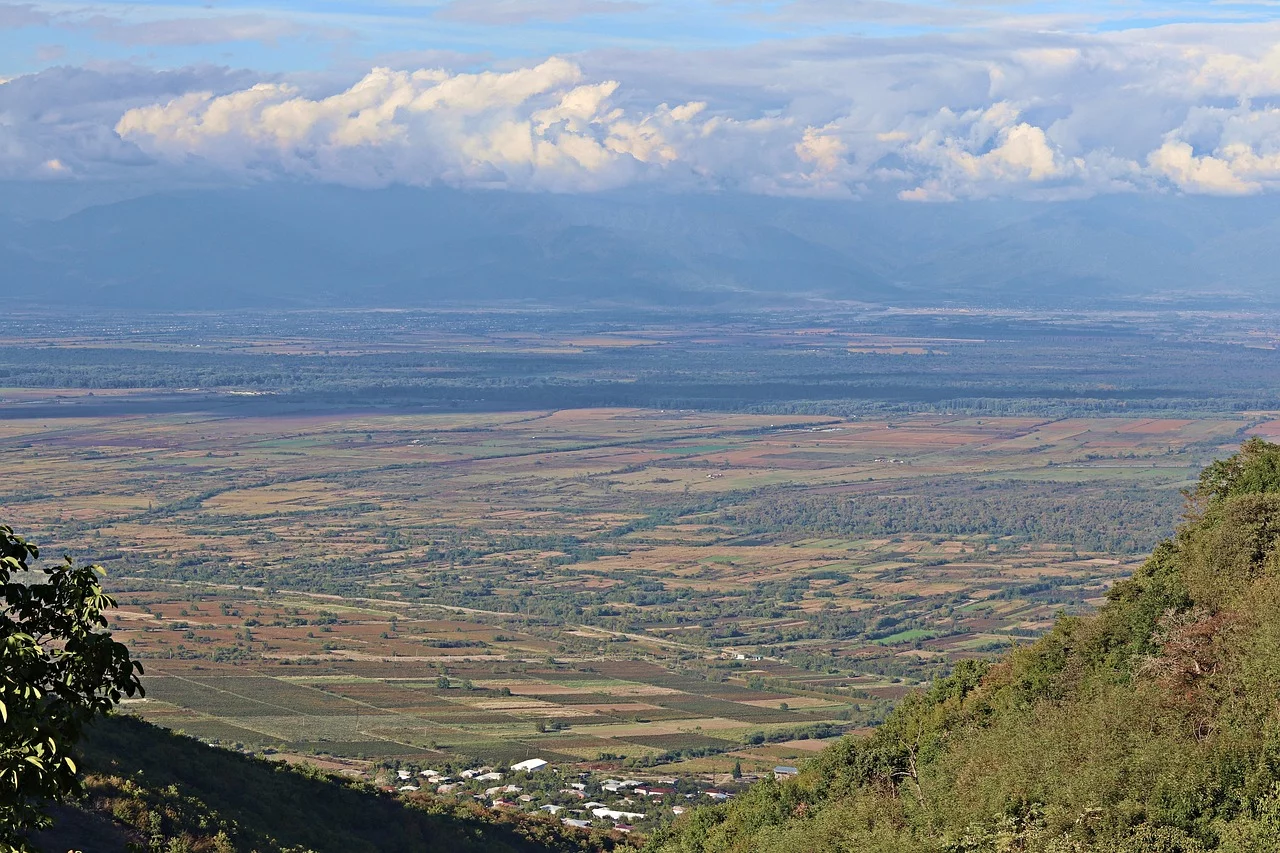
You leave at 11 am from the Giant Bicycle monument in Tbilisi. There are tastings of Georgian wines and spirits at KTW Warehouse, then at the Vineria cellar, a stop in Badiauri village to try churchkhela, a visit to Bodbe Monastery, a walk around Sighnaghi and its walls above the Alazani Valley, and a sunset stop. Back around 10 pm.
From €34 per person, with an English-speaking guide, transport and entry fees included; the 10 premium tastings depend on the option, and lunch costs extra. The simplest way to see Kakheti if you are not renting a car.
- 10 hours
- from €34 per person (GetYourGuide rate, 2026)
Georgian Military Road to Kazbegi
A day by air-conditioned bus from Vakhtang Gorgasali Square in Tbilisi: Ananuri fortress above the Zhinvali reservoir, the view and the Friendship Monument at Gudauri, then a 4x4 jeep ride up to Gergeti Trinity Church, at 2,170 m, facing Mount Kazbek. A wine and honey tasting is included.
From €46 per person, with a Russian- or English-speaking guide. The jeep to Gergeti is not included (20 GEL, cash preferred), and neither are meals. The route can change in bad weather. It is a way to see the Greater Caucasus without driving those mountain roads yourself.
- 10.5 hours
- from €46 per person (GetYourGuide rate, 2026)
Khor Virap, Areni-1 cave and Noravank from Yerevan
You meet in front of the Tamanyan statue near the Cascade in Yerevan. The first stop is Khor Virap monastery, facing Mount Ararat, followed by the Areni-1 cave, where the oldest known winery was found, Noravank monastery among its red cliffs, and a tasting of local wines in Areni village.
From €31 per person, with an English- or Russian-speaking guide depending on the option. Entry tickets are not included and lunch is optional; the tasting is part of the group tour. The day stays in the Ararat and Vayots Dzor provinces, outside Syunik.
- 8 to 9 hours
- from €31 per person (GetYourGuide rate, 2026)
Garni, Geghard and a lavash workshop from Yerevan
You leave from the Komitas State Conservatory in Yerevan. There is a stop at the Charents Arch for the view of Ararat, then Garni temple, the only building from the pagan era still standing in Armenia, Geghard monastery and the Symphony of Stones, the basalt columns of the Azat gorge. The day ends with a lavash baking class, the Armenian flatbread.
From €27 per person, with transport and the class included; guides speak Armenian, English, French, Italian, Spanish or Russian. Entry fees are extra (1,500 AMD at Garni, 300 AMD at the Symphony of Stones), and lunch costs about 5 to 10 dollars. It is the shortest trip for seeing monasteries around Yerevan.
- 6 hours
- from €27 per person (GetYourGuide rate, 2026)
Sources
The figures in this guide come from the sources below, checked on the publication date.
Leave a comment
Share your thoughts or travel experience. Your email will not be published.