

Contents 28
Split, Croatia's second city and the main port of the Dalmatian coast, has a rare feature: its historic centre fills Diocletian's Palace, a Roman emperor's residence built around 295-305 and a UNESCO World Heritage Site since 1979. People live, drink their coffee and do their shopping inside ancient walls.
Around the palace, the Riva runs along the harbour, the wooded Marjan hill closes the city to the west and Bačvice beach is a quarter of an hour's walk away. Ferries and catamarans leave the port for Hvar, Brač, Šolta and Vis.
Here are 11 things to do in Split, with prices checked in 2026, day trips (Krka, the Blue Cave) and links to our guides to Hvar and Dubrovnik.
Overview
Croatia's second city, Split is built around Diocletian's Palace, a 4th-century Roman palace listed by UNESCO and still lived in today.
Split is Croatia's second-largest city and the main port on the Dalmatian coast. Its historic core is unique in the world: it sits inside Diocletian's Palace, a Roman imperial residence built between 295 and 305 AD. People still live within its walls, cellars and towers, which also house shops, cafés and apartments.
The palace and historic centre have been a UNESCO World Heritage Site since 1979, under the name "Historical Complex of Split with the Palace of Diocletian". Beyond its ancient stones, Split is a genuine Mediterranean city: a seafront promenade (the Riva), beaches such as Bačvice, the wooded Marjan hill, and an ideal launch point for the islands of Hvar, Brač, Šolta and Vis.
11 places to take with you
In the guide's order, ready for Google Maps or your GPS.
Book the activities from this guide
Our picks for Split, well rated and free to cancel.
-
Book this activity
Guided walking tour of Diocletian's Palace
From €30 per person (GetYourGuide price 2026)
-
Book this activity
Day trip to Krka National Park from Split
From €35 per person, park entry extra (GetYourGuide price 2026)
-
Book this activity
Blue Cave, Vis and Hvar: 5-island speedboat tour
From €79 per person, Blue Cave entry extra (GetYourGuide price 2026)
Affiliate links: Travel Advice earns a commission if you book, at no extra cost to you. Learn more

Diocletian's Palace
Diocletian's Palace is the residence the Roman emperor Diocletian had built around 295-305 for his retirement. A fortified enclosure of about 30,000 m², it is laid out around the Peristyle, the colonnaded courtyard, with the emperor's mausoleum, now the Cathedral of Saint Domnius, and the Temple of Jupiter, now a baptistery.
After Salona fell in the 7th century, its inhabitants took refuge in the palace, which became the core of the city. It has been a UNESCO World Heritage Site since 1979 and is still a lived-in neighbourhood you can walk through freely. Beneath the southern half, the vaulted cellars, almost intact, mirror the layout of the vanished imperial apartments above.

Explore the old town
In Split, the "old town" is not a district around a monument: it is Diocletian's Palace itself, turned into a lived-in urban core. You enter through four Roman gates (the Golden, Silver, Iron and Bronze Gates) and come out onto the Peristyle, the emperor's former ceremonial courtyard.
Around it, stone lanes link the Cathedral of Saint Domnius, the Temple of Jupiter and squares such as the Pjaca (People's Square, just west of the walls) and Voćni trg, among shops, cafés and flats. Outside the Golden Gate stands Ivan Meštrović's statue of Gregory of Nin, a 10th-century Croatian bishop.

Riva promenade
The Riva (officially Obala hrvatskog narodnog preporoda) is the harbour promenade at the foot of the southern façade of Diocletian's Palace. A wide palm-lined esplanade with benches and café terraces, it runs from Republic Square (the Prokurative) in the west to the ferry terminal in the east.
It is the city's living room: people come for the late-afternoon stroll, a coffee facing the Adriatic and the sunset. It also hosts concerts and big celebrations, and excursion boats pick up their passengers here.

Marjan Hill
Marjan is the wooded hill covering the peninsula west of the historic centre. Covered in pines and crossed by trails, it is the park where Split's residents come to walk, run or cycle.
From the Vidilica viewpoint, above the Varoš district, the view takes in the city, the harbour and the islands of Brač, Šolta and Hvar. Further on, the trails pass small old churches, including Saint Nicholas (Sveti Nikola), and drop down to swimming coves on the south and west shores of the peninsula, such as Kašjuni.

Visit to nearby islands
Split is the gateway to the central Dalmatian islands. Hvar, the most popular, is reached by catamaran to Hvar Town or by car ferry to Stari Grad; Brač is famous for Zlatni Rat beach at Bol; Šolta, the closest, stays quiet; Vis, further out, is the base for the Blue Cave on Biševo; Korčula, further south, is better for an overnight stay.
All departures leave from the port, east of the Riva. Timetables change with the season and catamarans sell out quickly in summer.

Bačvice Beach
Bačvice is Split's city beach, in a sheltered bay a quarter of an hour's walk east of the palace. One of the town's rare sandy beaches, it shelves very gently, which makes it a good choice with children.
It is also the birthplace of picigin, the local game in which players keep a small ball in the air with the flat of their hand, standing in shallow water and diving to reach it. In the evening, the bars and clubs above the beach take over.

Visit to Salona
Salona, in Solin, about 6 km north-east of Split, was the capital of the Roman province of Dalmatia. The archaeological park preserves part of the walls, the amphitheatre, baths and several early Christian basilicas with their cemeteries.
It was from Salona, destroyed in the 7th century, that the refugees who settled in Diocletian's Palace came: the visit explains how Split began.

Museums and galleries
The Meštrović Gallery, in the villa sculptor Ivan Meštrović built at the foot of Marjan, gathers much of his work in its rooms and garden facing the sea. It is Split's standout museum.
Inside the palace, the Split City Museum (Papalić Palace) traces the city's history; the Archaeological Museum, north of the centre, displays finds from Salona; the Gallery of Fine Arts (Galerija umjetnina) shows Croatian painting.

Cruises and boat trips
Agencies along the Riva and at the port sell full-day or half-day trips: speedboat tours of the Blue Cave and the islands of Vis and Hvar, the Blue Lagoon near Trogir and Šolta, or a simple cruise along the Marjan coast. Krka National Park and its waterfalls, inland, are visited on a day trip by coach with a short river cruise.
Compare what is included: entry fees for the Blue Cave and Krka park are not always part of the price.

Night walk
In the evening, Split's life gathers inside the palace and along the Riva. Wine bars and terraces fill the courtyards and lanes within the walls, and the Peristyle comes alive with music on some summer nights. The lanes of Varoš, to the west, keep quieter konobas.
For dancing, the clubs are mostly above Bačvice beach. For a quiet end to the evening, head up Marjan to see the city lit up.

Events and festivals
The Split Summer Festival (Splitsko ljeto) stages theatre, opera, music and dance every summer, partly outdoors, in venues such as the Peristyle and the Croatian National Theatre. In July, Ultra Europe, a major electronic music festival, draws tens of thousands of visitors.
In winter, the carnival livens up the city in February. Dates change every year: check the tourist board's calendar before booking.
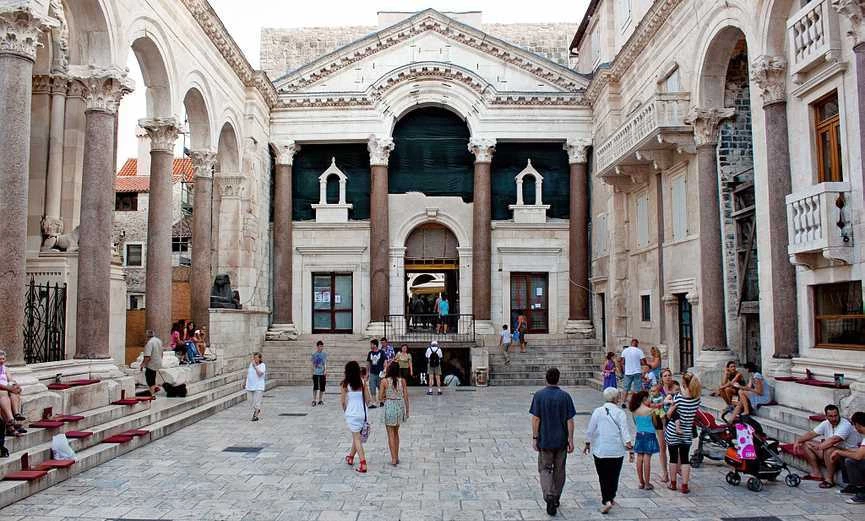
Guided walking tour of Diocletian's Palace
A tour with a Split guide, starting at the Golden Gate: the remains of the palace, the Peristyle, the Cathedral of Saint Domnius, the statue of Gregory of Nin and the seafront, with 1,700 years of the city's history told on the spot. The highlight: understanding how the refugees from Salona turned an emperor's palace into a city.
Allow from €30 per person on GetYourGuide for the basic tour (1.5 hours), in English or French depending on the slot, free cancellation up to 24 hours ahead. Entry to the cathedral and cellars is not always included: check the option you choose.
- 1.5 hrs
- From €30 per person (GetYourGuide price 2026)
Day trip to Krka National Park from Split
A day by coach from Split: about 1 hr 15 on the road, a 30-minute cruise on the Krka river, a one-hour guided walk along the boardwalks to the waterfalls, then two hours free in the park. On the way back, a swimming stop at Primošten, a small coastal town. The highlight: the Skradinski buk falls seen from the boardwalks.
Allow from €35 per person on GetYourGuide, with a reduced park entry fee, an English-speaking guide and free cancellation up to 24 hours ahead. Bring your swimsuit for the stop at Primošten.
- 9 hrs
- From €35 per person, park entry extra (GetYourGuide price 2026)
Blue Cave, Vis and Hvar: 5-island speedboat tour
A day by speedboat from Republic Square (Prokurative), 12 people at most: the Blue Cave on Biševo, the village of Komiža and the former Stupišće military base on Vis, the Budikovac lagoon, then Hvar and the Pakleni islands. The highlight: the blue light inside the cave when the sun is high.
Allow from €79 per person on GetYourGuide, free cancellation up to 24 hours ahead, English-speaking guide. Blue Cave entry (€18 to €24 depending on the season in 2026) is extra, and the cave closes in rough seas: the skipper then reorders the stops.
- 10.5 hrs
- From €79 per person, Blue Cave entry extra (GetYourGuide price 2026)
Kayaking on the Žrnovnica river and along the Stobreč cliffs
Three hours with an instructor, 20 minutes by minibus from the centre: after a safety briefing, you paddle down the Žrnovnica river estuary, facing the Mosor range, then follow the Stobreč cliffs at sea, with a snorkelling break. The highlight: going from the calm river water to the rocky coast.
Allow from €40 per person on GetYourGuide, run in English, suitable for beginners, free cancellation up to 24 hours ahead. Bring a swimsuit, sunscreen and clothes that can get wet.
- 3 hrs
- From €40 per person (GetYourGuide price 2026)
Getting there
Split Airport (SPU) is about 20 km away, linked to the centre by shuttle and public bus 37. Ferries and catamarans leave from the port next to the Riva.
By air: Split Airport (code SPU), in Kaštela, lies about 20 km west of the centre. An airport shuttle runs to the bus station, and public bus 37 also serves the city.
By ferry and catamaran: Split's port, east of the Riva, is the main port in Dalmatia. The Jadrolinija car ferry reaches Stari Grad (Hvar) in about 2 hours; catamarans (Jadrolinija, Krilo) go straight to Hvar Town, Bol (Brač), Vis or Korčula, foot passengers only. Krilo lists €25 one way Split-Hvar in 2026. In summer, book online: seats are tied to the departure you choose.
By bus and car: the bus and train stations are next to the port. The A1 motorway links Split with Zagreb and, southwards, continues as the coast road to Dubrovnik.
Hvar is the most popular day trip from Split: see which port to use for the car-free ferry, then the top 10 things to do on the island. Heading further south? See our Dubrovnik guide.
Getting around
The historic centre is walkable. Use Promet buses for outer districts and beaches, and ferries for the islands.
Split's historic core, around Diocletian's Palace and the Riva, is best explored on foot: it's a compact pedestrian area.
- Bus: the Promet network serves outer neighbourhoods, beaches and the bus station.
- Taxi and ride-hailing: regular taxis and apps (Uber, Bolt) operate in the city.
- Car: mainly useful for exploring the hinterland and national parks (Krka, Plitvice); the centre is pedestrianised and parking is limited.
- Ferry: essential for the islands, departing from the central port.
What to do
Diocletian's Palace and its cellars in the morning, Bačvice beach or Marjan in the afternoon, the Riva at sunset; for day trips, Hvar, the Blue Cave, Krka and Salona.
A typical day starts at Diocletian's Palace when the cellars open, carries on through the old town lanes and the green market, then the afternoon goes to Bačvice beach or the Marjan trails. In the evening, everyone meets on the Riva.
For day trips, Split is the best base in central Dalmatia: catamaran to Hvar or Brač, speedboat to the Blue Cave on Biševo and Vis, coach to the Krka National Park waterfalls, city bus to the Roman ruins of Salona.
Food
Dalmatian cuisine: grilled fish and seafood, peka (slow-cooked meat under a bell), pršut (cured ham) and local wines.
Dalmatian cooking centres on grilled fish and seafood, olive oil, herbs and market vegetables. Try pršut (dry-cured ham), Pag cheese, peka (meat or octopus slow-cooked under a bell of embers) and fritule for dessert.
The green market (Pazar), east of the palace, and the fish market (Ribarnica) give a good sense of local produce. For drinks, Dalmatia produces well-regarded wines (plavac mali reds, pošip whites).
Itineraries
Day 1: the palace and old town; day 2: Marjan, Bačvice and Salona; day 3: an island or Krka National Park.
Day 1: Diocletian's Palace
The palace cellars at opening time, the Peristyle, the Cathedral of Saint Domnius and its bell tower, then the lanes up to the Golden Gate and the statue of Gregory of Nin. Lunch near the green market, late afternoon on the Riva.
Day 2: Marjan, the beach and Salona
An early climb to the Vidilica viewpoint through Varoš, a walk on the Marjan trails and the Meštrović Gallery. In the afternoon, a swim at Bačvice, or a bus to the ruins of Salona in Solin if the heat allows.
Day 3: an island or the waterfalls
A morning catamaran to Hvar or Bol (Brač), a speedboat tour of the Blue Cave, or a day trip to Krka National Park. If you are heading south, the coast road leads to Dubrovnik.
Climate & seasons
When to go to Croatia?
Monthly averages over the past 5 years (Open-Meteo).
Best months
- June
- July
Avoid
- November
| Jan | Feb | Mar | Apr | May | Jun | Jul | Aug | Sep | Oct | Nov | Dec | |
|---|---|---|---|---|---|---|---|---|---|---|---|---|
| Our take | ||||||||||||
| Weather | ||||||||||||
| High | 12° | 13° | 15° | 18° | 23° | 29° | 32° | 31° | 26° | 22° | 16° | 13° |
| Rain (mm) | 163 | 80 | 111 | 108 | 110 | 49 | 23 | 76 | 137 | 110 | 258 | 157 |
| Beach | Beach June | Beach July | Beach August | |||||||||
| City sightseeing | City sightseeing February | City sightseeing March | City sightseeing April | City sightseeing May | City sightseeing June | City sightseeing September | City sightseeing October |
What to do by season (autumn)
-
City sightseeing
Pedestrian-friendly most of the year.
When to go
May-June and September are the sweet spot: warm sea, pleasant weather and fewer crowds than July-August.
Split has a Mediterranean climate, with hot dry summers and mild winters.
- July-August: peak season, hot days (often 30 °C and above), warm sea but a very busy city and high prices.
- May-June and September: the ideal window. Pleasant temperatures, swimmable sea, fewer crowds at the sites and lower prices.
- April and October: great for sightseeing and hiking on Marjan, though the sea is still cool.
- November-March: low season, mild winters but many ferries and excursions run on reduced schedules.
Budget
Split is cheaper than Hvar or Dubrovnik, but prices rise in July-August; a few 2026 benchmarks: palace cellars €10, catamaran to Hvar €25.
Split remains more affordable than Hvar or Dubrovnik, although accommodation climbs sharply in July-August and during Ultra Europe. The centre is walkable, which keeps transport costs down.
- Diocletian's Palace cellars: €10 adult, €8 reduced, €18 family (Split City Museum, 2026).
- Split-Hvar catamaran: €25 one way with Krilo (2026).
- Blue Cave on Biševo: €18 to €24 entry depending on the season, on top of the boat trip.
- Tours on GetYourGuide (2026): Krka from €35, 5-island tour from €79, guided palace tour from €30.
Terraces on the Riva are the priciest in town; the konobas of Varoš and the green market (Pazar) are cheaper places to eat.
Where to stay
To do everything on foot, stay in or near Diocletian's Palace; Bačvice for the beach, Varoš and Meje for quiet.
In or around Diocletian's Palace: at the heart of the action, steps from the Cathedral of Saint Domnius, the palace cellars and the Riva. Ideal for a first visit, though lively at night.
Bačvice: a few minutes' walk from the centre, perfect for combining beach and old town.
Varoš and Matejuška: traditional stone neighbourhoods with narrow lanes and an authentic feel near the port.
Meje: residential and quiet, on the seafront below Marjan, with fine views.
Safety
Split is a safe city; take care with pickpockets in high season, the heat and swimming. Emergencies: 112, ambulance 194.
Split carries no particular risk, including at night in the historic centre. In July-August, watch your belongings in the crowded lanes of the palace and on the Riva, where crowds make pickpocketing easier.
Heat is the main challenge in summer: water, hat and sunscreen for Marjan or Salona, which have little shade. On pebble beaches, water shoes protect against sea urchins. Useful numbers in Croatia: European emergency number 112, police 192, fire brigade 193, ambulance 194, search and rescue at sea 195.
Formalities
Croatia has been in the Schengen Area and the euro zone since 1 January 2023: an ID card is enough for EU citizens, the 90-in-180-days rule applies to others.
Croatia joined the Schengen Area and the euro zone on 1 January 2023: there are no more checks at internal borders when arriving from another Schengen country, and the kuna has been replaced by the euro.
EU/EEA nationals enter with a valid ID card or passport; non-EU travellers fall under the Schengen rule of 90 days in any 180-day period — check whether your nationality needs a visa. Since 10 April 2026, the EES Entry/Exit System records the biometric data of non-European travellers at Schengen's external border, for example at Split Airport on a flight from outside Schengen. The ETIAS travel authorisation is not in service yet and no launch date has been set (September 2026). Neither EES nor ETIAS applies to EU citizens.
Tips
Visit the palace early, book catamarans online in summer, pack water shoes and carry a little cash.
- Timing: the palace cellars open at 8.30 am in summer; before 10 am, the Peristyle and the lanes are still quiet.
- Boats: buy catamaran tickets online in July-August, as morning departures sell out fast.
- Swimming: water shoes for the pebble beaches and the Marjan coves.
- Money: cards are widely accepted, but keep a few euros in cash for small konobas and markets.
- Museums: several museums close on Mondays, including the Split City Museum.
FAQ
Visa, currency, length of stay, airport, ferries and palace prices: the key answers for planning Split.
Do I need a visa to visit Split?
Not for EU citizens: Croatia has been in the Schengen Area since 1 January 2023 and an ID card is enough. Other nationalities follow Schengen rules (90 days in 180); since 10 April 2026, EES records non-European travellers at the external border. The ETIAS travel authorisation is not in service yet and no launch date has been set (September 2026).
What currency is used in Split?
The euro, adopted on 1 January 2023; the kuna is no longer in use.
How many days do I need in Split?
Two days cover Diocletian's Palace, the Riva, Marjan and a beach; add a day for an island, Salona or Krka National Park.
How do I get from the airport to the city centre?
The airport (SPU) is about 20 km away. An airport shuttle and public bus 37 serve the city; taxis and ride-hailing are also available.
How do I get to Hvar from Split?
By direct catamaran to Hvar Town (Krilo lists €25 one way in 2026), or by Jadrolinija car ferry to Stari Grad, in about 2 hours. Book ahead in summer.
When is the best time to visit Split?
May-June and September offer the best balance of good weather, swimmable sea and moderate crowds.
Is there an entry fee for Diocletian's Palace?
No: the palace is a lived-in neighbourhood, free to enter. The cellars cost €10 in 2026 (€8 reduced); the Cathedral of Saint Domnius, its bell tower and the Temple of Jupiter have their own tickets.
Sources
The figures in this guide come from the sources below, checked on the publication date.
Leave a comment
Share your thoughts or travel experience. Your email will not be published.