

Contents 24
Tunisia holds some of the largest ancient sites in the Mediterranean, left by the Phoenicians, the Carthaginians, the Numidian kings and then Rome. Four are UNESCO World Heritage sites: Carthage (1979), the El Jem amphitheatre (1979), the Punic town of Kerkouane (1985) and Dougga (1997).
This guide covers those four and five quieter ones: the underground villas of Bulla Regia, the forum of Sbeïtla, Utica, Uthina south of Tunis and Gigthis opposite Djerba. For each: what you see, how to get there, and the entry fees in force since April 2026.
Overview
A crossroads of Phoenician, Punic, Numidian and Roman civilisations, Tunisia has four UNESCO-listed ancient sites: Carthage, Dougga, Kerkouane and the El Jem amphitheatre.
From Cap Bon to the inland plains, Tunisia holds an ancient heritage left by the Phoenicians, the Carthaginians, the Numidian kings and then the Romans. Four ensembles are on the UNESCO World Heritage List: Carthage (1979), the El Jem amphitheatre (1979), the Punic town of Kerkouane (1985) and the Roman town of Dougga (1997).
Five lesser-known sites complete the circuit: the semi-underground villas of Bulla Regia, the forum of Sbeïtla (Sufetula), Utica, Uthina south of Tunis and Gigthis opposite Djerba. All are outdoors: bring water, a hat and sturdy shoes.
Further reading: Kerkouane, the only Punic city left intact, and our guides to Kelibia and Cap Bon and Djerba.
9 places to take with you
In the guide's order, ready for Google Maps or your GPS.
Book the activities from this guide
Our picks for Tunisie, well rated and free to cancel.
-
Book this activity
Private day in Carthage, Sidi Bou Said and the Tunis medina
Price depends on group size, entry fees not included (GetYourGuide listing)
-
Book this activity
Guided half day at the El Jem amphitheatre and museum
€29 per person (GetYourGuide price 2026)
-
Book this activity
Private trip to Dougga and Bulla Regia from Tunis
€145 per person, entry fees and lunch included (GetYourGuide price 2026, private group)
Affiliate links: Travel Advice earns a commission if you book, at no extra cost to you. Learn more

Archaeological site of Carthage
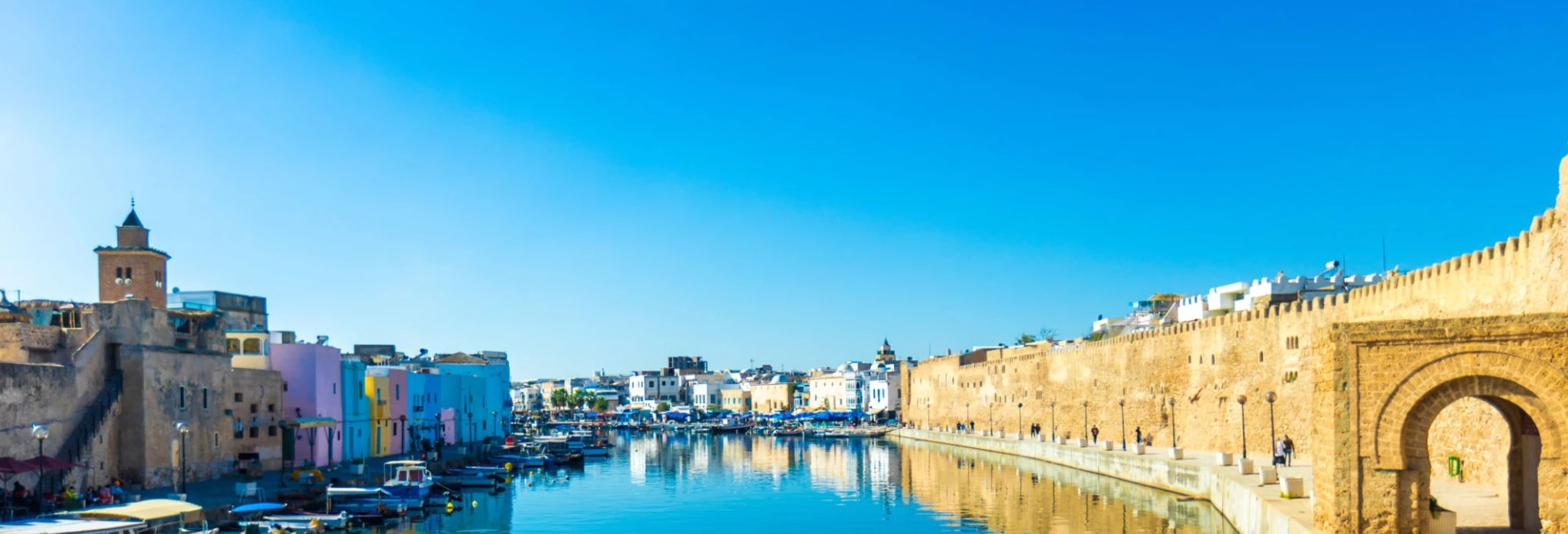
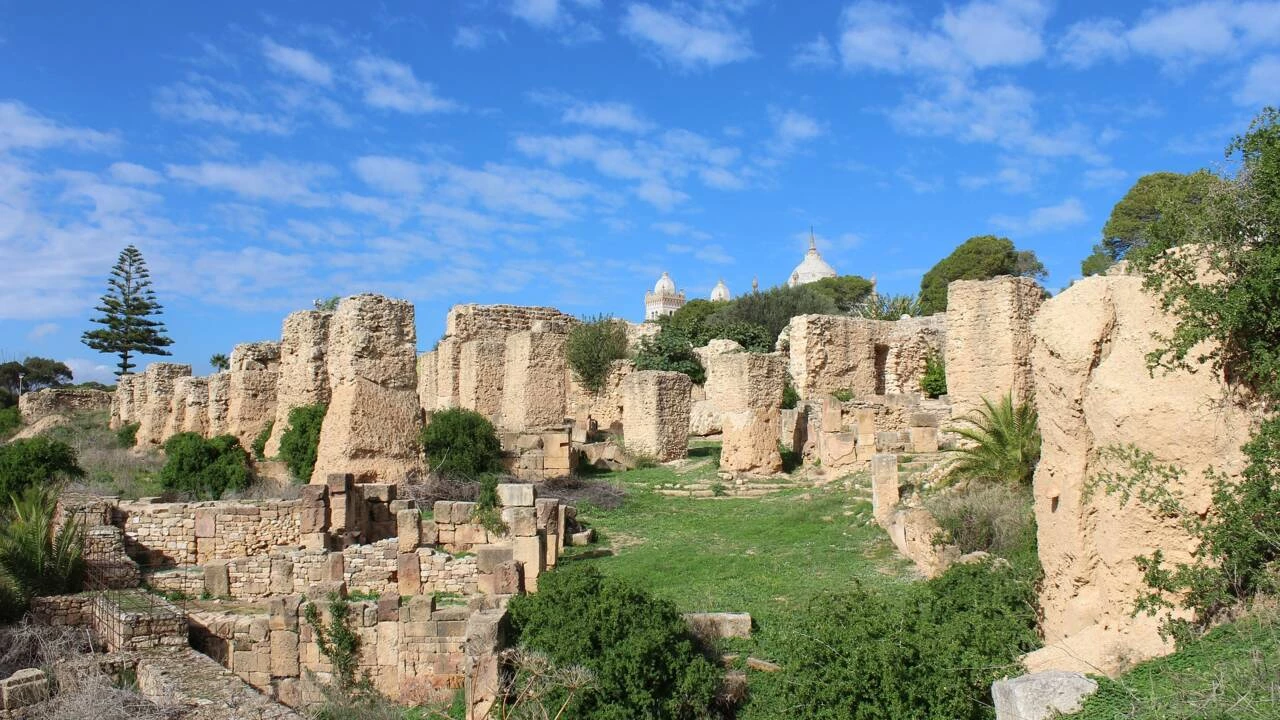
Founded, according to tradition, by Phoenician settlers from Tyre, Carthage became the capital of a maritime power before Rome destroyed it in 146 BC and rebuilt it as a Roman colony. The site, UNESCO-listed in 1979, is scattered across the northern suburbs of Tunis: Byrsa hill and its museum, the Antonine Baths by the sea, the Punic ports, the tophet, the theatre and the Roman villa quarter.
The sectors lie a few hundred metres to over a kilometre apart: move between them on foot, by taxi or on the TGM light rail, whose stations run alongside the site.

El Jem Amphitheatre
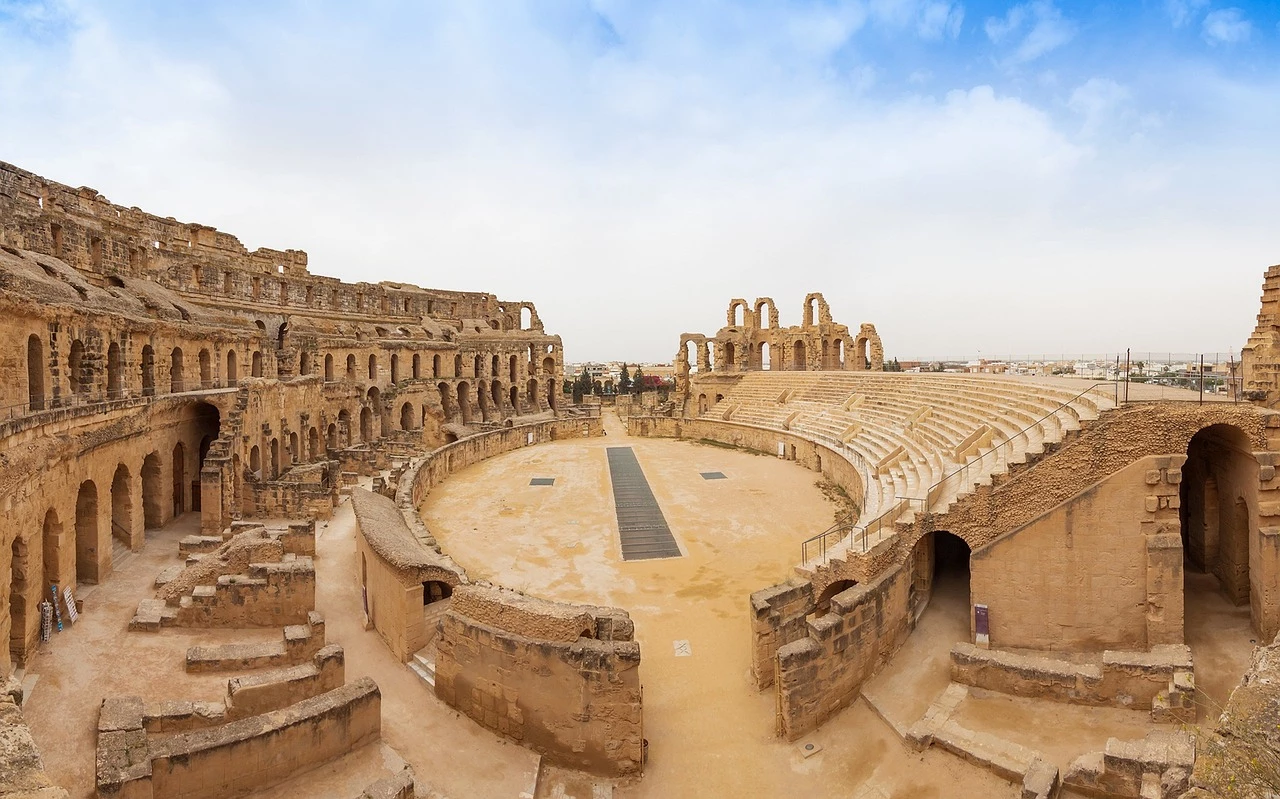
Built in the 3rd century in ancient Thysdrus, a town grown rich on the olive oil trade, the El Jem amphitheatre held some 35,000 spectators. UNESCO, which listed it in 1979, describes it as the largest amphitheatre in North Africa. You walk the tiers, the arena and the underground galleries where wild animals and gladiators waited.
The archaeological museum, a few hundred metres away, displays the mosaics found in the villas of Thysdrus; the amphitheatre ticket also covers it.

Dougga
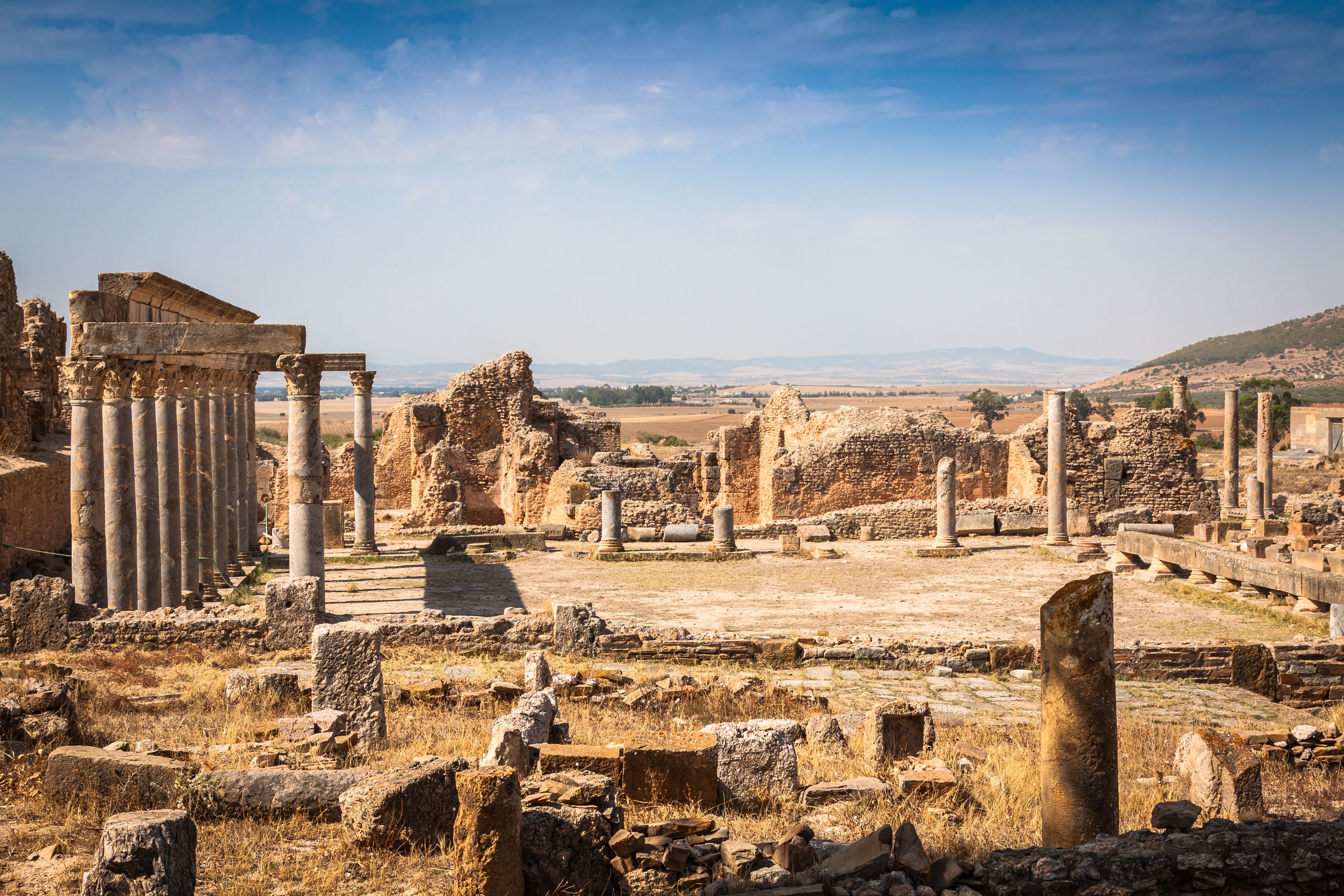
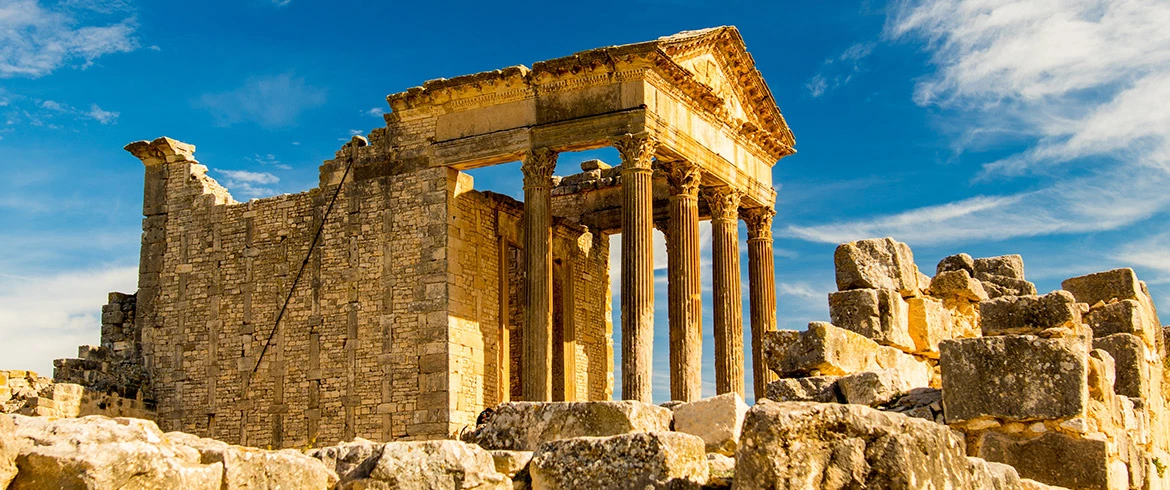
On a plateau overlooking a farming plain in the north-west, Thugga was an important Numidian town before it became a Roman city. UNESCO, which listed it in 1997, describes it as the best-preserved Roman town in North Africa. You see the 2nd-century Capitol, a theatre with about 3,500 seats, baths, mosaic houses and the Libyco-Punic mausoleum, a rare example of Numidian royal architecture.
The site is hilly with little shade: allow two to three hours to walk round it. Téboursouk is the nearest town.

Kerkouane
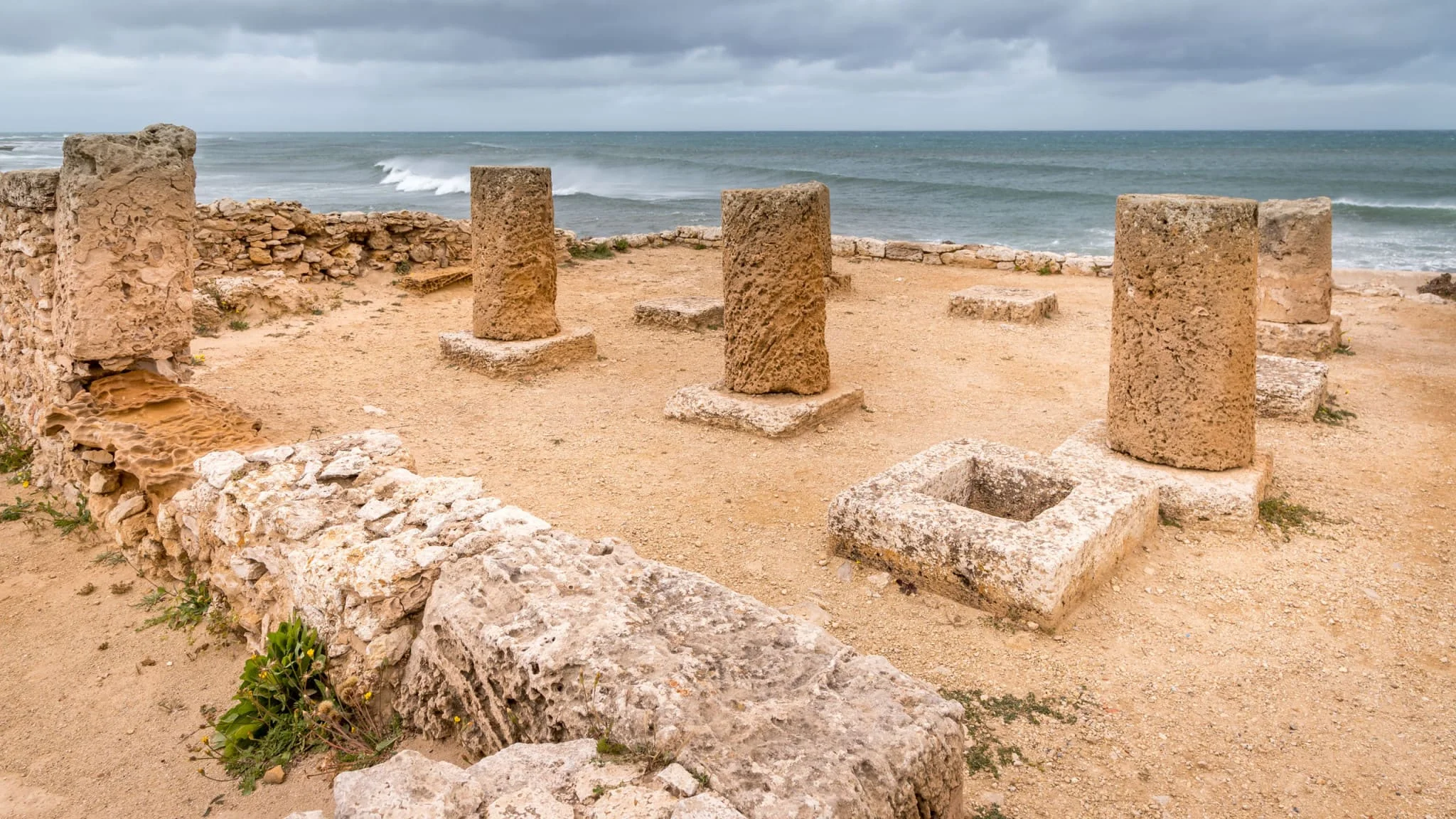
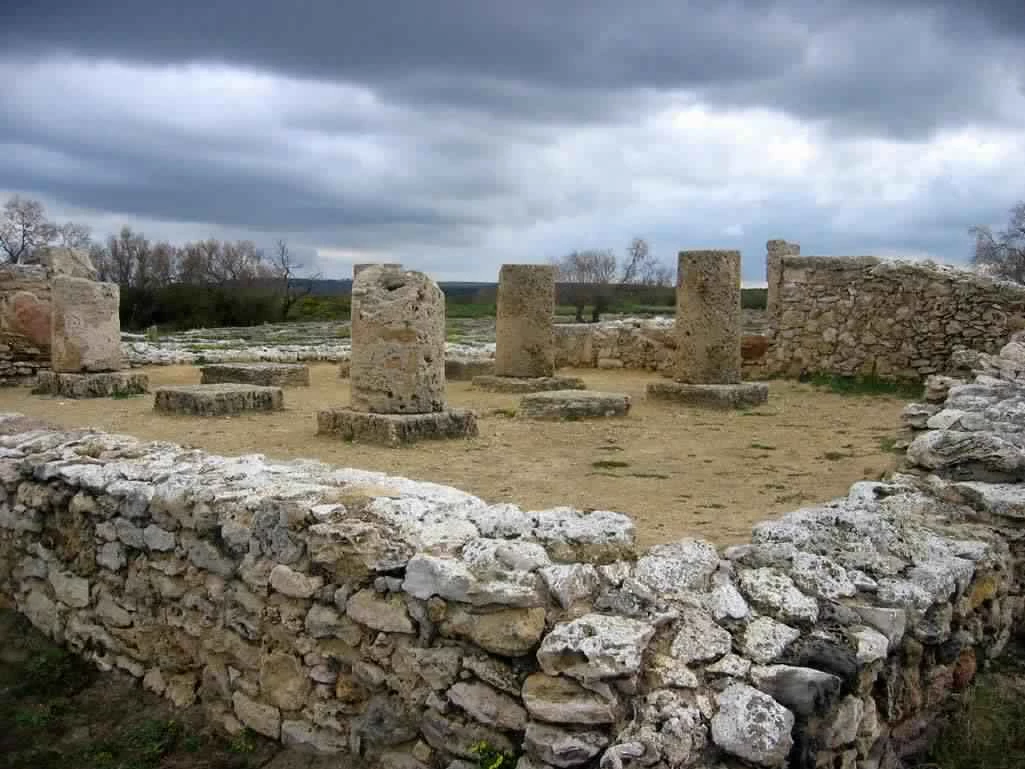
On the Cap Bon coast, Kerkouane is a Punic town abandoned around the middle of the 3rd century BC, during the First Punic War, and never rebuilt by the Romans, so its street plan has come down to us unchanged. UNESCO-listed in 1985, it keeps its streets, a sanctuary and courtyard houses, many with a washroom and a plastered bathtub.
A small on-site museum displays objects found in the town and in the nearby necropolis.

Bulla Regia
Near Jendouba, in the Medjerda valley, Bulla Regia was a Numidian and then a Roman town. Its hallmark: villas whose reception rooms were built underground, around a courtyard, to escape the summer heat. Several have kept their mosaics in place, such as the House of the Hunt and the House of Amphitrite.
The site also has a theatre, baths and a forum. It is not on the UNESCO World Heritage List.

Archaeological site of Sbeïtla (Sufetula)
In the centre-west of the country, ancient Sufetula has a rare ensemble: three temples side by side at the back of an enclosed forum, entered through a monumental gate dedicated to Antoninus Pius. Around it lie baths, houses, a theatre, the Arch of Diocletian and several Byzantine churches, showing the town mattered until the 7th century.
The site is on UNESCO's tentative list but not inscribed. A museum stands at the entrance.

Utica
North of Tunis, on the Bizerte road, Utica is thought to be one of the oldest Phoenician foundations in North Africa. Once a port, the town now lies several kilometres from the sea, pushed back by the silt of the Medjerda. It became the capital of the Roman province of Africa after the fall of Carthage in 146 BC.
You can visit Roman houses with mosaics, including the House of the Cascade, a Punic necropolis and a small museum. The site is not UNESCO-listed.

Archaeological site of Uthina (Oudhna)
About thirty kilometres south of Tunis, Uthina was one of the first Roman colonies in Africa, founded under Augustus for veterans of the Thirteenth Legion. The site keeps a restored amphitheatre, the foundations of the Capitol, large cisterns and baths.
The mosaics of the House of the Laberii, found here, are on display at the Bardo Museum. The site is not UNESCO-listed.

Archaeological site of Gigthis
On the shore of the Gulf of Bou Grara, opposite Djerba, Gigthis was a Punic trading post that grew into a prosperous Roman town. Excavations have uncovered the forum, several temples including one dedicated to Serapis, baths and the area around the port.
The site has few facilities and sees few visitors. It is not UNESCO-listed.
Private day in Carthage, Sidi Bou Said and the Tunis medina
A day by car with a driver-guide: the Tunis medina or the Bardo Museum as you prefer, about an hour on the Carthage site, then Sidi Bou Said and a stop in La Marsa. The highlight: going from the Punic and Roman ruins to the blue-and-white village above them.
Private-group tour, commentary in French, English, German, Italian or Arabic, pick-up depending on the option (Tunis, Hammamet, Sousse or Mahdia). The price per person depends on group size (see the GetYourGuide listing), free cancellation up to 24 hours before; Carthage and Bardo entry fees are extra.
- 7 to 9 hrs
- Price depends on group size, entry fees not included (GetYourGuide listing)
Guided half day at the El Jem amphitheatre and museum
A half day with transport and a guide: about an hour's guided visit of the amphitheatre, tiers, arena and underground passages included, then half an hour in the archaeological museum and its mosaics from Thysdrus. The highlight: stepping out of the galleries onto the arena, beneath the 35,000 seats.
Hotel pick-up in the Sahel (Hammamet or Sousse depending on the option), commentary in French, English, German or Italian. Allow €29 per person on GetYourGuide, free cancellation up to 24 hours before; check on the listing whether the entry ticket is included.
- 5 hrs
- €29 per person (GetYourGuide price 2026)
Private trip to Dougga and Bulla Regia from Tunis
A day in the north-west with a guide: an hour at Bulla Regia and its underground mosaic houses, an hour and a half at Dougga, then a stop at Testour and its large Andalusian mosque on the way back. The highlight: going down into the villas of Bulla Regia, kept cool underground.
Private car with pick-up in Tunis, a mlawi lunch and entry to both sites included, guides in French, English, Italian, German, Polish or Arabic. Allow €145 per person on GetYourGuide, free cancellation up to 24 hours before.
- 7 hrs
- €145 per person, entry fees and lunch included (GetYourGuide price 2026, private group)
Private Cap Bon tour: Kerkouane, Kelibia fort and El Haouaria
A day by car with a local driver-guide: the Punic town of Kerkouane, Kelibia fort, the coastal caves of El Haouaria and the hot springs of Korbous, with a beach stop. The highlight: walking through the Punic houses of Kerkouane, facing the sea.
Private-group tour, commentary in French, English, German, Arabic or Italian, pick-up depending on the option. From €40 per person on GetYourGuide, free cancellation up to 24 hours before; site entry fees are extra.
- 8 to 9 hrs
- from €40 per person, entry fees not included (GetYourGuide price 2026, private group)
Getting there
From Tunis, Carthage is reached in 25 min on the TGM light rail (Carthage-Hannibal station). Inland sites (Dougga, Bulla Regia, Sbeïtla) are visited by car, organised tour or louage.
Most travellers arrive at Tunis-Carthage airport. For Carthage, the easiest option is the TGM light rail from Tunis Marine to Carthage-Hannibal station (about 25 minutes, frequent trains).
The other sites are not served directly by rail. El Jem lies about 200 km south of Tunis (reachable by road or the Tunis-Sfax railway). Dougga, Bulla Regia, Kerkouane, Sbeïtla, Utica, Uthina and Gigthis are reached by hire car, organised tour or louage (a shared taxi seating 5 to 6). Driving at night is strongly discouraged.
Getting around
A hire car is the most flexible option for Dougga, Bulla Regia and Sbeïtla; the train serves El Jem and the TGM Carthage; without a car, a day tour from Tunis is simplest.
A hire car is the most flexible way to link the inland sites (Dougga, Bulla Regia, Sbeïtla), which public transport serves poorly. Avoid driving at night outside towns. The louage (shared taxi) links towns cheaply, but you need a taxi for the last stretch to the sites.
The train suits El Jem, which has a station on the Tunis-Sousse-Sfax line, and the TGM light rail suits Carthage from Tunis Marine. Without a car, a day tour with a driver from Tunis is the simplest way to see Dougga and Bulla Regia.
What to do
Three hubs: Carthage and the Bardo Museum in Tunis, Dougga and Bulla Regia in the north-west, the El Jem amphitheatre in the Sahel; add Kerkouane to a day on Cap Bon and Gigthis to a stay on Djerba.
An archaeological circuit is built around three hubs: Carthage and the Bardo Museum in Tunis, the Roman towns of the north-west (Dougga, Bulla Regia) and the El Jem amphitheatre in the Sahel. Kerkouane fits into a day on Cap Bon, Gigthis into a stay on Djerba.
Guided tours from Tunis, Hammamet or Sousse save you the driving and include transport; check on each offer whether entry fees are included.
Itineraries
Carthage and the Bardo, Utica and Bizerte, Dougga and Bulla Regia, Kerkouane on Cap Bon, El Jem, then Kairouan and Sbeïtla: six days for the main sites of the north and centre.
Day 1: Carthage and the Bardo Museum (combined ticket), night in Tunis or La Marsa. Day 2: Utica, then Bizerte or Uthina south of Tunis. Day 3: Dougga and Bulla Regia by car or on a tour, back to Tunis.
Day 4: Cap Bon and Kerkouane, night in Kelibia or Hammamet. Day 5: El Jem, night in Sousse or Mahdia. Day 6: Kairouan, then Sbeïtla if the vigilance map allows. With a few more days, head down to Djerba for Gigthis.
Climate & seasons
When to go to Tunisia?
Monthly averages over the past 5 years (Open-Meteo).
Best months
- January
- February
- March
- April
- May
- June
- July
- August
- September
- October
- November
- December
| Jan | Feb | Mar | Apr | May | Jun | Jul | Aug | Sep | Oct | Nov | Dec | |
|---|---|---|---|---|---|---|---|---|---|---|---|---|
| Our take | ||||||||||||
| Weather | ||||||||||||
| High | 16° | 17° | 18° | 20° | 24° | 29° | 33° | 32° | 30° | 26° | 21° | 18° |
| Rain (mm) | 36 | 38 | 43 | 41 | 54 | 19 | 0 | 3 | 21 | 57 | 36 | 54 |
| City sightseeing | City sightseeing January | City sightseeing February | City sightseeing March | City sightseeing April | City sightseeing May | City sightseeing June | City sightseeing September | City sightseeing October | City sightseeing November | City sightseeing December |
What to do by season (autumn)
-
City sightseeing
Pedestrian-friendly most of the year.
When to go
Spring (March-May) and autumn (September-November) are the best times: mild temperatures for sites that are mostly outdoors, away from the summer heat.
Almost all of Tunisia's ancient remains are visited outdoors with little shade. Spring (March to May) and autumn (September to November) are therefore ideal: sunny days with bearable temperatures, perfect for walking large sites such as Dougga or Carthage.
Summer (June to August) is very hot, especially inland (El Jem, Sbeïtla): visit early in the morning and carry plenty of water. Winter stays mild on the coast but can be rainy. In all cases, set off early to enjoy the light and avoid the afternoon heat.
Budget
Since April 2026, 30 dinars for Carthage, El Jem and the Bardo (45 dinars from January 2027), 45 dinars for the Bardo-Carthage ticket, 20 to 5 dinars for other sites.
Since April 2026 (decree of 27 March 2026), category A sites (Carthage, El Jem, the Bardo Museum, Kairouan) cost 30 dinars for foreign visitors; the price is due to rise to 45 dinars in January 2027. The combined Bardo-Carthage ticket costs 45 dinars (70 dinars planned for 2027). Other sites and museums fall into cheaper categories: 20 dinars for category B (30 in 2027), then 10, 8 and 5 dinars.
Students and seniors get reductions; free entry on the first Sunday of the month and on public holidays applies to residents only. For tours, allow from €22 per person for a day in Carthage, about €29 for the half day at El Jem, from €40 for Cap Bon and €145 for the private day at Dougga and Bulla Regia (GetYourGuide prices 2026).
Where to stay
Tunis, La Marsa or Sidi Bou Said for Carthage, Utica, Uthina and Dougga; Sousse, Monastir or Mahdia for El Jem; Kelibia for Kerkouane; Kairouan for Sbeïtla; Djerba for Gigthis.
Tunis, La Marsa and Sidi Bou Said are the best base for Carthage, Utica, Uthina and Dougga, all visited on day trips. For El Jem, stay on the Sahel coast in Sousse, Monastir or Mahdia. Kerkouane is visited from Kelibia, about ten kilometres away, or from Hammamet and Nabeul.
For Bulla Regia, the nearest town is Jendouba; most travellers pair it with Dougga from Tunis. Sbeïtla is reached from Kairouan, and Gigthis from Djerba, the starting point for trips into southern Tunisia.
Safety
The classic-circuit sites are under heightened vigilance (France Diplomatie, 15/09/2026); the Saharan borders and centre-west mountains are advised against. Emergencies: police 197, ambulance 190, civil protection 198.
According to France Diplomatie (vigilance map of 15 September 2026), all travel is advised against to the Saharan region near the borders with Libya and Algeria and to the mountain massifs of the centre-west (Orbata, Selloum, Semmama, Chambi, Mghila). The rest of the country, including the classic-circuit sites, is under heightened vigilance.
Sbeïtla, in Kasserine governorate, lies close to those massifs: check the map for your travel dates and do not drive at night. Drones and professional photography on the sites need prior permission from the AMVPPC, the national heritage agency.
Emergency numbers: police 197, ambulance (SAMU) 190, civil protection 198.
Formalities
No visa for French and EU citizens for up to 3 months, but since 1 January 2025 every visitor needs a passport valid for at least 3 months (ID cards refused). The dinar is a closed currency: change money locally.
Entry: French and EU citizens need no visa for a tourist stay of 3 months or less; other nationalities should check their own government's advice. Since 1 January 2025, all visitors, including on package tours, must show a passport valid for at least 3 months on arrival: national ID cards are no longer accepted. Franco-Tunisian dual nationals enter and leave on their Tunisian passport.
Currency: the Tunisian dinar (TND) is a closed currency: importing or exporting it is prohibited. Change money locally, keep your receipts to change dinars back when leaving, and carry cash for site ticket desks, which do not always take cards.
Check the latest rules on the France Diplomatie travel advice page.
FAQ
Passport, UNESCO sites, 2026 prices, combined ticket, access, season and safety: the answers for planning an archaeological circuit in Tunisia.
Can you enter Tunisia with a national ID card?
No. Since 1 January 2025, every visitor, including on package tours, must show a passport valid for at least 3 months on arrival. French citizens need no visa for stays of 3 months or less.
Which Tunisian archaeological sites are UNESCO-listed?
Carthage (1979), the El Jem amphitheatre (1979), Kerkouane (1985) and Dougga (1997). Sbeïtla is on the tentative list; Bulla Regia, Utica, Uthina and Gigthis are not inscribed.
How much do the sites cost in 2026?
Since April 2026, category A sites (Carthage, El Jem, the Bardo Museum, Kairouan) cost 30 dinars for foreign visitors, rising to 45 dinars from January 2027. Other sites fall into cheaper categories, from 20 down to 5 dinars.
Is there a combined ticket?
Yes, the Bardo-Carthage ticket costs 45 dinars (70 dinars planned for 2027). At El Jem, the amphitheatre ticket also covers the archaeological museum.
How do you get to Carthage from Tunis?
On the TGM light rail from Tunis Marine to Carthage-Hannibal station, in about 25 minutes.
When is the best time to visit the ancient sites?
Spring (March-May) and autumn (September-November), for mild temperatures on outdoor sites with little shade.
Is Tunisia safe for an archaeological circuit?
The classic-circuit sites are in the heightened-vigilance zone according to France Diplomatie. The Saharan border areas and the centre-west mountains are advised against; for Sbeïtla, close to those mountains, check the current map.
Can you take Tunisian dinars home?
No. The dinar is a closed currency and exporting it is prohibited. Change your dinars back before leaving, showing your exchange receipts.
Sources
The figures in this guide come from the sources below, checked on the publication date.
Leave a comment
Share your thoughts or travel experience. Your email will not be published.