

Contents 27
The former Safavid capital, Isfahan gathers around Naqsh-e Jahan Square, a UNESCO World Heritage Site since 1979, the Shah Mosque, the Sheikh Lotfollah Mosque, the Ali Qapu palace and the gate of the grand bazaar. This guide covers its 14 major sites, from the Zayandeh bridges to the Armenian quarter of Jolfa, followed by practical information.
Warning: France Diplomatie formally advises against all travel to Iran and recommends that French nationals already there leave the country immediately (page updated on 10 September 2026). Read the safety section before making any plans.
Overview
A former Safavid capital, Isfahan gathers around Naqsh-e Jahan Square (UNESCO, 1979) turquoise-domed mosques, garden palaces, bridges and a grand bazaar; France Diplomatie formally advises against travel to Iran.
'Isfahan is half the world', says the Persian proverb. Capital of the Safavid empire from Shah Abbas I onwards, the city has kept around Naqsh-e Jahan Square, a UNESCO World Heritage Site since 1979, an ensemble of early 17th-century mosques, palaces and bazaars.
Turquoise-domed mosques, pavilion palaces in Persian gardens, Safavid bridges over the Zayandeh, the grand bazaar and the Armenian quarter of Jolfa: the essentials can be seen on foot in two or three days. Read the safety section first: France Diplomatie formally advises against travel to Iran.
14 places to take with you
In the guide's order, ready for Google Maps or your GPS.

Naqsh-e Jahan Square
Built between 1598 and 1629 under Shah Abbas I, who made Isfahan his capital, Naqsh-e Jahan Square ('image of the world') measures 560 by 160 metres. It has been a UNESCO World Heritage Site since 1979. Four monuments line it: the Shah Mosque to the south, the Sheikh Lotfollah Mosque to the east, the Ali Qapu palace to the west and, to the north, the Qeysarie gate opening onto the grand bazaar.
In the middle, a long pool and lawns where families settle in the evening; all around, two-storey arcades house shops and workshops. The square appears on the back of the 20,000-rial banknote.

The Shah Mosque (Imam Mosque)
Begun in 1611 on the orders of Shah Abbas I and completed around 1630, the Shah Mosque, officially called the Imam Mosque, closes the south side of Naqsh-e Jahan Square. Its tiled portal faces the axis of the square, while the prayer hall is turned towards Mecca: the vestibule makes up the difference. Around the courtyard, four iwans lead to the prayer hall and its turquoise dome.
It ranks among the masterpieces of Persian architecture of the Islamic era and is, with the square, part of the UNESCO World Heritage Site. Friday prayer is still held there.

Sheikh Lotfollah Mosque
On the east side of Naqsh-e Jahan Square, opposite the Ali Qapu palace, the Sheikh Lotfollah Mosque was built from 1602-1603 to 1618-1619 by the architect Muhammad Reza, during the reign of Shah Abbas the Great. It has neither minaret nor courtyard: a bent corridor leads straight under a single dome, entirely covered in tiles.
Smaller than the Shah Mosque, it ranks among the masterpieces of Safavid architecture. It was restored in the 1920s on the advice of the art historian Arthur Upham Pope.

The Friday Mosque (Masjed-e Jameh)
Often overshadowed by Naqsh-e Jahan Square, Isfahan's Friday Mosque has been a UNESCO World Heritage Site in its own right since 2012. It juxtaposes twelve centuries of styles, from the 9th-century Abbasid period to Seljuk, Ilkhanid, Timurid and Safavid additions.
You can see two Seljuk domes, a four-iwan plan that became a model across the Iranian world, and finely worked brick and stucco decoration.

Ali Qapu Palace
On the west side of the square, opposite the Sheikh Lotfollah Mosque, the Ali Qapu palace ('the grand gate') was originally the gateway to a vast palace complex that stretched to Chahar Bagh avenue. It is 48 metres high, with six floors linked by narrow spiral staircases.
On the sixth floor, the music room is pierced with circular niches cut into the stucco, both decorative and acoustic. The palace is part of the square's UNESCO World Heritage listing.

Chehel Sotoun Palace
Built under the Safavid shah Abbas II, the Chehel Sotoun palace ('the forty columns') owes its name to its twenty wooden columns whose reflection in the long pool gives the illusion of forty. A royal reception pavilion, it is famous for its large historical frescoes and miniatures. Its garden is one of the nine 'Persian Gardens' jointly inscribed on the UNESCO World Heritage List in 2011.

Si-o-se Pol Bridge
The most famous of Isfahan's historic bridges, the Si-o-se Pol ('the bridge of 33 arches'), also called the Allahverdi Khan bridge, spans the Zayandeh river over nearly 300 metres. Built in the early 17th century under Shah Abbas I, it is at once a bridge, a dam and a promenade: its two levels of brick arcades have become the city's emblem. Note: the river is often dry, the bridge then overlooking an arid bed.

Khaju Bridge
East of Si-o-se Pol, the Khaju Bridge spans the Zayandeh, the largest river of the Iranian plateau. Built in the 17th century under the Safavids, it is both a bridge and a weir, and links the Khaju quarter on the north bank with the old Zoroastrian quarter on the south bank.
Its arcades also served as a public meeting place, and it is often described as the city's finest bridge. The art historians Arthur Upham Pope and Phyllis Ackerman, specialists in Persian art, are buried in a mausoleum nearby.

Vank Cathedral
In the heart of the Armenian district of Jolfa, the Holy Saviour Cathedral, known as the Vank Cathedral, was founded in 1606 and completed around 1664. Behind a plain façade hides a teeming interior: its walls are entirely covered with biblical frescoes, from the Creation to the Last Judgment, blending Armenian art and Safavid decoration. An adjoining museum displays manuscripts and liturgical objects, including a record of the Armenian genocide.

Isfahan Grand Bazaar
The Grand Bazaar, or Qeysarie bazaar, was built in 1620 on the north side of Naqsh-e Jahan Square. It was one of the most luxurious trading centres of the Safavid era. Its covered alleys link Naqsh-e Jahan Square to the old Kohneh Square and the Seljuk quarter, home to the Friday Mosque.
You'll find carpets, miniatures, qalamkar (block-printed cottons), hammered copperware, spices and gaz, the local pistachio nougat.

The Armenian quarter of Jolfa
South of the Zayandeh, New Julfa (Jolfa) was founded in the early 17th century by the Armenians whom Shah Abbas I brought from Julfa, on the Aras river. The district still has several churches, including Vank Cathedral, and remains the centre of Isfahan's Armenian community.
Its streets are now among the liveliest in the city, with cafés and shops around Jolfa Square. Combine it with Vank Cathedral and the Si-o-se Pol bridge, about twenty minutes away on foot.

Hasht Behesht Palace
Built around 1669 under Shah Soleyman, the Hasht Behesht palace ('the eight paradises') is a refined Safavid pavilion set in the middle of a garden. More intimate than Chehel Sotoun, it charms with its muqarnas ceilings, water features and filtered light. Its garden, like that of Chehel Sotoun, belongs to the UNESCO-listed Persian Gardens.

Mount Soffeh
South of the city, Mount Soffeh overlooks Isfahan. Its slopes are laid out as a leisure park, popular with families late in the day, and trails climb to the heights, with views over the city and the Zayandeh valley.
It is Isfahan's nature outing, best kept for the end of the day, when the heat eases.

Haroun-e-Velayat Mausoleum
Completed in 1513, at the start of the Safavid era, the mausoleum of Haroun-e-Velayat is an imamzadeh (shrine) richly adorned with faience tiles. The identity of the saint resting there is disputed by historians, but the place is highly venerated locally, reputed for its 'miracles', and respected even by some of the city's Armenian Christians. Its flowered courtyard and mosaic portal make it a peaceful stop away from the crowds.
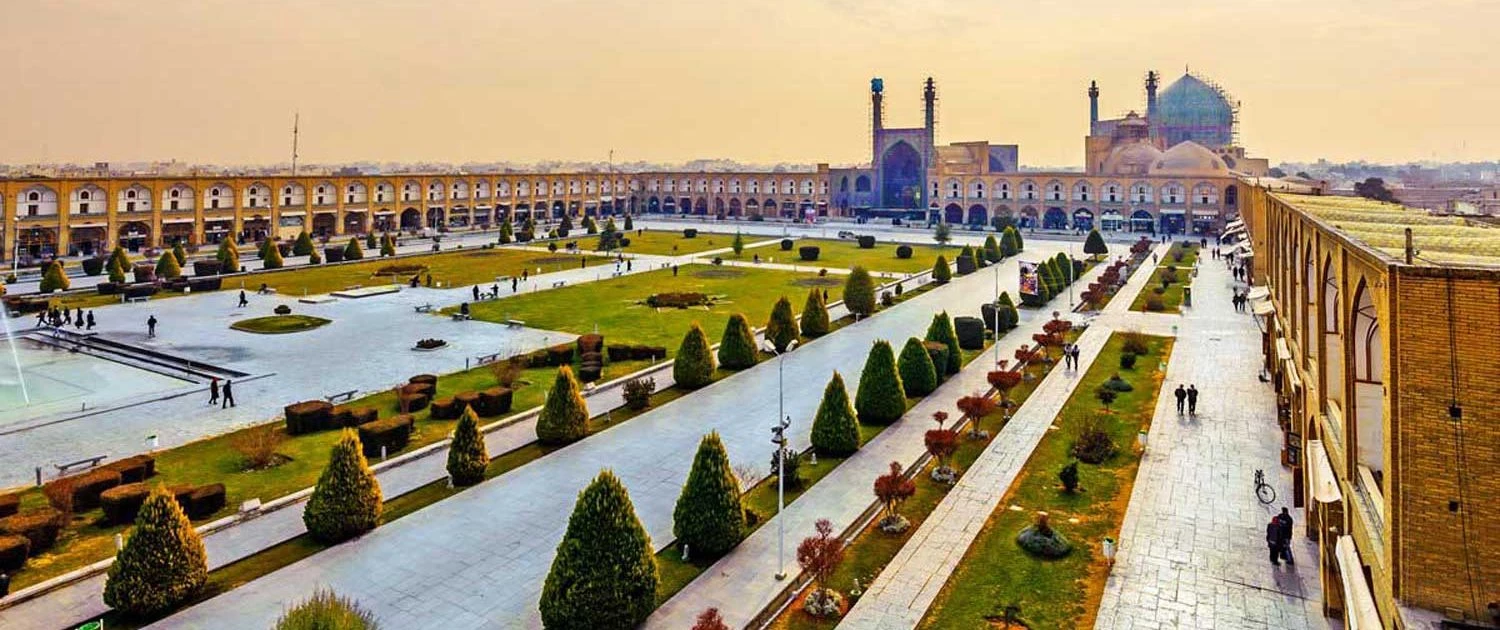
Tour of the monuments of Naqsh-e Jahan Square
Half a day to go round the four sides of the square: the Shah Mosque and its tiled portal to the south, the Sheikh Lotfollah Mosque, with neither minaret nor courtyard, to the east, then the Ali Qapu palace to the west, whose sixth-floor music room is pierced with acoustic niches. The highlight: the view over the whole square from the Ali Qapu terrace.
Start at opening time with the Shah Mosque, before the heat, and keep the Qeysarie gate and the bazaar for the end. Modest dress required, headscarf for women; entry fees are paid in cash.
- Half a day
- Paid entry, in cash (rials)
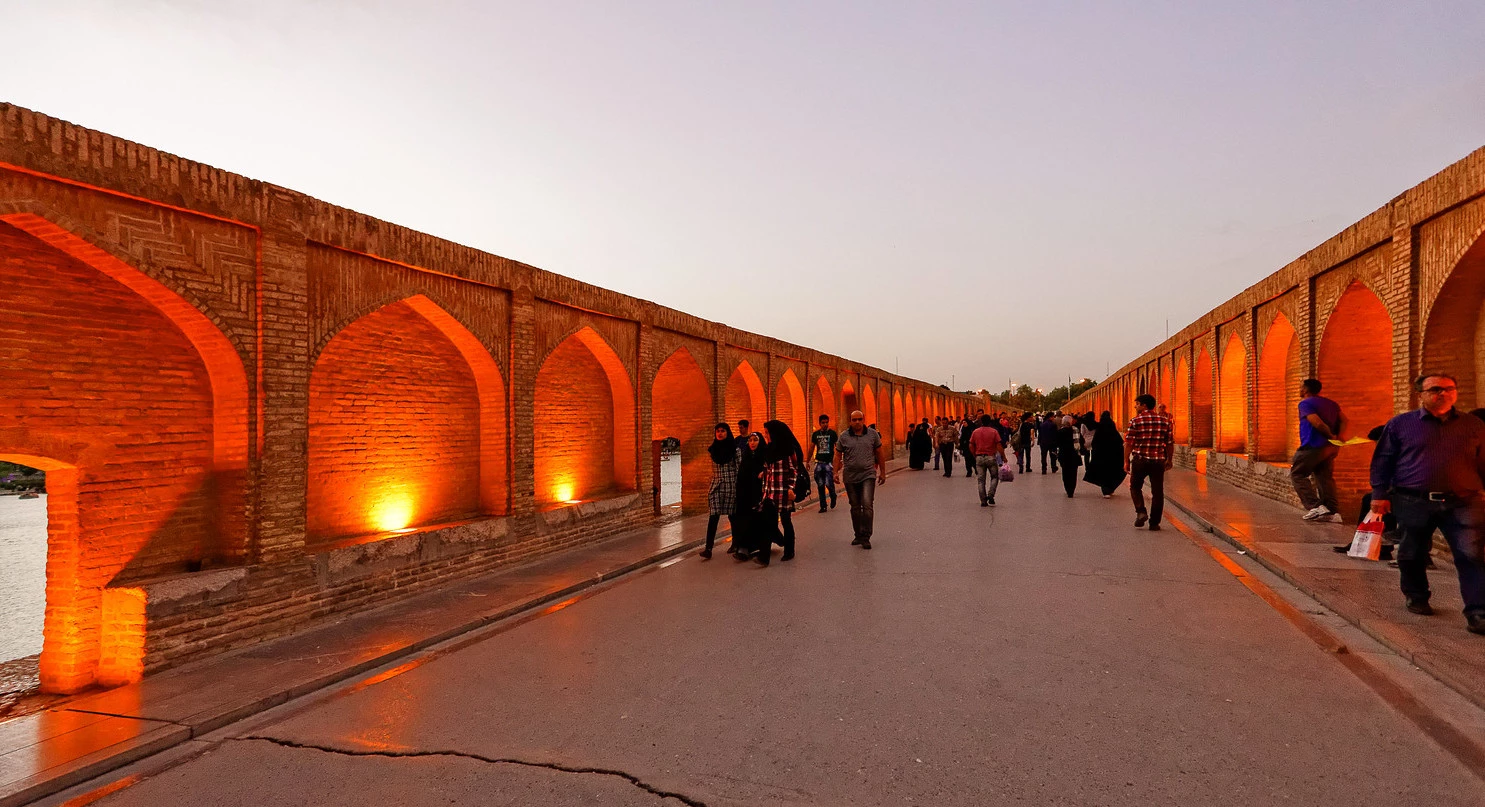
Evening walk across the Si-o-se Pol and Khaju bridges
The walk follows the Zayandeh for under 2 km, from Si-o-se Pol, the 33-arch bridge nearly 300 metres long, to the Khaju Bridge, a 17th-century bridge and weir. At sunset the arches light up and locals gather there; under the Khaju vaults, some come to sing for the acoustics. The highlight: the Khaju lit up at nightfall.
The river is often dry, so the bridges can also be seen from the riverbed. Set off an hour before sunset from Si-o-se Pol, on the Armenian quarter side.
- 2 hrs
- Free
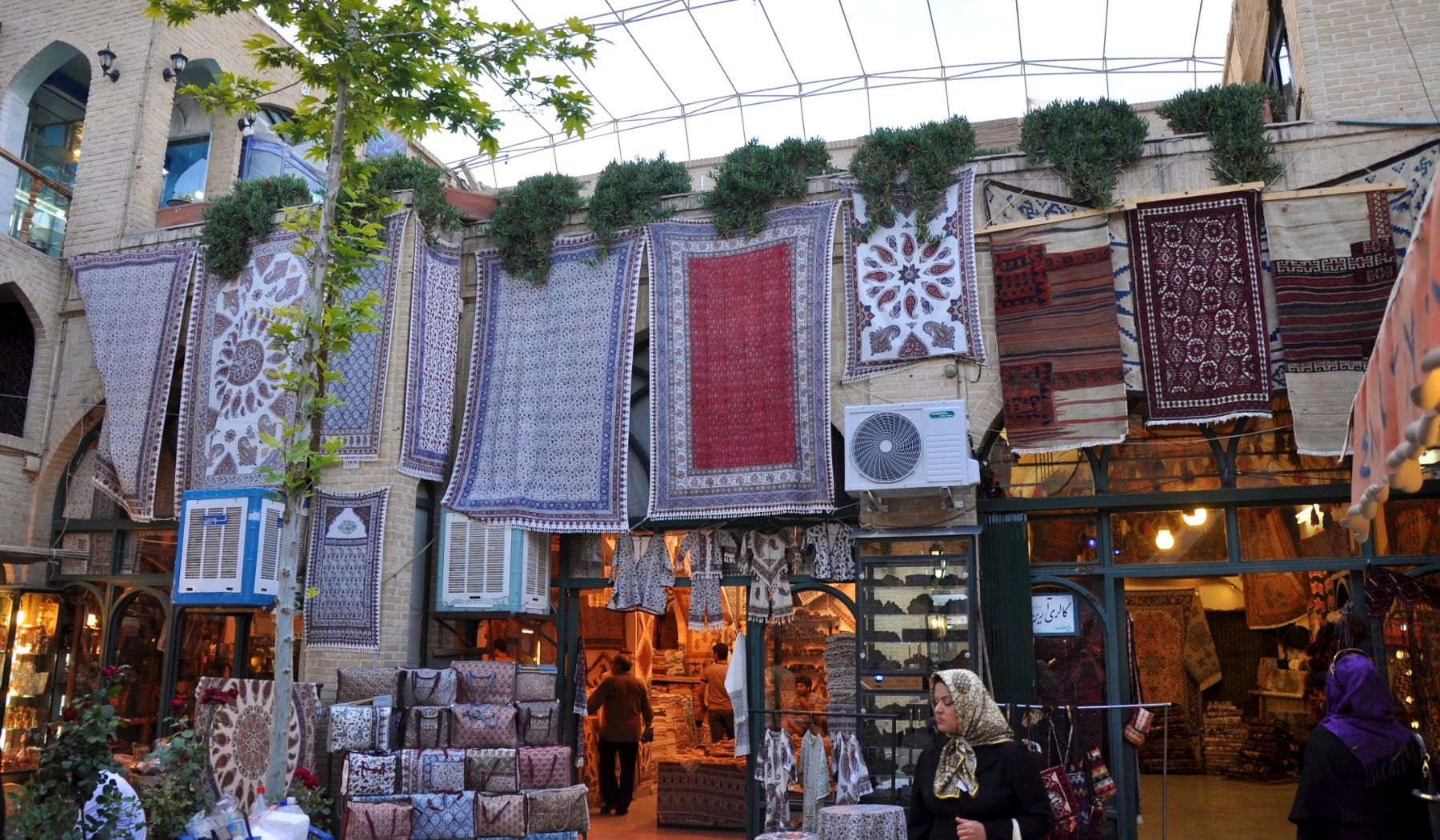
The craft workshops of the Grand Bazaar
From the Qeysarie gate, on the north side of the square, the covered alleys of the bazaar built in 1620 lead towards Kohneh Square and the Friday Mosque. Along the way are workshops for qalamkar, block-printed cottons, miniatures, hammered copper and carpets, plus stalls of spices and gaz, the local nougat. The highlight: watching a craftsman print a qalamkar or hammer a copper tray.
Come in the morning, when the workshops are busy. Prices are haggled and everything is paid in cash; an antique carpet requires an export permit.
- 2 to 3 hrs
- Free entry; purchases in cash, to be haggled
Getting there
Isfahan has its own airport (IFN) and connects to Tehran (~340 km) and Shiraz by road and rail; international access is usually via Tehran (IKA).
Most travellers arrive in Iran through Tehran-Imam Khomeini International Airport (IKA), then head to Isfahan. The city also has its own airport, Shahid Beheshti (IFN), served by domestic flights.
From Tehran (~340 km), Isfahan is reachable by train, long-distance bus (comfortable and cheap) or car on the motorway; allow about 4 to 5 hours. Shiraz, another major stop on the Persian circuit, lies to the south. Reminder: travel to Iran is formally advised against, and France Diplomatie warns that Iranian airspace and airports may close without notice (see the safety section).
Getting around
The historic centre is walkable; taxis and the metro (one line) for longer trips. Most major sites cluster around Naqsh-e Jahan Square.
Isfahan's main sites — Naqsh-e Jahan Square, the mosques, the bazaar, the palaces — are concentrated in the historic centre and best explored on foot. The Armenian district of Jolfa and the bridges over the Zayandeh are a little further south.
For longer trips, taxis are cheap (agree the price beforehand, or use a local ride-hailing app) and the city has a metro line. Keep cash in rials: foreign bank cards do not work in Iran.
What to do
Naqsh-e Jahan Square and its three monuments in the morning, the bazaar and the Friday Mosque, the garden palaces in the afternoon, the bridges at sunset, then the Armenian quarter of Jolfa.
A typical day starts early on Naqsh-e Jahan Square: the Shah Mosque to the south, the Sheikh Lotfollah Mosque to the east, the Ali Qapu palace to the west, then the grand bazaar through the Qeysarie gate to the north. The Friday Mosque, at the far end of the bazaar, takes half a day. In the afternoon, the Chehel Sotoun and Hasht Behesht garden palaces; at sunset, the Si-o-se Pol and Khaju bridges, then the Armenian quarter of Jolfa and Vank Cathedral.
Two to three days are enough for these sites. This plan remains theoretical while France Diplomatie formally advises against travel (see the safety section).
Further south, Shiraz and Persepolis have their own guide: the essential things to do in Shiraz, with the same safety caveats.
Food
Beryani (minced lamb served on flatbread) and gaz, a pistachio nougat, are Isfahan's specialities; all the Iranian classics are available too, paid in cash.
Isfahan has its specialities: beryani, minced lamb cooked and served on flatbread, and gaz, a pistachio nougat sold all over the city and in the bazaar. The Iranian classics are everywhere too: chelo kebab (saffron rice and skewers), fesenjan (pomegranate and walnut stew), ash reshteh (noodle and herb soup), black tea and doogh, a yoghurt drink.
The traditional tea houses around Naqsh-e Jahan Square and the bazaar serve tea and simple dishes. Alcohol is prohibited. Restaurants are paid in cash, in rials.
Climate & seasons
When to go to Iran?
Monthly averages over the past 5 years (Open-Meteo).
Best months
- February
- April
- May
- September
- October
- November
Avoid
- June
- July
- August
| Jan | Feb | Mar | Apr | May | Jun | Jul | Aug | Sep | Oct | Nov | Dec | |
|---|---|---|---|---|---|---|---|---|---|---|---|---|
| Our take | ||||||||||||
| Weather | ||||||||||||
| High | 9° | 13° | 19° | 26° | 30° | 36° | 38° | 36° | 33° | 26° | 18° | 11° |
| Rain (mm) | 17 | 27 | 22 | 9 | 9 | 2 | 1 | 0 | 0 | 2 | 16 | 17 |
| City sightseeing | City sightseeing February | City sightseeing March | City sightseeing April | City sightseeing October | City sightseeing November | City sightseeing December |
What to do by season (autumn)
-
City sightseeing
Pedestrian-friendly most of the year.
When to go
Spring (April-May) and autumn (September-October) offer the most pleasant temperatures. Summers are very hot and winters cold.
Isfahan's semi-arid continental climate makes two seasons ideal: spring (April-May), when the gardens bloom, and autumn (September-October), mild and bright. These are the best times to walk the square and the monuments without suffering from the heat.
Summers (June-August) are very hot and dry (visit early morning or evening), and winters can be cold, with freezing nights. Note: this advice remains theoretical while travel to Iran is formally advised against (see the safety section).
Where to stay
Around Naqsh-e Jahan Square to be in the heart of the monuments, or in the Armenian district of Jolfa for its atmosphere; Isfahan has superb hotels set in former traditional houses.
To make the most of the city, stay near Naqsh-e Jahan Square: you'll be on foot from the mosques, the Ali Qapu palace and the bazaar. It's the handiest area for sightseeing.
The Armenian district of Jolfa, further south, charms with its cafés and atmosphere, near the Vank Cathedral and the bridges. Isfahan is renowned for its boutique hotels set in former traditional courtyard houses, with an inner courtyard and Persian decor — an experience in itself. Book ahead in high season (spring, autumn).
Safety
France Diplomatie formally advises against all travel to Iran, across the whole country, and asks French nationals there to leave immediately: high risk of arrest and arbitrary detention, dual nationals included (updated 10 September 2026).
France Diplomatie formally advises French nationals against travelling to Iran, across the whole country, and recommends that those already there leave immediately (travel advice page updated on 10 September 2026). This guide describes Isfahan's heritage for information only; it is not an encouragement to go.
- Arbitrary detention: according to the ministry, Iran 'pursues a deliberate policy of taking Western hostages' and targets French visitors it accuses of espionage. Any French visitor, including dual nationals, faces a high risk of arrest, arbitrary detention and unfair trial.
- Very limited consular protection: the French embassy in Tehran is open, but it is not always informed of an arrest. Iran does not recognise dual nationality: a French-Iranian who enters on an Iranian passport cannot seek French protection.
- Air travel: Iranian airspace and airports may close without warning.
- Behaviour: no photos or videos at all (France Diplomatie), no drones, no gatherings or demonstrations, no criticism of the regime or of religious obligations on social media.
- Other risks: terrorist threat raised since the Kerman attack (January 2024), high seismic activity, dangerous driving on the roads.
Emergency numbers in Iran: police 110, ambulance 115, fire 125. Check France Diplomatie's Iran page before any decision: the situation can change very quickly.
Formalities
A visa is required for French nationals, from the Iranian embassy in Paris (one month maximum), or a 30-day visa on arrival (€75) at some airports. Pay in cash: foreign cards don't work. Travel formally advised against.
Reminder: travel is formally advised against (see the safety section). The rules below are those of France Diplomatie's entry and stay page, updated on 15 September 2026.
Visa: required for French nationals, to be requested from the Iranian embassy in Paris several weeks in advance, as the process can be slow. A tourist visa is valid for one month at most. A visa on arrival (30 days, €75) exists at some airports after online pre-registration, but the ministry recommends applying beforehand at the embassy. Keep the entry card, required on departure; if you overstay, border police will stop you from leaving the country.
Customs: importing alcohol is prohibited; antiques and antique carpets require an export permit; keep receipts for valuable purchases.
Money: the currency is the Iranian rial, but prices are often quoted in tomans (1 toman = 10 rials). Visa and Mastercard cards issued abroad do not work in Iran because of sanctions: you need cash (paying in Iran).
Customs and dress: modest dress, headscarf mandatory for women in public. Persian is the official language.
FAQ
Can you travel to Iran right now?France Diplomatie formally advises against all travel to Iran, across the whole country, and recommends that French nationals there leave immediately (updated 10 September 2026). There is a high risk of arrest and arbitrary detention, dual nationals included.Do you need a visa for Iran?Yes.
Can you travel to Iran right now?
France Diplomatie formally advises against all travel to Iran, across the whole country, and recommends that French nationals there leave immediately (updated 10 September 2026). There is a high risk of arrest and arbitrary detention, dual nationals included.
Do you need a visa for Iran?
Yes. Apply at the Iranian embassy in Paris several weeks in advance; a 30-day visa on arrival (€75) exists at some airports after online pre-registration. A visa does not lift the safety warning.
What currency and how do you pay?
The Iranian rial, often counted in tomans (1 toman = 10 rials). Foreign Visa and Mastercard cards do not work because of sanctions: you need cash.
How many days do you need in Isfahan?
Two to three days for Naqsh-e Jahan Square and its monuments, the Friday Mosque, the garden palaces, the bazaar, the bridges and the Armenian quarter.
What is the best time to visit?
Spring (April-May) and autumn (September-October); summer is very hot, winter cold.
How should you dress and behave?
Modest dress, headscarf mandatory for women in public. France Diplomatie asks visitors to take no photos or videos at all and not to fly drones.
Sources
The figures in this guide come from the sources below, checked on the publication date.
Leave a comment
Share your thoughts or travel experience. Your email will not be published.