

Contents 25
Capital of Persia under the Zand dynasty in the 18th century, Shiraz is the city of the poets Hafez and Saadi and of Persian gardens, including Eram Garden, a UNESCO World Heritage Site. This guide covers its 12 major sites, from the Nasir al-Mulk Mosque to Persepolis, some sixty kilometres away, followed by practical information.
Warning: France Diplomatie formally advises against all travel to Iran and recommends that French nationals already there leave the country immediately (page updated on 10 September 2026). Read the safety section before making any plans.
Overview
Capital of Persia under the Zands in the 18th century, Shiraz is the city of the poets Hafez and Saadi, of Persian gardens and the gateway to Persepolis; France Diplomatie formally advises against travel to Iran.
Shiraz, capital of Fars province in southern Iran, was the capital of Persia under the Zand, in the second half of the 18th century. From that period it keeps the Karim Khan Citadel and the Vakil bazaar, bathhouse and mosque.
Above all it is the city of poets: Hafez and Saadi are buried here, and their mausoleums draw Iranians and foreign visitors alike. Shiraz is also known for its Persian gardens, including Eram Garden, a UNESCO site, and for the Nasir al-Mulk Mosque and its stained glass. It is the base for Persepolis and Naqsh-e Rostam.
Read the safety section first: France Diplomatie formally advises against travel to Iran.
12 places to take with you
In the guide's order, ready for Google Maps or your GPS.

Persepolis
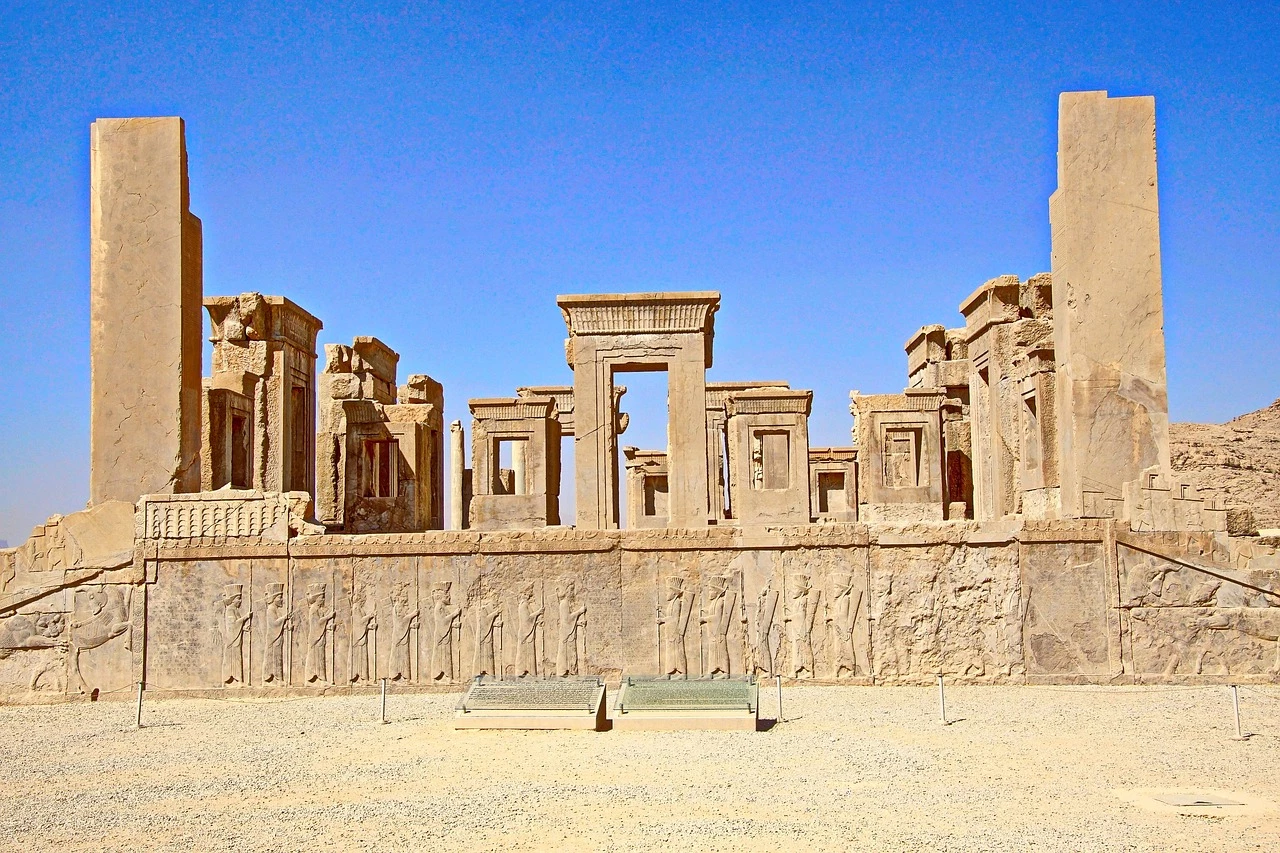
Some sixty kilometres north-east of Shiraz, Persepolis was the ceremonial capital of the Achaemenid Empire. Founded by Darius I around 518 BC, it was burned by Alexander the Great in 330 BC. The site has been a UNESCO World Heritage Site since 1979.
You enter by the monumental staircase and the Gate of All Nations, before reaching the Apadana, the Hall of a Hundred Columns and the carved staircases showing delegations bringing tribute. Royal tombs cut into the cliff overlook the site.

Nasir al-Mulk Mosque (Pink Mosque)
Completed in 1888, under the Qajar dynasty, the Nasir al-Mulk Mosque owes its 'Pink Mosque' nickname to the mainly pink tiles of its courtyard and vaults. It stands in the Gowd-e Araban district, a short walk from the Shah Cheragh shrine.
Its winter prayer hall is lit by large stained-glass windows: at sunrise, the light passes through the coloured glass and throws patterns across the carpets and the twisted columns.

Tomb of Hafez
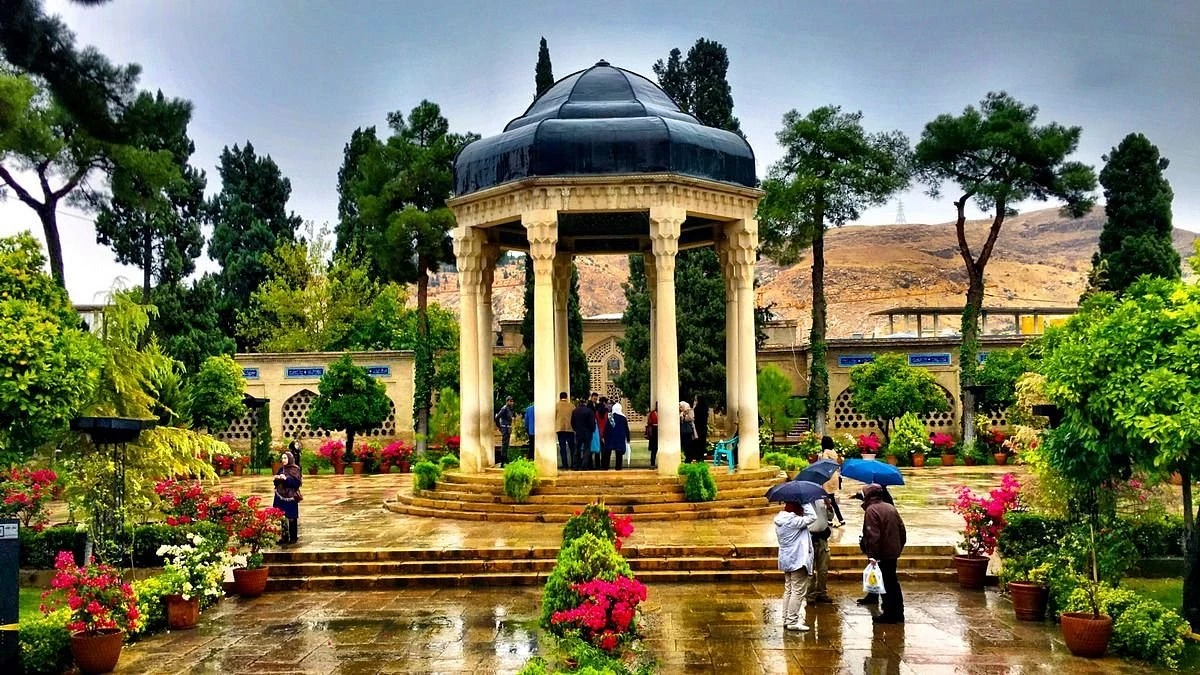
Hafez, the 14th-century poet whose Divan sits in most Iranian homes, is buried in the Musalla Gardens, north of the city. The current open pavilion, on eight columns, was built in 1935 to plans by the French archaeologist and architect André Godard, on the site of older monuments.
The marble tomb, carved with the poet's verses, draws many Iranians, who come to recite his ghazals.

Eram Garden
Eram Garden (Bagh-e Eram) lies on the north bank of the Khoshk river, north-west of the centre. Since 2011 it has been a UNESCO World Heritage Site along with eight other Iranian gardens, as part of 'The Persian Garden'.
Its alleys of cypress and orange trees and its pool lead to a 19th-century Qajar pavilion decorated with painted tiles.

Naqsh-e Rostam and Naqsh-e Rajab
About twelve kilometres north-west of Persepolis, the Naqsh-e Rostam cliff holds four cross-shaped Achaemenid royal tombs, attributed to Darius I, Xerxes I, Artaxerxes I and Darius II. Below the tombs, Sasanian reliefs show investitures and victories, including Shapur I's triumph over the Roman emperor Valerian. Facing the cliff stands an Achaemenid stone tower, the Ka'ba-ye Zartosht.
A few kilometres away, Naqsh-e Rajab gathers more Sasanian reliefs cut into the rock.

Vakil Bazaar
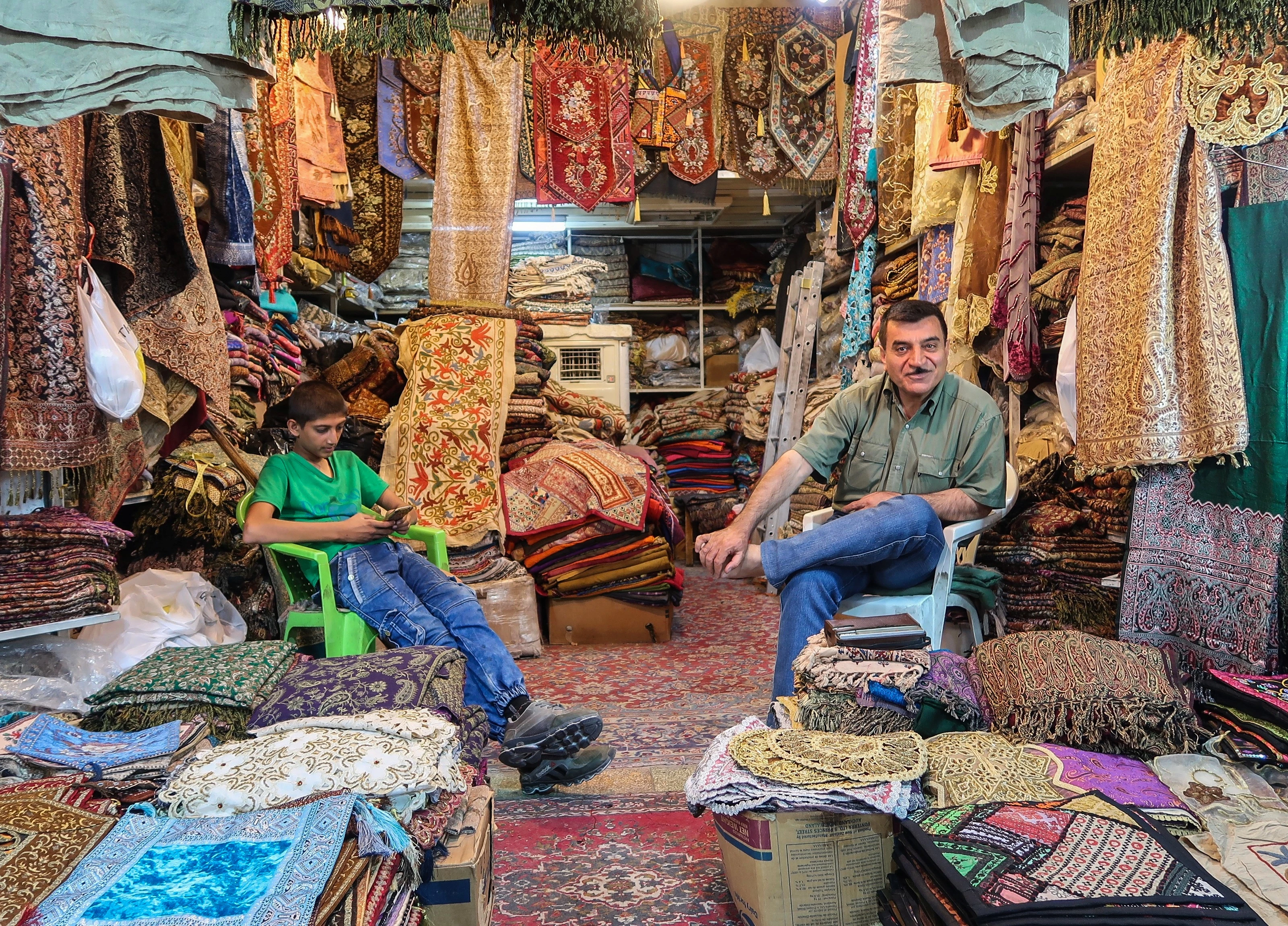
Built in the 18th century by Karim Khan Zand, the Vakil Bazaar was part of an urban complex that also included the Vakil Mosque and bathhouse, south of today's citadel. Its covered, brick-vaulted alleys hold carpets, spices, fabrics and copperware.
It is still a busy neighbourhood market, where Shiraz traders and visitors mix.

Shah Cheragh Shrine
Shah Cheragh ('king of light') is a Shia funerary complex built around the mausoleums of Ahmad ibn Musa and his brother Mir Muhammad, sons of the seventh imam Musa al-Kazim and brothers of Imam Reza. It is one of Iran's major pilgrimage sites, known for the interior of its dome and halls, entirely covered in mirror mosaics.
The shrine was targeted by two armed attacks, on 26 October 2022, claimed by the Islamic State, and on 13 August 2023. It remains a busy place of worship under heavy surveillance.

Karim Khan Citadel
Built in 1766-1767 for Karim Khan Zand, who lived there, the citadel (Arg-e Karim Khan) is a rectangle of high brick walls flanked by four round towers. It was used as a prison before being turned into a museum.
Inside, a courtyard planted with orange trees and a pool leads to the ruler's quarters. The south-east corner tower leans noticeably, having subsided over old baths.

Tomb of Saadi
The Saadi mausoleum (Saadieh) is dedicated to Saadi Shirazi, a 13th-century poet, author of the Golestan and the Bustan. The current building, topped with a turquoise dome, was built in 1950-1952 to plans by the architect Mohsen Foroughi.
It stands in the north-east of the city, in a garden crossed by a qanat, an underground channel whose water feeds a pool below the tomb.

Narenjestan-e Qavam garden and house
Home of the Qavam family, one of Shiraz's great families, the Narenjestan-e Qavam dates from the Qajar era, in the 19th century. Its name comes from the bitter orange trees (narenj) lining the garden's central pool.
The main pavilion combines a painted tile facade, carved woodwork and a hall covered in mirror mosaics.

Afifabad Garden
Formerly the Golshan Garden, Afifabad Garden (Bagh-e Afifabad) lies in the west of the city. Its Qajar-era palace, fronted by a pool and planted alleys, now houses a weapons museum.
Less visited than Eram Garden, it offers a shady walk away from the centre.

Saray-e Moshir caravanserai
This restored caravanserai, at the southern end of the Vakil Bazaar, is laid out around a courtyard with a pool, lined by two storeys of arcades. It gathers craft shops: carpets, marquetry (khatam), copperware and ceramics.
Quieter than the main bazaar, it takes about twenty minutes to visit.
A day at Persepolis and Naqsh-e Rostam
A day from Shiraz, by taxi for the day or with a driver-guide: about an hour's drive to Persepolis, the ceremonial capital of Darius I, then the Naqsh-e Rostam necropolis, about twelve kilometres away, and the Naqsh-e Rajab reliefs. The highlight: the Apadana staircases, carved with processions of delegations bringing tribute.
Leave early: there is no shade on the sites and summer is very hot. Entry fees are paid in cash; agree the taxi price before setting off.
- 1 day
- Day taxi + entry fees, in cash (rials)
An evening at the Tomb of Hafez
Late in the day, the Musalla Gardens north of the city fill with locals visiting the Tomb of Hafez. Many recite his ghazals in front of the marble tomb; others open the poet's Divan at random to read an answer to a question, following the 'fal-e Hafez' tradition. The highlight: André Godard's pavilion lit up at nightfall, when the garden is at its busiest.
Allow an hour or two; entry is paid in cash. The Tomb of Saadi, about 3 km away, can be seen just before, by taxi.
- 1 to 2 hrs
- Paid entry, in cash (rials)
A Zand morning: citadel, Vakil Bazaar and bathhouse
A morning on foot through the complex built by Karim Khan Zand in the 18th century: the citadel and its leaning tower, then, across the avenue, the Vakil Bazaar and its vaulted alleys, the Vakil Mosque and the Vakil bathhouse, now a museum. The walk ends at the Saray-e Moshir caravanserai, south of the bazaar. The highlight: the bazaar's brick vaults, lit through openings in the domes.
Start when the citadel opens, before the heat. Entry fees and purchases are paid in cash; prices at the bazaar are haggled.
- 3 hrs
- Citadel, mosque and bathhouse entry fees, in cash
Getting there
Shiraz has its own airport (SYZ), linked by domestic flights to Tehran and Isfahan; international access is usually via Tehran (IKA). Iranian airspace may close without notice.
Shiraz is served by Shahid Dastgheib International Airport (SYZ), linked by domestic flights to Tehran, Isfahan and Mashhad. Most foreign travellers arrive in Iran through Tehran-Imam Khomeini Airport (IKA), then take a domestic flight of about 1 hr 15 or the road: Shiraz is some 480 km south of Isfahan by motorway.
Reminder: travel to Iran is formally advised against, and France Diplomatie warns that Iranian airspace and airports may close without notice (see the safety section).
What to do
The Nasir al-Mulk Mosque at sunrise, the citadel and the Vakil Bazaar, the gardens in the afternoon, the tombs of Saadi and Hafez in the evening, then a day at Persepolis and Naqsh-e Rostam.
A typical day starts early at the Nasir al-Mulk Mosque, for the light through the stained glass, then the Narenjestan-e Qavam, the Karim Khan Citadel and the Vakil Bazaar down to the Saray-e Moshir. In the afternoon, the Eram and Afifabad gardens; late in the day, the tombs of Saadi then Hafez. A second day goes to Persepolis and Naqsh-e Rostam.
Two to three days are enough for these sites. This plan remains theoretical while France Diplomatie formally advises against travel (see the safety section).
Food
Shirazi salad, kalam polo and faloodeh, a rose-water frozen dessert, are Shiraz's specialities; all the Iranian classics are available too, paid in cash.
Shiraz has its specialities: Shirazi salad (cucumber, tomato, onion, lime juice and dried mint), kalam polo, rice with cabbage and herbs, and faloodeh, a frozen dessert of thin rice noodles in syrup and rose water, served with lime juice. The Iranian classics are everywhere too: chelo kebab (saffron rice and skewers), ghormeh sabzi (herb stew with kidney beans), black tea and doogh, a yoghurt drink.
The tea houses of the centre and the bazaar serve tea and simple dishes. Alcohol is prohibited. Restaurants are paid in cash, in rials.
Climate & seasons
When to go to Iran?
Monthly averages over the past 5 years (Open-Meteo).
Best months
- January
- February
- April
- May
- October
- December
Avoid
- June
- July
- August
| Jan | Feb | Mar | Apr | May | Jun | Jul | Aug | Sep | Oct | Nov | Dec | |
|---|---|---|---|---|---|---|---|---|---|---|---|---|
| Our take | ||||||||||||
| Weather | ||||||||||||
| High | 13° | 15° | 21° | 27° | 32° | 37° | 39° | 37° | 34° | 28° | 21° | 15° |
| Rain (mm) | 35 | 34 | 42 | 11 | 10 | 0 | 4 | 0 | 0 | 4 | 15 | 35 |
| City sightseeing | City sightseeing January | City sightseeing February | City sightseeing March | City sightseeing April | City sightseeing October | City sightseeing November | City sightseeing December |
What to do by season (autumn)
-
City sightseeing
Pedestrian-friendly most of the year.
When to go
Spring (mid-March to mid-May) and autumn (September to November) are the best times; summer is very hot and winter nights are cold.
Spring (mid-March to mid-May) is the best time: mild weather and gardens in bloom. It is also Iran's high season, around Nowruz, the Persian New Year celebrated at the equinox (20-21 March), with many Iranian visitors and services disrupted during the holidays.
Autumn (September to November) is quieter and still mild. Summer (June to August) is very hot, with no shade on the ancient sites: visit early in the morning. Winter stays mild by day but cold at night, with some rain.
These pointers remain theoretical while France Diplomatie formally advises against travel (see the safety section).
Where to stay
The historic centre, near the Vakil Bazaar and the Nasir al-Mulk Mosque, to do everything on foot, with traditional courtyard houses; book early around Nowruz.
To stay within walking distance of the main sites, sleep in the historic centre, around the Vakil Bazaar, the citadel and the Nasir al-Mulk Mosque. The area has restored traditional courtyard houses turned into guesthouses.
The larger hotels are along the avenues north of the centre, closer to the tombs of Hafez and Saadi. Book early around Nowruz, in late March, when Iranians travel en masse. Hotels and guesthouses are paid in cash.
Safety
France Diplomatie formally advises against all travel to Iran, across the whole country, and asks French nationals there to leave immediately: high risk of arrest and arbitrary detention, dual nationals included (updated 10 September 2026).
France Diplomatie formally advises French nationals against travelling to Iran, across the whole country, and recommends that those already there leave immediately (travel advice page updated on 10 September 2026). This guide describes Shiraz's heritage for information only; it is not an invitation to go there.
- Arbitrary detention: according to the ministry, Iran 'pursues a deliberate policy of taking Western hostages' and targets French visitors it accuses of espionage. Any French visitor, dual nationals included, faces a high risk of arrest, arbitrary detention and unfair trial.
- Very limited consular protection: the French embassy in Tehran is open, but it is not always informed of an arrest. Iran does not recognise dual nationality: a French-Iranian who entered on an Iranian passport cannot request French protection.
- Air travel: Iranian airspace and airports may close without notice.
- Behaviour: no photos or videos at all (France Diplomatie's instruction), no drones, no gatherings or demonstrations, no criticism of the regime or of religious obligations on social media.
- Other risks: heightened terrorist threat since the Kerman attack (January 2024); in Shiraz itself, the Shah Cheragh shrine was targeted by two armed attacks, in October 2022 (claimed by the Islamic State) and August 2023. High seismic activity, dangerous driving on the roads.
Emergency numbers in Iran: police 110, ambulance 115, fire brigade 125. Check France Diplomatie's Iran page before making any decision: the situation can change very quickly.
Formalities
A visa is required for French nationals, from the Iranian embassy in Paris (one month maximum), or a 30-day visa on arrival (€75) at some airports. Pay in cash: foreign cards don't work. Travel formally advised against.
Reminder: travel is formally advised against (see the safety section). The rules below are those of France Diplomatie's entry and stay page, updated on 15 September 2026.
Visa: required for French nationals, to be requested from the Iranian embassy in Paris several weeks in advance, as the process can be slow. A tourist visa is valid for one month at most. A visa on arrival (30 days, €75) exists at some airports after online pre-registration, but the ministry recommends applying beforehand at the embassy. Keep the entry card, required on departure; if you overstay, border police will stop you from leaving the country.
Customs: importing alcohol is prohibited; antiques and antique carpets require an export permit; keep receipts for valuable purchases.
Money: the currency is the Iranian rial, but prices are often quoted in tomans (1 toman = 10 rials). Visa and Mastercard cards issued abroad do not work in Iran because of sanctions: you need cash (paying in Iran).
Customs and dress: modest dress, headscarf mandatory for women in public. Persian is the official language.
Tips
Cash only (foreign cards don't work), modest dress and headscarf for women, no photos or videos at all, and sites grouped by district.
- Money: Visa and Mastercard cards issued abroad do not work in Iran; bring cash in euros or dollars to change locally (paying in Iran).
- Dress: loose clothing covering arms and legs, headscarf mandatory for women; chador required at Shah Cheragh (lent at the entrance).
- Photos: France Diplomatie asks visitors to take no photos or videos at all and not to fly drones.
- Itinerary: group the sites by district: the historic centre on foot (citadel, Vakil Bazaar, Nasir al-Mulk, Narenjestan), the tombs of Hafez and Saadi to the north-east, Persepolis and Naqsh-e Rostam in one day.
- Heat: in summer, visit early in the morning and carry water; there is no shade on the ancient sites.
FAQ
Safety, visa, money, length of stay, getting to Persepolis and etiquette: answers to the most common questions about Shiraz.
Can you travel to Iran right now?
France Diplomatie formally advises against all travel to Iran, across the whole country, and recommends that French nationals there leave immediately (updated 10 September 2026). There is a high risk of arrest and arbitrary detention, dual nationals included.
Do you need a visa for Shiraz?
Yes. Apply at the Iranian embassy in Paris several weeks in advance; a 30-day visa on arrival (€75) exists at some airports after online pre-registration. A visa does not lift the safety warning.
What currency and how do you pay?
The Iranian rial, often counted in tomans (1 toman = 10 rials). Foreign Visa and Mastercard cards do not work because of sanctions: you need cash.
How many days do you need in Shiraz?
Two to three days: one or two for the city (mosques, gardens, bazaar, the poets' tombs) and one for Persepolis and Naqsh-e Rostam.
How do you get from Shiraz to Persepolis?
Persepolis is some sixty kilometres north-east of Shiraz, about an hour's drive: the simplest option is a taxi for the day, adding Naqsh-e Rostam, about twelve kilometres away.
When can you see the light in the Nasir al-Mulk Mosque?
Early in the morning, at sunrise, when the light passes through the stained glass of the winter hall. The effect is gone by midday.
How should you dress and behave?
Modest dress, headscarf mandatory for women in public, chador at Shah Cheragh. France Diplomatie asks visitors to take no photos or videos at all and not to fly drones.
Sources
The figures in this guide come from the sources below, checked on the publication date.
Leave a comment
Share your thoughts or travel experience. Your email will not be published.