

Contents 29
Paros sits in the middle of the Cyclades, about 150 km south-east of Piraeus. The island, roughly 196 km², combines sandy beaches, whitewashed villages and a heritage built on marble: the ancient Marathi quarries are believed to have supplied the stone for the Venus de Milo. This guide covers its 15 highlights, from Parikia's Panagia Ekatontapiliani church to the Byzantine Road from Lefkes and the Antiparos cave, then access, transport, entry requirements and safety.
Overview
Paros is a Cyclades island in the central Aegean, known for its whitewashed Cycladic villages (Parikia, Naoussa, Lefkes), its beaches, its ancient marble quarries and excellent access by ferry and plane.
Paros lies in the heart of the Cyclades, about 150 km south-east of Piraeus and just west of Naxos. The island, around 196 km² with 14,520 inhabitants (2021), combines sandy beaches, whitewashed Cycladic villages and an ancient heritage: its Parian marble, quarried on Mount Marathi, was used by Praxiteles and is believed to be the stone of the Venus de Milo.
The capital and main port, Parikia, is home to the Panagia Ekatontapiliani church. In the north, Naoussa lives around its fishing harbour; in the centre, the mountain village of Lefkes is the starting point of the Byzantine Road. Well connected by ferry to Piraeus and the neighbouring islands, Paros is also the base for Antiparos, a few minutes away by boat.
15 places to take with you
In the guide's order, ready for Google Maps or your GPS.
Book the activities from this guide
Our picks for Paros, well rated and free to cancel.
-
Book this activity
Swimming cruise around Antiparos and Despotiko
€50 per person (GetYourGuide price 2026)
-
Book this activity
Greek cooking class in Drios
€125 per person (GetYourGuide price 2026)
-
Book this activity
Natural wine tasting at Domaine Myrsini
€39 per person (GetYourGuide price 2026)
Affiliate links: Travel Advice earns a commission if you book, at no extra cost to you. Learn more

Kolymbithres Beach
At the back of Naoussa Bay on the north coast, Kolymbithres takes its name ("baptismal fonts") from the granite boulders, smoothed by erosion, that split the beach into small sandy coves and shallow pools of clear water.
You swim between the rocks, climb the boulders for a view over the bay, and choose between the main beach, with sunbeds and umbrellas in season, and the quieter coves next to it.

Parikia
Parikia, the capital, is also the port where ferries dock. Behind the waterfront, whitewashed lanes lead to the Panagia Ekatontapiliani, the "Church of a Hundred Doors": tradition credits Saint Helen with founding it in the 4th century, and Justinian had work resumed there in the 6th century.
The Archaeological Museum holds a fragment of the Parian Chronicle, a timeline carved in marble covering Greek history from 1500 to 264 BC. The bay opens to the west and faces the sunset.

Naoussa
Naoussa, on the north coast, grew around a large natural harbour. Its small fishing port, where caiques moor below the tavernas, is guarded by the remains of a Venetian fort half in the water.
In the evening, the whitewashed lanes fill with fish restaurants and bars. It is also the most convenient base for the northern beaches: Kolymbithres, Monastiri and Santa Maria.

Chrysi Akti (Golden Beach)
Chrysi Akti, the "golden beach", is a long stretch of sand on the south-east coast, between Piso Livadi and Drios. In summer the Meltemi, a northerly wind that blows mostly in July and August, sweeps this coast steadily.
It is one of the busiest windsurfing spots on Paros, with rental and beginner centres set up on the sand and a few tavernas and beach bars behind.

Santa Maria Beach
Santa Maria is a sandy beach on the north-east coast, on the peninsula that closes off Naoussa Bay. The water stays shallow for several metres, which makes it pleasant for families when the sea is calm.
Exposed to the wind, it also draws windsurfers. Sunbeds, beach bars and tavernas are concentrated on the main section; the coves to the north are wilder.

Lefkes
Lefkes is a mountain village in the centre of the island, 10 km from Parikia, and the former seat of the municipality of Iria. Emptied by emigration in the 1970s, it has regained residents through tourism (545 at the 2011 census).
People come for its marble-paved lanes, white houses clinging to the slope and the view over the east coast. It is also the starting point of the Byzantine Road down to Prodromos.

Antiparos and its cave
Antiparos is separated from Paros by a strait less than 2 km wide. The ferry leaves from Pounda, and the island makes an easy day trip: its harbour village, its beaches and above all its cave, 8 km from the village.
You descend about 411 steps to a depth of some 85 m, among the stalactites. Visitors have carved their names there over the centuries, and the French ambassador, the Marquis de Nointel, had Christmas Mass celebrated inside in 1673.

Hiking the Byzantine Road
The Byzantine Road links Lefkes to Prodromos over 3.5 km. This path paved with Parian marble dates from the Byzantine era, around AD 1000, and runs downhill almost all the way, apart from 150 to 200 m of climbing.
It first crosses farmland and low scrub, then drops into a ravine, with views of Naxos, the mountains of Ikaria and the coast, passing near Molos beach and the Kefalos and Antikefalos hills.
Ancient Marathi marble quarries
On the northern side of Mount Marathi, in the centre of the island, are the quarries where Parian marble was cut in antiquity, prized for its fine grain and translucency. Praxiteles and other Greek sculptors used it, and the Venus de Milo is believed to be carved from this marble.
You can still see the entrances of the galleries dug into the hillside above the hamlet of Marathi, on the road linking Parikia to Lefkes.

Marpissa
Marpissa is a village in the east of the island, built like an amphitheatre on a hill above Piso Livadi, near Prodromos and Marmara. Its white lanes, chapels and old windmills can be explored on foot in an hour.
Above the village, Kefalos hill is topped by the monastery of Agios Antonios, with views over Piso Livadi bay and, on a clear day, as far as Naxos.

Pounda kitesurfing spot
Pounda is a small village on the west coast, facing Antiparos. The channel between the two islands funnels the Meltemi, which blows hard and steadily in July-August, while the water stays fairly flat: ground well liked by kitesurfers and windsurfers.
Schools on the beach rent out gear and give lessons, from first sessions to advanced coaching. Pounda is also the ferry port for Antiparos.

Monasteries of Paros
On the heights between Parikia and Naoussa, the monastery of Longovarda (Zoodochos Pigi) is a still-active monastery for men, founded in the 17th century and known for its frescoes and icon workshop.
To the east, the monastery of Agios Antonios crowns Kefalos hill above Marpissa. In Parikia, the Panagia Ekatontapiliani is the second great Marian pilgrimage site of the Aegean after Tinos.

Prodromos
Prodromos is a village in the eastern interior of Paros, next to Marpissa and Marmara. Its white houses packed around narrow lanes and small churches keep a village life, away from the beaches.
It is the end point of the paved Byzantine Road that comes down from Lefkes: most visitors arrive on foot, at the end of the walk, for a break in the shade before heading back.

Traditional festivals of Paros
The big event of the year is the Feast of the Dormition on 15 August at Parikia's Panagia Ekatontapiliani: the church is the Aegean's second Marian pilgrimage site after Tinos, and the feast draws worshippers from all over the Cyclades.
Throughout the summer, villages hold their panigiria, patron-saint festivals with music, traditional dancing in costume and shared meals, often on the eve of the parish saint's day.

Paros crafts and local produce
Hand-painted ceramics are one of the typical souvenirs of Paros, along with local produce: honey, aromatic herbs, olive oil and the island's wines.
Parian marble, worked since antiquity, also inspires small carved objects. The lanes of Parikia behind the waterfront, and those of Naoussa, are where you find craft workshops, jewellers and delicatessens.
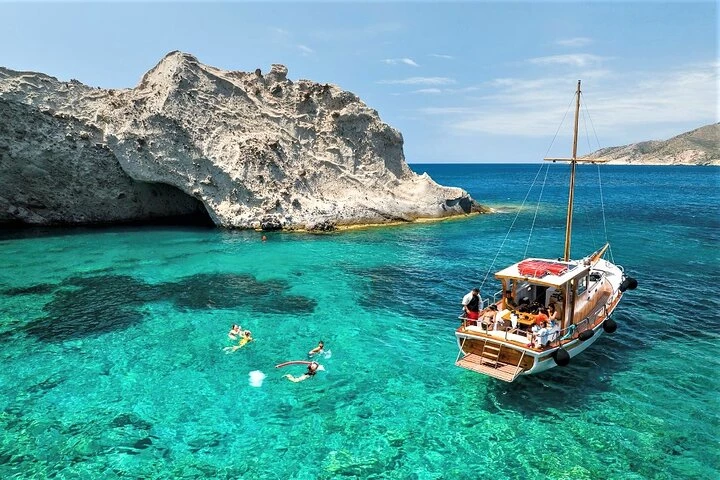
Swimming cruise around Antiparos and Despotiko
A day on a boat from Paros to the coasts of Antiparos and Despotiko, mostly reachable by sea: swimming stops in turquoise bays, including the Blue Lagoon, snorkelling with the gear provided and a pass by the sea caves. The highlight: the traditional Parian lunch served on board, with wine and drinks.
Allow €50 per person on GetYourGuide, with free cancellation up to 24 hours before. The route depends on the wind: on a Meltemi day, the crew picks sheltered bays.
- 7 hrs
- €50 per person (GetYourGuide price 2026)
Greek cooking class in Drios
In the village of Drios on the south-east coast, a local chef has you cook six dishes from family recipes: a starter, a salad, three mains (meat, fish, vegetarian) and a dessert. The aperitif comes with Greek wine and souma, the island's grape-pomace spirit. The highlight: the shared meal at the table, after a lesson in a traditional dance.
Allow €125 per person on GetYourGuide, with free cancellation; up to 25 participants, in English or Greek. The class fills up fast in summer: book several days ahead.
- 3.5 hrs
- €125 per person (GetYourGuide price 2026)
Natural wine tasting at Domaine Myrsini
At Domaine Myrsini, near Marpissa, a French winemaking couple pours five natural Paros wines, including a pét-nat, with a small snack from the garden, in the middle of the vines. The highlight: their explanations of the Parian terroir, which gives the wines their minerality, with the sea in the background.
Allow €39 per person on GetYourGuide, with free cancellation; over-18s only. A 15-minute tour of the estate can be added. Come in the late afternoon and plan a sober driver or a taxi.
- 1 hr
- €39 per person (GetYourGuide price 2026)
Beginner windsurfing at Chrysi Akti
On Chrysi Akti beach, the windsurfing centres set up on the sand offer rentals and lessons, from a first session to advanced coaching. The Meltemi that blows over the east coast in summer brings a steady wind. The highlight: your first runs on your own, once the instructor has taught you the basics.
Book directly with a beach centre, the day before in July-August. Beginners do best in the morning, when the wind is lighter; experienced kitesurfers should head to Pounda instead.
- By the hour or half-day
- Prices set by the beach centres
Getting there
Reach Paros by ferry from Piraeus, Rafina or Lavrio (Parikia port), or by air at Paros National Airport (PAS) with flights from Athens.
By ferry: Paros is served from the ports of Athens — mainly Piraeus, but also Rafina and Lavrio. Ferries dock at Parikia, the main port. Depending on the vessel (conventional or high-speed), the crossing from Piraeus takes about 3 to 5 hours. Ferries also link Paros with Naxos, Mykonos, Santorini and other Cyclades islands.
By air: Paros National Airport (PAS) receives domestic flights from Athens. It is the fastest option, followed by a transfer to where you are staying. In high season, book ferries and flights in advance.
Getting around
To explore Paros, a rental car or scooter offers the most freedom; the KTEL bus network links the main villages, and taxis fill the gaps.
Car or scooter rental: the most convenient way to explore the island at your own pace, with many agencies in Parikia and Naoussa. A valid licence is required; watch for narrow mountain roads.
Bus (KTEL): a public bus network connects Parikia, Naoussa, Lefkes, Piso Livadi and the main beaches. Reliable and affordable, with more frequent services in summer. Taxis: available but pricier, especially in high season. For Antiparos, the ferry leaves from Pounda (about a 10-minute crossing, several departures per hour).
What to do
Beaches and board sports, Cycladic villages (Parikia, Naoussa, Lefkes), the Byzantine Road, the Marathi marble quarries, monasteries, the Antiparos cave and a cruise around Antiparos and Despotiko.
For beaches, Paros lines up Kolymbithres and its granite boulders, Santa Maria and Chrysi Akti, with windsurfing and kitesurfing spots at Pounda and on the east coast. For villages, wander the lanes of Parikia, Naoussa, Lefkes, Marpissa and Prodromos.
For history, there is the Panagia Ekatontapiliani church, the monasteries of Longovarda and Agios Antonios, and the ancient Marathi marble quarries. For walking, the paved Byzantine Road from Lefkes to Prodromos (3.5 km). A day on Antiparos and its cave, a swimming cruise around Antiparos and Despotiko, a cooking class or a tasting at one of the island's wineries round off the stay.
Climate & seasons
When to go to Greece?
Monthly averages over the past 5 years (Open-Meteo).
Best months
- January
- February
- March
- April
- May
- June
- July
- August
- September
- October
- November
| Jan | Feb | Mar | Apr | May | Jun | Jul | Aug | Sep | Oct | Nov | Dec | |
|---|---|---|---|---|---|---|---|---|---|---|---|---|
| Our take | ||||||||||||
| Weather | ||||||||||||
| High | 15° | 14° | 16° | 19° | 23° | 27° | 30° | 29° | 27° | 23° | 20° | 17° |
| Rain (mm) | 53 | 37 | 35 | 27 | 14 | 5 | 1 | 3 | 6 | 25 | 41 | 71 |
| Beach | Beach June | Beach July | Beach August | Beach September |
What to do by season (autumn)
-
Beach
Warm air and water, little rain.
When to go
The best time to visit Paros is May to September. July-August are the hottest and busiest (and windiest, ideal for board sports); May-June and September offer the best balance of weather and crowds.
Paros's tourist season runs from May to September. At the height of summer (July-August), days are hot and sunny and the atmosphere is lively, but beaches and villages are crowded and prices peak: book accommodation well ahead.
May-June and September-early October offer an excellent balance: pleasant temperatures, sea still warm in September, and fewer people. The Meltemi winds, strongest in July-August, delight windsurfers and kitesurfers but can disrupt swimming on some days. In winter (November-April) the island is very quiet and many seasonal businesses close.
Where to stay
Parikia and Naoussa offer the most choice and buzz; Piso Livadi and Drios are quieter and more affordable; Lefkes appeals for an authentic mountain feel.
Parikia, the capital and port, has the widest range of accommodation and stays central for getting around. Naoussa, smarter and lively at night, is ideal for the northern beaches and going out.
For more peace and often gentler rates, look at Piso Livadi and Drios, coastal villages on the east near Golden Beach. Lefkes, a mountain village, offers a more authentic experience away from the coast. Book early in the summer high season, when availability shrinks fast.
Safety
Paros is a safe island; the main risks are the sea in strong wind, scooter riding and the sun. Emergency number: 112.
Paros poses no particular risk to travellers. The most common accidents involve the roads (scooters and quads on narrow, winding roads) and the sea: on Meltemi days, waves and currents make some exposed beaches dangerous, especially on the east coast. Protect yourself from the sun, as beaches and trails have little shade.
Useful numbers in Greece: European emergency number 112, police 100, ambulance 166, fire brigade 199, coast guard 108, tourist police 1571.
Formalities
Greece is part of the EU and the Schengen Area: EU/EEA nationals enter with a valid national ID card or passport, with no visa needed.
Greece is a member of the European Union and the Schengen Area. Citizens of the EU, the EEA and Switzerland travel with a valid ID card or passport, without a visa.
Non-EU travellers need a valid passport and, depending on their nationality, may stay visa-free for up to 90 days in any 180-day period in the Schengen Area; otherwise a Schengen visa is required. Since 10 April 2026, the EES Entry/Exit System records their biometric data at their first Schengen border crossing. The ETIAS travel authorisation is not yet in operation and no launch date has been set (September 2026). Neither EES nor ETIAS applies to EU citizens. No formalities are needed to travel between Paros and Antiparos (domestic route).
Tips
Book ferries and accommodation ahead in summer, plan beaches around the Meltemi winds, carry cash for small tavernas, and dress modestly in monasteries.
In high season (July-August), book ferries and accommodation well in advance. Keep an eye on the Meltemi winds: for swimming, favour sheltered beaches or the morning; for windsurfing and kitesurfing, they are an asset.
Keep some cash for small tavernas and village markets. When driving a car or scooter, beware of narrow roads and difficult parking in the centres of Parikia and Naoussa (park on the outskirts). In monasteries, cover shoulders and knees. Bring water, a hat and sunscreen for hikes, which offer little shade.
Planning Cyclades island-hopping? A few hours by ferry from Paros, Milos changes the scenery with its volcanic beaches: see the 12 essential things to do in Milos.
FAQ
How do you get to Paros?By ferry from Piraeus, Rafina or Lavrio (arriving at Parikia port, about 3 to 5 hours from Piraeus depending on the vessel), or by plane to Paros National Airport (PAS) with domestic flights from Athens.When is the best time to visit Paros?From May to September. May-June and September offer a good balance of weather and crowds; July-August are the hottest, busiest and windiest months (ideal for board sports).What are the best beaches on Paros?Kolymbithres (Naoussa Bay, granite boulders), Santa Maria (north-east coast) and Chrysi Akti (south-east coast, popular with windsurfers).How do you get around the island?Renting a car or scooter gives the most freedom; the KTEL bus network links the main villages and beaches, and taxis are available (pricier in summer).How do you get to Antiparos from Paros?The ferry leaves from the village of Pounda on the west coast: the crossing takes about ten minutes.
How do you get to Paros?
By ferry from Piraeus, Rafina or Lavrio (arriving at Parikia port, about 3 to 5 hours from Piraeus depending on the vessel), or by plane to Paros National Airport (PAS) with domestic flights from Athens.
When is the best time to visit Paros?
From May to September. May-June and September offer a good balance of weather and crowds; July-August are the hottest, busiest and windiest months (ideal for board sports).
What are the best beaches on Paros?
Kolymbithres (Naoussa Bay, granite boulders), Santa Maria (north-east coast) and Chrysi Akti (south-east coast, popular with windsurfers).
How do you get around the island?
Renting a car or scooter gives the most freedom; the KTEL bus network links the main villages and beaches, and taxis are available (pricier in summer).
How do you get to Antiparos from Paros?
The ferry leaves from the village of Pounda on the west coast: the crossing takes about ten minutes. Boats also leave from Parikia in season.
What are the opening hours and price of the Antiparos cave?
In 2026 the cave is open daily until October, 10 am to 4 pm (last entry 3.30 pm). The adult ticket costs €6 and includes the Antiparos Historical and Folklore Museum.
Do you need a visa to visit Paros?
Greece is in the EU and the Schengen Area. EU/EEA/Swiss nationals enter with a valid ID card or passport. Non-EU travellers follow Schengen rules (often 90 days in 180 visa-free depending on nationality) and go through EES registration; ETIAS is not yet in operation.
Why is Paros famous for its marble?
Parian marble, quarried on the northern side of Mount Marathi, has been prized since antiquity. Praxiteles and other Greek sculptors used it, and the Venus de Milo is believed to be carved from it.
Sources
The figures in this guide come from the sources below, checked on the publication date.
Leave a comment
Share your thoughts or travel experience. Your email will not be published.