

Contents 26
Within a few kilometres, Tulum brings together a Maya site on a cliff above the Caribbean, freshwater cenotes, long white-sand beaches and the Sian Ka'an Biosphere Reserve. This guide gathers its 12 must-sees, from Coba to Muyil, followed by the practical information: access, formalities, budget and safety.
Overview
Tulum is a small town on Mexico's Caribbean coast (Quintana Roo state), known for its clifftop Maya ruins, cenotes and white-sand beaches.
Tulum sits on Mexico's Caribbean coast in the state of Quintana Roo, about 130 km south of Cancun. It combines a rare seaside Maya archaeological site, cenotes (natural freshwater sinkholes), long beaches and access to the Sian Ka'an Biosphere Reserve.
There are two Tulums: the Pueblo (the more affordable, authentic town center, home to the ADO bus station) and the Zona Hotelera, the coastal strip of boutique hotels and beach clubs. Since Tulum's airport (TQO) opened in late 2023 and the Tren Maya arrived, the destination has become far easier to reach.
12 places to take with you
In the guide's order, ready for Google Maps or your GPS.
Book the activities from this guide
Our picks for Tulum, well rated and free to cancel.
-
Book this activity
Guided walking tour of the Tulum ruins
€17 per person, entry not included (GetYourGuide price 2026)
-
Book this activity
Maya canals and beach of Sian Ka'an
€148 per person (GetYourGuide price 2026)
-
Book this activity
Snorkelling with the turtles of Akumal
€38 per person, photos included (GetYourGuide price 2026)
Affiliate links: Travel Advice earns a commission if you book, at no extra cost to you. Learn more

The Mayan ruins of Tulum
Perched on a cliff above the Caribbean Sea, the Maya ruins of Tulum are one of the few Maya sites built on the coast. The walled city, whose name means "wall" in Maya, was an active trading port around 1200 AD until the Spanish arrived in the 16th century.
What to see on site:
- El Castillo: the main building at the cliff edge, likely used as a lighthouse or temple.
- Temple of the Frescoes: its Maya wall paintings are well preserved.
- Temple of the Descending God: dedicated to a winged deity shown upside down.
A staircase leads down from the site to Playa Ruinas, a small beach below. Plan 1 to 2 hours; shade is scarce.

Gran Cenote
Cenotes are natural freshwater sinkholes formed when limestone caves collapse; the Maya saw them as gateways to the underworld. Around Tulum the water is clear and cool, ideal for swimming, snorkeling and sometimes diving.
The main ones near Tulum:
- Gran Cenote: the most accessible, great for beginners, with small turtles.
- Cenote Calavera: more adventurous, with its light shafts.
- Cenote Dos Ojos: an underwater cave network popular with divers.
- Cenote Zacil-Ha: a small, quiet open cenote.
Bring a mask; only biodegradable sunscreen is allowed to protect the ecosystem.

Chichen Itza
About a 2h-2h30 drive from Tulum (153 km), Chichen Itza is one of Mexico's most famous Maya sites, a UNESCO World Heritage Site and one of the New Seven Wonders of the World.
How to get there:
- By rental car: full freedom; leave early (6-7am) to avoid heat and crowds.
- By guided tour: transport included, often paired with a cenote swim and a Valladolid stop.
- By ADO bus: cheaper but longer and less flexible.
What to see: the Kukulcan pyramid (El Castillo), the Great Ball Court, the Temple of the Warriors, the Skull Platform and the El Caracol observatory.

Sian Ka'an Biosphere Reserve
On the Caribbean coast of the Yucatan, the Sian Ka'an Biosphere Reserve covers about 528,000 hectares and has been a UNESCO World Heritage Site since 1987. Its name means "origin of the sky" in Maya. It brings together mangroves, coral reefs, lagoons and tropical forests.
Wildlife is abundant: jaguars, pumas, howler monkeys, hundreds of bird and fish species, and it is a sea-turtle nesting site.
You explore the reserve by boat, on guided hikes or snorkeling on the reef. Two ways in from Tulum: the coastal road to Punta Allen, through the Sian Ka'an arch south of the Zona Hotelera, and Muyil for the lagoons and Maya canals. Go with a certified guide: there is almost no tourist infrastructure.

The Coba ruins
About forty kilometres north-west of Tulum, in the jungle, Coba was one of the great Maya cities of the northern Yucatán, linked to its neighbours by a network of white causeways, the sacbés. You explore it on foot, by hire bike or by pedicab, from one group of temples to the next.
Its main temple, Nohoch Mul, reopened for climbing in late 2025 after six years of closure, via a wooden staircase laid over the original steps. From the top, the view stretches across the canopy to the Coba lagoons.

Playa Paraíso
Playa Paraiso is one of Tulum's best-known public beaches, just south of the archaeological site. White sand, turquoise water and a generally calm sea make it a good spot for swimming and snorkeling.
A few cafes and restaurants line the beach, but prices climb quickly. Bring cash in pesos, water and biodegradable sunscreen. Being exposed, its condition depends on sargassum between May and October: check before heading out.

Tulum Pueblo
Tulum Pueblo is the town center, a few kilometers from the coast. More affordable and more local than the hotel zone, it has traditional restaurants, taquerias, small hotels and hostels, craft markets and a lively nightlife.
It is also the transport hub: the ADO bus station sits right downtown. Bikes, scooters and taxis are easy to rent here for the beaches, the ruins, the cenotes or Sian Ka'an. Carry cash, as many shops don't take cards.

Casa Cenote
About ten kilometers north of Tulum (the Tankah area), Casa Cenote (or Cenote Manati) is an open cenote connected to the Caribbean Sea. That link creates a mix of fresh and salt water that draws tropical fish, turtles and, at times, manatees.
Lined with mangroves, the site is calm and easy to reach, with parking. People come for snorkeling, kayaking and swimming. Arrive early in the morning for clearer water and fewer people.

Kaan Luum Lagoon
About 15 minutes south of Tulum, Kaan Luum Lagoon combines a large, shallow turquoise lagoon with a deep-blue central cenote that drops to around 80 meters (divers only). The contrast between the two is striking.
The lagoon is fine for swimming and snorkeling; you can spot birds and small fish. An entrance fee helps maintain the site. Reachable by car or taxi from Tulum, it is a quieter alternative to the crowded beaches.

Playa Ruinas
Playa Ruinas is the small beach at the foot of the Tulum archaeological site. You reach it from inside the site (ticket required), down a wooden staircase from the cliff.
The setting is what sets it apart: Maya temples overlook turquoise water and pale sand. The cove is quiet, with no hotels or services, which makes it a fine photo spot, especially early morning for the light and calm. Bring water and cash.

Cenote Taak Bi Ha
Twenty to twenty-five minutes north of Tulum on Highway 307 towards Akumal, Cenote Taak Bi Ha lies inside the Dos Ojos park. It is an underground cenote with deep-blue water, quieter than the busiest sites.
You can swim and snorkel here, sometimes dive. Reach it by car, scooter, organized tour or by bike for the more active. Bring your snorkeling gear or rent it on site, and come early to enjoy the calm.

The Maya site of Muyil
About twenty kilometres south of Tulum on Highway 307, Muyil is one of the oldest Maya sites on the coast, occupied from 350 BC until the 13th-15th centuries. Its steep-walled Petén-style pyramids stand by the Sian Ka'an lagoon, once linked to the Caribbean by canals.
The city traded jade, obsidian, cacao, honey and salt with Coba, 44 km to the north. Far quieter than Tulum, it is also the way into the lagoons and canals of the Sian Ka'an reserve.
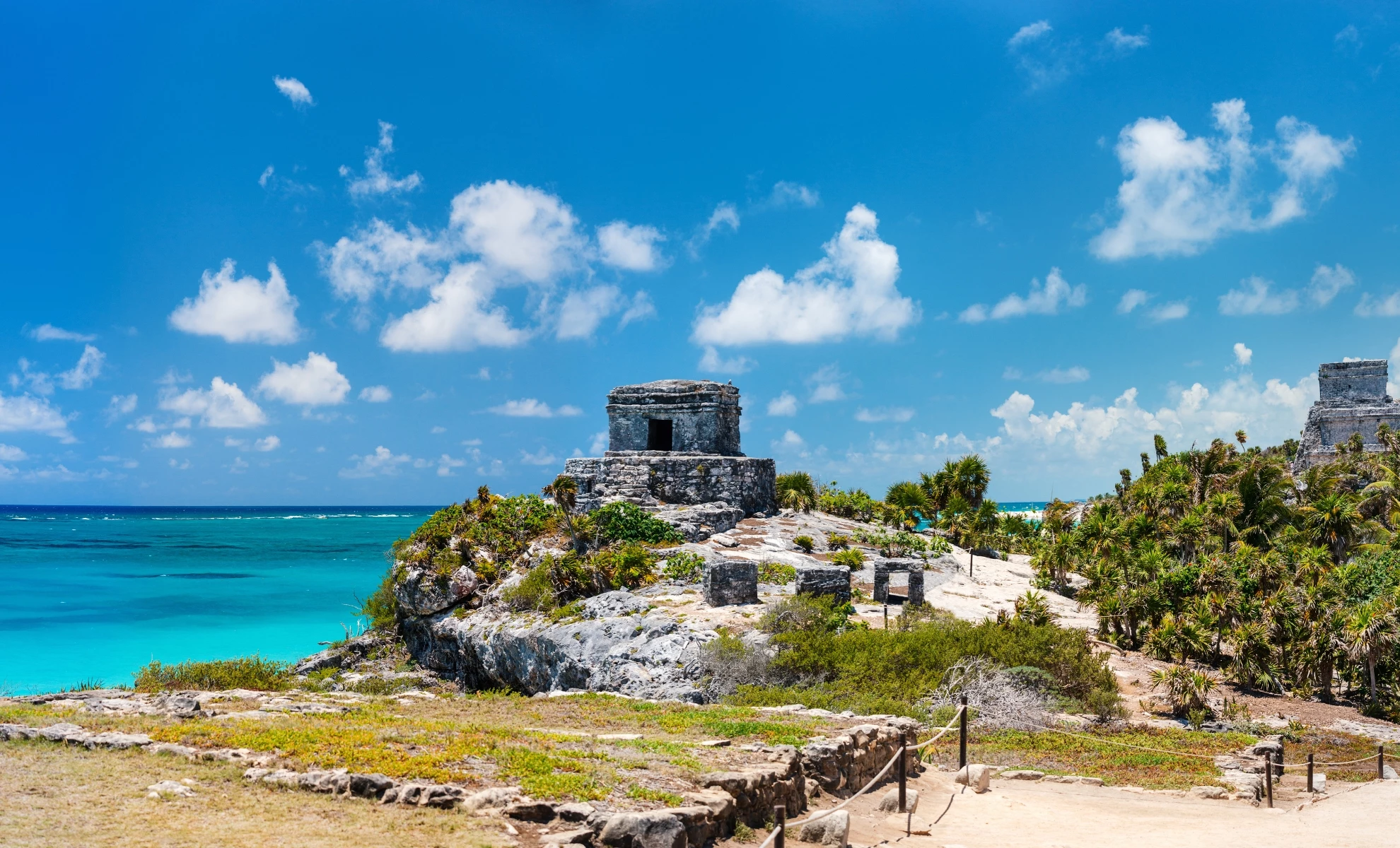
Guided walking tour of the Tulum ruins
An hour and a quarter with a guide in the archaeological zone: the enclosing wall that gave the city its name, El Castillo on the cliff edge, the Temple of the Frescoes and the Temple of the Descending God, with the story of this Maya trading port. The highlight: the view of El Castillo from the cliff, above the Caribbean.
Allow €17 per person on GetYourGuide, with free cancellation; check whether site entry fees are included. Pick the first morning slot, before the heat.
- 1.25 hrs
- €17 per person, entry not included (GetYourGuide price 2026)
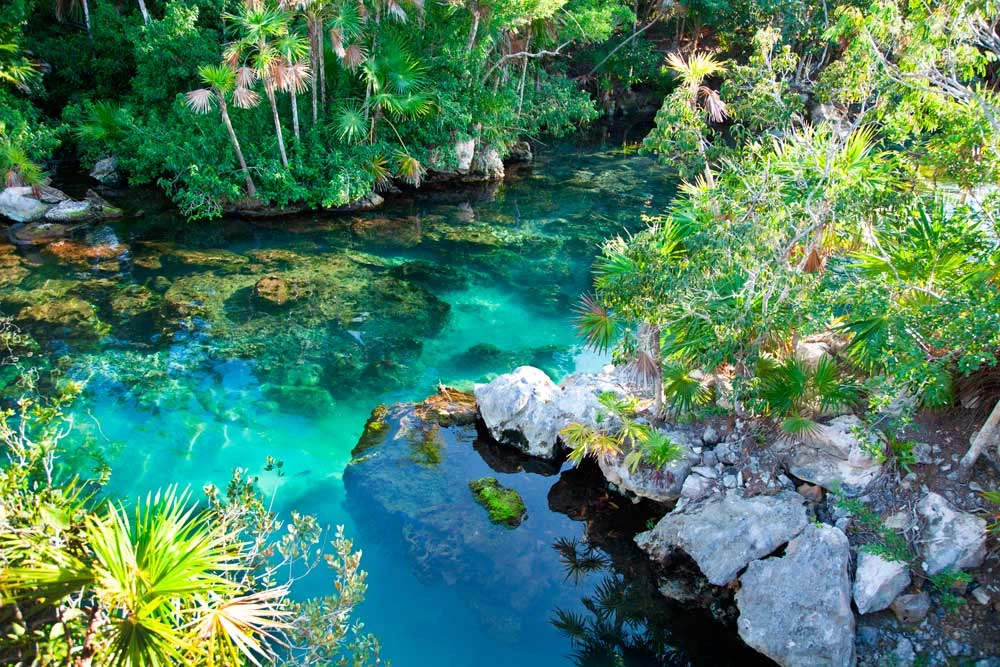
Maya canals and beach of Sian Ka'an
A day in the biosphere reserve: a boat across Chunyaxché lagoon, then floating downstream in a canal dug by the Maya about a thousand years ago, a Maya-style lunch and free time on Pez Maya beach, deep inside the reserve. The highlight: drifting with the current through the canal, between the mangroves.
Manatees, crocodiles and birds are sometimes seen. Allow €148 per person on GetYourGuide, with free cancellation. Insect repellent and biodegradable sunscreen are essential.
- 8 hrs
- €148 per person (GetYourGuide price 2026)
Snorkelling with the turtles of Akumal
About twenty minutes north of Tulum, Akumal bay is one of the few places on the coast where you swim with green turtles in the wild. The trip is in a small group with a guide, life vest compulsory, in the protected zone, and access to the beach facilities is included afterwards. The highlight: a turtle grazing the seagrass beneath you.
Allow €38 per person on GetYourGuide, GoPro photos included, with free cancellation. No guided trips on Mondays, mineral sunscreen only, and never touch the turtles.
- 1.5 hrs
- €38 per person, photos included (GetYourGuide price 2026)
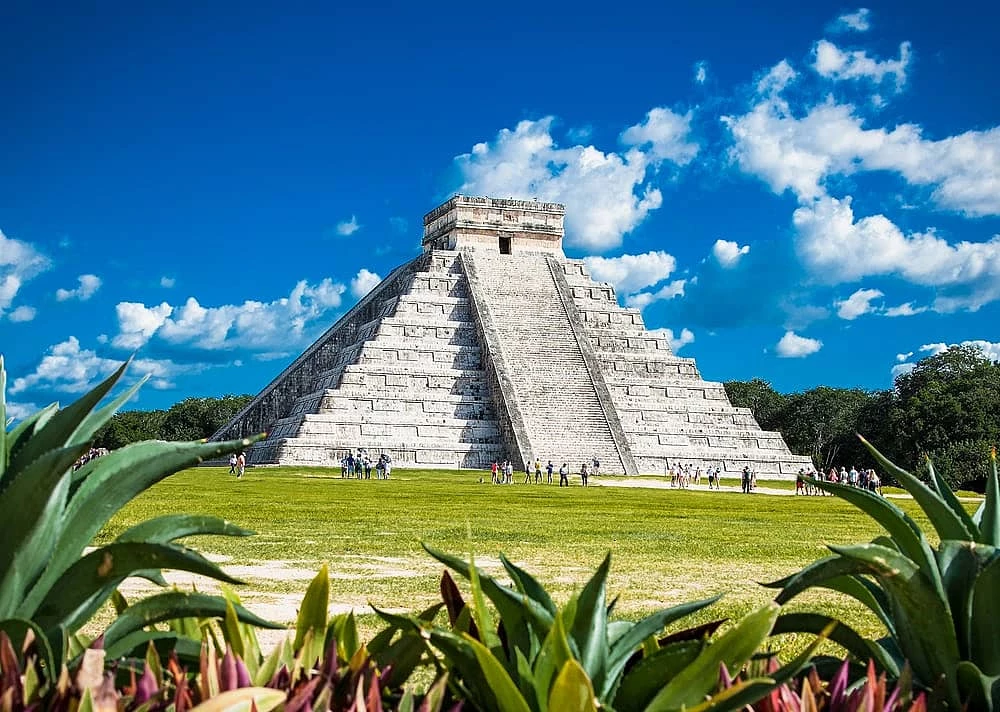
Day trip to Chichen Itza, a cenote and Valladolid from Tulum
A long day from Tulum: a visit to Chichen Itza and its Kukulcán pyramid, a swim in a cenote, a buffet lunch in the jungle, then a stroll through the colourful streets of colonial Valladolid. The highlight: stepping onto the esplanade in front of the Kukulcán pyramid.
Allow €79 per person on GetYourGuide, with free cancellation; very early departure, back in the evening. To see everything at your own pace, a hire car remains an alternative.
- 12 hrs
- €79 per person (GetYourGuide price 2026)
Getting there
Since late 2023 the fastest option is Tulum International Airport (TQO), ~20 km from town. Otherwise fly into Cancun (CUN) then ~2h by road, or take the Tren Maya, which now serves Tulum.
Tulum Airport (TQO): Felipe Carrillo Puerto International Airport opened on 1 December 2023, about 20 km southwest of Tulum. It is served by several airlines (Viva Aerobus, Aeromexico, American, Delta, United, Air Canada...).
Cancun Airport (CUN): long the only option, about 130 km / 2h by road to the north; the widest choice of international flights, then a transfer, ADO bus or Tren Maya.
Tren Maya: the train now serves Tulum (an urban station and an airport station) and links Cancun, Playa del Carmen, Valladolid, Chichen Itza and Mérida.
Getting around
Biking is the most practical option: the town is flat and compact, with rentals around $5-10/day. Add colectivos (shared minibuses, very cheap) and taxis (no meter, agree the fare before getting in).
Bike: the most popular way to move between downtown, the beach and the hotel zone. The town is flat; expect about $5-10 a day.
Colectivos: these shared minibuses run between Tulum and nearby areas, stop on request and are very cheap, ideal for the beaches or neighboring villages.
Taxis: easy to find but with no meter: agree the fare before getting in, especially at night.
On foot: the town center (Pueblo) is easily walkable for short distances.
What to do
Ruins at opening time, cenotes in the afternoon, Coba and Sian Ka'an as day trips, snorkelling with the turtles of Akumal; in the evening, the bars of the Zona Hotelera or the Pueblo.
A typical day starts at the ruins at opening time, moves on to Playa Paraíso beach and then a cenote, Gran Cenote or Casa Cenote. For day trips, Coba and its temple, climbable again, Muyil and the Sian Ka'an canals to the south, and Akumal bay to the north to swim with turtles.
In the evening, the Zona Hotelera has the bars and beach clubs, while the Pueblo stays more local and affordable. Sea turtles nest on the region's beaches in summer: keep out of marked areas.
Climate & seasons
When to go to Mexico?
Monthly averages over the past 5 years (Open-Meteo).
Best months
- February
- March
- April
Avoid
- June
| Jan | Feb | Mar | Apr | May | Jun | Jul | Aug | Sep | Oct | Nov | Dec | |
|---|---|---|---|---|---|---|---|---|---|---|---|---|
| Our take | ||||||||||||
| Weather | ||||||||||||
| High | 27° | 28° | 29° | 30° | 31° | 30° | 31° | 32° | 31° | 30° | 29° | 28° |
| Rain (mm) | 83 | 57 | 47 | 40 | 91 | 259 | 108 | 177 | 171 | 134 | 113 | 89 |
| Beach | Beach January | Beach February | Beach March | Beach April | Beach May | Beach December |
When to go
The best time is the dry season, December to April: sunny weather (24-30C) and clear sea, but crowds and high prices. The rainy season (May-October) is cheaper but brings a hurricane risk (Aug-Oct) and sargassum.
High season (December-April): dry, sunny weather, 24-30C, ideal for the beach and excursions; also the priciest and busiest stretch, so book ahead.
Rainy season (May-October): hot and humid with showers often late in the day, fewer crowds and lower rates; hurricane risk from August to October.
Sargassum: this seaweed hits Tulum's beaches from April to October, worst from May to August (2025 set records). It affects neither the cenotes nor the ruins. Check a sargassum-tracking map before booking a beachfront hotel.
Budget
Allow 265 MXN for the archaeological zone and Parque del Jaguar, about 330 MXN at Coba, 200-350 MXN for Akumal bay; the best-known cenotes often cost several hundred pesos.
Sites are paid in pesos, often in cash: 265 MXN in total for the Tulum archaeological zone and Parque del Jaguar (foreign rate since July 2026), about 330 MXN at Coba, 200-350 MXN for access to Akumal bay, set by the ejido. The best-known cenotes, such as Gran Cenote, often cost several hundred pesos.
For getting around, colectivos and bikes remain very cheap; the Zona Hotelera is much more expensive than the Pueblo for sleeping and eating. Always carry pesos in cash.
Where to stay
The Pueblo (town center) has the most affordable lodging and local life; the beachfront Zona Hotelera gathers pricier boutique hotels and eco-resorts. Areas near the cenotes and Sian Ka'an suit nature lovers.
Tulum Pueblo: the lively center, with affordable hotels, hostels and rentals close to restaurants, shops and the ADO station; easy access to beaches and sites.
Zona Hotelera (beachfront): boutique hotels, eco-resorts and villas along the coast for a calm, more luxurious stay, but noticeably pricier.
Near the cenotes / Sian Ka'an: ideal for nature lovers seeking quiet, away from the bustle. Tulum is also known for its eco-friendly accommodations.
Safety
Enhanced vigilance advised by France Diplomatie; take care at night around the Zona Hotelera bars, use marked taxis, hurricane season June to November, emergencies on 911.
France Diplomatie advises enhanced vigilance for travellers in Mexico; check its page before leaving, especially for weather alerts. In Tulum, take care at night around the bars and beach clubs of the Zona Hotelera, watch your belongings and only use marked taxis, agreeing the fare before getting in.
Hurricane season runs from June to November: follow local instructions if an alert is issued. The emergency number is 911.
Formalities
French and US citizens need no visa for a tourist stay of up to 180 days; a passport valid for 6 months is recommended.
Visa: no visa for French or US citizens for a tourist stay of up to 180 days, the length set by the immigration officer on arrival (keep proof of return travel and accommodation). A migration registration (FMM, now being digitized) is done on arrival.
Passport: at least 6 months' validity is recommended.
Visitax: Quintana Roo charges all foreign visitors a tourist tax, paid online at visitax.gob.mx; keep the QR-code receipt linked to your passport number.
Currency: the Mexican peso (MXN). Many small businesses take cash only; carry pesos.
FAQ
Quick answers to the most common questions about a trip to Tulum: access, budget, safety and the best time to go.
How much is entry to the Tulum ruins?
Since July 2026, foreign visitors pay 265 MXN in total, archaeological zone and Parque del Jaguar included. The zone opens 8 am-5 pm, last entry 3:30 pm.
Does Tulum have an airport?
Yes. Tulum International Airport (TQO), opened in late 2023, is about 20 km from town and handles international flights.
Does the Tren Maya serve Tulum?
Yes, the train links Tulum to Cancun, Playa del Carmen, Valladolid, Chichen Itza and Mérida, with a station in town and one at the airport.
When is there sargassum in Tulum?
Sargassum affects the beaches from April to October, mainly May to August. The cenotes and the ruins are unaffected.
Do I need a visa for Mexico?
Not for French or US citizens: a tourist stay of up to 180 days without a visa. Budget for the Visitax, Quintana Roo's tourist tax, paid online.
What is the best time to visit Tulum?
December to April for dry weather and clear sea; November and early December are a good compromise between weather and crowds.
How long does it take to reach Chichen Itza from Tulum?
About a 2-hour drive (153 km). Leave early in the morning to avoid the heat and crowds.
Sources
The figures in this guide come from the sources below, checked on the publication date.
Leave a comment
Share your thoughts or travel experience. Your email will not be published.