

Contents 27
The cradle of French America, Québec City is the only walled city north of Mexico, and its Old Quebec is a UNESCO World Heritage site. Between Upper Town and Lower Town, you walk from the Château Frontenac to the lanes of Petit-Champlain. This guide gathers the city's 10 must-sees and its surroundings — including the Citadelle, Montmorency Falls, Île d'Orléans and the Tadoussac whales — with the practical tips (eTA, budget, transport, best seasons) to plan your stay.
Overview
The cradle of French America and the only walled city north of Mexico, Québec is explored on foot; two to three days cover the essentials.
Overview
Founded in 1608, Québec City is the cradle of French America and the only walled city in North America north of Mexico. Its historic district, Old Quebec, is a UNESCO World Heritage site: ramparts, cobbled lanes, the Château Frontenac and the Petit-Champlain district spread between Upper Town and Lower Town.
The city is easily walkable, and two to three days cover the essentials. A little further out, Montmorency Falls and Île d'Orléans round off the trip. A French-speaking capital, Québec offers a European feel in the heart of Canada.
10 places to take with you
In the guide's order, ready for Google Maps or your GPS.
Book the activities from this guide
Our picks for Québec, well rated and free to cancel.
-
Book this activity
Grand walking tour of Old Quebec
About €26 per person (GetYourGuide price 2026)
-
Book this activity
Montmorency Falls and Île d'Orléans half-day trip
About €62 per person (GetYourGuide price 2026)
-
Book this activity
Whale-watching day trip to Tadoussac from Québec
About €161 per person (GetYourGuide price 2026)
Affiliate links: Travel Advice earns a commission if you book, at no extra cost to you. Learn more

Old Quebec
Old Quebec, a UNESCO World Heritage site, is the historic heart of the city and the only fortified part of North America north of Mexico. Its cobbled streets, lined with old façades, connect Upper Town — crowned by the Château Frontenac and Dufferin Terrace, with its view over the St. Lawrence — to Lower Town and Place-Royale, the cradle of New France. You move between the ramparts and the Saint-Jean and Saint-Louis gates, and the quarter takes on a different feel in the evening, under the lights.

The Château Frontenac
Opened in 1893 for the Canadian Pacific Railway, the Château Frontenac is Québec City's iconic hotel and one of the most photographed buildings in the country. Set on Cap Diamant, above Dufferin Terrace, it dominates the St. Lawrence with its French-château silhouette, green copper roofs and turrets.
It's a working hotel: you can freely approach its surroundings, the lobby and Dufferin Terrace, a long boardwalk with views over the river, Lévis and Île d'Orléans. In winter a traditional toboggan slide on the terrace is part of the scene.

The Petit-Champlain district
In Lower Town, at the foot of Cap Diamant, the Petit-Champlain district is one of the oldest commercial areas in North America. Its cobbled lanes and old houses hold artisan shops, studios and restaurants. You climb to Upper Town via the Breakneck Stairs or the funicular, and Place-Royale, where the first French colony settled, opens up nearby. The quarter is especially lively and lit up in the evening.

La Citadelle de Québec
Perched on Cap Diamant, at the highest point of Old Quebec, the Citadelle is a star-shaped fortress still in service: it houses the Royal 22e Régiment and an official residence of the Governor General. The guided tour of about an hour takes in ramparts, bastions and cannons, then gives access to the regimental museum. From the top of the walls, the view opens onto the St. Lawrence and the roofs of the old town.
In summer the parade square hosts the mounting of the guard: soldiers in scarlet tunics and bearskins parade to the Musique en Rouge, with the mascot Batisse, a goat. The mounting of the guard, accompanied by the Musique en Rouge, takes place from 24 June to 30 August 2026 (except 1 and 3 July), Wednesday to Sunday at 10am, cancelled in case of rain; it is included in the ticket.

Montmorency Falls
About twelve kilometres east of the city, Montmorency Falls plunges 83 metres into the St. Lawrence — some thirty metres higher than Niagara Falls. A suspension bridge spans the top of the cascade, a cable car links the bottom to the top of the site, and a staircase runs right alongside the falls. In winter, the frozen spray forms an ice "sugar loaf" at the base. The park also has trails and picnic areas.

Notre-Dame-de-Québec Cathedral
At the heart of Upper Town, Notre-Dame-de-Québec Cathedral is the seat of the oldest Catholic diocese in the Americas north of Mexico. The first church was built in 1647 by French settlers; the neo-classical façade dates from 1843, but the interior was rebuilt after the fire of 1922. Inside, stained glass and religious works recall its significance; the cathedral also holds a crypt where governors of New France and bishops lie. Since 2013 it has had the first Holy Door outside Europe.

Île d'Orléans
In the middle of the St. Lawrence, facing Montmorency Falls, Île d'Orléans is nicknamed the "Garden of Quebec" for its farmland: strawberries, apples, maple syrup, vineyards and cheese dairies. It's reached by a bridge from the north shore, and Route 368 loops around the island linking its villages, such as Sainte-Pétronille and Saint-Jean. It's a rural, foodie escape, best done by car.

The Plains of Abraham
West of the Citadelle, the Plains of Abraham form Québec City's great park, on the plateau where the 1759 battle between Wolfe's and Montcalm's troops decided the fate of New France. The Battlefields Park lines up lawns, wooded paths, the Martello tower and viewpoints over the river.
Locals run and picnic here and, in winter, ski or skate; it's also the stage for the big Festival d'été concerts in July. The Musée national des beaux-arts du Québec borders the park.

The Samuel-De Champlain Promenade
The Samuel-De Champlain Promenade runs along the St. Lawrence for a few kilometres, southwest of the centre. Laid out as a riverside park, it alternates lawns, river viewpoints and contemporary installations, with separate paths for walkers and cyclists. It's one of locals' favourite spots to walk, run or cycle, especially at the end of the day when the light falls on the water.

The Museum of French America
Housed in the Séminaire de Québec, founded in 1663, the Museum of French America is the oldest museum in Canada: its collection began in 1806. It traces the history and spread of French culture across North America, through artworks, religious pieces and scientific collections. The setting — a heritage complex in the heart of Old Quebec — is part of the visit.
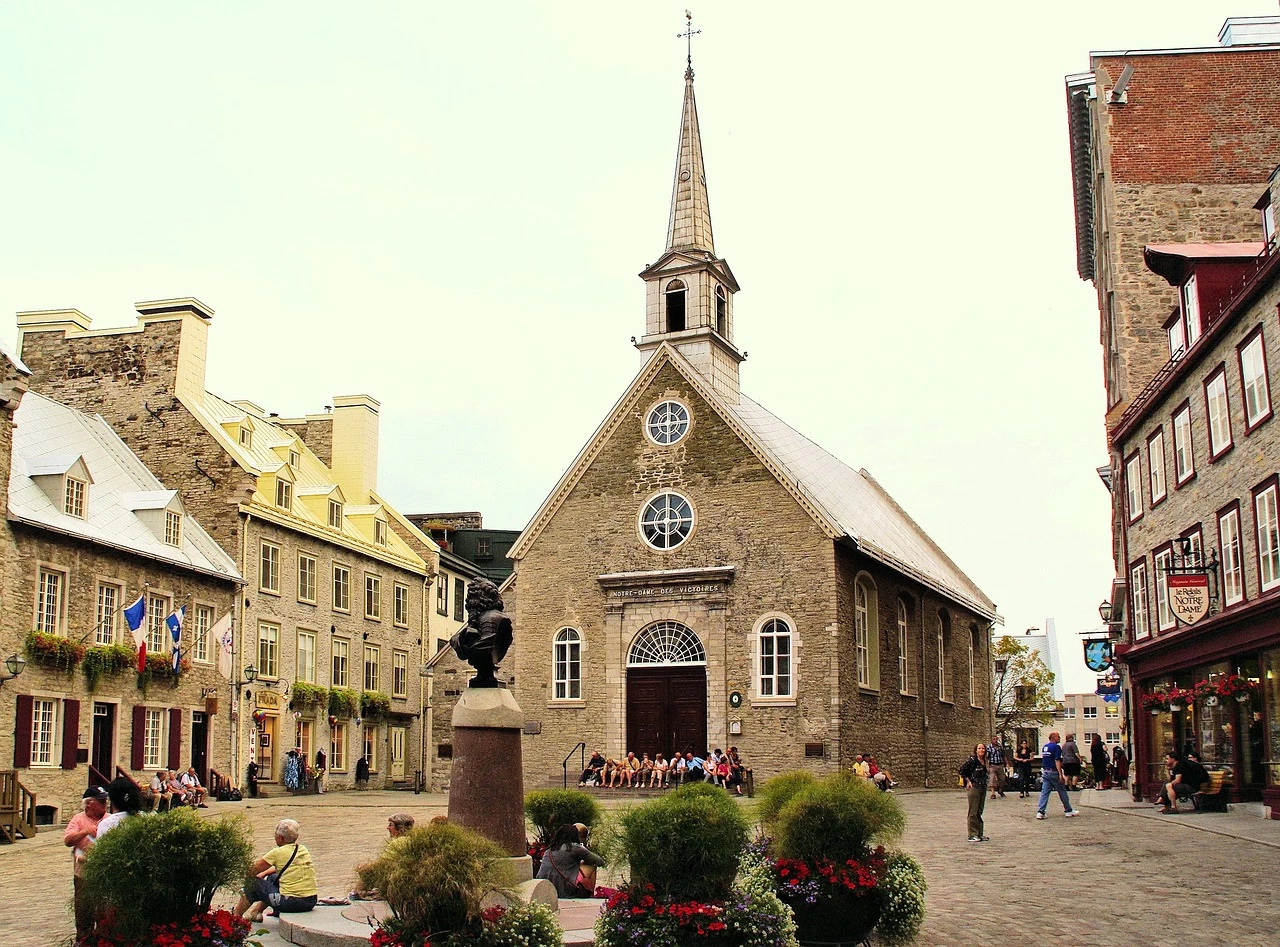
Grand walking tour of Old Quebec
Two hours with a local guide between Upper and Lower Town: Dufferin Terrace and the Château Frontenac, the ramparts, Place-Royale and Petit-Champlain, with the stories of the 1608 founding, the 1759 siege and life inside the walled quarter. The highlight: the descent to Lower Town and the river view from the terrace.
Ideal on day one to get your bearings. Allow about €26 per person on GetYourGuide, with free cancellation; a private option is available. Wear good shoes, the route is steep and cobbled.
- 2 hrs
- About €26 per person (GetYourGuide price 2026)
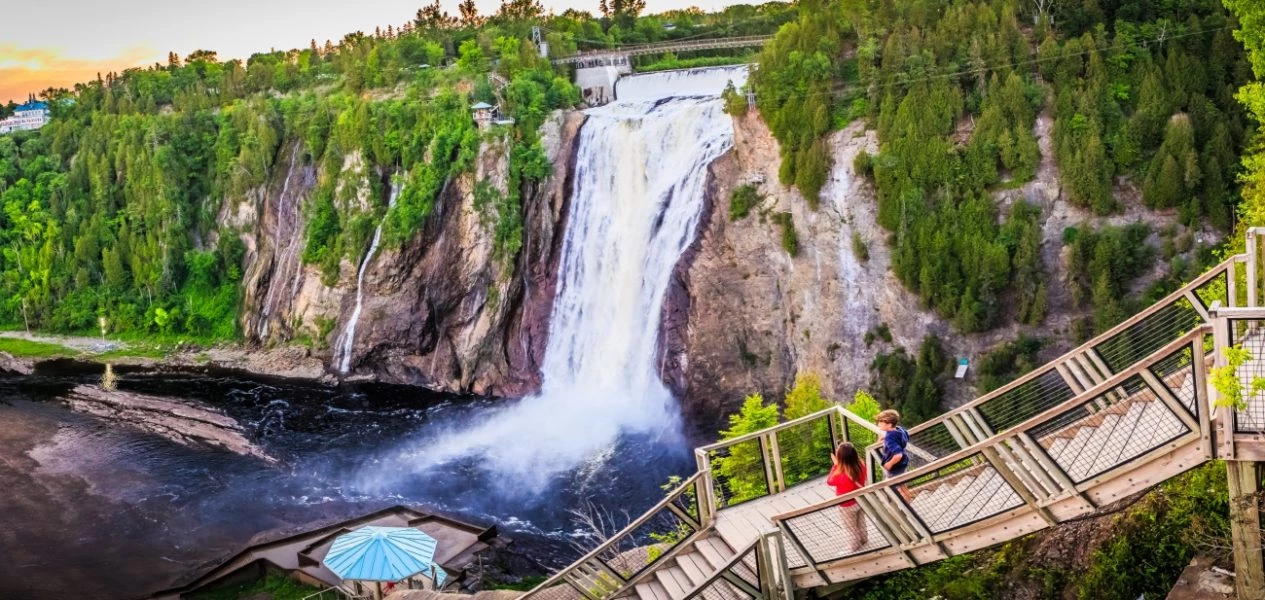
Montmorency Falls and Île d'Orléans half-day trip
A half day by minibus from Old Quebec: a stop at Montmorency Falls for the suspension bridge and viewpoints, then the loop around Île d'Orléans on Route 368 with stops at producers (chocolate shop, cidery or sugar shack depending on the season). The highlight: the panorama over the falls and the river from the suspension bridge.
The simplest option without a car. Allow about €62 per person on GetYourGuide, with free cancellation; check on the listing whether park admission and the cable car are included, they aren't always.
- Half day (about 4 hrs)
- About €62 per person (GetYourGuide price 2026)
Whale-watching day trip to Tadoussac from Québec
Coach departure from Old Quebec along the Charlevoix road (Baie-Saint-Paul, La Malbaie), across the Saguenay, then a boat or zodiac trip in the Saguenay-St. Lawrence Marine Park with a naturalist guide. The highlight: a fin whale blowing a few dozen metres away, or a pod of white belugas at the mouth of the fjord.
May to October only. Allow about €161 per person on GetYourGuide, with free cancellation; it's a long day (about 12 hrs), so pack a fleece and windbreaker, it's cold on the water even in August.
- Full day (about 12 hrs)
- About €161 per person (GetYourGuide price 2026)
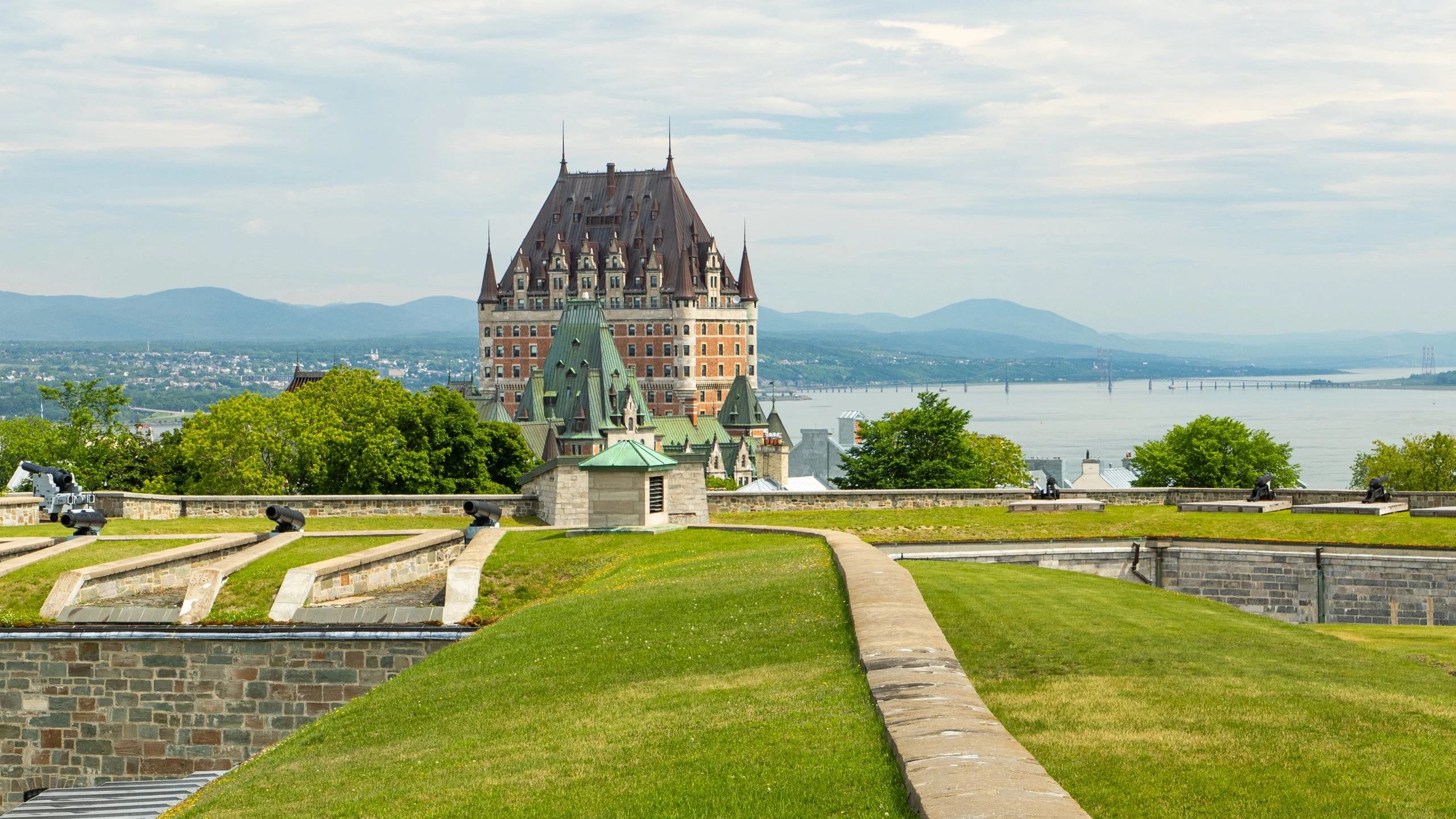
Guided tour of the Citadelle of Québec
The star-shaped fortress can only be visited with a Citadelle guide: an hour on the ramparts and bastions, cannons and powder magazine, then free access to the Royal 22e Régiment museum. The highlight: in summer, the mounting of the guard at 10am on the parade square, to the Musique en Rouge, with the mascot Batisse. The mounting of the guard, accompanied by the Musique en Rouge, takes place from 24 June to 30 August 2026 (except 1 and 3 July), Wednesday to Sunday at 10am, cancelled in case of rain; it is included in the ticket.
Ticket with guided tour at about €14 per person on GetYourGuide, with free cancellation, or CAD 22 adult at the gate (official 2026 rate); regular departures in French and English. Open 9am-5:30pm from 16 May to 31 August 2026, 10am-5:30pm the rest of the year.
- 1 hr (1.5 to 2 hrs with the museum)
- About €14 per person (GetYourGuide price 2026); CAD 22 adult at the gate (official 2026 rate)
Getting there
Fly to Jean-Lesage airport (YQB), or take the VIA Rail train / bus from Montreal (about 3 hrs) to the Gare du Palais.
How to get there
By air
Québec City's Jean-Lesage International Airport (YQB) handles domestic and international flights; it sits west of the city, about twenty minutes' drive from Old Quebec.
By train or bus from Montreal
The VIA Rail train links Montreal to Québec in about 3 hours, with several departures a day, arriving at the Gare du Palais in Lower Town. Coaches also run the route (~3 hrs).
A formality not to forget
As Canada is not in the Schengen Area, visa-exempt travellers arriving by air (including French and EU citizens) must obtain an eTA online before flying — see the Formalities section.
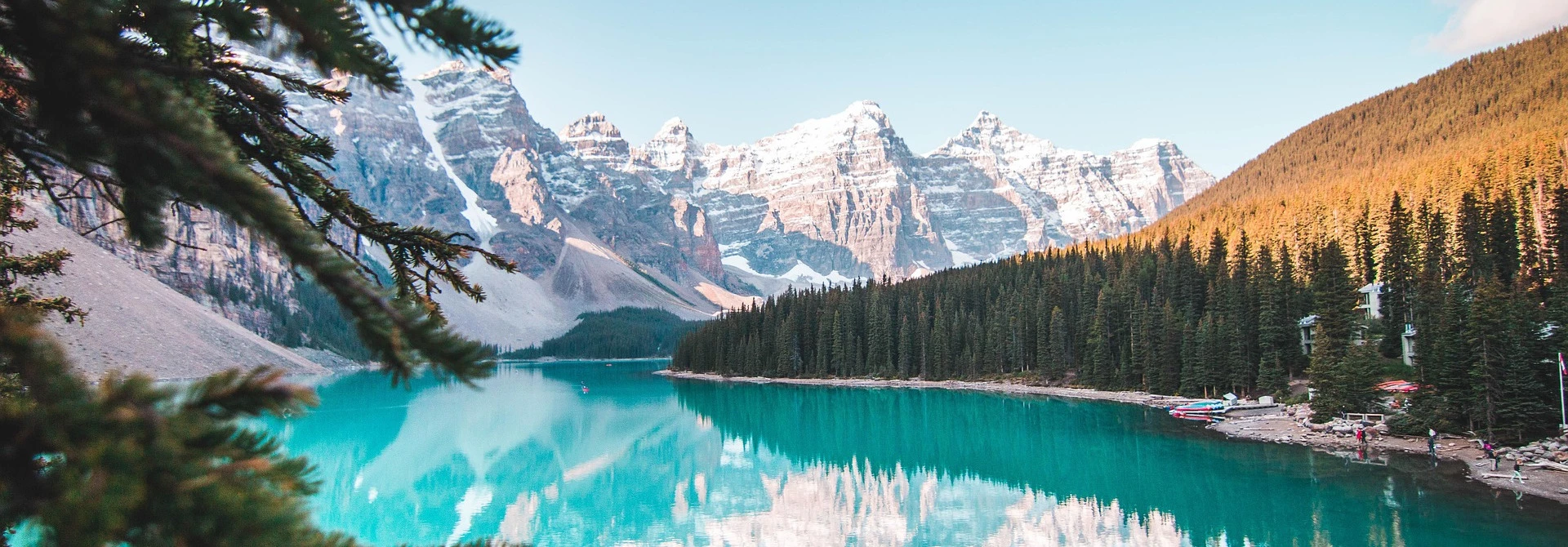
To widen the trip, our guide to Canada's most beautiful lakes covers the country from east to west.
Getting around
Old Quebec is walkable; a funicular and the Breakneck Stairs link Upper and Lower Town. A car is handy for Montmorency and Île d'Orléans.
Getting around
On foot
The heart of Québec is best seen on foot. Upper Town and Lower Town are linked by the funicular (~CAD 7 one-way) and, for free, by the Breakneck Stairs.
Bus
The urban network is run by the RTC (Réseau de transport de la Capitale), handy for trips outside the historic centre.
Car
Unnecessary in Old Quebec (compact and partly pedestrian), but very useful for reaching Montmorency Falls and looping around Île d'Orléans on Route 368.
What to do
Walk Old Quebec, tour the Citadelle, climb Montmorency Falls, loop around Île d'Orléans and, from May to October, go whale-watching at Tadoussac.
The heart of the stay is on foot: ramparts, Dufferin Terrace, Petit-Champlain and Place-Royale, with the Citadelle on a guided tour and, in summer, the mounting of the guard on the parade square (24 June-30 August 2026). Half a day is enough to combine Montmorency Falls and the loop around Île d'Orléans, by car or on a tour.
From early May to late October, Tadoussac, about 3 hrs' drive north-east, is the great whale meeting point of the St. Lawrence: fin whales, minke whales and belugas are seen by zodiac or boat from the mouth of the Saguenay. In winter, the Carnival (February) and the Dufferin Terrace toboggan slide take over. To go further, our guide to Canada's most beautiful lakes gives ideas from east to west.
Food
Poutine, tourtière, pea soup and maple syrup; strawberries, cider and cheeses from the Île d'Orléans producers; bistros in Petit-Champlain and on Rue Saint-Jean, regional producers at the Grand Marché de Québec.
Québec cooking is hearty: poutine (fries, cheese curds, gravy), tourtière meat pie, pea soup, baked beans and pâté chinois, then sugar pie or pouding chômeur for dessert. Maple syrup is everywhere; in spring the sugar shacks around the city serve the traditional meal and maple taffy on snow.
Île d'Orléans supplies strawberries, apples, ice cider, wine and cheeses, tasted straight from the producers along Route 368. In town, Petit-Champlain and Rue Saint-Jean concentrate bistros and local-produce tables; the Grand Marché de Québec, near the Vidéotron Centre, gathers the region's producers. A 15-20% tip is added to the bill, as are taxes.
Itineraries
Two days for Old Quebec and the Citadelle, a third for Montmorency and Île d'Orléans, two more for Tadoussac and the whales (May-October).
2 days: Old Quebec
Day 1: Upper Town — Dufferin Terrace, Château Frontenac, Notre-Dame Cathedral and the Museum of French America, then the Citadelle on a guided tour (guard mounting at 10am from 24 June to 30 August, unless it rains). End the day on the Governors' Promenade to the Plains of Abraham (the promenade is closed in winter: take Grande Allée instead).
Day 2: Lower Town — Breakneck Stairs, Petit-Champlain, Place-Royale, ferry to Lévis for the view, then the ramparts and the Saint-Jean and Saint-Louis gates. Evening on Rue Saint-Jean.
3 days: + falls and island
Day 3: Montmorency Falls in the morning (suspension bridge, staircase or cable car), then the loop around Île d'Orléans on Route 368 with stops at producers, by car or on a half-day tour.
5 days: + Tadoussac
Days 4-5: the Charlevoix road (Baie-Saint-Paul, La Malbaie) to Tadoussac, a whale-watching trip in the Saguenay-St. Lawrence Marine Park (May-October), back via the Saguenay fjord. Without a car, the day trip from Québec replaces these two days with a single long day.
Climate & seasons
When to go to Canada?
Monthly averages over the past 5 years (Open-Meteo).
Avoid
- January
- February
- March
- November
- December
| Jan | Feb | Mar | Apr | May | Jun | Jul | Aug | Sep | Oct | Nov | Dec | |
|---|---|---|---|---|---|---|---|---|---|---|---|---|
| Our take | ||||||||||||
| Weather | ||||||||||||
| High | -6° | -5° | 2° | 10° | 18° | 22° | 25° | 24° | 20° | 14° | 4° | -2° |
| Rain (mm) | 64 | 82 | 89 | 91 | 106 | 169 | 164 | 157 | 92 | 93 | 91 | 106 |
| City sightseeing | City sightseeing May | City sightseeing September | City sightseeing October |
What to do by season (autumn)
-
City sightseeing
Pedestrian-friendly most of the year.
When to go
Summer for festivals and mild weather, autumn for the colours, winter for the Carnival (6-15 February 2026) and snow.
When to go
Each season shows a different side of Québec.
Summer (June to August)
The high season: mild weather, terraces and many festivals. The liveliest and most pleasant time to walk around Old Quebec.
Autumn (September-October)
The surrounding forests turn spectacular colours, ideal for Île d'Orléans and the surroundings, with thinning crowds.
Winter (December to March)
Intense cold and heavy snow, but the city looks like a postcard. The Québec Winter Carnival, the world's largest, runs in February (6-15 February in 2026). Dress very warmly.
Spring (April-May)
A quieter transition season, with the thaw and the gradual return of the terraces.
Budget
Allow around CAD 180-250 per person per day in high season in Old Quebec (mid-range lodging), CAD 120-180 off-season or in Saint-Roch; taxes (nearly 15%) and tip come on top of posted prices.
Québec City is expensive in summer and during the Carnival, more affordable in April-May and November. As a guide, a double room in Old Quebec runs around CAD 200-350 a night in high season, much less in Saint-Roch or off-season; hostels offer dorm beds.
In restaurants, a bistro main costs CAD 20-35, a takeaway poutine CAD 10-15. Add taxes (GST + QST, nearly 15%) and a tip of 15-20%, never included in posted prices. The Citadelle costs CAD 22, the funicular a few dollars, Montmorency Falls a per-person admission, and a whale-watching day from Québec more than €150. All told, plan on CAD 180-250 per person per day in high season in Old Quebec (shared double room, meals, one visit), and more like CAD 120-180 off-season or staying in Saint-Roch.
Where to stay
In Old Quebec (Upper or Lower Town) to do everything on foot; Saint-Roch and Saint-Jean-Baptiste for a more local, affordable feel.
Where to stay
In Old Quebec
The most practical choice for exploring on foot. Upper Town, around the Château Frontenac, is the most sought-after; Lower Town and Petit-Champlain offer a picturesque setting. It's also the priciest area, especially in summer and during the Carnival.
Outside the walls
The Saint-Roch and Saint-Jean-Baptiste districts, just to the west, have a more local feel, good restaurants and gentler prices, a short walk or bus ride from the historic centre.
Book well ahead for summer and for the Québec Winter Carnival (February).
Safety
Québec City is very safe; the real risks are extreme winter cold (-20°C is common) and black ice on the sloping streets. Emergencies: 911.
Québec City is one of the safest cities in North America: ordinary care is enough, including in Old Quebec at night. The emergency number is 911.
The main risk is the weather. From December to March, temperatures routinely drop below -20°C with wind chill: dress in layers, protect your face and hands, and watch for black ice on the sloping streets and the Breakneck Stairs. In summer, sun and mosquitoes (outside town, on Île d'Orléans or towards Tadoussac) call for sunscreen and repellent. On the river, whale-watching trips provide flotation suits: the wind offshore is cold even in August. Check France Diplomatie's Canada advisory before departure for summer wildfires.
Formalities
Canada isn't Schengen: by air, an eTA (~CAD 7) is mandatory before flying for visa-exempt travellers. Currency: the Canadian dollar.
Formalities
Canada is not part of the Schengen Area. A valid passport is required. Visa-exempt nationals — including French and EU citizens — arriving by air must obtain an eTA (Electronic Travel Authorization): applied for online on the official Canadian government site before flying, costing about CAD 7, valid for up to 5 years (tourist stays up to 6 months). The eTA is not required when arriving by land or sea.
The currency is the Canadian dollar (CAD). Cards are accepted almost everywhere. Tipping (around 15-20%) is customary in restaurants and taxis. The official language is French. The emergency number is 911.
Tips
Apply for the eTA as soon as the flight is booked, book the Citadelle and the whales ahead in summer, take the Lévis ferry for the view, and factor taxes and tip into every price.
- eTA: apply on the Canadian government site as soon as the flight is booked (CAD 7); approval often comes within minutes, sometimes several days.
- Québec-Lévis ferry: a ten-minute crossing from Lower Town for the best view of the Château Frontenac, especially at sunset.
- Guard mounting: at 10am on the Citadelle parade square, 24 June to 30 August 2026 (except 1 and 3 July), Wednesday to Sunday, cancelled in case of rain; included in the ticket, arrive before opening.
- Whales: book the Tadoussac day several days ahead in July-August and pack a fleece even in midsummer.
- Prices: taxes (nearly 15%) and tip (15-20%) are added to posted prices in shops and restaurants.
- Winter: boots with grips or non-slip soles, the city is steep and icy; the Carnival (6-15 February 2026) is lived outdoors.
- Île d'Orléans: without a car, go for an organised trip that combines Montmorency Falls; city buses don't loop around the island.
FAQ
Do you need an eTA to visit Québec?
Do you need an eTA to visit Québec?
Yes, for most visa-exempt travellers (including French and EU citizens) arriving in Canada by air. The eTA is applied for online before flying, costs about CAD 7 and is valid for up to 5 years. It's not required when arriving by land.
How many days do you need in Québec?
Two to three days cover Old Quebec and its highlights (Château Frontenac, Citadelle, Petit-Champlain), plus a half-day for Montmorency Falls and Île d'Orléans.
When is the best time?
Summer for mild weather and festivals, autumn for the colours. Winter is harsh but magical, with the Québec Winter Carnival in February (6-15 February in 2026).
How do you get around Québec?
Old Quebec is walkable; the funicular (~CAD 7) and the Breakneck Stairs link Upper and Lower Town. A car is handy for Montmorency Falls and Île d'Orléans.
Is French spoken in Québec?
Yes: Québec is a French-speaking city, where French is the official and everyday language.
Can you see whales from Québec City?
Yes, at Tadoussac, about 3 hrs' drive north-east, from early May to late October: fin whales, minke whales and belugas are watched by boat or zodiac in the Saguenay-St. Lawrence Marine Park. Without a car, day trips leave from Old Quebec.
How do you visit the Citadelle?
Only on a guided tour of about an hour (CAD 22 adult in 2026), Royal 22e Régiment museum included. The mounting of the guard, accompanied by the Musique en Rouge, takes place from 24 June to 30 August 2026 (except 1 and 3 July), Wednesday to Sunday at 10am, cancelled in case of rain; it is included in the ticket.
Sources
The figures in this guide come from the sources below, checked on the publication date.
Leave a comment
Share your thoughts or travel experience. Your email will not be published.