
Contents 21
Nine Canadian lakes, from west to east: Lake Louise, Moraine Lake and Emerald Lake in the Rockies (Banff and Yoho parks), Maligne Lake in Jasper, Okanagan Lake in British Columbia, then Lake Superior, Lake Winnipeg, Lake Muskoka and Lac Saint-Jean. For each: what to do, the right season and the access rules, such as Moraine Lake Road, closed to personal vehicles year-round, or the Parks Canada pass.
Overview
Nine Canadian lakes from west to east, from the Rockies (Louise, Moraine, Emerald, Maligne) to Lac Saint-Jean, best grouped by region given the distances.
Overview
Canada has tens of thousands of lakes. This guide picks nine, from west to east. In the Rockies: Lake Louise and Moraine Lake (Banff park), Emerald Lake (Yoho park, in British Columbia) and Maligne Lake (Jasper park). Further south-west, Okanagan Lake fills a wine valley.
Eastwards come the great lakes and the resort regions: Lake Superior, Lake Winnipeg, Lake Muskoka north of Toronto and Lac Saint-Jean in Québec. The distances are huge: you usually pick one or two regions per trip.
9 places to take with you
In the guide's order, ready for Google Maps or your GPS.
Book the activities from this guide
Our picks for Banff, well rated and free to cancel.
-
Book this activity
Moraine Lake and Lake Louise trip from Banff
From €28 per person (GetYourGuide price 2026)
-
Book this activity
Maligne Valley and Spirit Island cruise
About €146 per person (GetYourGuide price 2026)
-
Book this activity
Emerald, Moraine and Louise lakes and Johnston Canyon day
From €55 per person (GetYourGuide price 2026)
Affiliate links: Travel Advice earns a commission if you book, at no extra cost to you. Learn more

Lake Louise, Alberta
In Banff National Park, Alberta, Lake Louise is fed by glaciers: turquoise water framed by peaks and overlooked by the Victoria Glacier. In summer people canoe and hike up to Lake Agnes and its tea house; in winter the frozen lake becomes a skating rink. The Fairmont Château Lake Louise stands on the east shore.

Moraine Lake, Alberta
Next to Lake Louise in Banff National Park, Moraine Lake lies at the foot of the Valley of the Ten Peaks. The Rockpile viewpoint, a few minutes' walk from the parking area, gives the classic view of the lake and peaks. Its blue colour comes from suspended glacial flour; it is most vivid when the lake is full, in early summer.

Emerald Lake, British Columbia
In Yoho National Park, British Columbia, Emerald Lake owes its green-turquoise colour to suspended glacial flour. An easy trail loops around the lake, canoes are rented at the water's edge and a wooden lodge lines the shore. It gets fewer visitors than Lake Louise and Moraine Lake.

Maligne Lake, Alberta
In Jasper National Park, Maligne Lake is the largest natural lake in the Canadian Rockies. The cruise heads to Spirit Island, a wooded islet that has become one of Jasper's best-known images. The lake road crosses a valley where elk, moose and bears are often seen, and passes Medicine Lake.

Okanagan Lake, British Columbia
A long lake in a wine valley in southern British Columbia, Okanagan Lake combines beaches, swimming and vineyards around Kelowna and Penticton. The hot, dry summer makes it a popular beach destination, between tastings and water sports. Local legend places Ogopogo, its lake monster, here.

Lake Superior, Ontario
Lake Superior is the largest freshwater lake in the world by surface area. On its Canadian shore, in Ontario, Lake Superior Provincial Park offers wild coastline, pebble beaches, trails and the Indigenous Agawa pictographs. The water stays cold even in summer, between boreal forest and cliffs.

Lac Saint-Jean, Québec
At the heart of the Saguenay-Lac-Saint-Jean region, this large Québec lake is blueberry country, with freshwater beaches. The Véloroute des Bleuets cycle route loops around it, linking villages, farms and viewpoints. In summer people swim and eat blueberry pie; the lake also hosts an international swimming crossing.

Lake Muskoka, Ontario
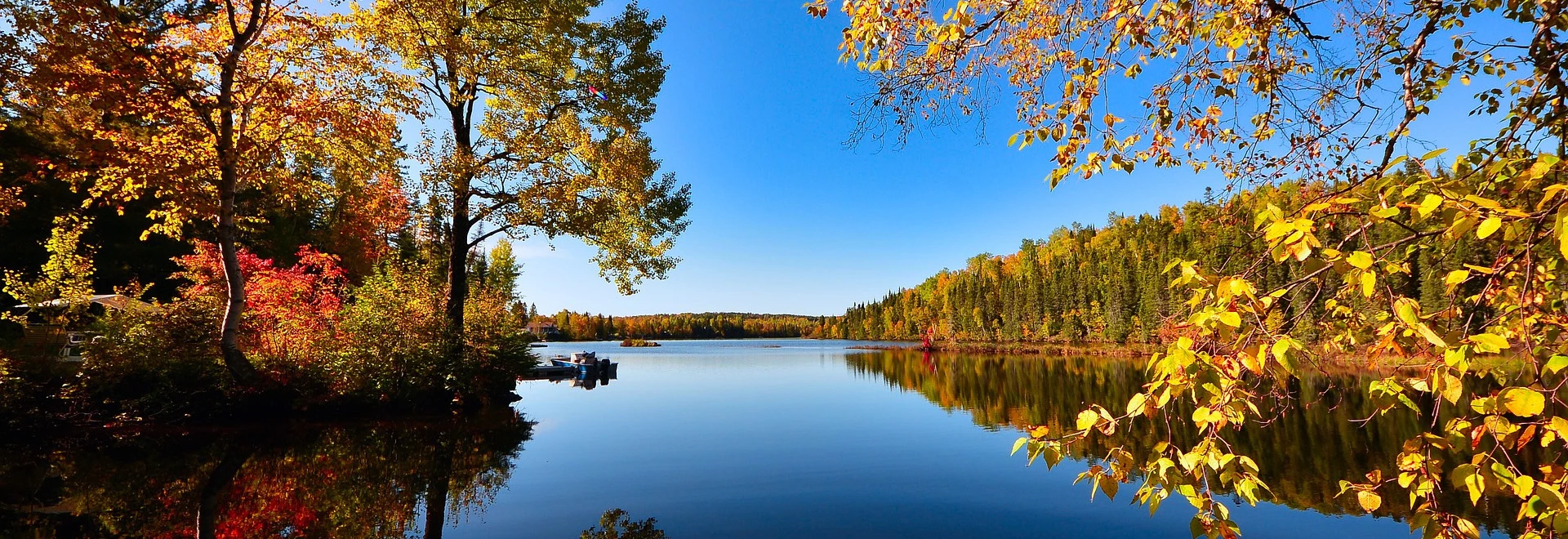
About two hours north of Toronto, Lake Muskoka is at the heart of Ontario's cottage country, the region of waterside cabins. Between forests, Canadian Shield rock and towns like Gravenhurst, people come for canoeing, swimming and rest. In autumn, the maples turn the shores red and orange.

Lake Winnipeg, Manitoba
A vast lake in Manitoba, Lake Winnipeg ranks among the largest freshwater lakes in the world. On its east shore, Grand Beach and its dunes draw swimmers in summer, about an hour's drive from Winnipeg. Its size feels like an inland sea, with sunsets over a horizon of water.

Moraine Lake and Lake Louise trip from Banff
With Moraine Lake Road closed to personal vehicles, a licensed operator is the other way to get there without a Parks Canada shuttle. This half-day from Banff or Canmore spends about 1.5 hrs at Moraine Lake, then as long at Lake Louise, with an English-speaking guide. The highlight: the view from the Rockpile over the Valley of the Ten Peaks.
Allow from €28 per person on GetYourGuide, with free cancellation up to 24 hours before. The length ranges from 5.5 to 8 hours depending on the pick-up point.
- 5.5 to 8 hrs
- From €28 per person (GetYourGuide price 2026)

Maligne Valley and Spirit Island cruise
Six hours in the Maligne Valley with a naturalist guide, with hotel pick-up in Jasper: the lake road, where you watch for bears, elk and moose, a stop at Medicine Lake, then the 90-minute cruise on Maligne Lake to Spirit Island. The highlight: the stop facing the islet, ringed by peaks.
Allow about €146 per person on GetYourGuide, with free cancellation up to 24 hours before. Tour in English; bring a warm layer, the wind is cool on the lake.
- 6 hrs
- About €146 per person (GetYourGuide price 2026)

Emerald, Moraine and Louise lakes and Johnston Canyon day
A long bus day from Calgary, Banff or Canmore that links Lake Louise, Moraine Lake, Emerald Lake and the Natural Bridge in Yoho park, then the lower and upper falls of Johnston Canyon. The highlight: Emerald Lake, quieter than its Banff neighbours.
Allow from €55 per person on GetYourGuide, with free cancellation up to 24 hours before. Tour in English; stops last from 20 minutes to an hour, wear good shoes for the canyon.
- 11 hrs
- From €55 per person (GetYourGuide price 2026)

Tasting in the Okanagan vineyards
The shores of Okanagan Lake, around Kelowna, West Kelowna and Penticton, are lined with wineries that open their tasting rooms in summer. Half a day is enough to visit two or three, with lake views from the slopes.
Pick a designated driver or join an organised tour from Kelowna; check each winery's opening hours and booking rules.
- Half day
- Depends on the winery (tastings charged)
Getting there
By air via Calgary (gateway to the Rockies), Vancouver, Toronto or Montreal depending on the region, then a rental car.
How to get there
The lakes are spread over thousands of kilometres: choose your entry airport according to the region you're visiting.
- Calgary (YYC): the gateway to the Rockies — Banff and Lake Louise are about 1h30 by road; ideal for Louise, Moraine, Emerald and Maligne.
- Vancouver (YVR): for British Columbia and the Okanagan valley.
- Toronto (YYZ): for Lake Muskoka and Lake Superior (Ontario).
- Montreal (YUL): for Lac Saint-Jean (Québec).
A rental car is almost essential: apart from the park shuttles, the sites are poorly served by public transport.
A formality not to forget
As Canada is not in the Schengen Area, visa-exempt travellers arriving by air must obtain an eTA online before flying — see the Formalities section.
For a city stop, Québec City is the most distinctive in the East, a three-hour drive from Montreal.
Getting around
By car, with the park shuttles in the Rockies: Moraine Lake Road closed to personal vehicles, paid parking at Lake Louise in season.
Getting around
Car
The most practical way to link the regions and lakes; distances are long and public transport scarce outside the cities.
Park shuttles (Rockies)
Moraine Lake Road is closed to personal vehicles year-round: you go by Parks Canada shuttle (1 June-12 October, reservation required), with a licensed commercial operator or by staying at Moraine Lake Lodge. At Lake Louise, lakeshore parking is paid during the shuttle season (15 May-12 October); the Park and Ride at the Lake Louise ski resort is linked to the lake by shuttle, and Roam Transit route 8X serves Lake Louise from Banff year-round.
Cruises and canoes
On site, the Maligne Lake cruise to Spirit Island and canoe rentals (Louise, Moraine, Emerald) let you enjoy the water.
What to do
Shuttle or tour to Moraine Lake and Lake Louise, Spirit Island cruise, canoeing, hiking and, further east, beaches and cycling.
In the Rockies, days revolve around the lakes: a shuttle or tour to Moraine Lake and Lake Louise, the loop around Emerald Lake on foot or by canoe, a cruise on Maligne Lake to Spirit Island. Further south-west, the Okanagan combines beaches and wineries.
In the east, the lakes are enjoyed differently: coastal trails on Lake Superior, cottages and canoeing in Muskoka, Grand Beach on Lake Winnipeg and a bike loop around Lac Saint-Jean on the Véloroute des Bleuets.
Climate & seasons
When to go to Canada?
Monthly averages over the past 5 years (Open-Meteo).
Best months
- July
Avoid
- January
- February
- March
- April
- May
- October
- November
- December
| Jan | Feb | Mar | Apr | May | Jun | Jul | Aug | Sep | Oct | Nov | Dec | |
|---|---|---|---|---|---|---|---|---|---|---|---|---|
| Our take | ||||||||||||
| Weather | ||||||||||||
| High | -12° | -12° | -6° | -3° | 4° | 9° | 16° | 14° | 10° | 1° | -8° | -12° |
| Rain (mm) | 34 | 49 | 43 | 43 | 55 | 90 | 56 | 61 | 37 | 50 | 63 | 70 |
| Hiking & nature | Hiking & nature July | Hiking & nature August |
When to go
Summer (June to September) for the lakes, hiking and swimming; late September-October for the autumn colours.
When to go
Summer (June to September)
The main lake season: roads and trails open, shuttles running in the Rockies, water at its highest and swimming possible (except cold Lake Superior). It's also the busiest period — book shuttles and accommodation ahead.
Autumn (late September-October)
The forests, especially in Ontario (Muskoka) and Québec, blaze with colour; crowds thin, but some shuttles close in October.
Winter and spring
Winter turns Lake Louise into a skating rink and the Rockies into a ski domain; spring is a transition season, still snowy at altitude. Most lake activities resume from June.
Where to stay
Lake Louise village or Banff for the Rockies, Kelowna for the Okanagan, and lakeside cottages/lodges elsewhere.
Where to stay
Rockies (Banff, Jasper, Yoho)
The village of Lake Louise and the town of Banff are the most practical bases; the iconic hotels (Château Lake Louise, Emerald Lake Lodge) are right by the water but expensive. Book well ahead in summer.
Okanagan
Kelowna and Penticton offer hotels, beaches and access to the vineyards.
Ontario and Québec
In cottage country (Muskoka) and around Lac Saint-Jean, renting a lakeside cottage or guesthouse is popular — book early for summer and autumn.
Formalities
Outside Schengen: eTA (CAN$7) when arriving by air; Parks Canada pass in the parks (free from 19 June to 7 September 2026 only).
Formalities
Canada is not part of the Schengen Area. A valid passport is required. Visa-exempt nationals arriving by air (including French and EU citizens) must obtain an eTA (electronic travel authorization) before flying, on the Government of Canada's official website: it costs CAN$7 and is valid for up to 5 years, or until the passport expires if that comes first. You need a passport, a bank card and an email address. The currency is the Canadian dollar (CAD) and the emergency number is 911.
National parks. A Parks Canada pass (daily or annual Discovery Pass) is required in Banff, Jasper and Yoho, home to Lakes Louise, Moraine, Maligne and Emerald. In 2026, the Canada Strong Pass made entry free from 19 June to 7 September; outside that window, the pass must be paid for. Parking, shuttles and guided tours are charged in any case.
FAQ
How do you reach Moraine Lake?
How do you reach Moraine Lake?
Moraine Lake Road is closed to personal vehicles year-round. You go by Parks Canada shuttle (1 June-12 October, reservation required), with a licensed commercial operator or by staying at Moraine Lake Lodge. 40% of seats open in mid-April, the remaining 60% two days before departure, at 8 am.
Do you need a pass for the parks?
Yes, a Parks Canada pass is required in Banff, Jasper and Yoho. In 2026, the Canada Strong Pass made entry free from 19 June to 7 September; the rest of the year, it is charged.
Do you need an eTA for Canada?
Yes, for most visa-exempt travellers arriving by air (including French and EU citizens). The eTA is applied for online before flying, costs CAN$7 and is valid for up to 5 years.
Is Maligne Lake accessible after the Jasper fires?
Yes: Maligne Lake and its road reopened after the 2024 fires and the Spirit Island cruise is running. Some neighbouring areas remain closed, though — check the Parks Canada bulletins before you go.
When is the best time?
Summer (June to September) for the lakes, hikes and shuttles; late September-October for the autumn colours, especially in Ontario and Québec.
Sources
The figures in this guide come from the sources below, checked on the publication date.
Leave a comment
Share your thoughts or travel experience. Your email will not be published.