

Contents 29
Interlaken is a town in the canton of Bern, Switzerland, set at 566 m between Lake Thun to the west and Lake Brienz to the east. It is the gateway to the Jungfrau Region and its three peaks, the Eiger, the Mönch and the Jungfrau.
People come all year round: hiking, paragliding, canyoning and the lakes in summer, skiing at Grindelwald-Wengen in winter. The best-known sight is the Jungfraujoch, at 3,454 m, in the heart of the Swiss Alps Jungfrau-Aletsch UNESCO site.
Interlaken has two stations, Interlaken Ost and Interlaken West, where trains leave for Lauterbrunnen and Grindelwald and boats for both lakes.
Overview
Interlaken, between Lake Thun and Lake Brienz, is the gateway to the Bernese Alps and the Jungfrau Region, less than an hour by train from Lauterbrunnen, Grindelwald and the Jungfraujoch.
Interlaken lies in the canton of Bern, on the plain linking Lake Thun and Lake Brienz, at about 566 m. Its name means "between the lakes".
The town is above all a base: in less than an hour by train you reach Lauterbrunnen and its waterfalls, Grindelwald at the foot of the Eiger, or the Jungfrau-Aletsch massif, a UNESCO World Heritage Site since 2001. It is also an adventure-sports capital: paragliding, canyoning, via ferrata and kayaking on Lake Brienz.
Most people stay 3 to 4 days to combine a big high-altitude excursion (Jungfraujoch, Schilthorn or First), a day on the lakes and an outdoor activity.
16 places to take with you
In the guide's order, ready for Google Maps or your GPS.
Book the activities from this guide
Our picks for Interlaken, well rated and free to cancel.
-
Book this activity
Beginner canyoning near Interlaken
€163 per person (GetYourGuide price 2026)
-
Book this activity
Kayaking on Lake Brienz from Bönigen
€122 per person (GetYourGuide price 2026)
-
Book this activity
Treetop courses at Seilpark Interlaken
€48 per person (GetYourGuide price 2026)
Affiliate links: Travel Advice earns a commission if you book, at no extra cost to you. Learn more

Jungfraujoch
The Jungfraujoch is the saddle linking the Mönch and the Jungfrau in the Bernese Alps. Its station, at 3,454 m, is the highest in Europe, hence its nickname "Top of Europe"; the pass itself tops out at about 3,463 m.
Since 1912 the Jungfrau Railway has climbed up from Kleine Scheidegg and Eigergletscher through a tunnel bored through the Eiger and the Mönch. At the top: the Sphinx terrace, the Ice Palace, the snow plateau and the view of the Aletsch Glacier, the longest in the Alps, at the heart of the Jungfrau-Aletsch UNESCO site.

Grindelwald
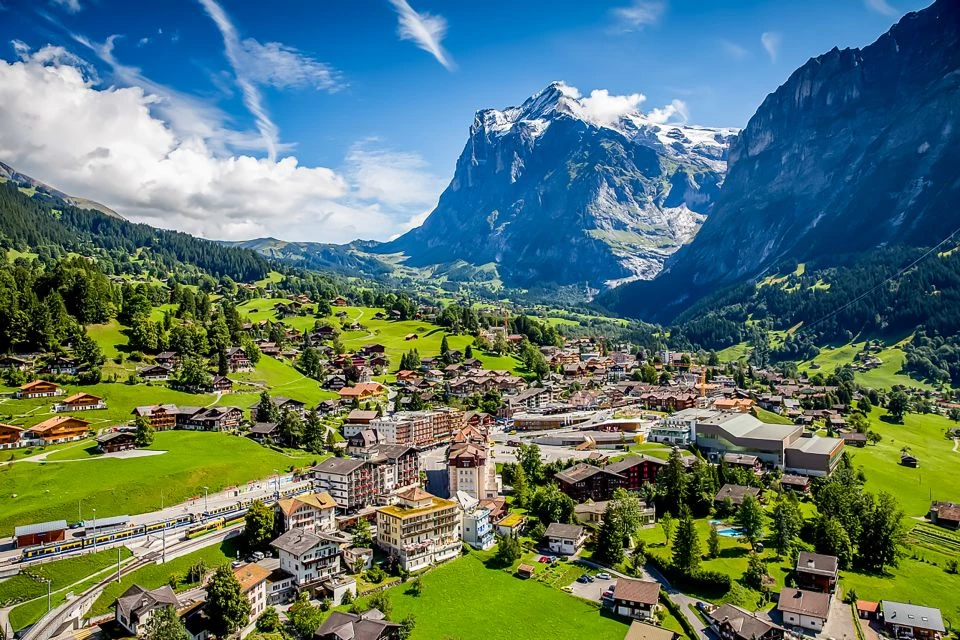
Grindelwald spreads out at the foot of the Eiger's north face, about thirty minutes by train from Interlaken Ost. The village is the starting point for the First gondola and, from Grindelwald Terminal, for the Eiger Express to the Jungfraujoch.
People come for the high-altitude hikes, including the walk from First to Bachalpsee lake, for the glacier gorge and, in winter, for skiing. Unlike Wengen and Mürren, the village can also be reached by car.

Lauterbrunnen Valley
The Lauterbrunnen valley is a sheer-sided glacial trough nicknamed the "valley of 72 waterfalls". The most famous, Staubbach Falls, drops about 297 m in a veil of water above the village.
Further on, the Trümmelbach Falls thunder down inside the mountain, lit and reached by a tunnel lift. The village is about twenty minutes by train from Interlaken Ost; lifts to Mürren and Wengen also leave from here.

Schilthorn (Piz Gloria)
The Schilthorn rises to 2,970 m above the Lauterbrunnen valley, facing the Eiger, the Mönch and the Jungfrau. Its summit carries Piz Gloria, the revolving panoramic restaurant made famous by the James Bond film On Her Majesty's Secret Service (1969).
You go up by a series of cable cars from Stechelberg or Mürren. At the Birg intermediate station, the Thrill Walk, a path clinging to the cliff, and a glass walkway provide the thrills before the 360-degree summit panorama.

Harder Kulm
Harder Kulm is Interlaken's viewpoint, at about 1,322 m above the town. A funicular climbs up in about ten minutes from the valley station near Interlaken Ost.
From the panoramic walkway, the view takes in both lakes, the town between them and the line of Eiger-Mönch-Jungfrau peaks. A restaurant sits on the summit; sunset draws the biggest crowds.

Grindelwald-Wengen ski area
In winter, Interlaken is a base for the Jungfrau Region ski areas. The largest, Grindelwald-Wengen, has around a hundred kilometres of pistes between Kleine Scheidegg, Männlichen and Eigergletscher, facing the Eiger; Mürren-Schilthorn lies across the Lauterbrunnen valley.
The area includes the Lauberhorn downhill, about 4.5 km long, raced every January in the World Cup at Wengen. Sledging, snowshoeing and cross-country skiing round out the offer.

Paragliding over Interlaken
Interlaken is one of Europe's top paragliding spots: the terrain and the thermals above the lakes lend themselves to it. Tandem flights take off from the heights of Beatenberg (Amisbühl) and land on the Höhematte, right in the centre, facing the Eiger, the Mönch and the Jungfrau.
No experience is needed: a professional pilot flies the wing and the passenger enjoys the view. The flight lasts ten to twenty minutes depending on conditions.

Lake Brienz promenade
Lake Brienz stretches east of Interlaken, between wooded slopes and rock walls. Its turquoise colour comes from the fine glacial particles its streams carry down from the peaks.
The promenade follows the shore from Interlaken Ost to Bönigen, on foot or by bike. From there, boats serve Iseltwald, Giessbach and Brienz. It is the quieter and less built-up of the two lakes.

Lake Thun promenade
Lake Thun (Thunersee) borders Interlaken to the west. Larger than Lake Brienz, it is lined with villages, vineyards and Spiez Castle, which overlooks a bay.
Boats leave from Interlaken West and sail down the lake to Spiez and Thun, stopping below the main sights; the crossing combines easily with a visit ashore.

Schynige Platte
Above Wilderswil, two kilometres from Interlaken, Schynige Platte is a balcony at about 2,000 m facing the Eiger, the Mönch and the Jungfrau. You go up by a historic cogwheel train; at the top, an alpine botanical garden displays the region's flora.
It is the start of waymarked hikes for all levels, from easy loops around the garden to the panoramic trail to the Faulhorn and First, a long day's walk above Lake Brienz.

Giessbach Falls
The Giessbach Falls tumble about 400 m in fourteen steps towards the south shore of Lake Brienz, in front of the Grandhotel Giessbach.
They are reached by boat from Interlaken Ost or Brienz, then by the Giessbach funicular, opened in 1879 and presented as the oldest in Europe. Paths climb alongside the falls; one passes behind a curtain of water.

Unterseen old town and Höheweg
The heart of Interlaken is split between the Höheweg, a broad avenue along the Höhematte meadow with the best-known view of the Jungfrau, and the small town of Unterseen, across the Aare.
Founded in the 13th century, Unterseen lines up old houses, a church square and quiet lanes. The walk is free and takes an hour or two, away from the bustle of the Höheweg.

Spiez Castle
Spiez Castle stands on a promontory above Lake Thun, surrounded by terraced vineyards. Its oldest parts date back to the early Middle Ages; the keep and the neighbouring Romanesque church form one of the most complete medieval ensembles in the Bernese Oberland.
Now a museum, it shows the interiors of the noble families who lived here in turn and offers a view down onto the bay from its gardens. It is reached directly by boat from Interlaken West.

Canyoning
Canyoning means descending a narrow gorge by combining walking, swimming, jumps, natural slides and abseils along a mountain stream. The Saxetbach canyon, about ten minutes from Interlaken, is used for beginners.
Experienced canyoners go further, to the more technical Chli Schliere in the canton of Obwalden. Trips always run with a guide, wetsuit and helmet provided.

Seilpark Interlaken
Seilpark Interlaken is a forest adventure park south of the town, off Wagnerenstrasse. Nine courses of increasing difficulty link wooden bridges, nets, "Tarzan" swings and zip lines between the trees.
Harness and helmet are provided after a safety briefing with an instructor; then everyone moves at their own pace. It suits families as well as groups.

Mürren via ferrata
A via ferrata follows a rock face using cables, rungs and fixed bridges, with climbers clipped in by a lanyard. The best known in the region links Mürren to Gimmelwald, above the Lauterbrunnen valley.
The route, about 2.2 km and three hours, downhill, is graded K3 (fairly difficult) and only for people comfortable with exposure. It is done in summer and is best avoided in rain, when the rungs become slippery.
Beginner canyoning near Interlaken
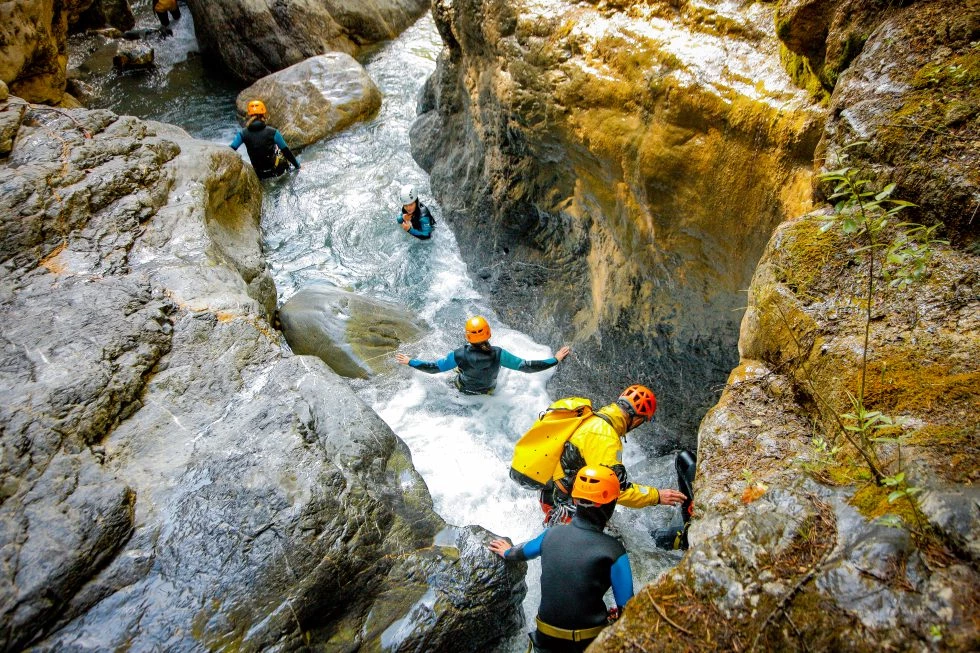
Three hours in all, including an hour and a half in the gorge: after gearing up at the Wilderswil base, a ten-minute transfer takes you to the local canyon. There you string together a 10 m abseil, natural slides, swims under the waterfalls and jumps, the highest 5 m and optional. The highlight: the opening abseil between the narrow walls.
Allow €163 per person on GetYourGuide, gear, guides and a drink included, with free cancellation up to 24 hours before. From age 12, suitable for beginners; hot showers and changing rooms back at the base.
- 3 hrs
- €163 per person (GetYourGuide price 2026)
Kayaking on Lake Brienz from Bönigen
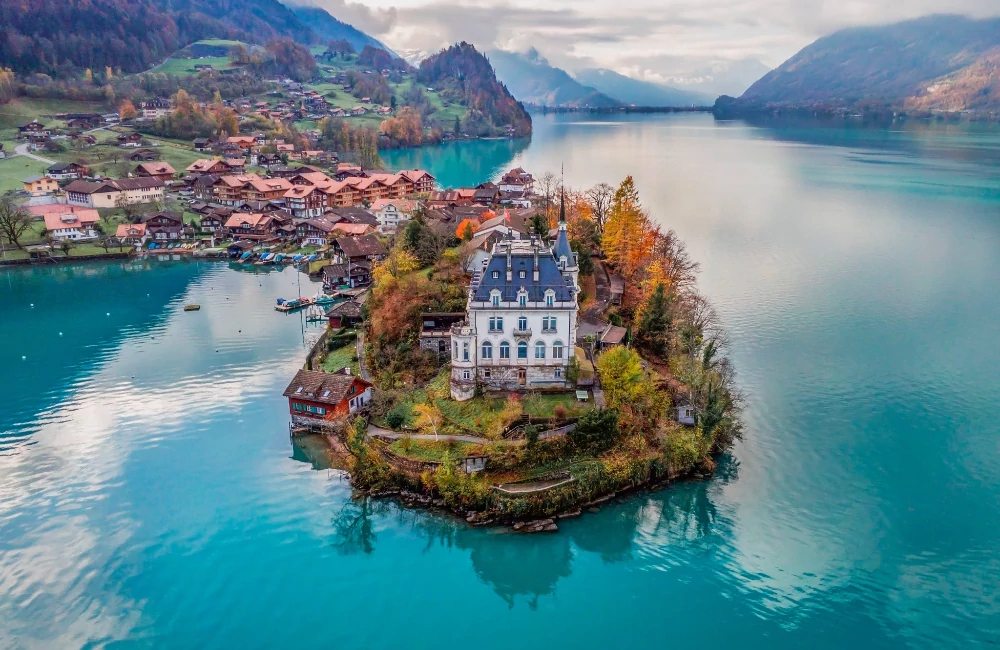
A half-day kayak trip from Bönigen, at the western end of Lake Brienz, in a small group of no more than six per coach: a short lesson on the shore, then a relaxed paddle on the turquoise water with stops for photos. The highlight: paddling on smooth water, facing the slopes that plunge into the lake.
Allow €122 per person on GetYourGuide, gear and photos included; free cancellation up to 3 days before. Regular trips from May to October, suitable for beginners; wetsuit and jacket provided if needed.
- 3 hrs
- €122 per person (GetYourGuide price 2026)
Treetop courses at Seilpark Interlaken
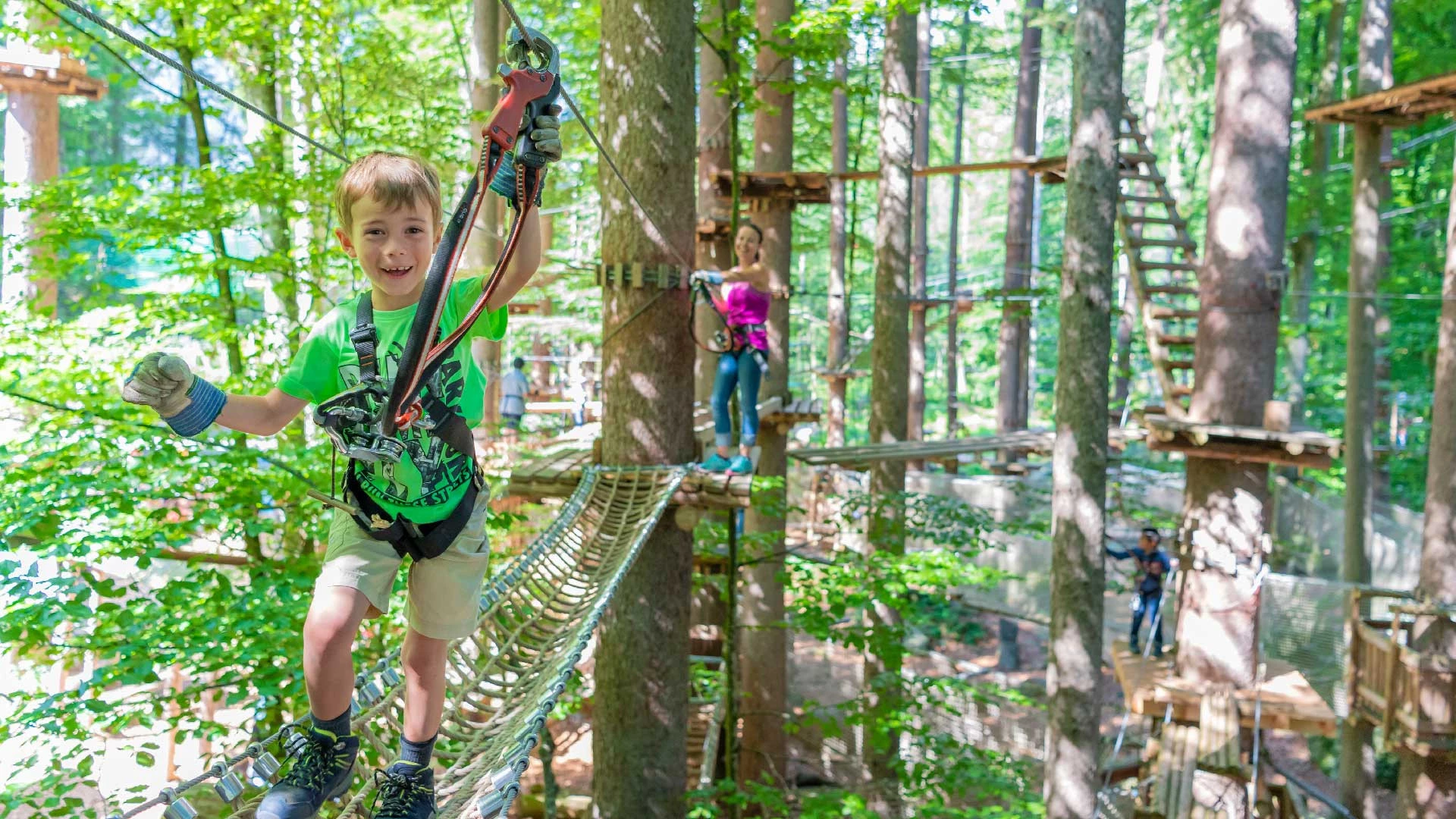
After gearing up and a briefing with an instructor, you tackle the Seilpark's nine courses, from the easiest to the most airy: wooden bridges, nets, "Tarzan" swings and zip lines in the treetops, in the forest south of Interlaken. The highlight: the first zip line over the undergrowth.
Allow €48 per person on GetYourGuide, entry and gear included, with free cancellation up to 24 hours before. It is the park's only offer on the platform. Not suitable for people afraid of heights or over 120 kg.
- 3 hrs
- €48 per person (GetYourGuide price 2026)
Grindelwald Glacier Canyon
At the bottom of the Grindelwald valley, the Lower Glacier has carved a narrow gorge that you follow along a kilometre of walkways and galleries cut into the rock, above the roar of the Lütschine. Entry includes the small crystal museum. The highlight: the galleries cut into the rock, above the torrent.
Allow €22 per person on GetYourGuide, with free cancellation. Open from 25 April to 29 November 2026, until 8 pm from 14 May to 30 August. Bring warm clothes: it is cool and damp in the gorge.
- About 1 hr (1 km path)
- €22 per person (GetYourGuide price 2026)
Getting there
Interlaken is reached by train from Zurich (about 2 hours), Geneva or Basel; Interlaken Ost and Interlaken West stations serve the whole region.
The nearest airport is Bern-Belp, but in practice international travellers arrive via Zurich (direct trains in about 2 hours), Geneva or Basel, then continue by train.
Interlaken has two stations: Interlaken Ost, where trains leave for Lauterbrunnen, Grindelwald and the Jungfraujoch along with the Lake Brienz boats, and Interlaken West, near the Lake Thun boats.
The Swiss Travel Pass covers trains, buses and boats and gives discounts on mountain lifts (-25% on the Jungfraujoch, -50% on Harder Kulm); the Half Fare Card gives -50% on most journeys, including the Jungfraujoch.
Getting around
Train and boat for excursions, walking in town: you do not need a car in Interlaken.
Interlaken is compact: the centre, the lakeshores and most hotels are within walking distance. For excursions, the train is the obvious choice: Lauterbrunnen in about 20 minutes and Grindelwald in about 35 minutes from Interlaken Ost.
Boats serve both lakes, including Spiez, Thun and Giessbach. Bikes let you follow the shores. A car adds nothing and parking is paid; Wengen and Mürren have no access road anyway.
What to do
Three kinds of activities: big high-altitude excursions, days by the two lakes and adventure sports.
Interlaken's programme falls into three parts. High-altitude excursions first: the Jungfraujoch and the Aletsch Glacier, the Schilthorn, Harder Kulm for the view over the town, Schynige Platte, Grindelwald and the Lauterbrunnen valley of 72 waterfalls.
Days on the water next: walks and cruises on Lake Thun and Lake Brienz, kayaking from Bönigen, a stop at Spiez Castle, and the Giessbach Falls reached by an 1879 funicular.
Adventure sports last, which made the town's name: tandem paragliding above the lakes, canyoning in the Saxetbach, the Mürren via ferrata and the Seilpark courses. The entries below detail each of these 16 stops.
Climate & seasons
When to go to Switzerland?
Monthly averages over the past 5 years (Open-Meteo).
Avoid
- January
- February
- March
- April
- May
- June
- July
- August
- September
- October
- November
- December
| Jan | Feb | Mar | Apr | May | Jun | Jul | Aug | Sep | Oct | Nov | Dec | |
|---|---|---|---|---|---|---|---|---|---|---|---|---|
| Our take | ||||||||||||
| Weather | ||||||||||||
| High | -11° | -9° | -9° | -7° | -3° | 3° | 4° | 4° | 1° | -2° | -8° | -9° |
| Rain (mm) | 158 | 104 | 156 | 150 | 156 | 80 | 108 | 90 | 110 | 135 | 173 | 188 |
When to go
Summer (June-September) for hiking, the lakes and outdoor activities; winter (December-March) for skiing at Grindelwald-Wengen. The Jungfraujoch stays open all year.
Summer (June to September): high season, long days, ideal for hiking, paragliding, canyoning and the lakes. It is also the busiest and most expensive period.
Autumn (September to November): quieter trails and golden larches up high, but Spiez Castle closes on 31 October and some lifts stop for maintenance.
Winter (December to March): skiing at Grindelwald-Wengen and Mürren-Schilthorn, the Lauberhorn race at Wengen in January. The Jungfraujoch stays open all year.
Spring (April-May): snowmelt and waterfalls at their peak in Lauterbrunnen, but snow still covers the high trails.
Where to stay
From the Victoria-Jungfrau, the historic grand hotel on the Höheweg, to hostels near Interlaken Ost; book early in summer and during the ski season.
Interlaken suits every budget. Luxury: the Victoria-Jungfrau Grand Hotel & Spa, a historic address on the Höheweg. Mid-range: plenty of 3- and 4-star hotels around the two stations. Budget: hostels and backpackers, including the Interlaken youth hostel next to Interlaken Ost.
Several campsites line the Aare and the lakes. To be closer to the peaks, you can also stay in Lauterbrunnen, Wengen, Mürren or Grindelwald. Either way, book well ahead in summer and during the ski season.
Safety
Interlaken is very safe; the risks come mainly from the mountains (weather, altitude, trails). Emergency numbers: 117 police, 144 ambulance, 118 fire brigade, 1414 Rega, 112.
Interlaken and the villages of the Jungfrau Region are very safe. The risks come mainly from the mountains: fast-changing weather, cold and strong sun at the Jungfraujoch (3,454 m), where the altitude can cause headaches and breathlessness. Go up with a warm jacket and sunglasses, and come down if you feel unwell.
For adventure activities (paragliding, canyoning, via ferrata), use a supervised operator and accept weather postponements.
Emergency numbers in Switzerland:
- 117: police
- 144: ambulance
- 118: fire brigade
- 1414: Rega, mountain air rescue
- 112: European emergency number
Formalities
Switzerland is in the Schengen area but outside the EU: an ID card or passport for Europeans. The currency is the Swiss franc (CHF).
Switzerland is part of the Schengen area: EU citizens enter with a valid ID card or passport, without a visa. Travellers from other countries follow the usual Schengen rules (90 days in any 180); check according to your nationality.
The currency is the Swiss franc (CHF), not the euro; some shops accept euros but give change in francs. Cards are accepted almost everywhere. No vaccinations are required and tap water is safe to drink.
FAQ
Quick answers on the Jungfraujoch's altitude and price, access, the Swiss Travel Pass, how long to stay, activity bookings and emergency numbers.
How high is the Jungfraujoch?
Jungfraujoch station is at 3,454 m: it is the highest railway station in Europe, nicknamed "Top of Europe".
How much is a ticket to the Jungfraujoch?
Return tickets start at CHF 129.60 from Grindelwald Terminal, more from Interlaken Ost. The Half Fare Card gives -50% and the Swiss Travel Pass -25%. Check the day's fare on jungfrau.ch.
Do I need to reserve a seat to go up to the Jungfraujoch?
It is not compulsory, but a seat reservation (CHF 10) is recommended in good weather to avoid waiting.
Which airport for Interlaken?
Bern-Belp is the closest, but most people arrive via Zurich (direct trains in about 2 hours), Geneva or Basel. Interlaken has two stations: Interlaken Ost and Interlaken West.
Is the Swiss Travel Pass worth it?
It includes trains, buses and boats and gives -50% on Harder Kulm and -25% on the Jungfraujoch. The Half Fare Card (-50% on most journeys) can work out cheaper if you do few excursions: count your trips before choosing.
How many days should I stay in Interlaken?
Allow 3 to 4 days to combine a big high-altitude excursion, a day on the lakes and an outdoor activity.
Should I book paragliding and canyoning in advance?
Yes, in summer online booking is advisable for paragliding, canyoning, kayaking and the Seilpark. Flights and trips are postponed in bad weather.
What are the emergency numbers in Switzerland?
117 for the police, 144 for ambulance, 118 for the fire brigade, 1414 for Rega (air rescue) and 112, the European emergency number.
Sources
The figures in this guide come from the sources below, checked on the publication date.
Leave a comment
Share your thoughts or travel experience. Your email will not be published.