

Contents 27
From the car-free villages of the Bernese Oberland to the medieval town of Gruyères, by way of Zermatt below the Matterhorn and Morcote on Lake Lugano, this guide brings together 14 of Switzerland's most beautiful villages across six regions. Each entry explains how to get up there, often by train or cable car, and what makes it worth the trip.
The practical information follows: when to go, how to get around on the rail network, where to stay depending on the region, and formalities (Schengen area, Swiss franc).
Overview
Switzerland's most beautiful alpine villages are concentrated in the Bernese Oberland, Valais, Ticino, Fribourg and Graubünden, almost all reachable by train.
This guide gathers fourteen Swiss villages and small towns spread across six regions: the Bernese Oberland (Interlaken, Grindelwald, Lauterbrunnen, Brienz, Mürren, Wengen), Valais (Zermatt at the foot of the Matterhorn, Champéry in the Portes du Soleil), Ticino (Ascona on Lake Maggiore, Morcote on Lake Lugano), Fribourg (the medieval town of Gruyères), central Switzerland (Lucerne, Engelberg) and St. Moritz in the Engadine.
Several of these places (Zermatt, Mürren, Wengen) are car-free and reached by train or cable car. Interlaken and Lucerne are towns rather than villages, but they serve as bases for exploring the surrounding villages.
14 places to take with you
In the guide's order, ready for Google Maps or your GPS.
Book the activities from this guide
Our picks for Switzerland, well rated and free to cancel.
-
Book this activity
Tandem paragliding above Interlaken
€191 per person (GetYourGuide price 2026)
-
Book this activity
Guided day trip to the Jungfraujoch from Interlaken
€276 per person (GetYourGuide price 2026)
-
Book this activity
Gornergrat railway facing the Matterhorn
€140 per person, return (GetYourGuide price 2026)
Affiliate links: Travel Advice earns a commission if you book, at no extra cost to you. Learn more

Zermatt
Zermatt, in the Upper Valais, is the village of the Matterhorn (4,478 m), the pyramid-shaped peak visible from the main street. Combustion-engine cars are banned: you arrive by train, from Visp or on the shuttle from the Täsch terminal.
The Gornergrat rack railway, running since 1898, climbs to 3,089 m in 33 minutes, facing the Matterhorn and the Gorner glacier. In winter, the ski area links up with Cervinia in Italy. In the old quarter, larch-wood granaries raised on stilts recall the farming village that existed before tourism.

Lauterbrunnen
Lauterbrunnen lies in a deep glacial valley in the Bernese Oberland, framed by sheer cliffs and ribbons of falling water. The Jungfrau Region tourism board calls it the "valley of 72 waterfalls", and its most famous, the Staubbach Falls, drops about 297 metres, among the highest free-falling waterfalls in Switzerland.
The village is also a gateway to the car-free resorts of Wengen and Mürren and to the Schilthorn, and a starting point for some of the best-known hikes in the Alps.

Grindelwald
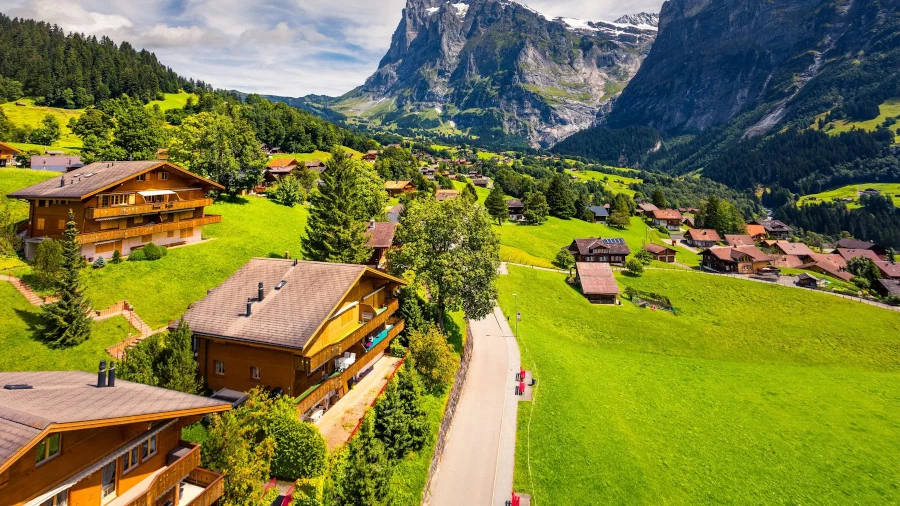
Grindelwald spreads out below the north face of the Eiger, one of the most famous walls in the Alps. Unlike Wengen and Mürren, the village can be reached by car as well as by direct train from Interlaken Ost, which makes it a handy base for the Jungfrau region.
Two lifts shape a visit. The First gondola leads to high trails, including the walk to Bachalpsee lake, where the peaks are reflected. The Eiger Express reaches Eigergletscher, from where the Jungfrau railway climbs to the Jungfraujoch at 3,454 m.

Mürren
Mürren sits on a terrace above the Lauterbrunnen valley, facing the Eiger, Mönch and Jungfrau. No road climbs up here: the chalet village is reached by cable car and narrow-gauge train, which keeps it unusually quiet.
Above it, the Schilthorn cable car climbs to Piz Gloria, the revolving restaurant made famous by the James Bond film On Her Majesty's Secret Service (1969). On foot, the trail to the neighbouring hamlet of Gimmelwald runs down between meadows and farms.

Interlaken
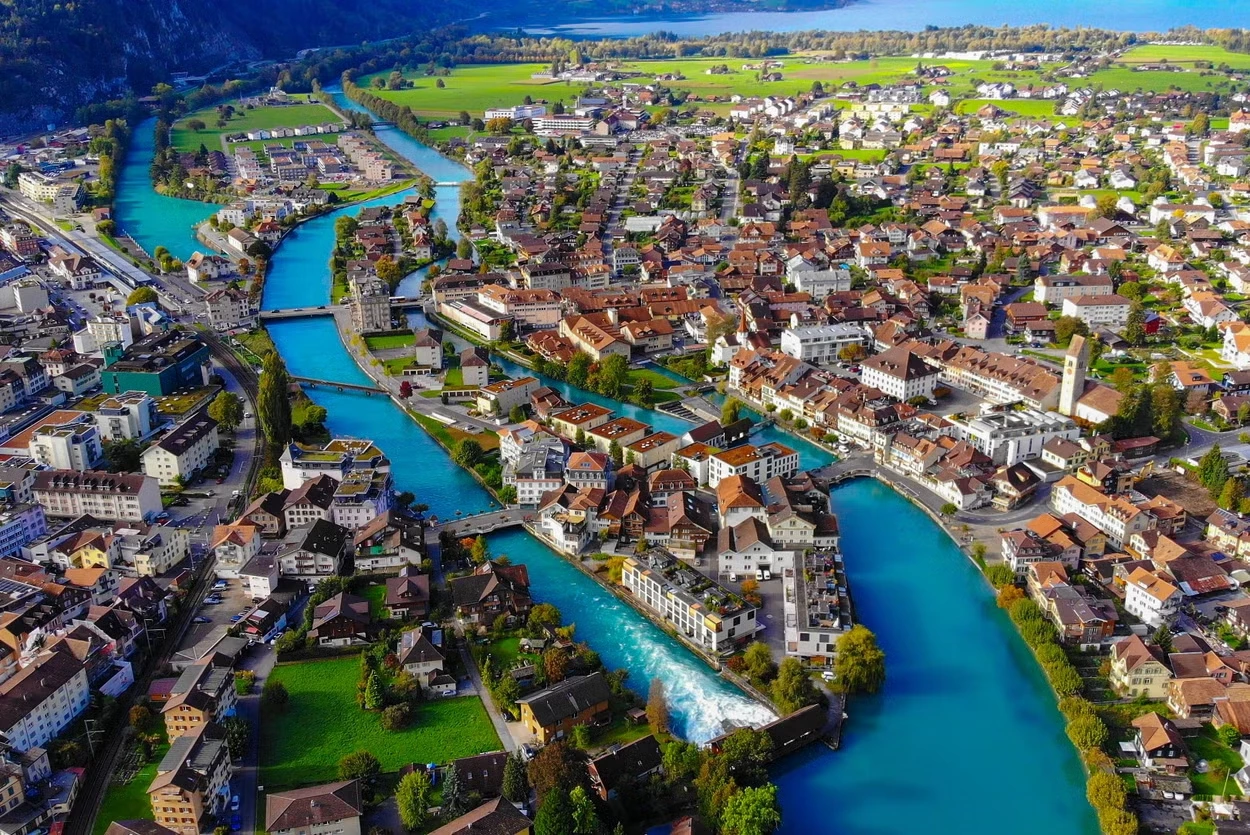
Interlaken sits on the alluvial plain between Lake Thun and Lake Brienz, hence its Latin name, "between the lakes". It is a small town rather than a village, but it is the rail hub of the Jungfrau region: trains to Grindelwald, Lauterbrunnen, Wengen and the Jungfraujoch leave from Interlaken Ost station.
In the centre, the large Höhematte meadow stays open towards the Jungfrau and doubles as the landing field for paragliders. For the overview of both lakes, the Harder Kulm funicular climbs to the viewpoint above the town.

Wengen
Wengen sits on a sunny terrace above Lauterbrunnen, below the Jungfrau. Like Mürren, the village has no access road: the Wengernalpbahn rack railway is the only way up, and the streets stay pedestrian.
Every January, Wengen hosts the Lauberhorn races, a ski World Cup event held since 1930. The rest of the year, the Männlichen cable car leads to a viewpoint over the Eiger, Mönch and Jungfrau, the start of a panoramic trail to Kleine Scheidegg.

Gruyères
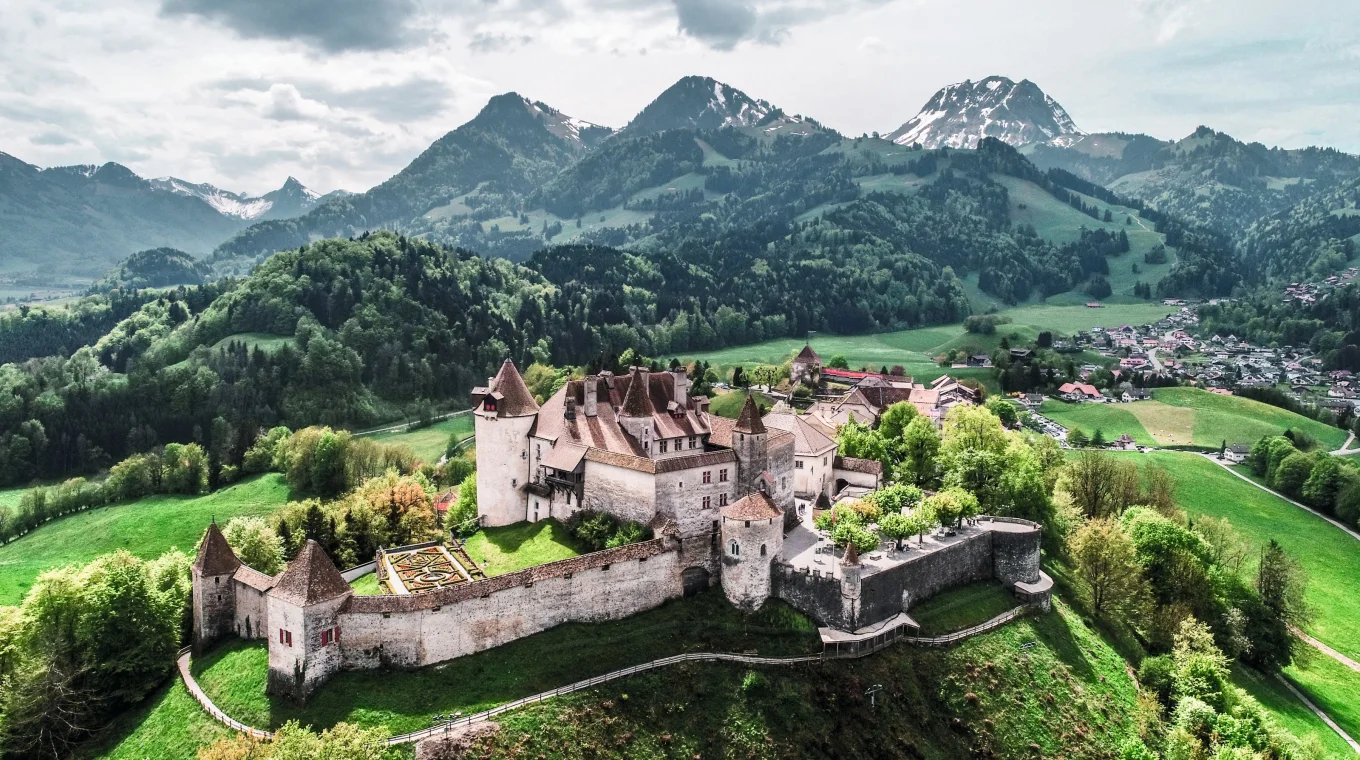
Gruyères is a medieval town on a hilltop in the canton of Fribourg, ringed by ramparts and closed to cars. A cobbled main street leads up to the castle, built in the 13th century, which is open to visitors and overlooks the Gruyère meadows.
In the town, the HR Giger Museum shows the work of the visual creator of Alien, a deliberate contrast with the old façades. At the foot of the hill, in Pringy, La Maison du Gruyère shows how the PDO cheese is made, and the Maison Cailler chocolate factory is a few minutes away in Broc.

Lucerne
Lucerne nestles at the northern tip of Lake Lucerne, where the Reuss leaves the lake, between Mount Pilatus and the Rigi. It is a cantonal capital of about 80,000 people: a town rather than a village, but the natural base for Engelberg, Weggis or Vitznau.
Its emblem is the Chapel Bridge (Kapellbrücke), a covered wooden footbridge from the 14th century, the oldest covered wooden bridge in Europe, lined with painted panels and flanked by an octagonal water tower. The lake steamers leave right opposite, from the quays by the station.

St. Moritz
St. Moritz, at about 1,800 m in the Upper Engadine, overlooks a lake that freezes every winter. In 1864 the hotelier Badrutt bet some English guests that they would enjoy winter here: the wager launched winter tourism in the Alps. The resort hosted the Winter Olympics in 1928 and 1948.
From that era come the St. Moritz-Celerina bobsleigh run, 1.72 km of natural ice rebuilt every winter, and the Cresta Run, a historic skeleton track. In summer, the Engadine lakes and high trails take over from the luxury of the grand hotels.

Engelberg
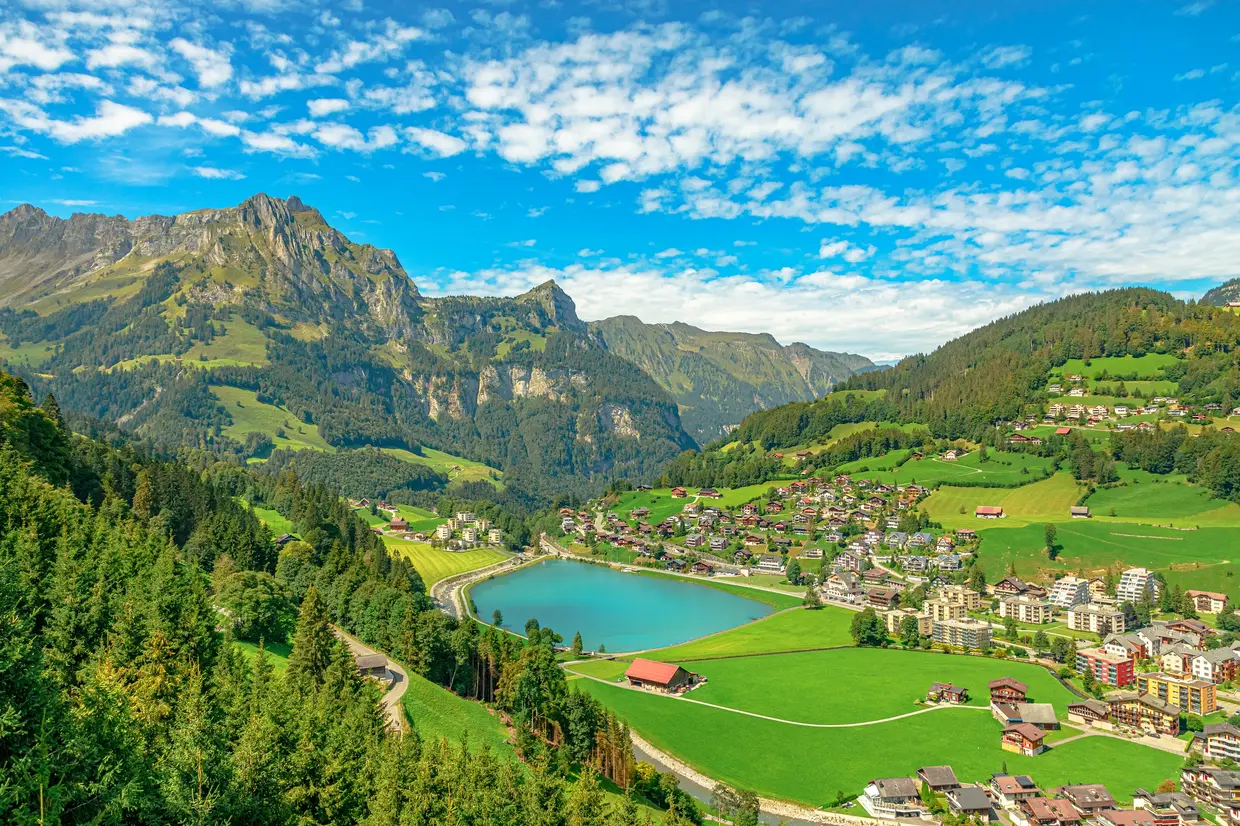
Engelberg grew up around its Benedictine abbey, founded in 1120, whose baroque church still dominates the village in central Switzerland. The village is an hour by train from Lucerne, at the end of a valley closed off by the walls of the Titlis.
The cable cars climb to 3,020 m in about thirty minutes. The last section, the TITLIS Rotair, was the world's first revolving cable car: the cabin turns on itself during the ascent. At the top, the Cliff Walk, a suspension bridge about a hundred metres long, crosses the void above the glacier.

Brienz
Brienz stretches along the eastern shore of Lake Brienz, whose turquoise water comes from the Aare glaciers. The village is the Swiss centre of woodcarving: workshops, shop windows and a carving school keep the craft alive.
Two excursions start here. The Brienz Rothorn Bahn, a steam rack railway opened in 1892, climbs 7.6 km to 2,244 m, with views over the lake and the Oberland peaks. A few kilometres away, the Ballenberg open-air museum brings together more than 100 historic buildings from all over Switzerland.

Morcote
Morcote clings to the southern shore of Lake Lugano, in Ticino, with its arcades, stepped lanes and ochre-toned houses. It was voted the most beautiful village in Switzerland in 2016.
A way of the cross of 400 steps climbs to the baroque church of Santa Maria del Sasso, with views down over the lake and the Italian mountains. By the lake, Parco Scherrer, a garden created by the textile merchant Arthur Scherrer, mixes subtropical plants with follies inspired by Italy and the East.

Champéry
Champéry is a village of wooden chalets in the Valais Chablais, at the end of the Val d'Illiez, facing the seven peaks of the Dents du Midi. Its main street keeps old façades and a church with an onion-domed bell tower.
In winter, the Croix de Culet cable car links the village to the Portes du Soleil, a French-Swiss area of about 600 km of slopes shared with Avoriaz and Morzine. In summer, the same lifts serve hikers and mountain bikers, who are numerous on the region's downhill trails.

Ascona
Ascona lines the northern shore of Lake Maggiore, in Italian-speaking Ticino, next to Locarno. Its lungolago promenade is a row of coloured houses, terraces and palm trees: this is Mediterranean Switzerland, under 200 m above sea level, where the country's lowest point lies.
Behind the town, the Monte Verità hill hosted a colony of artists and reformers in the early 20th century, and the site can be visited. In late June the JazzAscona festival, held here since 1985, takes over the lakefront.
Tandem paragliding above Interlaken
A shuttle climbs to Beatenberg, above Lake Thun, where you take off from a grassy slope strapped to a professional pilot. The flight passes over the lake, with the Eiger, Mönch and Jungfrau opposite, then lands in the centre of Interlaken. The highlight: the first seconds after take-off, as the ground drops away beneath your feet.
No experience is needed. Allow €191 per person on GetYourGuide, with free cancellation; the flight is postponed if wind or rain prevent it. Book a morning slot, when the air is often calmer.
- 1.5 hrs
- €191 per person (GetYourGuide price 2026)
Guided day trip to the Jungfraujoch from Interlaken
A coach takes you from Interlaken to the Grindelwald Terminal, then the Eiger Express climbs to Eigergletscher, where you board the rack railway that runs through the Eiger up to the Jungfraujoch, at 3,454 m the highest station in Europe. At the top: the Sphinx terrace facing the Aletsch glacier, the Ice Palace and the snowy Plateau. The highlight: the view of the Aletsch glacier from the Sphinx.
Allow €276 per person on GetYourGuide, transport and guide included, with free cancellation. Bring a warm jacket and sunglasses, and take it slowly: the altitude is noticeable.
- 7 hrs
- €276 per person (GetYourGuide price 2026)
Gornergrat railway facing the Matterhorn
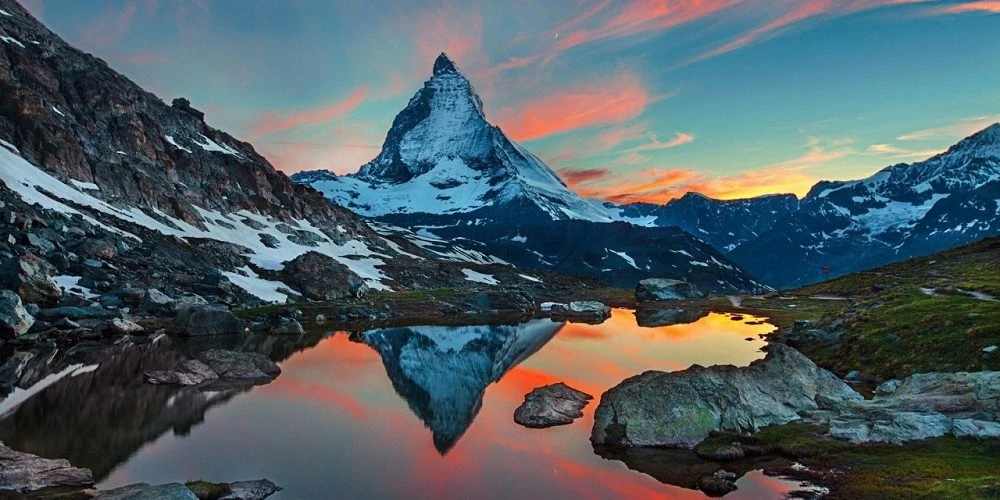
From the station opposite Zermatt's main station, the Gornergrat rack railway climbs to 3,089 m in 33 minutes, via Riffelalp, Riffelberg and Rotenboden. At the top, the platform looks out over the Matterhorn, the Gorner glacier and 29 peaks above 4,000 m, including the Dufourspitze (4,634 m). The highlight: the Matterhorn appearing on the last bends.
Allow €140 per person on GetYourGuide for the return trip, with free cancellation. Take the first train of the morning, then walk down from Rotenboden to Riffelsee lake for the reflection of the Matterhorn.
- Half a day (33-min ascent)
- €140 per person, return (GetYourGuide price 2026)
Titlis ascent and Cliff Walk
From Engelberg valley station, the gondolas climb via Trübsee lake, then the TITLIS Rotair, whose cabin turns on itself, reaches the station at 3,020 m. At the top, you cross the Cliff Walk, a suspension bridge over the void, enter the glacier cave and try the sledges in the snow park. The highlight: the middle of the Cliff Walk, above a 500 m drop.
Allow €121 per person on GetYourGuide, with free cancellation. Take the first cable car up and stop at Trübsee on the way down to walk round the lake.
- Half a day
- €121 per person (GetYourGuide price 2026)
Maison Cailler chocolate factory in Broc, near Gruyères
A few minutes from Gruyères, Maison Cailler in Broc tells the story of the oldest Swiss chocolate brand still in business, then shows the stages of production, from bean to bar. The interactive visit ends with a free tasting of many varieties. The highlight: the tasting room at the end of the tour.
Allow €18 per person on GetYourGuide, with free cancellation. Combine it with the town of Gruyères and La Maison du Gruyère in Pringy for a cheese-and-chocolate day.
- 1 hr
- €18 per person (GetYourGuide price 2026)
Getting there
Fly into Zurich or Geneva, then continue by Switzerland's dense, punctual train network to the alpine villages.
The main international gateways are Zurich and Geneva airports, with Basel and Bern-Belp as secondary options. From either, the Swiss rail network takes you to the Alps: Interlaken in about 2 h from Zurich, Zermatt via Visp, St. Moritz via Chur, Lucerne in under an hour from Zurich.
The Swiss Travel Pass covers trains, buses and boats and discounts most mountain lifts; the Half Fare Card gives -50% on most journeys. Car-free villages (Zermatt, Mürren, Wengen) are reached by train or cable car from a gateway car park (Täsch for Zermatt, Lauterbrunnen for Mürren and Wengen).
Getting around
Trains, postbuses and boats link the villages; a car is of little use in the car-free resorts.
Trains, postbuses (PostAuto) and boats link almost every village, with connections timed to the timetable. To move from one region to another (Bernese Oberland, Valais, Ticino, Engadine), the train remains the simplest option, with panoramic lines such as the Glacier Express between Zermatt and St. Moritz.
A rental car gives flexibility for remote valleys, but is no use in the car-free resorts of Zermatt, Mürren and Wengen, where you park at a gateway station before finishing by train or cable car. On motorways, the annual vignette is compulsory.
What to do
Ride a rack railway or cable car up to the viewpoints (Gornergrat, Jungfraujoch, Schilthorn, Titlis), walk between two villages, and visit lowland towns such as Gruyères or Morcote.
Most days follow the same pattern: a rack railway or cable car up to a viewpoint in the morning, while the sky is clear, then a walk down to another village. The great classics are the Gornergrat facing the Matterhorn from Zermatt, the Jungfraujoch (3,454 m) from Grindelwald or Wengen, the Schilthorn from Mürren and the Titlis from Engelberg.
Lower down, visits are on foot: Gruyères castle and cheese-making in Pringy, the Lauterbrunnen waterfalls, the Chapel Bridge in Lucerne, Morcote's 400-step path. Interlaken concentrates the sports activities, including tandem paragliding above the Höhematte.
Climate & seasons
When to go to Switzerland?
Monthly averages over the past 5 years (Open-Meteo).
Avoid
- May
| Jan | Feb | Mar | Apr | May | Jun | Jul | Aug | Sep | Oct | Nov | Dec | |
|---|---|---|---|---|---|---|---|---|---|---|---|---|
| Our take | ||||||||||||
| Weather | ||||||||||||
| High | 7° | 10° | 12° | 14° | 18° | 24° | 25° | 25° | 21° | 18° | 11° | 9° |
| Rain (mm) | 144 | 83 | 121 | 156 | 204 | 157 | 189 | 163 | 163 | 120 | 169 | 156 |
| Hiking & nature | Hiking & nature October |
What to do by season (autumn)
-
Hiking & nature
Mild temperatures, stable conditions.
When to go
From June to September for hiking and the lakes; from December to March for skiing and snow-covered villages.
Summer (June to September): long days, high-altitude hiking, the lakes (Brienz, Maggiore, Lugano) and open passes; it is the busiest and most expensive season.
Autumn (September to November): golden larches in the Engadine and Valais, the grape harvest in Ticino, quieter trails, but some lifts close for servicing between late October and December.
Winter (December to March): snow-covered villages, skiing at Zermatt, Grindelwald-Wengen, St. Moritz and in the Portes du Soleil, and the Lauberhorn races in January at Wengen.
Spring (April to May): valleys in bloom and the gardens of Ticino, but snow still lies at altitude; the Trümmelbach Falls reopen in April.
Where to stay
Pick a base by region: Interlaken or Lucerne for variety, Zermatt for the Matterhorn, St. Moritz for the Engadine.
Choose your base according to the area you want to explore. Interlaken is central for the Jungfrau region (Grindelwald, Lauterbrunnen, Wengen, Mürren). Lucerne suits central Switzerland (Engelberg, Weggis, Vitznau). Zermatt is the base for the Matterhorn, St. Moritz for the Engadine, and Lugano or Locarno for the villages of Ticino (Morcote, Ascona).
Accommodation ranges from grand historic hotels to family chalets, mountain huts and youth hostels. Staying in a car-free village (Wengen, Mürren) often costs less than Zermatt and makes for very quiet evenings. Book early for summer and the ski holidays.
Formalities
Switzerland is in the Schengen area but outside the EU; the currency is the Swiss franc (CHF).
Switzerland is part of the Schengen area: EU citizens enter with an ID card or passport, with no visa for short stays. Non-EU travellers follow the usual Schengen rules (90 days in 180); check according to your nationality.
The currency is the Swiss franc (CHF), not the euro, though some border shops accept euros and give change in francs. Cards are accepted everywhere. No specific vaccine is required and tap water is drinkable. To drive on motorways you need the annual vignette.
FAQ
Car-free villages, best base, Swiss Travel Pass, the Matterhorn, getting to Mürren, currency and visas.
Which Swiss villages are car-free?
Zermatt, Mürren and Wengen. You park at a gateway station (Täsch for Zermatt, Lauterbrunnen for Mürren and Wengen) and finish by shuttle train, rack railway or cable car.
What is the best base for the Jungfrau region?
Interlaken, between Lake Thun and Lake Brienz: from Interlaken Ost, trains reach Grindelwald, Lauterbrunnen, Wengen and Mürren in under an hour.
Is the Swiss Travel Pass worth it?
It covers trains, buses and boats and gives discounts on most mountain lifts. It pays off if you change region often; for a few journeys, the Half Fare Card (-50% on most tickets) often works out cheaper.
When is the Matterhorn best seen from Zermatt?
Early in the morning, when the sky is clearest; the summit often clouds over during the day. The Gornergrat railway, which climbs to 3,089 m in 33 minutes, offers one of the best viewpoints.
How do you get to Mürren?
From Lauterbrunnen, take the cable car to Grütschalp then the narrow-gauge train, or go up from Stechelberg by cable car via Gimmelwald.
Are Interlaken and Lucerne villages?
No: they are towns (Lucerne has about 80,000 inhabitants). They appear here as bases for exploring the surrounding villages.
Do I need a visa and which currency should I bring?
No visa for EU nationals, who can enter with an identity card; others follow Schengen rules (90 days in 180). The currency is the Swiss franc (CHF).
Sources
The figures in this guide come from the sources below, checked on the publication date.
- zermatt.swiss
- www.gornergrat.ch
- www.matterhornparadise.ch
- en.portesdusoleil.com
- www.chateau-gruyeres.ch
- www.myswitzerland.com
- www.luzern.com
- www.titlis.ch
- www.titlis.ch
- en.wikipedia.org
- jungfrauregion.swiss
- www.truemmelbachfaelle.ch
- www.ascona-locarno.com
- www.schilthorn.ch
- brienz-rothorn-bahn.ch
- www.myswitzerland.com
- en.wikipedia.org
- ssrsr.ch
- www.getyourguide.com
Leave a comment
Share your thoughts or travel experience. Your email will not be published.