

Contents 33
Capri is a 10 km² island in the Gulf of Naples, 45 minutes by hydrofoil from Naples and 20 minutes from Sorrento. Two towns share it: Capri, around the Piazzetta and Via Camerelle, and Anacapri, higher up and quieter, where the chairlift to Monte Solaro (589 m) departs. The main sights make a short list: the Blue Grotto, the three Faraglioni rocks, Tiberius's Villa Jovis, the Gardens of Augustus and Via Krupp, Villa San Michele and the Charterhouse of San Giacomo.
The island is visited on day trips from Naples or the Amalfi Coast, but one or two nights change everything: day-trippers leave in the late afternoon and the lanes empty out. This guide covers each place with official prices read in 2026, the ferries, transport on the island, the budget to plan for and three itinerary ideas.
Overview
Capri is a 10 km² limestone island in the Gulf of Naples, split between Capri and Anacapri, famous for the Blue Grotto and the Faraglioni.
Capri is a 10 km² limestone island in the south of the Gulf of Naples, 5 km off the tip of Sorrento. Two towns share it: Capri, around the Piazzetta, Via Camerelle and the port of Marina Grande, and Anacapri, on the quieter western plateau, where the chairlift to Monte Solaro (589 m, the highest point) departs. The island has been inhabited since antiquity: Emperor Tiberius ruled Rome from Villa Jovis between 27 and 37 AD.
Today Capri lives on tourism, with heavy day-trip traffic from April to October. Its main sights fit on a pocket map: the Blue Grotto in the north-west, the Faraglioni in the south-east, the Gardens of Augustus and Via Krupp south of Capri town, Villa San Michele in Anacapri. Many travellers combine it with Naples, Pompeii or the Amalfi Coast: see our guide to Rome's must-dos to extend towards the capital.
15 places to take with you
In the guide's order, ready for Google Maps or your GPS.
Book the activities from this guide
Our picks for Capri, well rated and free to cancel.
-
Book this activity
Island boat tour with a swim stop
€50 per person (GetYourGuide price 2026)
-
Book this activity
Blue Grotto, Capri and Anacapri with a guide
€115 per person (GetYourGuide price 2026)
-
Book this activity
Capri day trip from Naples, Blue Grotto included
€170 per person (GetYourGuide price 2026)
Affiliate links: Travel Advice earns a commission if you book, at no extra cost to you. Learn more

The Blue Grotto
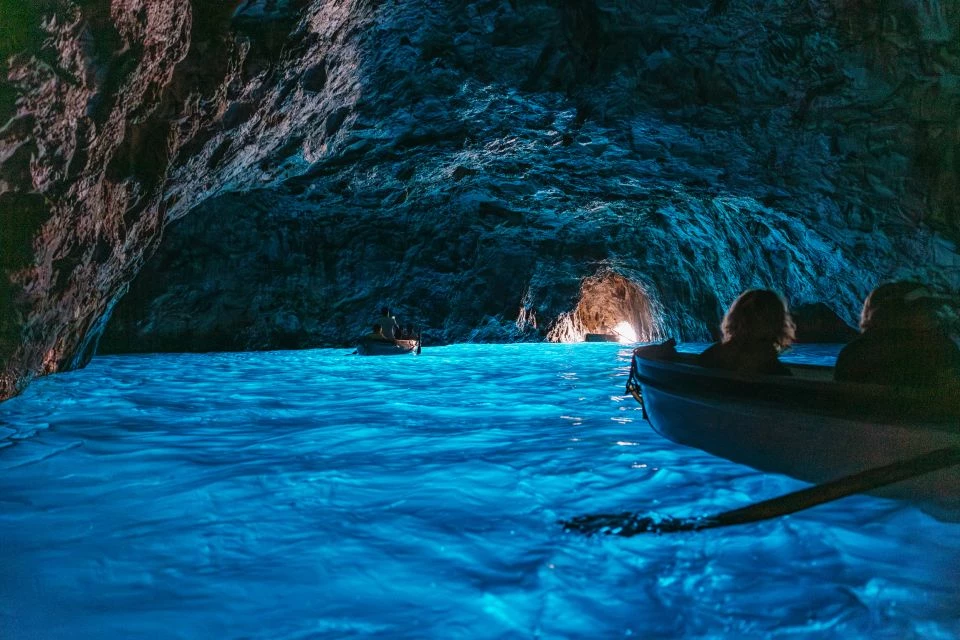
The Blue Grotto (Grotta Azzurra) is Capri's most famous sight, on the island's north-west coast. Sunlight enters through an underwater opening and bounces back as electric-blue reflections on the water: the effect is sharpest on a calm sea under a clear sky, roughly between 10:00 and 13:00.
There are two ways in: by boat from Marina Grande, or by bus to Anacapri and then the staircase down to the landing stage. Either way you transfer into a four-seat rowing boat; the oarsman pulls it under a metre-high opening using a chain. The visit inside lasts about five minutes.
The site is run by the Ministry of Culture: the site ticket and the rowing boat are paid separately; check coopculture.it for whether online booking is required on your date. The grotto closes as soon as swell or high tide blocks the entrance, and on 25 December and 1 January.

The Faraglioni
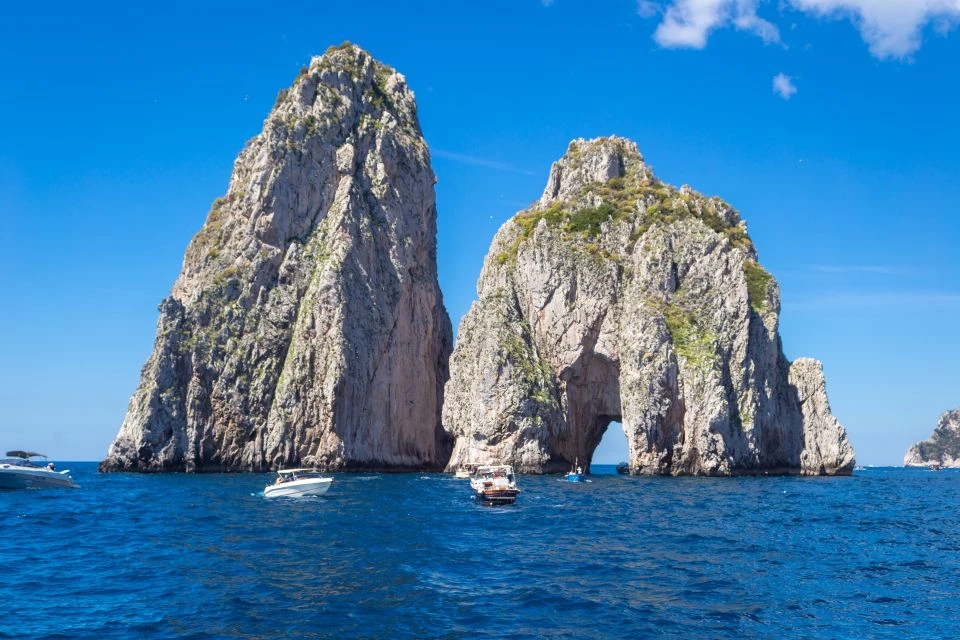
The Faraglioni are Capri's iconic rock formation: three limestone stacks rising from the sea off the island's south-eastern coast.
Each has a name: "Stella" (the stack still joined to land), "Faraglione di Mezzo" (the middle one, pierced by an arch that boats can pass through), and "Faraglione di Fuori," the farthest out. The latter is home to the blue lizard (Podarcis siculus coeruleus), an endemic subspecies.
They are best admired from the island's viewpoints, especially the Gardens of Augustus, or up close on a boat tour around the island.

Mount Solaro
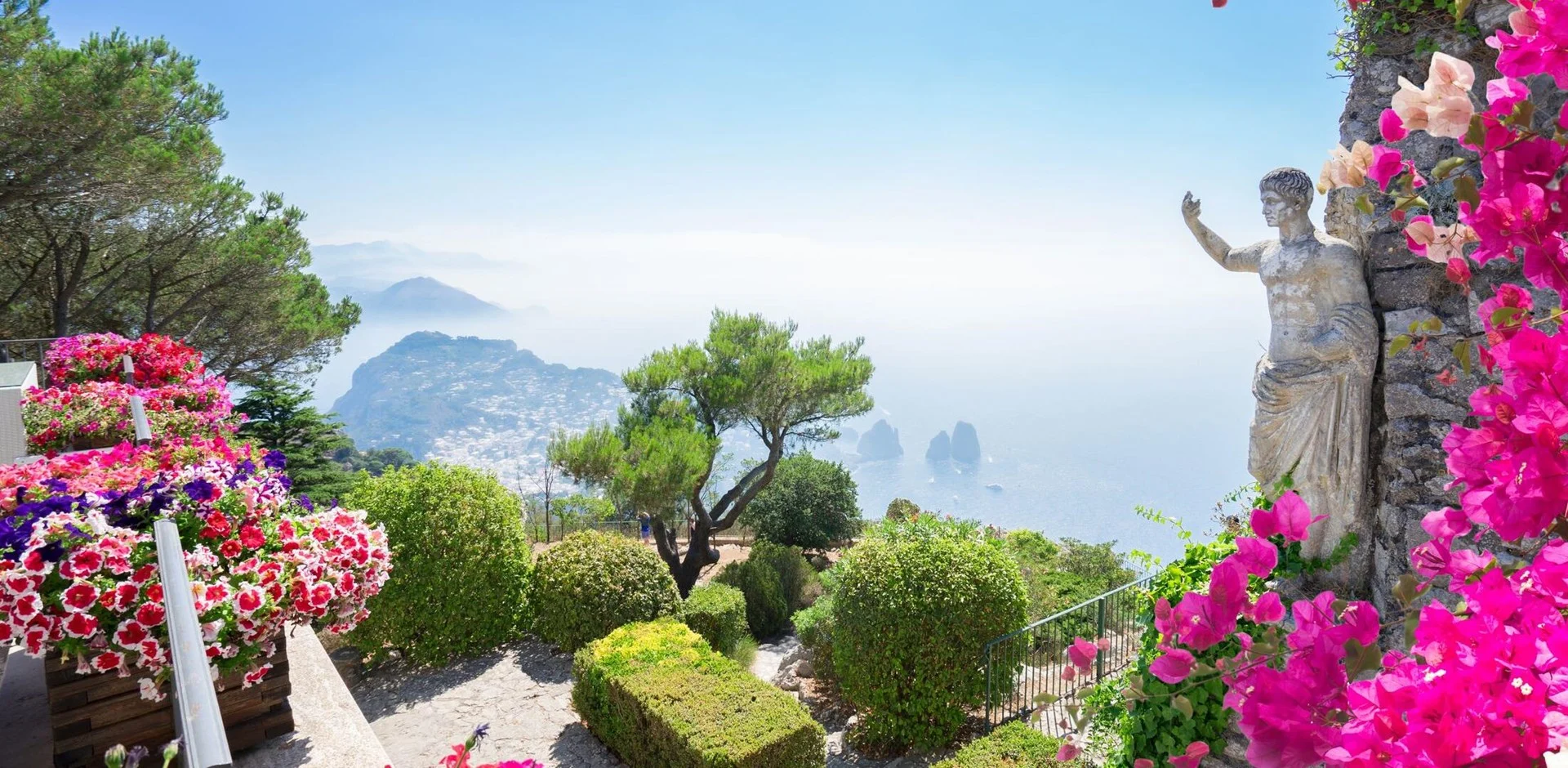
Mount Solaro is the highest point on Capri, at 589 m. It offers panoramic views over the Bay of Naples, the Amalfi Coast, and the islands of Ischia and Procida.
To reach the summit you can hike the scenic trails or take the single-seat chairlift (seggiovia) from Piazza Vittoria in Anacapri; the ride takes about 13 minutes. A small café at the top lets you enjoy refreshments while taking in the view.
The mountain is home to diverse flora and fauna. A few minutes below the summit, toward Marina Piccola, stands the Hermitage of Santa Maria a Cetrella, a 16th-century chapel that adds a historical dimension to the visit.

Villa Jovis
Villa Jovis ("Villa of Jupiter") is the largest of the twelve Roman villas Emperor Tiberius built on Capri. Completed around 27 AD, it was the residence from which Tiberius governed the Roman Empire until his death in 37 AD.
Perched atop Monte Tiberio (334 m) at the north-eastern tip of the island, it spans about 7,000 m² across several terraces. Surviving walls, cisterns, and staircases remain, along with the "Salto di Tiberio," the cliff from which, according to legend, the emperor had his victims thrown.
It is one of the best-preserved imperial Roman residences in Italy, reached by a pleasant walk of about 45 minutes from Capri town.

Villa San Michele
Villa San Michele is the house that Swedish doctor and writer Axel Munthe had built in Anacapri at the end of the 19th century, on the ruins of a chapel and a Roman villa. He told its story in "The Story of San Michele" (1929), one of the best-selling books of the interwar years.
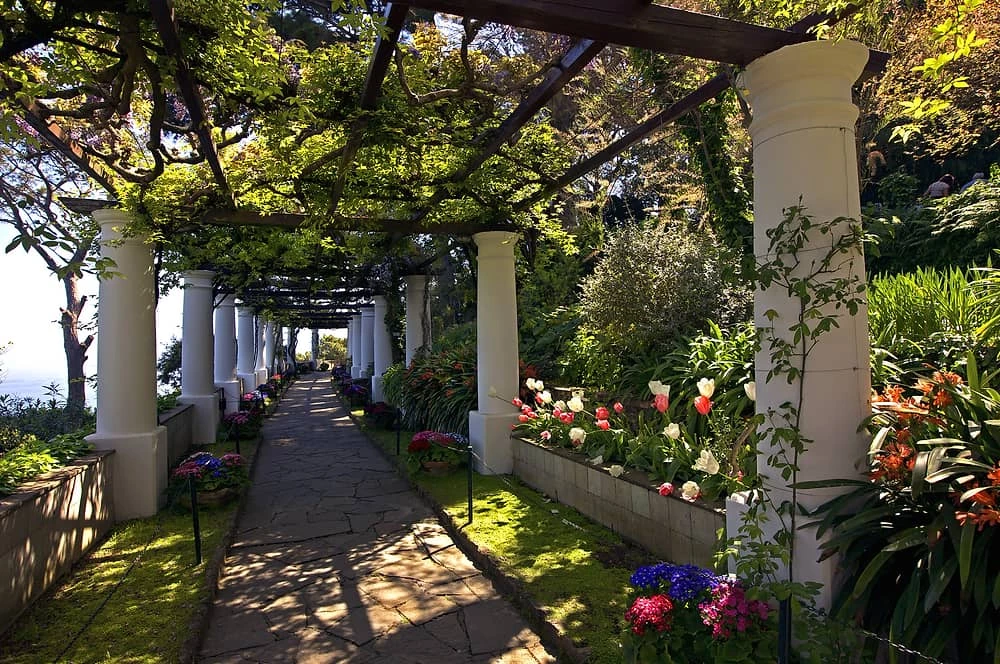
The visit runs through the rooms of the house, furnished with antiques and Roman fragments found on the island, then the pergola and the terraced garden overlooking Marina Grande and the Bay of Naples. The Egyptian sphinx at the end of the terrace is Anacapri's most photographed viewpoint.
The villa belongs to the Swedish state and also houses a bird observatory. It is open all year, with shorter hours from November to February; entry is paid.

The gardens of Augustus
The Gardens of Augustus are an iconic spot on Capri. Laid out in terraces on the southern slope of Capri town, a few minutes from the Piazzetta and next to the Charterhouse of San Giacomo, they overlook Marina Piccola and offer one of the finest views of Via Krupp and the Faraglioni rocks.
They were created in the early 20th century by German industrialist Friedrich Alfred Krupp, who designed them as a place of rest and meditation planted with exotic species. First called the "Krupp Gardens," they were renamed "Gardens of Augustus" in 1918.
Now open to the public, they feature shaded paths, terraces flowering with geraniums and dahlias, and panoramic benches. They also hold a monument to Lenin sculpted by Giacomo Manzù in 1968.

Anacapri
Anacapri is the island's second town, perched on the western slope of Capri, in the Tyrrhenian Sea. It offers a more peaceful, traditional atmosphere than Capri town, with views of the Mediterranean, rugged cliffs, and flowering gardens.
Among its highlights: Villa San Michele, the former home of Swedish physician Axel Munthe now turned into a museum, and the church of San Michele Arcangelo, famous for its 18th-century majolica-tiled floor. The historic centre is best explored on foot, along streets lined with colourful houses.
From Piazza Vittoria, the chairlift climbs to the summit of Mount Solaro, the island's highest point. Anacapri is also known for its handmade sandals, custom-made in several shops around town.

The Piazzetta
La Piazzetta (officially Piazza Umberto I) is the central square of Capri town, in the Bay of Naples. Tiny but lively, it serves as a meeting point for locals and visitors alike, from morning until late at night.
Lined with cafes, restaurants, and boutiques, and overlooked by the clock tower, it concentrates the island's elegant way of life. People settle in for an espresso or an aperitif while watching the comings and goings.
It is also a handy starting point for the rest of Capri: the shopping lanes, the Gardens of Augustus, and the Faraglioni viewpoints all lead off from here.

The Charterhouse of San Giacomo
The Charterhouse of San Giacomo (Certosa di San Giacomo) is a former monastery perched on a cliff south of Capri town, overlooking the sea and the Faraglioni. Founded in 1371 by Giacomo Arcucci, secretary to Queen Joan I of Naples, it was home to Carthusian monks.
Over the centuries the monastery was enlarged and restored several times and served as a major spiritual centre on the island. It was suppressed in 1808 and is no longer an active monastery.
Today the Charterhouse is open as a museum and cultural venue: it houses the Karl Wilhelm Diefenbach museum, a library, exhibition rooms, and fine gardens, and regularly hosts events.

Marina Grande and Marina Piccola
Marina Grande, on the north coast, is where every hydrofoil and ferry from Naples and Sorrento docks. The waterfront gathers ticket offices, restaurants and the lower funicular station, which climbs to Capri town in 4 minutes; buses and taxis leave from the same square.
Marina Piccola, on the south coast, is a small cove linked to Capri town by bus and the starting point of many boat trips to the Faraglioni. The beaches of both marinas are described below.

The Via Krupp
Via Krupp is a switchback path cut into Capri's southern cliff between 1900 and 1902 at the initiative of German industrialist Friedrich Alfred Krupp. It links the Charterhouse of San Giacomo and the Gardens of Augustus to Marina Piccola, about a hundred metres below.
Krupp had it built to reach his yacht and his bathing cave more quickly. The route strings together tight hairpin bends hugging the rock face, with a continuous view of the Faraglioni and the cove of Marina Piccola.
Closed in 2014 after rockfalls, the path reopened to walkers in 2023 after nine years of safety works. It can close at short notice for maintenance or after rockfalls.

Marina Grande Beach
Marina Grande beach is the closest beach to Capri's main port, on the island's north coast. It mixes pebbles and sand and stays easy to reach, a few minutes' walk from the landing stage.
There are paid bathing sections (loungers, parasols) and a free stretch. The view takes in the busy harbour and the cliffs that frame it.
Several restaurants and cafes line the beach, handy for lunch between visits without straying far from the port.

Marina Piccola beach
Marina Piccola beach sits in a cove on the south coast of Capri, facing the Faraglioni. It is in fact made up of two small beaches, Marina Piccola and Pennaulo, separated by a rock, the Scoglio delle Sirene.
The waters are clear and good for swimming and snorkelling; the shore is fairly rocky. Bathing establishments rent loungers and parasols, and restaurants overlook the sea.
It is also a handy starting point for boat trips that run along the Faraglioni and the caves of the coast.

Bagni di Tiberio beach
Bagni di Tiberio beach lies on the north coast of Capri, in a small bay with clear waters. Its name, "Baths of Tiberius," refers to the Roman emperor Tiberius, whose villa once stood nearby.
It is a quiet beach, well suited to swimming and snorkelling. You will also find Roman archaeological remains incorporated into a seaside bathing establishment.
The spot appeals to those seeking a peaceful setting away from the bustle of the main sights, with a touch of ancient history.

The Via Camerelle
Via Camerelle is one of the most elegant streets in Capri. It is lined with the boutiques of major fashion houses — Gucci, Prada, Louis Vuitton — alongside local artisans and stylish cafes.
It is also the busiest street in the early evening, as day-trippers head back. Many visitors sit down for a coffee or an aperitif along the promenade.
The street links the Piazzetta to the grand-hotel district and leads to fine viewpoints, making it a natural route for exploring the centre of Capri.
Island boat tour with a swim stop
Departure from Marina Grande for a full loop of Capri in a small group: the White Grotto, the Green Grotto, the Arco Naturale seen from the sea, then the passage under the arch of the Faraglione di Mezzo and a swim stop in a cove. The highlight is the arch, impossible to reach from land.
For everyone, even on a first visit; towels, water and a limoncello tasting included, Blue Grotto entry not included. Book online with free cancellation; bring swimwear and sunscreen.
- 2 hrs
- €50 per person (GetYourGuide price 2026)
Blue Grotto, Capri and Anacapri with a guide
From Capri's port, a guide takes you by minibus to Anacapri and then to the Blue Grotto: the rowing boat and the entry ticket are included, as is admission to the Gardens of Augustus. The highlight is entering the grotto lying flat in the boat, before the light shifts.
Ideal if you would rather not handle the queues and cash payments. If the sea closes the grotto, another site replaces the visit. Book online with free cancellation.
- 4 hrs
- €115 per person (GetYourGuide price 2026)
Capri day trip from Naples, Blue Grotto included
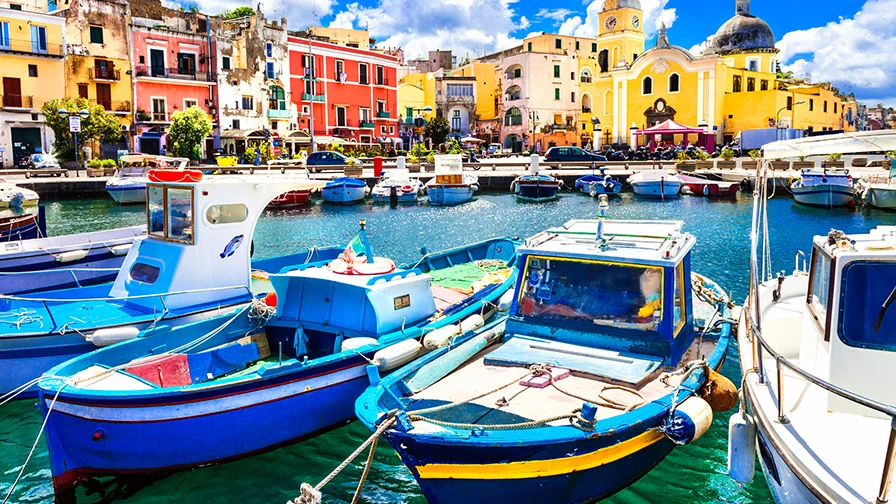
Meet at Molo Beverello in Naples: return ferry, shuttle on the island, Capri and Anacapri with a small-group guide, Blue Grotto entry and rowing boat included (replaced by a boat tour if the grotto is closed). The highlight is the crossing back with Vesuvius ahead.
For those staying in Naples who want to see everything in one day without organising the connections. Monte Solaro chairlift as a paid option. Book online with free cancellation.
- 9 hrs
- €170 per person (GetYourGuide price 2026)
Monte Solaro by chairlift, back down on foot
From Piazza Vittoria in Anacapri, the single-seat chairlift climbs in 13 minutes to the top of Monte Solaro (589 m), feet dangling above the gardens. The highlight is the arrival: the Bay of Naples, Ischia, the Amalfi Coast and the Faraglioni in a single glance.
For everyone, children included (accompanied). Ticket on site: €15 return, €12 one-way; good walkers come down in 45 minutes via the hermitage of Santa Maria a Cetrella. Open 9:15-17:00 from April to October.
- 2 hrs
- €15 return (official 2026 price)
Visit to Villa San Michele
Entry ticket for Axel Munthe's house in Anacapri: rooms furnished with antiques, the chapel, the pergola and the terraced garden above Marina Grande. The highlight is the granite sphinx at the end of the terrace, facing the whole Bay of Naples.
For lovers of history and gardens, and for anyone who wants Anacapri's finest view without effort. Book online with free cancellation, and combine with the chairlift next door.
- 1 hr
- €12 per person (GetYourGuide price 2026)
Getting there
Capri is reached only by boat: hydrofoil or ferry from Naples or Sorrento, landing at the port of Marina Grande.
Capri has no airport and can only be reached by sea. All boats dock at Marina Grande, the island's only port.
From Naples: hydrofoils (aliscafi) leave from Molo Beverello (about a 45 to 50-minute crossing); car-and-passenger ferries leave from Calata Porta di Massa. The main operators are NLG, SNAV, and Caremar.
From Sorrento: allow about 15 to 20 minutes by hydrofoil and 25 minutes by ferry, with Caremar, NLG/Gescab, or Alilauro-Gescab.
Book ahead in high season and check return times, which are less frequent late in the day.
Naples is also the departure port for the overnight ferries to Palermo: if you are heading further south, see our complete guide to Sicily.
Getting around
Funicular from Marina Grande to Capri, chairlift to Mount Solaro, buses and taxis for Anacapri and the Blue Grotto, and boats for the coast.
Capri is small and many sights are walkable. For the rest:
- Funicular: links Marina Grande to Capri Town (Piazza Umberto I) in about 4 minutes; €2.40 at the office.
- Chairlift (seggiovia): from Piazza Vittoria in Anacapri to the summit of Mount Solaro.
- Bus: the network links Capri, Anacapri, and the main sites, including the access road to the Blue Grotto; cheap and convenient.
- Taxi: handy for saving time; the open-top convertibles are a local institution.
- Boat: essential for the Blue Grotto, the island tour, and secluded coves.
What to do
The Blue Grotto by rowing boat, a boat tour of the island under the Faraglioni arch, the Monte Solaro chairlift, Villa Jovis on foot and the Gardens of Augustus at sunset.
Start with the Blue Grotto in the morning, when the sea is calmest, then take a boat tour of the island: it is the only way to pass under the arch of the Faraglione di Mezzo and to see the Green and White grottoes. On land, Villa Jovis is earned with a 45-minute climb from the Piazzetta, and the Gardens of Augustus give the classic view over Via Krupp and the Faraglioni.
In Anacapri, ride the Monte Solaro chairlift (13 minutes) for the panorama over the gulf and walk down via the hermitage of Santa Maria a Cetrella, then visit Villa San Michele. Walkers add the Sentiero dei Fortini, linking the Blue Grotto to Punta Carena past the old forts of the west coast (about 3 hours, free). The activities below detail the bookable excursions.
Food
Ravioli capresi, insalata caprese, chocolate-and-almond torta caprese, fish of the day and limoncello: the island's food is simple and pricey near the Piazzetta.
Three dishes carry the island's name: ravioli capresi (thin pasta filled with caciotta cheese and marjoram, tomato sauce), insalata caprese (tomatoes, mozzarella, basil) and torta caprese, a flourless chocolate-and-almond cake. Add the fish of the day, spaghetti alle vongole and limoncello made with lemons from Sorrento and the island.
The terraces of the Piazzetta and Via Camerelle charge for the setting: expect twice the Anacapri price for the same dish. To eat well without overspending, aim for the trattorias in Anacapri's lanes, the Marina Grande restaurants used by locals, or a quick lunch (panini, focaccia) before the beach. Book for dinner in summer.
Itineraries
One day: Blue Grotto, boat tour, Gardens of Augustus; two days: add Anacapri, Monte Solaro and Villa San Michele; three days: Villa Jovis, Sentiero dei Fortini and a beach.
1 day from Naples or Sorrento: first hydrofoil, Blue Grotto by boat from Marina Grande, island tour passing under the Faraglioni arch, funicular up to the Piazzetta, lunch, Gardens of Augustus and Via Krupp, back on the 17:00 boat.
2 days: day 1 as above, night in Anacapri. Day 2: Monte Solaro chairlift at opening time, walk down via Santa Maria a Cetrella, Villa San Michele, San Michele church and its majolica floor, afternoon at Marina Piccola beach.
3 days: add the climb to Villa Jovis via Via Tiberio and the Arco Naturale (morning), then the Sentiero dei Fortini from the Blue Grotto to the Punta Carena lighthouse for sunset. To carry on through the South, our Puglia guide and our Sicily guide take over.
Climate & seasons
When to go to Italy?
Monthly averages over the past 5 years (Open-Meteo).
Best months
- April
- May
- June
- July
- August
Avoid
- November
| Jan | Feb | Mar | Apr | May | Jun | Jul | Aug | Sep | Oct | Nov | Dec | |
|---|---|---|---|---|---|---|---|---|---|---|---|---|
| Our take | ||||||||||||
| Weather | ||||||||||||
| High | 13° | 13° | 13° | 15° | 18° | 23° | 26° | 26° | 24° | 21° | 18° | 15° |
| Rain (mm) | 117 | 71 | 78 | 50 | 50 | 22 | 10 | 36 | 95 | 100 | 208 | 132 |
| Beach | Beach July | Beach August |
When to go
May-June and September-October: 20-27 °C air temperature, sea warm enough for swimming, all sites open, fewer crowds than in July-August; in winter part of the island shuts down.
The best months are May-June and September-October: 20 to 27 °C, a sea warm enough to swim in, every site and the chairlift open, and bearable crowds. July-August are hot (30 °C and above), packed with day-trippers from 10:00 to 17:00 and the most expensive for accommodation.
From April to mid-May the island is in bloom and quiet, but the sea is still cool and the Blue Grotto closes more often because of swell. From November to March many hotels, restaurants and sea links stop, the chairlift closes for about twenty days in January-February and Via Krupp closes for maintenance: Capri is then a place for trails and quiet, not for the beach.
Budget
An expensive island: as a guide, €150-250 per person per day in a simple hotel in Anacapri, meals and transport included; a day trip from Naples costs €60-120 without an organised tour.
Capri is one of Italy's most expensive destinations. As a guide, allow €150 to 250 per person per day in a double room at a simple hotel or B&B in Anacapri, with two meals, buses and the funicular; in Capri Town in summer, boutique hotels easily exceed €300 a night. On a day trip from Naples, €60 to 120 per person covers the return hydrofoil, a meal, the chairlift and one entry.
Spending benchmarks read in 2026: Monte Solaro chairlift €15 return, Villa Jovis €6, funicular €2.40 per ride. The Blue Grotto is paid in two parts on site (site ticket and rowing boat), in cash. Beach clubs rent a lounger and parasol by the day, but Marina Grande and Marina Piccola keep a free stretch. Boat trips around the island book for €25 to 55 per person depending on the package.
Where to stay
Capri Town to be central, Anacapri for quiet and gentler prices, Marina Grande for the ferries; book months ahead for summer.
Capri Town gathers the boutique hotels and grand hotels around the Piazzetta and Via Camerelle: central, everything on foot, but the most expensive part of the island. Anacapri, 10 minutes away by bus, is quieter, greener and noticeably cheaper, with guesthouses and family hotels near the chairlift and Villa San Michele.
Marina Grande is handy for an early ferry and has a beach, but the port bustle lasts all day. Marina Piccola, to the south, has a few hotels facing the Faraglioni with direct access to the water. Whichever area you pick, book several months ahead for June-September: the island is small and fills up fast.
Safety
A safe island; the risks are heat on the trails, swell that closes the Blue Grotto and pickpockets in the port crowds; emergencies on 112.
Capri is a safe destination. The only serious risks come from the terrain: heat and lack of shade on the paths to Villa Jovis, the Sentiero dei Fortini and the walk down from Monte Solaro (start early, with water and good shoes), and possible rockfalls on Via Krupp, which then closes without notice. Do not swim at Marina Piccola in heavy swell, and never jump from the Faraglioni rocks.
In the crowds at Marina Grande and the funicular, keep wallet and phone out of back pockets. There is a pharmacy and a first-aid post in both Capri and Anacapri; the nearest hospital is in Capri (Ospedale Capilupi), serious cases are evacuated to Naples. European emergency number: 112.
Formalities
Italy is in the EU and Schengen: a valid ID card or passport for Europeans, the euro, ETIAS not yet in service (no date set as of September 2026), EES in force since 10 April 2026 for non-EU travellers.
Capri is part of Italy, a member of the European Union and the Schengen Area: EU nationals only need a valid identity card or passport. The currency is the euro (€). Non-EU travellers should check Schengen rules (90 days within 180) and the upcoming ETIAS travel authorisation, not yet in service, with no launch date set (September 2026) depending on nationality — always check official EU sources before travelling. Since 10 April 2026, the EU Entry/Exit System (EES) registers non-EU short-stay travellers at the border, with a facial image and fingerprints, instead of a passport stamp.
The European emergency number is 112. EU nationals can use their European Health Insurance Card; travel insurance is advisable for others. Cards are widely accepted, but keep cash: the Blue Grotto rowing boat and some beach clubs take cash only.
Tips
Take the first hydrofoil, do the Blue Grotto first, carry cash, save Anacapri for the afternoon and stay a night if you can.
- Arrive early: the first hydrofoil from Naples or Sorrento gets you on the island before the groups; visit the Blue Grotto first, before the swell builds.
- Cash: the Blue Grotto rowing boat, some buses and beach vendors do not take cards.
- Buses: the Capri–Anacapri minibuses are full between 11:00 and 15:00; board at the first stop or walk up the Scala Fenicia (921 steps, 40 min).
- Luggage: no visitor cars (banned April to October); hotels send a porter to the port, for a fee.
- Return: check the last boat, earlier off season, and buy the return ticket on arrival in summer.
- One night on the island is worth the price: the Piazzetta after 18:00 is nothing like the one at noon.
FAQ
Capri is reached by boat from Naples or Sorrento, the Blue Grotto is paid in two parts on site, the Monte Solaro chairlift costs €15 return and Europeans enter with just an ID card.
How do you get to Capri?
Only by boat: hydrofoil or ferry from Naples (Molo Beverello for hydrofoils, Calata Porta di Massa for ferries, about 45-50 min) or from Sorrento (about 20 min). All dock at Marina Grande.
How much does the Blue Grotto cost?
Two separate payments: the site entry ticket (Ministry of Culture, details on coopculture.it) and the rowing boat, charged separately. Boat tours that "pass by the Blue Grotto" do not include these two fees unless explicitly stated.
How do you get up Monte Solaro?
By the single-seat chairlift from Piazza Vittoria in Anacapri (€15 return, €12 one-way, about 13 min, 2026 price), or on foot via the Santa Maria a Cetrella trail.
When is the best time to visit Capri?
May-June and September-October: the sea is warm enough to swim, every site is open and there are fewer people than in July-August. In winter many hotels and restaurants close.
Do you need a visa to visit Capri?
Italy is in the Schengen Area: ID card or passport for EU citizens, visa-free entry for many non-Europeans (90 days within 180). ETIAS is not yet in service and no date has been set (September 2026).
How long do you need in Capri?
One day covers the Blue Grotto, the Piazzetta and the Gardens of Augustus; two days let you add Anacapri, Monte Solaro and Villa Jovis without rushing.
Is Via Krupp open?
Yes, since 2023, after nine years of closure; it can close at short notice for maintenance or rockfalls, so check on site. Check on site, as a rockfall can close it without notice.
Sources
The figures in this guide come from the sources below, checked on the publication date.
Leave a comment
Share your thoughts or travel experience. Your email will not be published.