

Contents 31
Budapest stretches along both banks of the Danube: Buda, on the hills of the west bank, holds the castle and Fisherman's Bastion; Pest, on the flatter east bank, gathers the Parliament, the grand boulevards and the Jewish Quarter. It is a city of thermal baths, illuminated bridges and historic cafés, where a few minutes take you from a neo-Gothic palace to a bar set up in a derelict building.
Hungary uses the forint (HUF), not the euro, and is part of the Schengen Area: travellers from the European Union enter with just an ID card or passport. Public transport (metro, tram and buses run by BKK) covers the whole city, and the M1 metro line, UNESCO-listed, is the oldest electrified underground railway in continental Europe.
From Fisherman's Bastion to the Széchenyi pools, by way of the Great Market Hall and the ruin bars of the Jewish Quarter, here are 13 must-dos on both banks, with prices checked in 2026. Good to know before you go: the Gellért Baths have been closed for renovation since 1 October 2025.
Overview
Budapest, the capital of Hungary, was formed in 1873 from the merger of Buda, Óbuda and Pest on both banks of the Danube.
Budapest, the capital of Hungary, was formed in 1873 from the merger of three towns: Buda and Óbuda on the hills of the Danube's west bank, and Pest on the flat east bank. The river, listed together with the Banks of the Danube and the Buda Castle Quarter as a UNESCO World Heritage Site since 1987, still shapes the city today.
Nicknamed the "city of baths", Budapest sits on thermal springs used since Roman and later Ottoman times. It boasts an outstanding architectural heritage — from the neo-Gothic Parliament to Art Nouveau buildings and historic cafes — and a famous nightlife driven by the ruin bars of the Jewish Quarter.
13 places to take with you
In the guide's order, ready for Google Maps or your GPS.
Book the activities from this guide
Our picks for Budapest, well rated and free to cancel.
-
Book this activity
Night cruise on the Danube
From €14 per person, welcome drink included (GetYourGuide price 2026)
-
Book this activity
Jewish Quarter tour with the Dohány Synagogue
From €55 per person, synagogue entry included (GetYourGuide price 2026)
-
Book this activity
Food tour of the Jewish Quarter and Andrássy Avenue
From €69 per person, tastings and 3 drinks included (GetYourGuide price 2026)
Affiliate links: Travel Advice earns a commission if you book, at no extra cost to you. Learn more

Hungarian Parliament
The Hungarian Parliament, on the Pest bank facing the Danube, is one of the largest parliament buildings in the world and the emblem of Budapest. Designed by Imre Steindl, it was begun in 1885, inaugurated in 1896 for Hungary's millennium and completed in 1904; Steindl died in 1902, before the work was finished.
Neo-Gothic in style, it rises to 96 metres, a figure that refers to the year 896, the date given for the Magyars' arrival. The visit takes in the grand staircase, the Dome Hall, where the Hungarian Holy Crown and coronation regalia are displayed, and a former session chamber. The façade is even more striking from the Buda bank or a boat once it is lit up.

Chain Bridge
The Széchenyi Chain Bridge (Széchenyi lánchíd), opened in 1849, was the first permanent bridge across the Danube in Budapest, at a time when Buda and Pest were still separate towns. It is named after Count István Széchenyi, who championed it.
It links Széchenyi Square, on the Pest side, with the foot of Castle Hill on the Buda side, where the funicular starts. Renovated and reopened in August 2023, it gives one of the best views of the Parliament and the castle, especially after dark, when its chains are lit up.

Buda Castle and Fisherman's Bastion
On Castle Hill, on the Buda side, the Royal Palace (Budavári Palota), rebuilt several times since the Middle Ages, now houses the Hungarian National Gallery and the Budapest History Museum. A few minutes' walk away, Matthias Church is easy to spot by its roof of coloured glazed tiles.
Just behind it, Fisherman's Bastion, built from 1895 to 1902 by Frigyes Schulek in neo-Romanesque style, lines up seven towers recalling the seven Magyar tribes. Its terraces look over the Danube and the Parliament; in front stands the equestrian statue of Saint Stephen, Hungary's first king.

Széchenyi Thermal Baths
Opened in 1913 in City Park, the Széchenyi Baths are one of the largest thermal complexes in Europe, with 18 pools, including the large heated outdoor pools used even in winter, saunas and steam baths, in a yellow neo-Baroque palace.
The other historic baths each have their own character: Rudas, at the foot of Gellért Hill, keeps an Ottoman-era dome; Lukács is more popular with locals. The Gellért Baths, famous for their Art Nouveau decor, have been closed since 1 October 2025 for a full renovation; they are expected to reopen in 2028.

Dohány Street Synagogue and the Jewish Quarter
Built from 1854 to 1859, the Dohány Street Synagogue is the largest synagogue in Europe, with around 2,964 seats. Its Moorish style, twin onion-domed towers and richly decorated interior make it one of Pest's major landmarks. The complex includes the Jewish Museum, a cemetery and the Raoul Wallenberg memorial park, with the Tree of Life in memory of the Hungarian victims of the Holocaust.
Around it, the 7th district (Erzsébetváros) was the heart of Jewish life in Budapest, then the ghetto of 1944-1945. It also holds the Rumbach Street and Kazinczy Street synagogues and the Gozsdu passage, now lined with bars and restaurants.

Heroes' Square
Heroes' Square closes Andrássy Avenue, at the entrance to City Park (Városliget). It is dominated by the Millennium Monument, begun in 1896 for the thousandth anniversary of the Magyars' arrival in the Carpathian Basin and unveiled in 1906: a column topped by the Archangel Gabriel, surrounded by the leaders of the seven tribes, and two colonnades of statues of kings and figures from Hungarian history.
Two museums frame it: the Museum of Fine Arts and the Hall of Art (Műcsarnok), devoted to contemporary art. Behind it, City Park holds Vajdahunyad Castle, the zoo and the Széchenyi Baths.

Hungarian State Opera
On Andrássy Avenue, the Hungarian State Opera was designed by Miklós Ybl in neo-Renaissance style and opened in 1884. Its horseshoe auditorium, gilding and grand staircase make it one of the finest opera houses in Central Europe; the season alternates operas and ballets, in their original languages with surtitles.
Outside performances, guided tours of the building run several times a day, in English and other languages, with access to the foyer and the auditorium.

Great Market Hall (Nagycsarnok)
At the foot of Liberty Bridge, on the Pest side, the Great Market Hall (Nagycsarnok) is Budapest's largest covered market. Samu Pecz's building, opened in 1897, stands out for its roof of coloured Zsolnay tiles and its great iron frame.
On the ground floor, stalls of fruit, cured meats, salami and paprika; in the basement, fish and pickles; upstairs, stands selling Hungarian dishes (lángos, goulash) and crafts, more geared to tourists.

Gellért Hill
Gellért Hill towers over the Danube on the Buda side, between Elisabeth Bridge and Liberty Bridge. It is named after Bishop Gellért, whose statue faces Elisabeth Bridge. At the top stand the Citadel, a fortress built by the Austrians after the 1848-1849 revolution, and the Liberty Statue, visible from all over the city.
Wooded paths climb in twenty to thirty minutes from the bottom of the hill. The view takes in the bridges, the Parliament, the castle and the whole plain of Pest, a favourite viewpoint at sunset.

Danube cruise
The Danube runs through Budapest from north to south, and its banks, from the Parliament to Liberty Bridge, are a UNESCO World Heritage Site. A cruise of about an hour passes the Parliament, Buda Castle, Fisherman's Bastion, the Chain Bridge and Gellért Hill.
Boats leave from piers on both banks, notably near the Vigadó and Batthyány Square. Night cruises, when the monuments are lit up, are the most popular; some include dinner or an audioguide.

Cave Church (Sziklatemplom)
The Cave Church occupies a natural cavity on the southern side of Gellért Hill, facing Liberty Bridge. The cave is said to have sheltered a hermit, Iván, hence its other name, St Ivan's Cave.
It was turned into a church in 1926 by the Pauline monks, the only monastic order founded in Hungary. The communist regime closed it and walled it up in 1951; it was returned to the Paulines in 1989. Inside are chapels cut into the rock and part of the adjoining monastery.

Ruin bars and Szimpla Kert
Ruin bars (romkocsma) appeared in the early 2000s in run-down buildings and courtyards of the 7th district, furnished with odds and ends. Szimpla Kert, on Kazinczy Street, a pioneer of the genre, is the best known: a maze of rooms and courtyards decorated with salvaged objects, with concerts and screenings.
Other venues in the district follow the same formula, around Kazinczy and Király streets and the Gozsdu passage. It is now Budapest's liveliest nightlife area, very popular with tourists at weekends.

Margaret Island
Margaret Island (Margitsziget), about 2.5 km long in the middle of the Danube, is a large, largely car-free park, reached by Margaret Bridge to the south and Árpád Bridge to the north. It is named after Saint Margaret of Hungary, daughter of King Béla IV, who lived in the Dominican convent whose ruins can still be seen.
People come for the musical fountain near the southern entrance, the 1911 water tower, the Japanese garden, the running track around the island and, in summer, the outdoor pools of the Palatinus baths.

Night cruise on the Danube
A 50-minute to one-hour cruise with Mahart, the historic Danube shipping company, from Batthyány Square or a central pier: the Chain Bridge, the Parliament, Buda Castle, Fisherman's Bastion and Matthias Church, then Gellért Hill and Liberty Bridge. The highlight: the illuminated Parliament seen from the water.
Allow from €14 per person on GetYourGuide, welcome drink included, free cancellation up to 24 hours ahead. Boarding is via a pontoon, which can be awkward for people with reduced mobility.
- 50 min to 1 hr
- From €14 per person, welcome drink included (GetYourGuide price 2026)
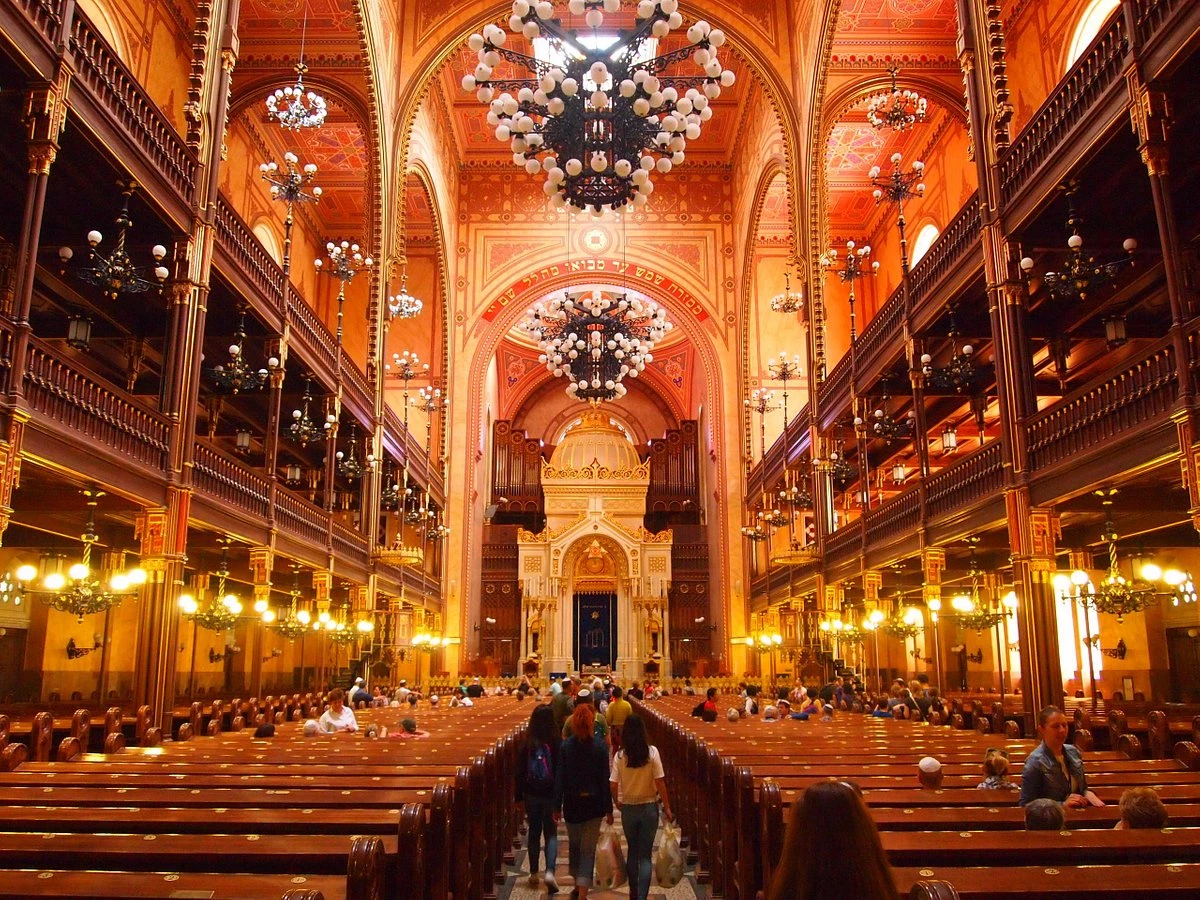
Jewish Quarter tour with the Dohány Synagogue
Two and a half hours on foot in the 7th district with a guide: the Dohány Street Synagogue, entry included, the Raoul Wallenberg memorial park, the Rumbach Street Synagogue designed by Otto Wagner, Király Street and the Gozsdu passage, then Dob Street, the heart of the former ghetto, ending at the Kazinczy Street Synagogue. The highlight: the interior of Europe's largest synagogue, explained by a guide.
Allow from €55 per person on GetYourGuide, entry and priority access included, tours in French or English, free cancellation up to 24 hours ahead.
- 2.5 hrs
- From €55 per person, synagogue entry included (GetYourGuide price 2026)
Food tour of the Jewish Quarter and Andrássy Avenue
Two and a half hours with a food guide, starting on Kazinczy Street: two hours in the Jewish Quarter between Hungarian street food and traditional dishes in neighbourhood places, then half an hour on Andrássy Avenue, with the story of Hungarian cooking along the way. Three drinks are included, wine, beer and shots, or soft drinks. The highlight: tasting street food and tavern cooking side by side.
Allow from €69 per person on GetYourGuide, run in English, vegetarian diets catered for on request, free cancellation up to 24 hours ahead. Come hungry.
- 2.5 hrs
- From €69 per person, tastings and 3 drinks included (GetYourGuide price 2026)

Guided tour of the Buda Castle district
Two hours on foot on Castle Hill with a guide: Matthias Church, Fisherman's Bastion, the lanes of the district, a viewpoint over the Danube, the entrance to the castle caves, the funicular and then the Royal Palace, with Hungarian legends and history along the way. The highlight: a slice of Dobos cake, a Hungarian cake from the late 19th century, tasted during the tour.
Allow from €20 per person on GetYourGuide, run in English, free cancellation up to 24 hours ahead. Entry to the monuments is not included.
- 2 hrs
- From €20 per person, slice of cake included (GetYourGuide price 2026)

A day at the Széchenyi Baths
A full or half day at Budapest's most famous baths: the three large heated outdoor pools, one of them for swimming, then the indoor thermal pools, saunas and steam rooms. The highlight: regulars playing chess in the hot water outdoors, even in winter when steam rises from the pools.
Allow HUF 13,200 on weekdays and HUF 14,800 Friday to Sunday (official 2026 prices, with locker), or HUF 10,500 with the "Good morning" ticket before 9 am on weekdays. Buy your ticket on the baths' official website, and bring a swimsuit, towel and flip-flops.
- Half day to full day
- HUF 13,200 to 15,800 per adult with locker (official 2026 price)
Getting there
Budapest Ferenc Liszt Airport (BUD) is linked to the center by bus 100E (Deák Ferenc tér, 24/7, 2,500 HUF ticket).
Budapest is served by Ferenc Liszt Airport (BUD), about 16 km southeast of the center.
- Bus 100E (Airport Express): direct link between the airport and Deák Ferenc tér, in the heart of the city, 24/7, in about 40 minutes. A dedicated 2,500 HUF ticket is required — standard BKK tickets are not valid.
- Bus 200E + metro M3: bus 200E reaches Kőbánya-Kispest station, from where metro M3 runs into the center (a standard BKK single ticket is valid on the 200E).
From France, several daily direct flights link Paris and other major cities to Budapest. By train, the city is also reachable from Vienna in under 3 hours.
Getting around
The BKK network (metro M1-M4, trams, buses) covers the whole city; a single ticket costs 500 HUF bought in advance.
The public transport network, run by BKK, is dense and efficient.
- Metro: four lines (M1, M2, M3, M4). Line M1, a UNESCO site opened in 1896, is the oldest electrified underground on the European continent.
- Trams: lines 4 and 6 are among the busiest in Europe; tram 2, along the Danube, runs past the Parliament.
- Buses: an extensive network complementing the metro and tram.
A single ticket costs 500 HUF bought in advance (machine or the BudapestGO app) versus 700 HUF on board (since 1 June 2025). The center is easily explored on foot.
What to do
On the Buda side, the castle, Fisherman's Bastion and Gellért Hill; on the Pest side, the Parliament, the Dohány Synagogue and the Great Market Hall; in the evening, a Danube cruise, the baths or the ruin bars.
Spend one day in Buda: Castle Hill, Fisherman's Bastion, Matthias Church, then Gellért Hill and the Cave Church. The other day goes to Pest: the Parliament in the morning with a booking, the Jewish Quarter and Dohány Synagogue, the Great Market Hall, Andrássy Avenue up to the Opera and Heroes' Square.
In the evening, three classics: a Danube cruise when the monuments are lit up, a soak at Széchenyi (open until 10 pm on Fridays) or a round of the 7th district's ruin bars. To extend the trip, Vienna is less than 3 hours away by train.
Food
Hungarian cuisine is rich and paprika-spiced: goulash, lángos and kürtőskalács are its emblems.
Hungarian cuisine is hearty and marked by paprika. Must-tries:
- Goulash (gulyás): a paprika beef soup-stew, the national dish.
- Lángos: fried dough flatbread, usually topped with sour cream and grated cheese — a typical market snack.
- Kürtőskalács: a "chimney cake" baked on a spit and rolled in sugar.
The Great Market Hall and historic cafes such as the New York Café are excellent starting points to discover local flavors.
Itineraries
Day 1: Buda and the castle; day 2: Pest, the Parliament and the Jewish Quarter; day 3: the baths, Heroes' Square and Margaret Island.
Day 1: Buda
Up to the castle by funicular from the Chain Bridge, Fisherman's Bastion and Matthias Church in the morning, then the National Gallery or the lanes of the castle district. In the late afternoon, Gellért Hill and sunset from the Citadel, then a night cruise on the Danube.
Day 2: Pest
The Parliament visit with a booking, tram 2 along the Danube to the Great Market Hall for lunch, then the Dohány Synagogue and the Jewish Quarter. Evening in the ruin bars around Szimpla Kert.
Day 3: baths and parks
A morning at the Széchenyi Baths ("Good morning" ticket before 9 am), Heroes' Square and City Park, then back down Andrássy Avenue to the Opera. End the day on Margaret Island with its musical fountain.
Climate & seasons
When to go to Hungary?
Monthly averages over the past 5 years (Open-Meteo).
Best months
- March
- April
- June
- July
- August
- September
- October
Avoid
- December
| Jan | Feb | Mar | Apr | May | Jun | Jul | Aug | Sep | Oct | Nov | Dec | |
|---|---|---|---|---|---|---|---|---|---|---|---|---|
| Our take | ||||||||||||
| Weather | ||||||||||||
| High | 6° | 8° | 13° | 16° | 21° | 28° | 30° | 29° | 23° | 17° | 9° | 5° |
| Rain (mm) | 37 | 27 | 41 | 59 | 83 | 49 | 55 | 58 | 66 | 45 | 60 | 56 |
| City sightseeing | City sightseeing March | City sightseeing April | City sightseeing May | City sightseeing June | City sightseeing July | City sightseeing August | City sightseeing September | City sightseeing October |
What to do by season (autumn)
-
City sightseeing
Pedestrian-friendly most of the year.
When to go
Spring (April-May) and autumn (September-October) are the best times: mild weather and moderate crowds.
Spring (April-May) and autumn (September-October) offer the best balance: pleasant temperatures, moderate crowds and reasonable prices.
Summer (June-August) is hot and very touristy, ideal for open-air festivals, Danube cruises and the baths' outdoor pools. Winter (December-February), cooler, charms with its Christmas markets and remains perfect for the thermal baths, open all year: the contrast between warm water and cold air is striking. July and August are the busiest months.
Budget
Budapest remains one of Europe's most affordable capitals; you pay in forints (HUF), not euros. 2026 benchmarks: Széchenyi from HUF 13,200, transport ticket HUF 500.
Hungary uses the forint (HUF), not the euro; use ATMs or pay by card in forints rather than in euros, which are often converted at a poor rate.
- Transport: single ticket HUF 500 bought in advance, HUF 700 on board; airport bus 100E HUF 2,500.
- Széchenyi Baths: HUF 13,200 on weekdays (Monday-Thursday) and HUF 14,800 Friday to Sunday, HUF 15,800 at peak times (official 2026 prices, with locker).
- Activities on GetYourGuide (2026): night cruise from €14, Buda Castle tour from €20, food tour from €69.
Budapest remains cheaper overall than Western European capitals, especially for food and accommodation, but check the bill: many restaurants add a service charge.
Where to stay
Central Pest (Belváros-Lipótváros) and the Jewish Quarter (Erzsébetváros) are the most convenient bases for visiting Budapest.
The choice of neighborhood depends on your travel style:
- Central Pest (Belváros-Lipótváros): near the Danube and Parliament, ideal for a first visit, with restaurants and shops close by.
- Jewish Quarter (Erzsébetváros): lively nightlife, ruin bars and a cultural scene, for those who want to go out.
- Castle District (Várkerület), on the Buda side: medieval atmosphere, quiet alleys and city views.
- Gellért Hill: more peaceful, with panoramas, while staying close to the sights.
Safety
Budapest is a safe city; the main thing to watch for is pickpockets on public transport and in tourist areas. Emergencies: 112.
Budapest is generally a safe city, including at night. The main risks are pickpockets on crowded public transport, in markets and in the busiest tourist areas.
A few useful precautions: use only official taxis or apps such as Bolt, beware of bars that tout for customers in the street (inflated bills), and tap water is safe to drink. Useful numbers in Hungary: European emergency number 112, police 107, ambulance 104, fire brigade 105.
Formalities
Hungary is in the Schengen Area: EU citizens enter with a valid ID card or passport, no visa needed.
Hungary is part of the European Union and the Schengen Area (since 21 December 2007 for land borders). French and other EU nationals enter with just a valid national ID card or passport, with no visa or residence formalities for a short stay.
Non-EU travellers fall under the Schengen rule of 90 days in any 180-day period. Since 10 April 2026, the EES Entry/Exit System records their biometric data at Schengen's external border, for example at Budapest Airport on a flight from outside Schengen. The ETIAS travel authorisation is not in service yet and no launch date has been set (September 2026). Neither EES nor ETIAS applies to EU citizens. The currency is still the forint (HUF); Hungary has not adopted the euro.
Tips
Buy transport tickets in advance, bring a swimsuit and flip-flops for the baths, and keep some forint in cash.
- Transport: buy tickets in advance (500 HUF) or use the BudapestGO app; always validate them.
- Thermal baths: bring a swimsuit, towel and flip-flops; a swim cap may be required in the lap pools.
- Money: pay in forint rather than euros; keep some cash for small markets.
- Tipping: about 10-15% in restaurants. Since 2024 many venues add a "szervizdíj" (service charge) of 10-15%: check the bill before leaving an extra tip.
FAQ
Answers to common questions about money, entry rules, the baths and getting around Budapest.
What currency is used in Budapest?
The forint (HUF): Hungary has not adopted the euro. Withdraw from ATMs or pay by card in forints rather than euros, which are often converted at a poor rate. 2026 benchmarks: a single transport ticket costs HUF 500 bought in advance, a day at Széchenyi HUF 13,200 on weekdays and HUF 14,800 at weekends.
Do I need a visa or an ETIAS?
Not for EU citizens: Hungary is in the Schengen Area and a valid national ID card or passport is enough. Non-EU travellers fall under the 90-in-180-days rule and have been registered by EES at the external border since 10 April 2026. The ETIAS travel authorisation is not in service yet and no launch date has been set (September 2026).
Are the thermal baths open all year?
Yes for Széchenyi, whose heated outdoor pools stay open in winter, as well as Rudas and Lukács. The Gellért Baths have been closed since 1 October 2025 for renovation, with reopening expected in 2028. Bring a swimsuit, towel and flip-flops; a swimming cap may be required in the lap pools.
When is the best time to visit?
Spring (April-May) and autumn (September-October) offer the best balance: pleasant temperatures, moderate crowds and reasonable prices. Summer is hot and very busy; winter is cold but brightened by the Christmas markets and ideal for the baths.
How do I get from the airport to the centre?
Ferenc Liszt Airport (BUD) is about 16 km south-east of the centre. Bus 100E links the airport with Deák Ferenc Square around the clock in about 40 minutes, with a dedicated HUF 2,500 ticket. Cheaper: bus 200E to Kőbánya-Kispest, then metro M3, on standard BKK single tickets.
Do I need to book the Parliament visit?
Yes: visits run on timed slots with an audioguide, and tickets on the official ticketing site (jegymester.hu) often sell out several days ahead. EEA nationals get a reduced price.
Is tap water safe to drink?
Yes, tap water is safe and meets European Union standards.
Should I tip?
Allow about 10 to 15% in restaurants, unless the bill already includes a "szervizdíj" (service charge) of 10 to 15%, which many places add automatically: check before leaving an extra tip.
Sources
The figures in this guide come from the sources below, checked on the publication date.
Leave a comment
Share your thoughts or travel experience. Your email will not be published.