

Contents 21
Giethoorn is a village in the province of Overijssel, in the Netherlands, about 5 km south-west of Steenwijk. Its historic centre has no roads: you get around by electric whisper boat, on foot along the Binnenpad path or by bike, between thatched farmhouses and wooden bridges, on the edge of the Weerribben-Wieden National Park.
The village receives around one million visitors a year: weekday mornings, spring and autumn remain the quietest times. This guide gathers its main sights, three ways to see it from the water, then access, budget and formalities.
Overview
Giethoorn is a car-free village in the province of Overijssel, Netherlands, nicknamed the "Venice of the North" for its canals, thatched-roof houses and wooden bridges.
Giethoorn is a village in the Netherlands located in the province of Overijssel, about 5 km southwest of Steenwijk. Its historic centre has no roads: you get around by electric boat, on foot along the Binnenpad path, or by bike. This feature has earned it the nickname "Venice of the North."
The village stretches along canals lined with thatched-roof houses linked by wooden bridges, on the edge of the Weerribben-Wieden National Park. It draws around one million visitors a year, mostly in summer. To enjoy its calm, it is best to come on weekdays, early in the morning, or off-season (spring and autumn).
6 places to take with you
In the guide's order, ready for Google Maps or your GPS.
Book the activities from this guide
Our picks for Giethoorn, well rated and free to cancel.
-
Book this activity
Narrated cruise through the village and the national park
from €9 per person (GetYourGuide price 2026)
-
Book this activity
Day trip from Amsterdam with a boat ride
from €68 per person (GetYourGuide price 2026)
Affiliate links: Travel Advice earns a commission if you book, at no extra cost to you. Learn more

The Dorpsgracht, the village's main canal
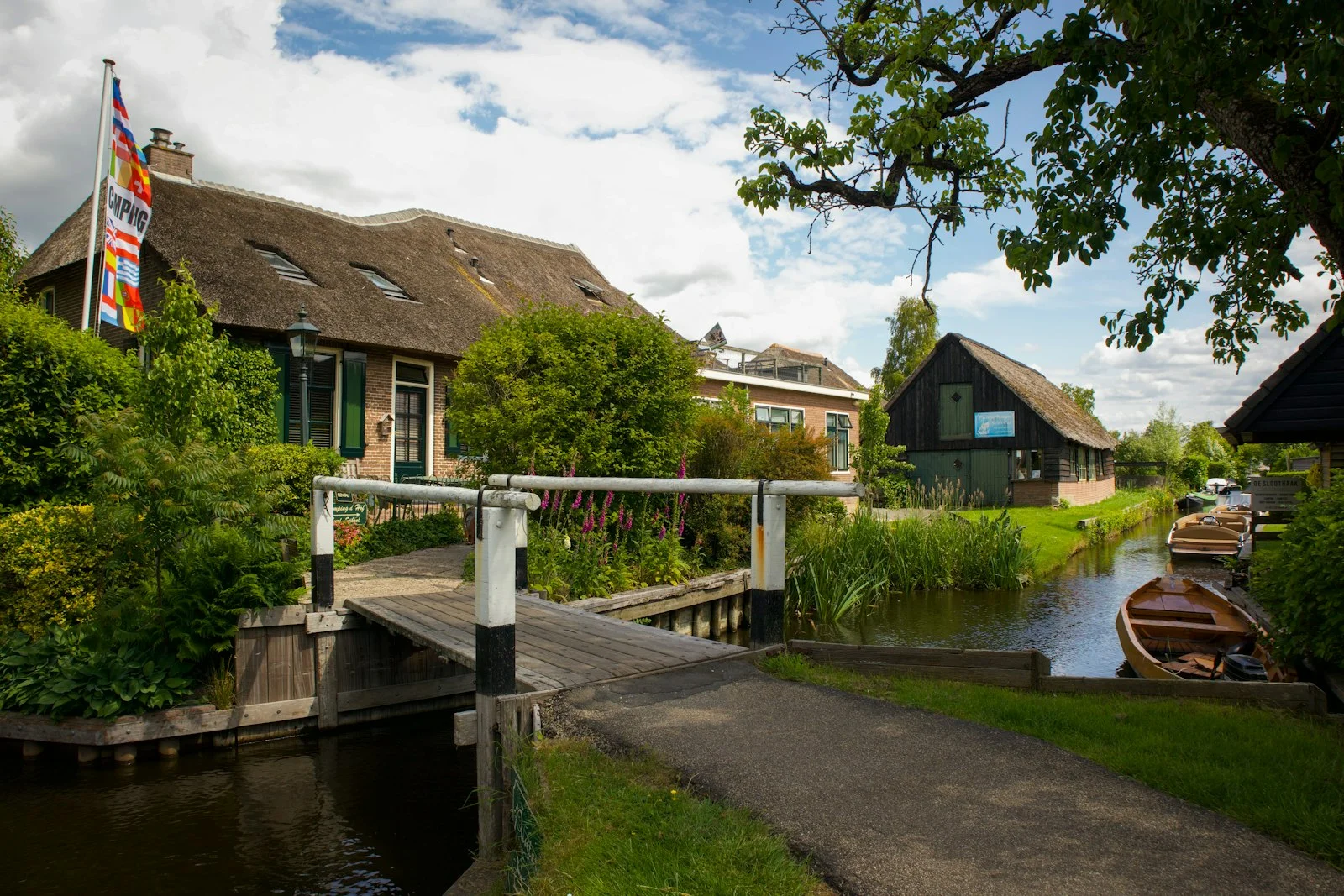
The Dorpsgracht is the canal that runs through old Giethoorn from north to south. The thatched farmhouses, each on its own islet, are linked only by wooden bridges and by water: this is the landscape that earned the village its nickname, the "Venice of the North".
You travel along it in a whisper boat, a small silent electric boat that needs no licence, or on a cruise narrated by a skipper. From the water you see the gardens and façades that the footpath does not pass, then the side-channels heading towards the Weerribben-Wieden park.

Weerribben-Wieden National Park
Weerribben-Wieden National Park covers more than 10,000 hectares around Giethoorn: it is the largest continuous lowland peat bog in north-western Europe. Its marshes, reed beds, ponds and woods were created by centuries of peat cutting; Weerribben National Park was established in 1992, then extended to the Wieden in 2009.
The otter, reintroduced, has become its emblem, alongside the black tern and the rare large copper butterfly. You explore it by canoe, by boat, by bike or on foot: the Weerribben section to the north suits footpaths, the Wieden to the south its large lakes.

The Binnenpad, the path along the canals
The Binnenpad is the footpath that follows the canal through old Giethoorn. It passes the thatched farmhouses, crosses the wooden bridges leading to the houses and links the two museums, the cafés and the boat-hire firms, with no cars at all.
The walk is free and takes one to two hours. By bike, you then leave the village on the cycle paths that follow the canals towards the Weerribben-Wieden park or Wanneperveen; several shops hire out bikes, some of them electric.

Giethoorn Museum 't Olde Maat Uus
The Giethoorn Museum 't Olde Maat Uus occupies an old farmhouse on the Binnenpad, at number 52. It tells the story of village life when everything travelled by water: peat cutting, building flat-bottomed boats, and farmhouse interiors with their furniture and tools.
The visit is with an audio guide. Entry costs €7.50 for an adult and €2.50 for a child aged 4 to 12 (prices valid until 31 December 2026).

Blokzijl and the nearby villages
Blokzijl, about 9 km west of Giethoorn, is a former Zuiderzee port with merchants' houses lined up around a harbour basin and a lock. It is the easiest outing by bike, on the paths across the Wieden.
Closer by, Wanneperveen, about 3 km south-east, stretches along the lakes. Vollenhove, a former merchant town, and Steenwijk, where the trains arrive, round off a one-day loop by bike or car.

De Oude Aarde, mineral museum
De Oude Aarde ("the Old Earth") is a museum of minerals, gemstones and fossils that opened in 1969 at Binnenpad 43, beside the canal. It is the village's oldest museum: a collection on public display, combined with a shop selling polished stones and minerals.
The visit takes half an hour and fits easily into a walk along the Binnenpad, for example with children or on a rainy day.
Canoe or kayak in the canals and the park
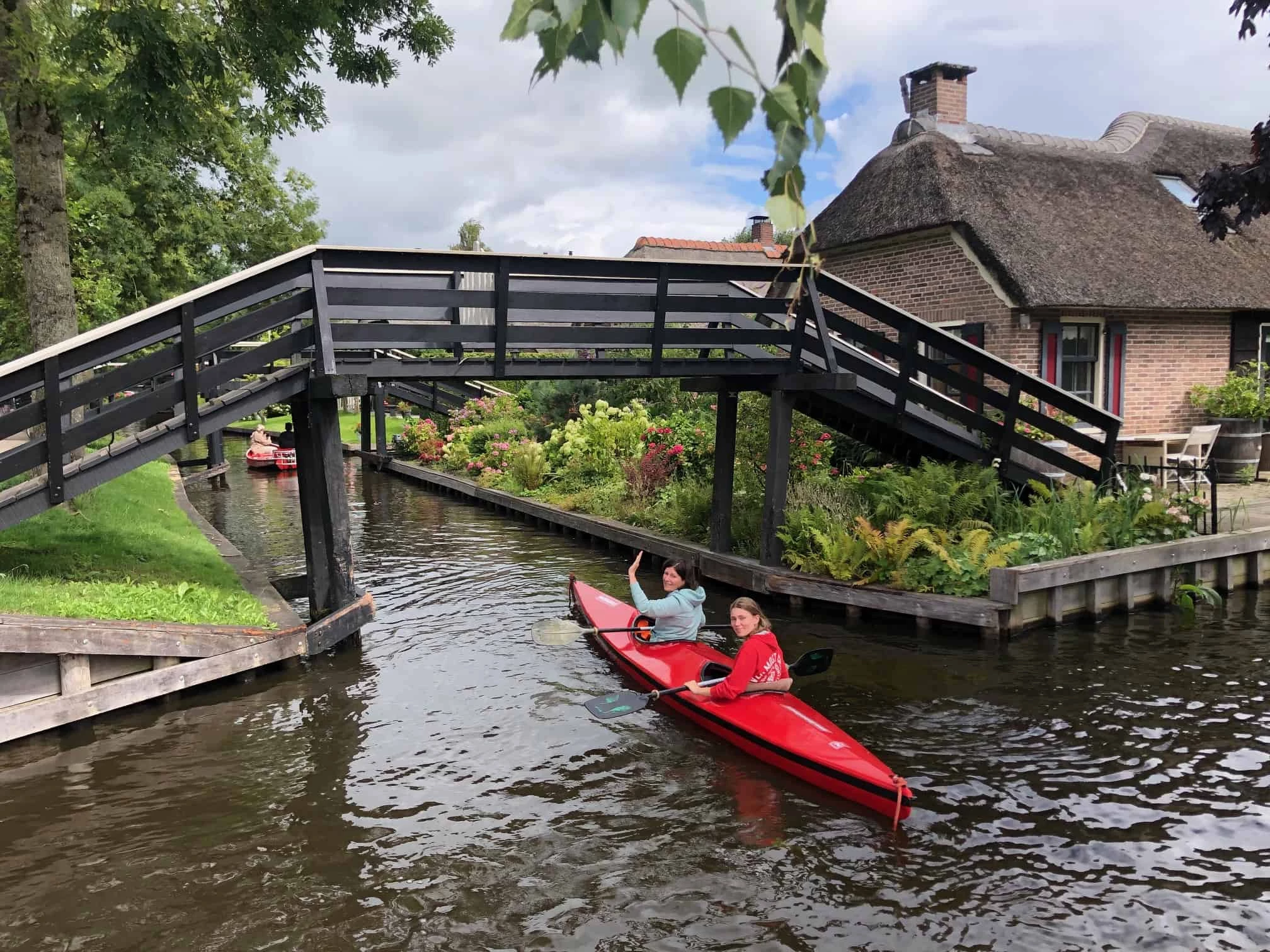
A canoe goes where electric boats cannot: the village's narrow side-channels, then the channels between the reed beds of Weerribben-Wieden park. You paddle at your own pace, on a short loop around the village or on a half-day trip to the lakes. The highlight: the silence of the channels, a few hundred metres from the Dorpsgracht.
Giethoorn's rental firms offer one- and two-seat canoes and kayaks, with a route map; book ahead in high season. No experience is needed and a life vest is provided.
- 2 hrs to a full day
- Hire on site, price set by each operator

Narrated cruise through the village and the national park
An hour on an electric boat with a local skipper: Giethoorn's maze of canals, the story of the farmhouses and peat cutters, then a stretch along Weerribben-Wieden park. Coffee, tea or lemonade is served on board. The highlight: leaving the narrow canals for the park's reed beds.
Allow from €9 per person on GetYourGuide, with free cancellation up to 24 hours before. Commentary in Dutch, German and English; free parking at the P1 car park in the centre.
- 1 hr
- from €9 per person (GetYourGuide price 2026)
Day trip from Amsterdam with a boat ride
An air-conditioned coach leaves Amsterdam for Giethoorn, with the driver's commentary on the way. On site, a boat ride on the canals, then free time to walk the Binnenpad and have lunch. The highlight: crossing the village by water, between the wooden bridges.
Allow from €68 per person on GetYourGuide, with free cancellation up to 24 hours before. Handy without a car; by train and bus, the trip is also possible on your own for less.
- 8 hrs
- from €68 per person (GetYourGuide price 2026)
Skipper a whisper boat yourself
A whisper boat is an electric boat for four to seven people that you drive without a licence: you are handed a map, then follow the Dorpsgracht, the small canals and, if time allows, nearby Bovenwijde lake at your own pace. The highlight: switching off the motor in the middle of a canal, with nothing but the sound of water.
Rental firms line the canals and charge per boat, not per person: in a group, it is the cheapest option. Book a morning slot in summer and take a boat for at least two hours.
- 1 hr to a full day
- from about €35 for 2 hrs per boat (village rental firms, 2026)
Getting there
From Amsterdam, take a train to Steenwijk (~1h40-2h), then bus 70 (EBS) to Giethoorn (~15 min); one way takes about 2 to 2.5 hours.
By train + bus (from Amsterdam): train to Steenwijk station (about 1h40 to 2h depending on the connection, often via Zwolle or Almere), then bus 70 (EBS company) to Giethoorn (about 15 min). Allow around 2 to 2.5 hours each way. From April to October, a seasonal line 270 "Giethoorn Express" also runs.
By car: as the centre is car-free, you park in the lots on the edge of the village, then continue on foot or by boat.
At about 2 to 2.5 hours each way, Giethoorn works as a day trip from Amsterdam; leave early to get ahead of the day-trippers.
Getting around
Giethoorn's centre is car-free: you travel by electric whisper boat, on foot along the Binnenpad path, or by bike to reach the surroundings.
By boat: the most iconic way to discover Giethoorn. Electric whisper boats need no licence; you can also choose a canoe, a kayak, or a guided cruise for a narrated tour.
On foot: the Binnenpad pedestrian path runs along the main canal and is free to walk; it lets you cross the wooden bridges and reach cafés and museums without a boat.
By bike: to explore beyond the centre — Weerribben-Wieden park and nearby villages such as Wanneperveen and Steenwijk. Several rental shops offer bikes, sometimes electric.
What to do
Travel the Dorpsgracht by electric boat, walk the Binnenpad, visit the 't Olde Maat Uus museum, then paddle or cycle in Weerribben-Wieden park.
A typical day starts on the water: an hour or two in a whisper boat or on a narrated cruise along the Dorpsgracht, before the coaches arrive. Carry on on foot along the Binnenpad, with the 't Olde Maat Uus farmhouse museum and the De Oude Aarde mineral museum.
Spend the afternoon in Weerribben-Wieden park, by canoe along the channels or by bike towards Blokzijl and Wanneperveen. In winter, if the cold lasts, the frozen canals can be skated; this does not happen every year.
Climate & seasons
When to go to Netherlands?
Monthly averages over the past 5 years (Open-Meteo).
Best months
- June
- August
- September
| Jan | Feb | Mar | Apr | May | Jun | Jul | Aug | Sep | Oct | Nov | Dec | |
|---|---|---|---|---|---|---|---|---|---|---|---|---|
| Our take | ||||||||||||
| Weather | ||||||||||||
| High | 6° | 8° | 11° | 13° | 17° | 21° | 22° | 22° | 20° | 15° | 10° | 7° |
| Rain (mm) | 89 | 77 | 53 | 74 | 73 | 72 | 106 | 70 | 70 | 107 | 88 | 81 |
| Hiking & nature | Hiking & nature April | Hiking & nature May | Hiking & nature June | Hiking & nature July | Hiking & nature August | Hiking & nature September | Hiking & nature October | |||||
| City sightseeing | City sightseeing March | City sightseeing April | City sightseeing May | City sightseeing June | City sightseeing July | City sightseeing August | City sightseeing September | City sightseeing October | ||||
| Winter sports | Winter sports January | Winter sports December |
What to do by season (autumn)
-
Hiking & nature
Mild temperatures, stable conditions.
-
City sightseeing
Pedestrian-friendly most of the year.
When to go
Spring and autumn, as well as weekday mornings, offer Giethoorn's charm without the crowds; summer is the busiest season.
Spring (March-May): lush scenery and peaceful canals, ideal for avoiding the summer crowds and enjoying mild weather by boat or bike.
Summer (June-August): the liveliest and warmest season, but also the busiest (the village receives around one million visitors a year). Favour early morning or evening.
Autumn (September-November): fewer people, golden colours reflecting in the water, weather still pleasant for walks.
Winter (December-February): the quietest season. If the canals freeze hard enough, you can skate on them — but this depends on the cold and is not guaranteed every year.
Recommendation: spring and autumn, or weekday mornings, for the village's charm without the crowds.
Budget
The Binnenpad is free; allow from about €35 for two hours of whisper boat (per boat), from €9 for a narrated cruise and €7.50 for the 't Olde Maat Uus museum.
Walking the Binnenpad and crossing the bridges costs nothing. On the water, whisper boat hire starts at around €35 for two hours at some of the village's firms, priced per boat rather than per person; a one-hour narrated cruise starts at €9 per person. The 't Olde Maat Uus museum costs €7.50 per adult and €2.50 per child in 2026.
The organised day trip from Amsterdam starts at €68; by train to Steenwijk then bus, the journey costs less. Sleeping beside the canals costs noticeably more than in the neighbouring villages.
Where to stay
Along the Dorpsgracht canal for immersion, in the north for quiet and nature, in the south for easier car access, or in Wanneperveen (~3 km) for tranquillity.
Giethoorn-Centre (Dorpsgracht): in the heart of the village, along the main canal, among the thatched-roof houses, with direct access to restaurants, shops and boat rentals. Ideal for full immersion or a romantic stay (B&Bs, hotels with canal views).
Giethoorn-North: quieter and surrounded by nature, perfect for exploring by bike or canoe away from the bustle (cottages, waterfront houses).
Giethoorn-South: closer to the roads and car parks, often a little cheaper and convenient for travellers by car (modern hotels, guesthouses).
Wanneperveen: a neighbouring village about 3 km away, a quiet alternative with fine views over Weerribben-Wieden park (gîtes, nature lodges).
Safety
Giethoorn is a safe village; the main risk is falling into the water. Emergency number in the Netherlands: 112 (police, fire, ambulance).
The village poses no particular risk for travellers. Accidents mostly involve the water: banks without railings, and narrow bridges that are slippery in wet weather. Put children in a life vest on board and never exceed the capacity shown on the boat.
In an emergency, dial 112 (police, fire, ambulance). To reach the police in a non-emergency, the number is 0900-8844. On the ice in winter, only skate when residents and the municipality allow it.
Formalities
The Netherlands is part of the Schengen Area: no visa for EU/EEA/Swiss nationals, and 90 days within 180 visa-free for many non-EU travellers.
The Netherlands is part of the Schengen Area. Citizens of the EU, EEA and Switzerland need no visa and travel freely with a valid identity card or passport.
Many non-EU nationals (United States, Canada, United Kingdom, etc.) can stay visa-free for up to 90 days in any 180-day period; other nationalities must apply for a Schengen short-stay visa.
An ETIAS travel authorisation (about €20, free for under-18s and over-70s) is expected for visa-exempt non-EU travellers: it is not yet in service and no launch date has been set (September 2026). Check the status on the official EU website before you leave. Since 10 April 2026, the European Entry/Exit System (EES) also records at the border the fingerprints and photo of non-EU short-stay travellers. No specific vaccines are required.
Tips
Arrive early in the morning or on weekdays to beat the crowds, walk the Binnenpad for free, and book your boat in advance in high season.
- Beat the crowds: with around one million visitors a year, the village is very busy in summer; come early in the morning, on weekdays, or off-season.
- No boat required: the Binnenpad path and wooden bridges can be walked for free.
- Book in high season: boat rentals and guided tours can sell out at peak hours.
- Keep the village quiet: the electric whisper boats are silent by design — respect the calm of the place.
- Safety on the water: wear a life jacket, especially with children or if you are a weak swimmer.
FAQ
How to get there, when to go, how long to stay, and whether you can visit Giethoorn without a boat: the essentials in short answers.
How do I get to Giethoorn from Amsterdam?
Take a train from Amsterdam to Steenwijk station, about 1h40 to 2 hours depending on the connection, often via Zwolle or Almere, then bus 70 run by EBS to Giethoorn, roughly 15 minutes. Allow 2 to 2.5 hours each way in total. From April to October, a seasonal route 270, the Giethoorn Express, also runs. By car, since the centre is car-free, you park in the car parks on the edge of the village and continue on foot or by boat.
Can you visit Giethoorn as a day trip from Amsterdam?
Yes. At 2 to 2.5 hours each way from Amsterdam, it is a very common day trip, by train to Steenwijk then bus 70. Leave early to get ahead of the day-trippers: the village draws around a million visitors a year, mostly in summer, and fills up by mid-morning. Half a day to a full day covers the canals, a boat trip, the Binnenpad path and a museum. Staying overnight, on the other hand, lets you enjoy the village once the coaches have gone.
What is the best time to visit?
Spring and autumn, or weekday mornings, to avoid the crowds. From March to May the landscape is green and the canals peaceful; from September to November golden colours reflect in the water with still-pleasant weather. Summer, June to August, is the liveliest season but also the busiest, with the village drawing around a million visitors a year: aim for early morning or the evening then. Winter is quietest, and if the canals freeze hard enough you can skate on them.
How long should I plan to spend?
Half a day to a full day covers the essentials: the canals, a trip on an electric whisper boat, the Binnenpad walking path along the main canal with its wooden bridges, and a museum. An overnight stay changes the experience, letting you enjoy the village once the day-trippers have gone and it settles back into quiet. By bike, add another day to explore beyond the centre, towards the Weerribben-Wieden national park and neighbouring villages such as Wanneperveen.
Can you visit without renting a boat?
Yes. The Binnenpad walking path runs along the main canal and is free to follow, crossing the wooden bridges, which gets you to the cafés and museums without boarding anything. A bike opens up the hinterland, towards the Weerribben-Wieden park and neighbouring villages, with several rental outfits on site, some offering e-bikes. The boat remains the most iconic way to see Giethoorn: electric whisper boats need no licence, and canoes, kayaks or guided cruises round out the choice. Iconic, but not compulsory.
Is it free to walk around the village?
Yes. Strolling the Binnenpad and crossing the wooden bridges costs nothing: the walking path follows the main canal and reaches the cafés and museums. Boat rentals, guided cruises and museum entry are paid. In high season, book boat rentals and guided tours, which sell out at peak times. On the water, wear a life jacket, especially with children, and respect the quiet: the electric whisper boats are silent by design, and that is part of the village's appeal.
Is Giethoorn dog-friendly?
Yes. Dogs are generally welcome on the electric whisper boats, except the cushioned deluxe sloops, as well as on the paths and most terraces. The Binnenpad, free and car-free, suits a walk with a dog particularly well, as do the cycle paths around the Weerribben-Wieden park. Check the terms with the rental operator when you book, as they vary from boat to boat. On the water, keep your dog inside the craft and wear a life jacket yourself.
Is the village really car-free?
Yes, literally: the historic centre has no roads. You move around by electric boat, on foot along the Binnenpad path or by bike, between thatched houses linked by wooden bridges. That quirk earned the village its nickname, the Venice of the North. Cars stay in the car parks on the outskirts, from where you continue on foot or on the water. The village stretches along the edge of the Weerribben-Wieden national park, in Overijssel province, about 5 km south-west of Steenwijk.
Sources
The figures in this guide come from the sources below, checked on the publication date.
Leave a comment
Share your thoughts or travel experience. Your email will not be published.