

Contents 24
Founded by Peter the Great in 1703 on the Neva delta, Saint Petersburg was the capital of the Russian Empire for two centuries. Its historic centre and the imperial residences around it have been a UNESCO World Heritage Site since 1990. This guide covers 11 sites, from the Hermitage to the Peterhof and Pavlovsk palaces, followed by practical information.
Warning: France Diplomatie formally advises against travel to Russia (page updated on 10 September 2026). Read the safety and formalities sections before making any plans.
Overview
Imperial capital from 1712 to 1918, Saint Petersburg is Russia's great museum city, listed by UNESCO; France Diplomatie formally advises against travel to Russia.
Founded by Peter the Great in 1703 on the banks of the Neva, Saint Petersburg was the capital of the Russian Empire from 1712 to 1918. Nicknamed the 'Venice of the North' for its canals and bridges, it lines up baroque and neoclassical palaces, broad avenues and pastel facades.
Its historic centre and the imperial residences around it (Peterhof, Tsarskoye Selo, Pavlovsk) have been a UNESCO World Heritage Site since 1990. The city holds some of the country's great cultural institutions, starting with the Hermitage and the Mariinsky Theatre.
Read the safety section first: France Diplomatie formally advises against travel to Russia.
11 places to take with you
In the guide's order, ready for Google Maps or your GPS.

The Hermitage Museum and the Winter Palace
Founded in 1764 by Catherine II, the Hermitage occupies a group of buildings along the Neva, including the Winter Palace, formerly the tsars' main residence, on Palace Square. Its collections range from Antiquity to European painting (Rembrandt, Leonardo da Vinci, the Flemish and Italian schools) and the imperial state rooms.
The museum is closed on Mondays and stays open late on Wednesdays and Fridays. Entry works with timed slots, so booking ahead helps.

Church of the Saviour on Spilled Blood
Built from 1883 to 1907 on the orders of Alexander III, the church stands on the Griboyedov Canal, on the spot where his father, Tsar Alexander II, was fatally wounded in an assassination in March 1881, hence its name. Its colourful onion domes follow the old Russian style.
The interior is covered with about 7,500 m² of mosaics. Closed in Soviet times and later restored, the church is now a museum run together with St Isaac's Cathedral.

Peterhof Palace and Gardens
Founded by Peter the Great in the early 18th century on the Gulf of Finland, some thirty kilometres west of the centre, Peterhof brings together the Grand Palace, the Lower Park and the Grand Cascade with its fountains and gilded statues. The fountains run by gravity, without pumps.
The estate also includes the Monplaisir pavilion on the shore. Peterhof is part of the UNESCO listing. The fountains only run in the warm season, from mid-May to October.

St Isaac's Cathedral
Designed by the French architect Auguste de Montferrand and completed in 1858 after some forty years of work, St Isaac's Cathedral is crowned by a gilded dome about 101 metres high. The interior combines malachite and lapis lazuli columns, mosaics and paintings.
Turned into a museum in Soviet times, it still operates mainly as a museum. The colonnade around the dome is open to visitors and looks out over the historic centre.

Catherine Palace in Tsarskoye Selo
In Tsarskoye Selo (now Pushkin), about 25 km south of the centre, the Catherine Palace was enlarged in the 18th century for Empress Elizabeth in the baroque style, then refitted under Catherine II. Its blue and white facade stretches for more than 300 metres.
The Amber Room, whose original panels disappeared during the Second World War, was recreated and reopened in 2003. The palace and its park are part of the UNESCO listing.

Peter and Paul Fortress
Founded in 1703 on Hare Island in the Neva, the fortress marks the birth of the city. Its Cathedral of Saints Peter and Paul, designed by Domenico Trezzini, holds the tombs of most Russian emperors since Peter the Great, as well as those of Nicholas II and his family, buried there in 1998.
The walls also enclose several sections of the city history museum, including the former Trubetskoy Bastion prison.

The Mariinsky Theatre
The Mariinsky's historic building, designed by Alberto Cavos, opened in 1860. Its stage premiered several of Tchaikovsky's ballets and is now home to the Mariinsky ballet and opera companies.
A second, modern hall, Mariinsky II, opened in 2013 across the Kryukov Canal. The programme alternates ballet, opera and concerts between the two stages.

Yusupov Palace
On the Moika embankment, this 18th-century palace was the residence of the Yusupov princes, one of the Empire's wealthiest families, from 1830 to 1917. It keeps its state rooms and a small private theatre.
Grigori Rasputin was murdered here in December 1916 by a group of conspirators led by Prince Felix Yusupov; an exhibition in the basement tells the story.

The Summer Garden
Laid out from 1704 for Peter the Great, between the Neva, the Fontanka and the Moika, the Summer Garden is the city's oldest garden. Its formal alleys are lined with Italian marble statues and fountains, and Peter I's small Summer Palace stands on the Neva side.
Restored in 2012, it remains a walking spot popular with locals, a few minutes on foot from the Church of the Spilled Blood and the Field of Mars.

Pavlovsk Palace
About 30 km south of the centre, Pavlovsk Palace was built from 1782 to 1786 by the architect Charles Cameron for Grand Duke Paul, the future Paul I, and his wife Maria Feodorovna. It is a neoclassical palace, more intimate than those of Peterhof or Tsarskoye Selo.
It is surrounded by a vast English-style landscape park. Badly damaged during the Second World War, it was restored after the war and is part of the UNESCO listing.

Krestovsky Island
In the Neva delta, north-west of the centre, Krestovsky Island is largely taken up by the Maritime Victory Park, with its ponds and alleys. It is also home to the Zenit Saint Petersburg stadium, built for the 2018 football World Cup.
Served by the metro (Krestovsky Ostrov station), the island suits a walk or a bike ride away from the museums of the centre.
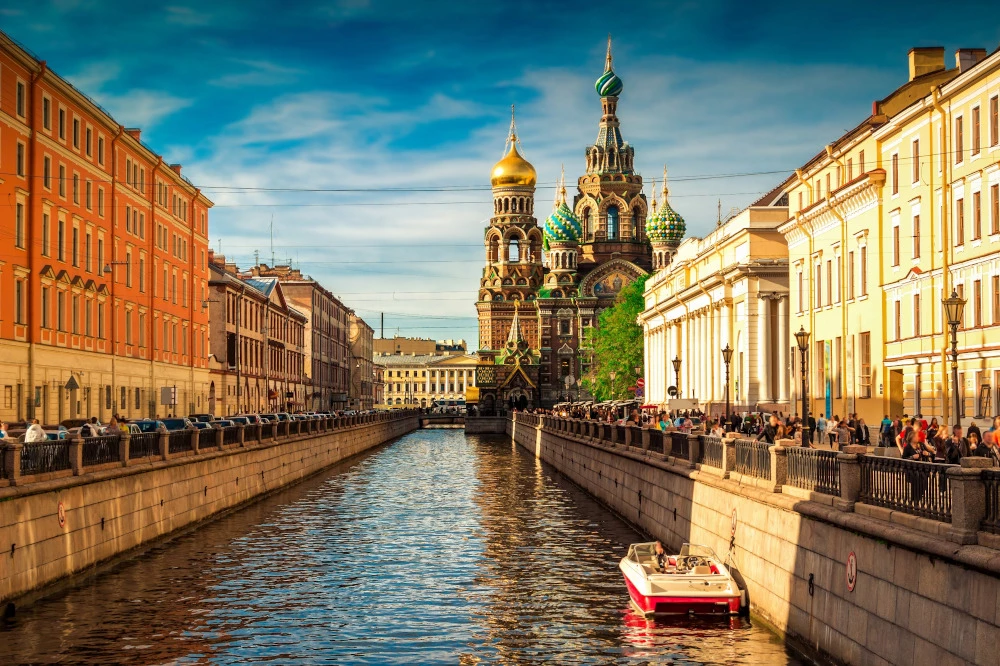
Boat trip on the Neva and the canals
Sightseeing boats leave from the Moika, Fontanka and Griboyedov Canal embankments, near Nevsky Prospekt, and follow the canals of the centre before coming out onto the Neva, opposite the Winter Palace and the Peter and Paul Fortress. Allow one to two hours depending on the route. The highlight: gliding through the narrow canals under the low bridges, then coming out onto the Neva.
The boats only run in the warm season, roughly May to September; tickets are bought at the pier, in cash. Bring a jacket, it is cool on the water.
- 1 to 2 hrs
- Tickets in cash (roubles) at the pier
Night of the raising bridges on the Neva
During the navigation season, from April to November, the Neva bridges are raised every night, one after another, to let cargo ships through between the Baltic and the Volga. Palace Bridge, between the Winter Palace and Vasilyevsky Island, draws the most spectators: watch it from the Admiralty embankment or the tip of Vasilyevsky Island, or from a night boat. The highlight: the two spans of Palace Bridge rising above the Neva during a white night.
The raising takes place at around 1 am: check the day's schedule, published by the city bridge service, and above all which side of the river you are sleeping on, as the city stays split for several hours.
- 2 hrs, around 1 am
- Free from the embankments; night boats charge a fare
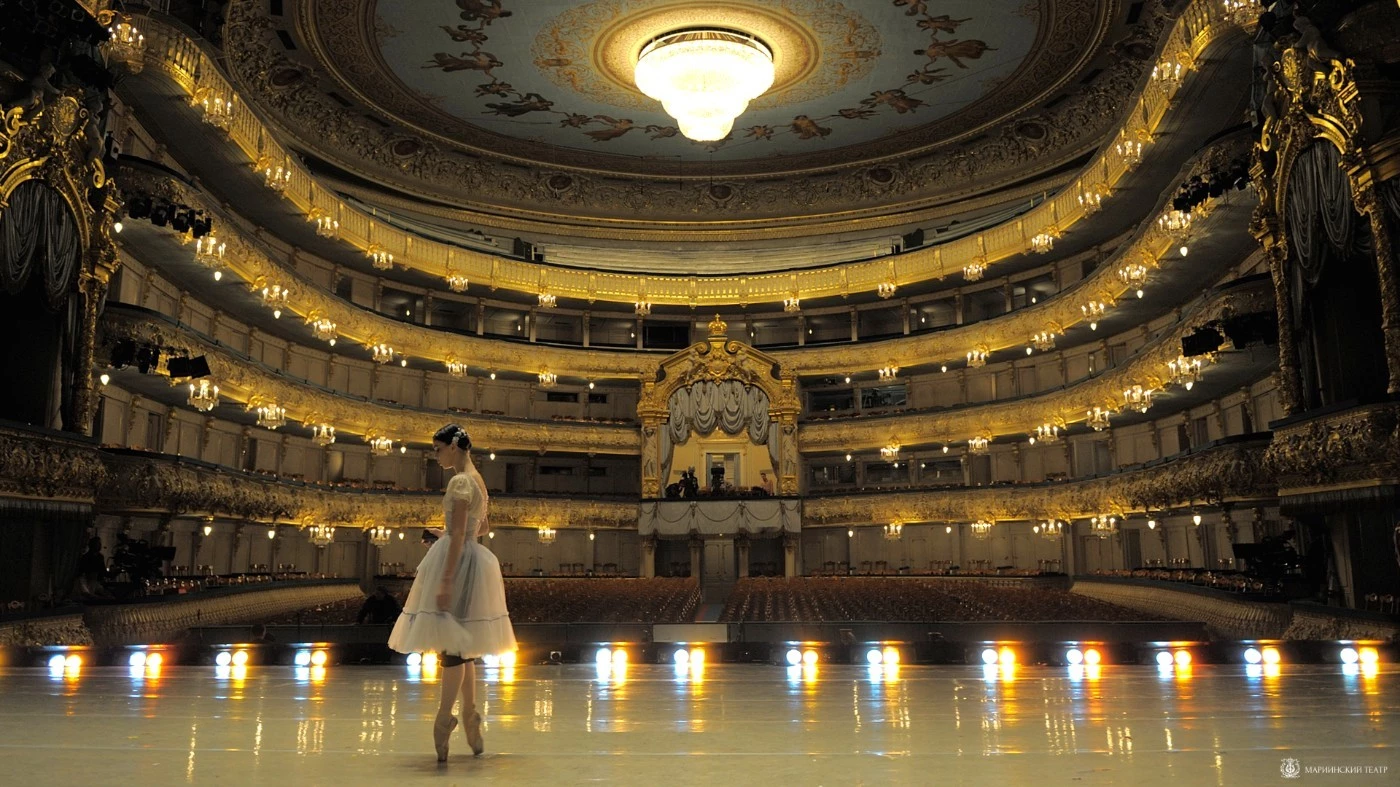
A ballet evening at the Mariinsky
The Mariinsky, where several of Tchaikovsky's ballets premiered, presents its ballet and opera companies on two stages facing each other: the historic 1860 building, with its blue and gold auditorium, and Mariinsky II, opened in 2013. A performance usually lasts two to three hours with intervals. The highlight: a Russian repertoire ballet in the historic hall.
The official box office is at mariinsky.ru and at the theatre's ticket windows; summer ballet evenings sell out early. Smart dress appreciated.
- 2 to 3 hrs
- Depends on seat and show, in roubles
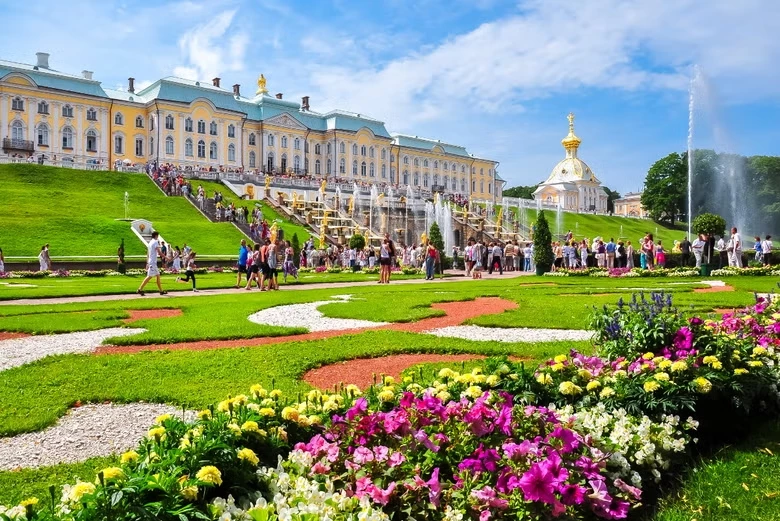
A day at Peterhof: fountains and Grand Palace
Peterhof lies some thirty kilometres west of the centre, on the Gulf of Finland. In summer, hydrofoils leave from the city-centre embankments and dock right in the Lower Park; the bus and the suburban train are cheaper. On site, the Lower Park, the Grand Cascade, the Monplaisir pavilion and the Grand Palace take a day. The highlight: the Grand Cascade and its gilded statues above the Sea Channel.
Go between mid-May and October, when the fountains run. The Lower Park and the palace have separate tickets, in roubles.
- 1 day
- Transport + park and palace tickets, in roubles
Getting there
No direct flights from the EU: a connection in a third country is required to reach Pulkovo Airport (LED), whose traffic is regularly interrupted by drones. The Finnish and Estonian borders are largely closed.
The city is served by Pulkovo Airport (LED), about twenty kilometres south of the centre, linked by bus to Moskovskaya metro station.
No direct flights from France or the European Union: since 2022 the airspace has been closed in both directions between the EU and Russia, and journeys go through a third country (Istanbul, for example). France Diplomatie notes that 21 Russian airlines are on the EU blacklist and that air traffic is regularly interrupted by the threat of drones and missiles, with closures of the Moscow and Saint Petersburg airports.
Overland, Finland and Estonia have closed most of their crossings with Russia, and the road and rail border between Belarus and Russia is closed to foreigners. From Moscow, the Sapsan high-speed train links the two cities in about 4 hours.
Getting around
The metro is fastest; buses, trams, taxis (Yandex Go, cash) and walking fill the gaps. At night, from April to November, the raised bridges split the city.
Metro: one of the deepest in the world, with decorated stations; it is the fastest way between districts. Buses, trolleybuses and trams complete the network.
Taxis: Yandex Go is the most widely used app. European bank cards do not work in Russia: pay in cash.
On foot and by boat: the historic centre is easy to explore on foot, and sightseeing boats run on the Neva and the canals in the warm season. Watch out at night during the navigation season: the Neva bridges are raised for several hours and split the city in two.
What to do
The Hermitage, St Isaac's, the Spilled Blood and the Peter and Paul Fortress on foot, a cruise or a ballet in the evening, then a day at Peterhof and one at Tsarskoye Selo and Pavlovsk.
The centre is explored on foot: the Hermitage and Palace Square, St Isaac's Cathedral and its colonnade, the Church of the Spilled Blood then the Summer Garden, and the Peter and Paul Fortress on the other bank. In the evening, a canal cruise or a ballet at the Mariinsky; during the navigation season, the raising of the bridges at around 1 am.
Keep one day for Peterhof and another for Tsarskoye Selo and Pavlovsk. This plan remains theoretical while France Diplomatie formally advises against travel (see the safety section).
Climate & seasons
When to go to Russia?
Monthly averages over the past 5 years (Open-Meteo).
Best months
- May
- June
- September
Avoid
- January
- February
- March
- November
- December
| Jan | Feb | Mar | Apr | May | Jun | Jul | Aug | Sep | Oct | Nov | Dec | |
|---|---|---|---|---|---|---|---|---|---|---|---|---|
| Our take | ||||||||||||
| Weather | ||||||||||||
| High | -3° | -3° | 3° | 9° | 15° | 22° | 24° | 22° | 17° | 9° | 3° | -2° |
| Rain (mm) | 51 | 40 | 43 | 46 | 54 | 72 | 88 | 87 | 48 | 66 | 66 | 54 |
| City sightseeing | City sightseeing May | City sightseeing June | City sightseeing July | City sightseeing August | City sightseeing September |
What to do by season (autumn)
-
City sightseeing
Pedestrian-friendly most of the year.
When to go
Summer (June-August) and its white nights is the most popular season; May and September are quieter. Winter is cold and dark, with the Peterhof fountains switched off.
Summer (June to August): high season, long days and the 'white nights' around the solstice, when it never gets completely dark. It is the season of the Peterhof fountains and boat trips, with the crowds and prices that come with it.
Spring and autumn: fewer people; the Peterhof fountains run from about May to early October and the Neva bridges are raised at night during the navigation season, from April to November. Winter (December to February): cold, very short days and fountains switched off, but quieter museums.
These pointers remain theoretical while France Diplomatie formally advises against travel (see the safety section).
Where to stay
The centre, around Nevsky Prospekt, is the most convenient; Vasilyevsky Island and the Petrograd Side are quieter, but cut off from the centre at night when the bridges are up.
Centre (Nevsky Prospekt, Palace Square): the most convenient, within walking distance of the Hermitage, St Isaac's and restaurants, with accommodation in every price range.
Vasilyevsky Island: quieter and residential, linked to the centre by metro and bridges; the Petrograd Side: calmer streets near the Peter and Paul Fortress. Note: at night during the navigation season, the raised bridges cut these two districts off from the centre.
As European bank cards do not work in Russia, paying for accommodation is an issue: check before you leave which payment method is accepted.
Safety
France Diplomatie formally advises against travel to Russia, across the whole country (updated 10 September 2026): risk of arbitrary arrest and detention, drone strikes and airport closures, including in Saint Petersburg.
France Diplomatie formally advises against travel to Russia, across the whole country (travel advice page updated on 10 September 2026). This guide describes Saint Petersburg's heritage for information only; it is not an invitation to go there.
- Arbitrary detention: the ministry warns of a risk of arbitrary arrest and detention of nationals of countries declared 'unfriendly', France among them.
- War in Ukraine: the Kursk, Belgorod, Bryansk, Voronezh and Rostov oblasts and Krasnodar Krai are the most exposed; other areas are regularly targeted by drones and missiles. Air traffic is regularly interrupted, with closures of the Moscow and Saint Petersburg airports.
- Behaviour: do not discuss political issues, especially the war in Ukraine, in public or with strangers, and stay away from demonstrations.
- Law: zero tolerance for drugs and drink-driving; the law punishes 'LGBT propaganda' with fines of up to one million roubles and, for foreigners, detention before expulsion. In Saint Petersburg, alcohol sales are banned from 10 pm to 11 am.
- Terrorism: the threat is real, as the 2024 Crocus City Hall attack near Moscow showed.
A French consulate general is open in Saint Petersburg. Single emergency number in Russia: 112 (police 102, ambulance 103, fire 101). Check France Diplomatie's Russia page before making any decision: the situation can change very quickly.
Formalities
A visa is required for French nationals: Russian consulate or the online unified e-visa (30-day stay maximum). Keep the migration card. European bank cards are refused: bring cash. Travel formally advised against.
Reminder: travel to Russia is formally advised against (see the safety section). The rules below are those of France Diplomatie's entry and stay page, updated on 15 September 2026.
Visa: required for French nationals, including in transit, to be requested from the Russian consular authorities of your country of residence (website of the Russian embassy in France). Russia also offers a unified e-visa on its official portal evisa.kdmid.ru, for nationals of a list of countries set by its government: valid for 120 days from issue, for a stay of up to 30 days and a single entry, processed within 4 days at most, with a non-refundable fee and compulsory medical insurance valid in Russia. It is only valid through the crossing points listed on the portal.
On entry: passport valid for at least 6 months after the visa expires, with two blank facing pages; a migration card is compulsory, to be kept and handed back on departure. If you overstay, you will not be allowed to leave; expulsion with a ban of up to 5 years is possible.
Money: European bank cards are no longer accepted in Russia because of sanctions. Bring euros or dollars to change into roubles at exchange offices; above USD 10,000, cash must be declared on entry, and taking out more than that amount is prohibited.
FAQ
Safety, visa, flights, payments, length of stay and white nights: answers to the most common questions about Saint Petersburg.
Can you travel to Russia right now?
France Diplomatie formally advises against travel to Russia, across the whole country (updated 10 September 2026): risk of arbitrary arrest and detention for nationals of countries deemed 'unfriendly', drone and missile strikes, airport closures.
Do you need a visa for Saint Petersburg?
Yes. French nationals apply for a visa from the Russian consular authorities or, if their nationality is on the list of the evisa.kdmid.ru portal, for a unified e-visa: 30-day stay maximum, single entry. A visa does not lift the safety warning.
Are there direct flights from France?
No. The airspace has been closed between the EU and Russia since 2022: you need a connection in a third country, Istanbul for example.
Can you pay by bank card?
No, European bank cards are no longer accepted in Russia. Bring euros or dollars to change into roubles.
How many days do you need?
Three to four days for the centre and the Hermitage, one or two more for Peterhof, Tsarskoye Selo and Pavlovsk.
When can you see the white nights and the raised bridges?
The white nights come around the solstice, in June and early July. The Neva bridges are raised every night during the navigation season, from April to November.
Sources
The figures in this guide come from the sources below, checked on the publication date.
Leave a comment
Share your thoughts or travel experience. Your email will not be published.